Fluid Mechanics Fundamentals
Cheatsheet Content
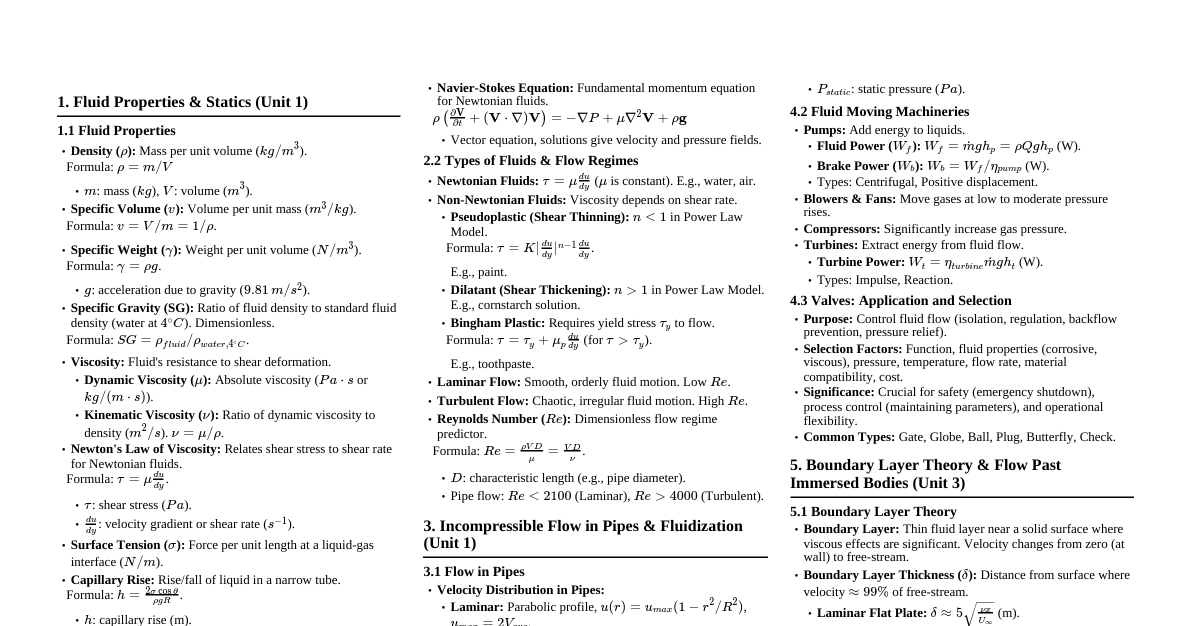
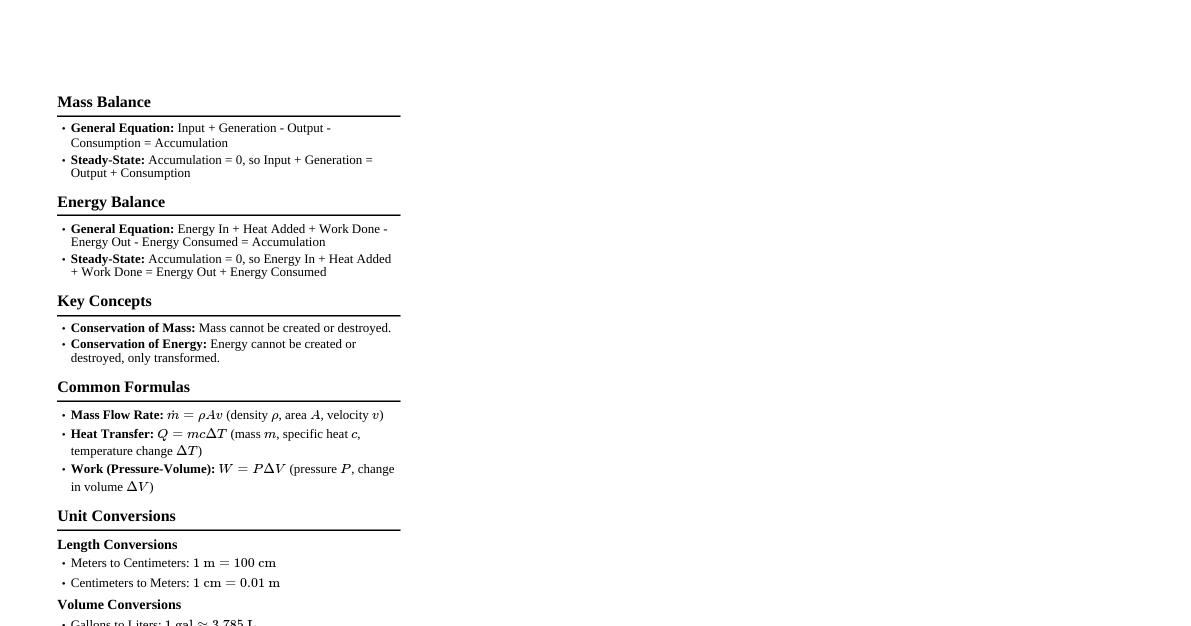
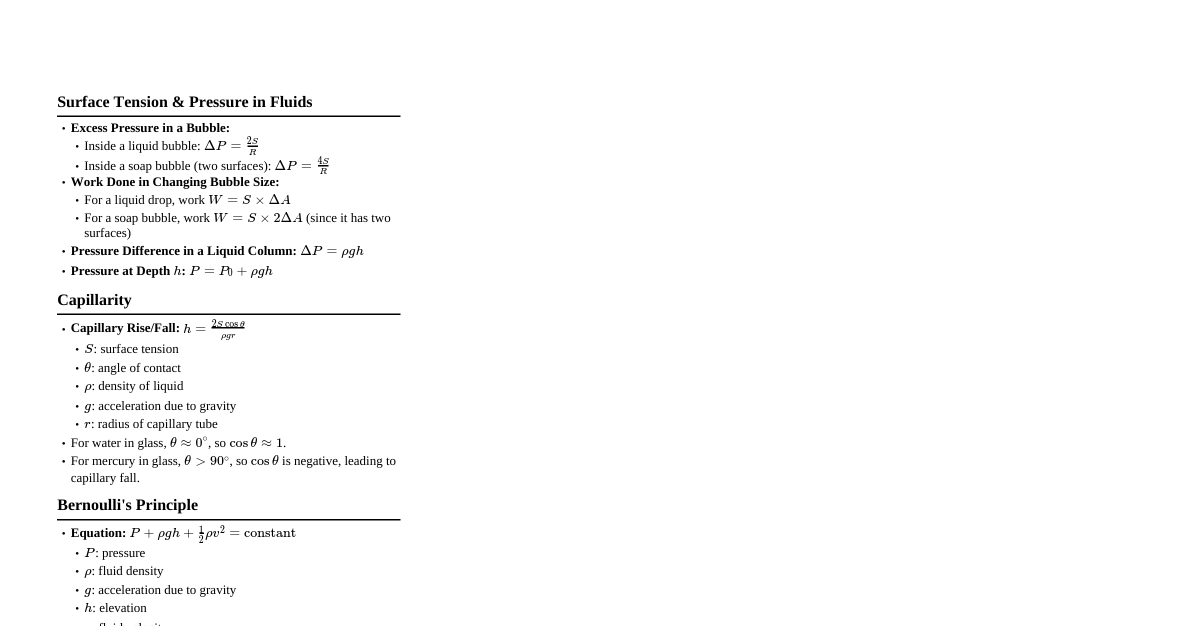
### Objectives - Fluid properties, fluid interaction, fluid forces on boundaries (walls) - Fundamental equations of fluid flows - Simplifying assumptions, modeling of complex phenomena - Types of flows in fluid dynamics ### Fluid Model - **Fluid:** Liquid, gas, or plasma - **Fluid Mechanics:** - **Statics:** (absolute rest, relative rest) - Air: Aerostatics - Water: Hydrostatics - **Dynamics:** - Air: Aerodynamics - Water: Hydrodynamics/Hydraulics - **Phases:** Solids, liquids, gases, and plasma - **Continuum Media:** Assumed for most fluid mechanics problems. ### Continuum Media - **Knudsen Number ($Kn$):** Evaluates the importance of collisions in a flow. $$Kn = \frac{\lambda_0}{L_0}$$ - $\lambda_0$: mean free path [m] - $L_0$: reference length [m] - **Regimes based on Knudsen Number:** - $Kn \ll 1$: Collisions are negligible. (Continuum media with flow adherence to the wall) - $0.1 ### Fluid Properties | Property | Air ($[kg/m^3]$) | Water ($[kg/m^3]$) | Mineral Oil ($[kg/m^3]$) | |----------|-----------------|-------------------|-------------------------| | $\rho$ | 1.225 | 1000 | 950-1020 | | $\mu$ ($[mPa \cdot s]$) | 1.7e-3 | 1 | 100 | | $k$ ($[mW/mK]$) | 26 | 600 | 150 | | $c_p$ ($[kJ/kgK]$) | 1.005 | 4.186 | 1.8 | - *Figures for ambient temperature!* ### Units and Conversions #### Fundamental Units - **7 Fundamental Units:** Length (m), Mass (kg), Time (s), Temperature (K), Current (A), Amount of substance (mol), Light intensity (candela). - **Derived Units:** - Force: $F = ma \implies [F] = \frac{kg \cdot m}{s^2} = N$ - Energy/Work: $L = Fd \implies [L] = \frac{kg \cdot m^2}{s^2} = N \cdot m = J$ #### Pressure Units - **SI Unit:** Pascal ($Pa$) or $N/m^2$ $$[P]_{SI} = \frac{[F]}{[A]} = \frac{N}{m^2} = Pa$$ - **Conversions:** - $1 \, bar = 10^5 \, N/m^2 = 10^5 \, Pa$ - $1 \, mm \, H_2O = 9.8 \, Pa$ - $1 \, mm \, Hg = 133.32 \, Pa$ - $1 \, atm = 101325 \, Pa = 1.01325 \, bar$ - $1 \, mm \, Hg = 1 \, Torr$ - **Technical Atmosphere:** $[P]_{ST} = \frac{[F]}{[A]} = \frac{kgf}{m^2}$ #### Temperature Conversions - **Celsius to Kelvin:** $t[^\circ C] = T[K] - 273.15$ - **Rankine to Kelvin:** $t[^\circ R] = \frac{9}{5}T[K]$ - **Fahrenheit to Rankine:** $t[^\circ F] = t[^\circ R] - 459.67$ - **Celsius to Fahrenheit:** $t[^\circ F] = \frac{9}{5}t[^\circ C] + 32$ #### Volume - State Parameter (Extensive) - **Specific Volume:** $v = \frac{V}{m} \quad [m^3/kg]$ - **Molar Specific Volume:** $V_M = \frac{V}{n_M} \quad [m^3/kmol]$ - **Density:** $\rho = \frac{m}{V} = \frac{1}{v} \quad [kg/m^3]$ #### Viscosity - **Dynamic Viscosity ($\mu$):** $[ \mu ]_{SI} = \frac{N \cdot s}{m^2} = \frac{kg}{m \cdot s}$ - **Kinematic Viscosity ($\nu$):** $\nu = \frac{\mu}{\rho} \quad [\frac{m^2}{s}]$ - $[ \mu ]_{ST} = P (poise) = \frac{g}{cm \cdot s}$ - $[ \nu ]_{ST} = St (stokes) = \frac{cm^2}{s}$ #### Common Unit Conversions - $1 \, pound (lb) = 0.45359237 \, kilograms$ - $1 \, inch = 0.0254 \, meters$ - $1 \, foot = 0.3048 \, meters$ - $1 \, nautical \, mile = 1.85200 \, kilometers$ - $1 \, mile = 1.609344 \, kilometers$ - $1 \, knot = 0.514444444 \, meters/second$ ### Derivatives (Single Variable Functions) Denoted as: $d$ #### Basic Derivative Rules - $(c)' = 0$ - $(x^n)' = nx^{n-1}$ - $(x^r)' = rx^{r-1}$ - $(\sqrt{x})' = \frac{1}{2\sqrt{x}}$ - $(\ln x)' = \frac{1}{x}$ - $(e^x)' = e^x$ - $(a^x)' = a^x \ln a$ - $(\sin x)' = \cos x$ - $(\cos x)' = -\sin x$ - $(\tan x)' = \frac{1}{\cos^2 x}$ - $(\cot x)' = -\frac{1}{\sin^2 x}$ - $(\arcsin x)' = \frac{1}{\sqrt{1-x^2}}$ - $(\arccos x)' = -\frac{1}{\sqrt{1-x^2}}$ - $(\arctan x)' = \frac{1}{1+x^2}$ - $(\operatorname{arccot} x)' = -\frac{1}{1+x^2}$ #### Chain Rule for Composite Functions - $(u^n)' = nu^{n-1}u'$ - $(u^r)' = ru^{r-1}u'$ - $(\sqrt{u})' = \frac{u'}{2\sqrt{u}}$ - $(\ln u)' = \frac{u'}{u}$ - $(e^u)' = e^uu'$ - $(a^u)' = a^uu' \ln a$ - $(\sin u)' = \cos u u'$ - $(\cos u)' = -\sin u u'$ - $(\tan u)' = \frac{u'}{\cos^2 u}$ - $(\cot u)' = -\frac{u'}{\sin^2 u}$ - $(\arcsin u)' = \frac{u'}{\sqrt{1-u^2}}$ - $(\arccos u)' = -\frac{u'}{\sqrt{1-u^2}}$ - $(\arctan u)' = \frac{u'}{1+u^2}$ - $(\operatorname{arccot} u)' = -\frac{u'}{1+u^2}$ ### Partial Derivatives Denoted as: $\partial$ For functions with multiple variables. ### Vectors - **Definition:** A quantity with both magnitude and direction. - **Properties:** 1. **Modulus (Magnitude):** $|\vec{AB}|$ 2. **Direction** 3. **Verse (Unit Vector):** $\vec{D} = \frac{\vec{AB}}{|\vec{AB}|}$ - **2D Vector Representation:** $$\vec{V} = V_x \vec{u}_x + V_y \vec{u}_y$$ - $V_x, V_y$: components - Angle $\theta = (\text{0x}, \vec{V})$, modulo $2\pi$ - Components with magnitude and angle: - $V_x = |\vec{V}| \cos \theta$ - $V_y = |\vec{V}| \sin \theta$ - $0 \le \theta \le 2\pi$ #### Inner Product (Dot Product) - **Definition:** $$\vec{V}_1 \cdot \vec{V}_2 = |\vec{V}_1| |\vec{V}_2| \cos(\vec{V}_1, \vec{V}_2)$$ - **Commutative Property:** $\theta = \pm (\vec{V}_1, \vec{V}_2)$ - **Norm Squared:** $\vec{V} \cdot \vec{V} = |\vec{V}|^2 \ge 0$ - **Orthonormal Condition:** $$\vec{u}_m \cdot \vec{u}_n = \delta_{mn} = \begin{cases} 0 & \text{if } m \ne n \\ 1 & \text{if } m = n \end{cases}$$ - **Algebraic Expression (3D):** $$\vec{V}_1 \cdot \vec{V}_2 = V_{1x}V_{2x} + V_{1y}V_{2y} + V_{1z}V_{2z}$$ $$\vec{V} \cdot \vec{V} = |\vec{V}|^2 = V_x^2 + V_y^2 + V_z^2$$ #### Cross Product - **Magnitude:** $$|\vec{V}_1 \times \vec{V}_2| = |\vec{V}_1| |\vec{V}_2| \sin(\vec{V}_1, \vec{V}_2)$$ - **Area:** $|\vec{V}_1 \times \vec{V}_2| = \text{area}(\vec{V}_1, \vec{V}_2)$ - **Anticommutative Property:** $|\vec{V}_1 \times \vec{V}_2| = -|\vec{V}_2 \times \vec{V}_1|$ - **Algebraic Expression (3D):** $$\vec{V}_1 \times \vec{V}_2 = \det \begin{pmatrix} \vec{u}_x & \vec{u}_y & \vec{u}_z \\ V_{1x} & V_{1y} & V_{1z} \\ V_{2x} & V_{2y} & V_{2z} \end{pmatrix}$$ $$\vec{V}_1 \times \vec{V}_2 = \vec{u}_x (V_{1y}V_{2z} - V_{1z}V_{2y}) + \vec{u}_y (V_{1z}V_{2x} - V_{1x}V_{2z}) + \vec{u}_z (V_{1x}V_{2y} - V_{1y}V_{2x})$$ #### Triple Scalar Product and Double Cross Product - **Double Cross Product:** $$\vec{a} \times (\vec{b} \times \vec{c}) = \vec{b}(\vec{a} \cdot \vec{c}) - \vec{c}(\vec{a} \cdot \vec{b})$$ - **Triple Scalar Product:** $$\vec{a} \cdot (\vec{b} \times \vec{c}) = \det \begin{pmatrix} a_x & a_y & a_z \\ b_x & b_y & b_z \\ c_x & c_y & c_z \end{pmatrix}$$ ### Operators #### Gradient 1. **Definition:** For a scalar field $\Phi(x, y, z)$, the gradient is a vector field: $$\text{grad } \Phi = \begin{pmatrix} \frac{\partial \Phi}{\partial x} \\ \frac{\partial \Phi}{\partial y} \\ \frac{\partial \Phi}{\partial z} \end{pmatrix} = \nabla \Phi$$ 2. **Meaning:** $\nabla \Phi \cdot d\vec{r}$ is the local variation of $\Phi$ along the line. $\nabla \Phi$ is perpendicular to isolines/isosurfaces ($\Phi = \text{ct}$). $$d\Phi = \frac{\partial \Phi}{\partial x} dx + \frac{\partial \Phi}{\partial y} dy + \frac{\partial \Phi}{\partial z} dz = \text{grad } \Phi \cdot d\vec{r} = 0 \implies \text{grad } \Phi \perp d\vec{r}$$ #### Divergence 1. **Definition:** For a vector field $\vec{V}(x, y, z)$, the divergence is a scalar field: $$\text{div } \vec{V} = \nabla \cdot \vec{V} = \frac{\partial V_x}{\partial x} + \frac{\partial V_y}{\partial y} + \frac{\partial V_z}{\partial z}$$ 2. **Meaning:** $\text{div } \vec{V}$ is linked to the transport of a property (flux of a property). $\text{div } \vec{V} = 0$ indicates an incompressible flow. #### Rotor (Curl) 1. **Definition:** For a vector field $\vec{A}(x, y, z)$, the rotor (curl) is a vector field: $$\text{rot } \vec{A} = \nabla \times \vec{A} = \det \begin{pmatrix} \vec{e}_x & \vec{e}_y & \vec{e}_z \\ \frac{\partial}{\partial x} & \frac{\partial}{\partial y} & \frac{\partial}{\partial z} \\ A_x & A_y & A_z \end{pmatrix}$$ $$\text{rot } \vec{A} = \epsilon_{ijk} \vec{e}_i \frac{\partial}{\partial x_j} A_k$$ 2. **Meaning:** $\text{rot } \vec{V}$ shows the local curl of the velocity field. - If $\text{rot } \vec{V} = 0$, the flow is irrotational. - If $\text{rot } \vec{V} \ne 0$, the flow is rotational (turbulent/turbion). - For rigid body rotation: $\vec{V} = \vec{\omega} \times \vec{r}$, then $\text{rot } \vec{V} = 2\vec{\omega}$ #### Laplacian 1. **Scalar Laplacian:** For a scalar field $\Phi(x, y, z)$: $$\Delta \Phi = \nabla^2 \Phi = \text{div}(\text{grad } \Phi) = \frac{\partial^2 \Phi}{\partial x^2} + \frac{\partial^2 \Phi}{\partial y^2} + \frac{\partial^2 \Phi}{\partial z^2}$$ 2. **Vector Laplacian:** For a vector field $\vec{V}(x, y, z)$: $$\Delta \vec{V} = \Delta V_x \vec{e}_x + \Delta V_y \vec{e}_y + \Delta V_z \vec{e}_z$$ where $$\Delta V_x = \frac{\partial^2 V_x}{\partial x^2} + \frac{\partial^2 V_x}{\partial y^2} + \frac{\partial^2 V_x}{\partial z^2}$$ $$\Delta V_y = \frac{\partial^2 V_y}{\partial x^2} + \frac{\partial^2 V_y}{\partial y^2} + \frac{\partial^2 V_y}{\partial z^2}$$ $$\Delta V_z = \frac{\partial^2 V_z}{\partial x^2} + \frac{\partial^2 V_z}{\partial y^2} + \frac{\partial^2 V_z}{\partial z^2}$$ ### Shear - Solids - **Shear Stress ($\tau$):** Force per unit area, $\tau = F/A$. - **Shear Strain ($\gamma$):** Deformation per unit length, $\gamma = \Delta x / \Delta y$. - **Relationship:** For solids, shear stress is proportional to shear strain: $$\tau \propto \gamma \quad \text{or} \quad \tau = G\gamma$$ - $G$: Shear modulus $[N/m^2]$. - **Characteristics:** - Very small static displacement (small loads). - Deformed configuration is kept as long as the shear force is applied. - Returns to initial undeformed condition if load is not out of elastic domain. ### Shear - Fluids (Water) - **Fluid Behavior:** Fluids (like water) cannot withstand shear at rest; shear force generates flow. - **Shear Stress ($\tau$):** Proportional to the rate of shear strain (velocity gradient). $$\tau \propto \frac{d\gamma}{dt} \quad \text{or} \quad \tau = \mu \frac{d\gamma}{dt} = \mu \frac{du}{dy}$$ - $\mu$: Dynamic viscosity. - $\frac{du}{dy}$: Velocity gradient (shear rate). - **Newtonian Fluids:** Fluids where viscosity is constant and independent of shear rate. (Valid for Newtonian fluids) - **Characteristics:** - Fluid flow is a result of shear force. - Linear velocity profile between parallel plates. - Solids: shear stress and displacement are proportional. - Fluids: shear stress and shear rate are proportional. - As long as shear is applied, deformation (flow) continues (opposite to solids). ### Fluid Flow Classification #### Nondimensional Numbers - **Knudsen Number ($Kn$):** (Already discussed in Continuum Media) - $Kn \ll 1$: Continuum media, equations for fluid flow can be used. - $Kn \gg 1$: Kinetic molecular theory is used. - $Kn \approx 1$: Keeps features from both regimes. #### Mach Number ($Ma$) - **Definition:** Ratio of flow velocity to the speed of sound in the fluid. $$Ma = \frac{V}{a}$$ - **Flow Regimes:** - $Ma \le 0.2$: Incompressible flow. - $Ma \in (0.2 - 0.8)$: Compressible flow. - $0.8 \le Ma Re_{crt}$: Chaotic (turbulent) flow. ### Comparison Between States of Matter | Characteristic | Solids (Crystalline) | Liquids | Gases | |----------------|----------------------|---------|-------| | Shear Force Effect ($\tau$) | $\tau = G\gamma$ (resists deformation) | $\tau = \mu \frac{du}{dy}$ (resists deformation rate) | $\tau = \mu \frac{du}{dy}$ (resists deformation rate) | | Intermolecular Distance | Smallest | Small | Large | | Molecular Arrangement | Ordered | Semi-ordered (short-range) | Random | | Intermolecular Interaction | Strong | Intermediate | Weak | | Ability to take vessel shape | No | Yes | Yes | | Unlimited Expansion Capacity | No | No | Yes | | Free Surface Presentation | Yes | Yes | No | | Resistance to Small Tensile Force | Yes | Theoretically/Practically No | No | | Compressibility | Zero | Virtually Incompressible | Highly Compressible | ### Lagrange vs. Euler Reference Systems in Fluid Motion #### Flow Motion - Described by fundamental conservation equations: - **Mass Conservation:** $\frac{d}{dt}(m) = \dot{m}$ - **Momentum Conservation:** $\frac{d}{dt}(m\vec{V}) = \vec{F}$ - **Total Energy Conservation:** $\frac{d}{dt}(E_t) = \dot{Q} - \dot{L}_m$ #### Lagrange System (Material System) - **Concept:** Tracks individual fluid particles. - **Properties:** - Mass ($M$) is constant. - Volume ($V_0$) is not constant. - **Challenge:** Difficult to track all particles due to large number. #### Euler System (Control Volume) - **Concept:** Focuses on a fixed control volume in space. - **Properties:** - Volume ($V$) is constant. - Mass ($M_0$) is not constant. - **Approach:** Assesses balance between inlet and outlet, considering sources or sinks. #### Change of Reference System: Substantial Derivative - **Substantial Derivative:** Relates Lagrangian and Eulerian perspectives. $$\frac{Df}{Dt} = \frac{\partial f}{\partial t} + \vec{V} \cdot \nabla f$$ - $\frac{\partial f}{\partial t}$: Local derivative (change at a fixed point). - $\vec{V} \cdot \nabla f$: Convective derivative (change due to motion). #### Reynolds Transport Theorem for Extensive Quantities - **Definition:** Relates the rate of change of an extensive property ($\Psi$) of a system to the properties within a control volume. $$\frac{D\Psi}{Dt} = \frac{d}{dt} \int_{V_0} \rho \psi dV + \int_{S_0} \rho \psi \vec{V} \cdot \vec{n}dS$$ ### Flow Visualization #### Pathlines - **Definition:** The trajectory traced by a single fluid particle over a certain time interval. (Can be emphasized experimentally) #### Streamlines - **Definition:** Lines that are tangent to the velocity vector field at a given instant of time. (Like a snapshot of the velocity vector field) #### Streaklines - **Definition:** The locus of points of all fluid particles that have passed through a specific fixed point in space at some earlier time. (Can be emphasized experimentally) ### Hydrostatics #### Manometers - **Principle:** Measures pressure difference based on fluid column height. - **Hydrostatic Law:** $P_1 + \rho g Z_1 = P_2 + \rho g Z_2$ - **Height Difference:** $h = Z_2 - Z_1 = \frac{P_1 - P_2}{\rho g}$ - **Connected Vessels:** If $P_1 = P_2$, then $h=0$. - **Inclined Branch Manometer:** Enhances sensitivity. - $h = \frac{P_1 - P_2}{\rho g} = l \sin \alpha$ - $l = \frac{P_1 - P_2}{\rho g \sin \alpha}$ #### Barometer - **Principle:** Measures atmospheric pressure by the height of a fluid column in a vacuum. - **Equation:** $P_1 + \rho g Z_1 = 0 + \rho g Z_2$ (where $P_2=0$ for vacuum) - **Height:** $h = Z_2 - Z_1 = \frac{P_1}{\rho g}$ #### Vertical Wall - Lock - **Pressure Distribution:** - Left side: $P_L(z) = P_a + \rho g (2h - z)$ - At $z=0$: $P_L = P_a + \rho g 2h$ - At $z=2h$: $P_L = P_a$ - Right side: $P_R(z) = P_a + \rho g (h - z)$ - At $z=0$: $P_R = P_a + \rho g h$ - At $z=h$: $P_R = P_a$ - **Resultant Force ($R_{left}$):** - $R_{left} = B \int_0^{2h} \rho g (2h - z) dz = \rho g B h^2$ - **Resultant Force ($R_{right}$):** - $R_{right} = B \int_0^h \rho g (h - z) dz = \frac{1}{2} \rho g B h^2$ - **Moment About O:** $M = R_{left} \cdot \frac{2h}{3} - R_{right} \cdot \frac{h}{3} = \frac{7}{6} \rho g B h^3$ #### Tank with Oil and Water - **Average Density ($\bar{\rho}$):** $$\bar{\rho} = \frac{1}{H} \int_0^H \rho(z) dz = \frac{1}{H} (\rho_{water} h_{water} + \rho_{oil} h_{oil})$$ - **Pressure at Depth ($z$):** - For $z ### Conservation Laws #### Conservation of Mass (Continuity Equation) - **Integral Form:** $$\frac{\partial}{\partial t} \int_{CV} \rho dV + \int_{CS} \rho \vec{V} \cdot \vec{n} dA = 0$$ - **Local (Conservative) Form:** $$\frac{\partial \rho}{\partial t} + \nabla \cdot (\rho \vec{V}) = 0$$ - **Local (Non-Conservative) Form:** $$\frac{\partial \rho}{\partial t} + \vec{V} \cdot \nabla \rho + \rho \nabla \cdot \vec{V} = 0$$ - **Incompressible Flow ($\rho = \text{ct}$):** $$\nabla \cdot \vec{V} = 0$$ - **Steady State ($\frac{\partial}{\partial t} = 0$):** $$\nabla \cdot (\rho \vec{V}) = 0$$ #### Conservation of Momentum - **Integral Form:** $$\frac{\partial}{\partial t} \int_{CV} \rho \vec{V} dV + \int_{CS} \rho \vec{V} (\vec{V} \cdot \vec{n}) dA = \int_{CS} (-P\vec{n}) dA + \int_{CV} \rho \vec{g} dV + \vec{F}_{viscous}$$ - **Local (Conservative) Form:** $$\frac{\partial}{\partial t} (\rho \vec{V}) + \nabla \cdot (\rho \vec{V} \vec{V}) = -\nabla P + \rho \vec{g} + \vec{F}_{viscous}$$ - **Local (Non-Conservative) Form (for incompressible, inviscid flow):** $$\rho \frac{D\vec{V}}{Dt} = -\nabla P + \rho \vec{g}$$ (Euler Equation) #### Bernoulli's Equation - **Assumptions:** Steady, incompressible, inviscid, irrotational flow along a streamline. $$P + \frac{1}{2} \rho V^2 + \rho g Z = \text{constant}$$ - **Venturi Tube:** Applies Bernoulli's principle to measure flow rate. - $V_2^2 - V_1^2 = \frac{2}{\rho} (P_1 - P_2)$ - **Pitot-Prandtl Tube:** Measures total and static pressure to determine fluid velocity. - $P_{total} = P_{static} + \frac{1}{2} \rho V^2$ - $V = \sqrt{\frac{2(P_{total} - P_{static})}{\rho}}$