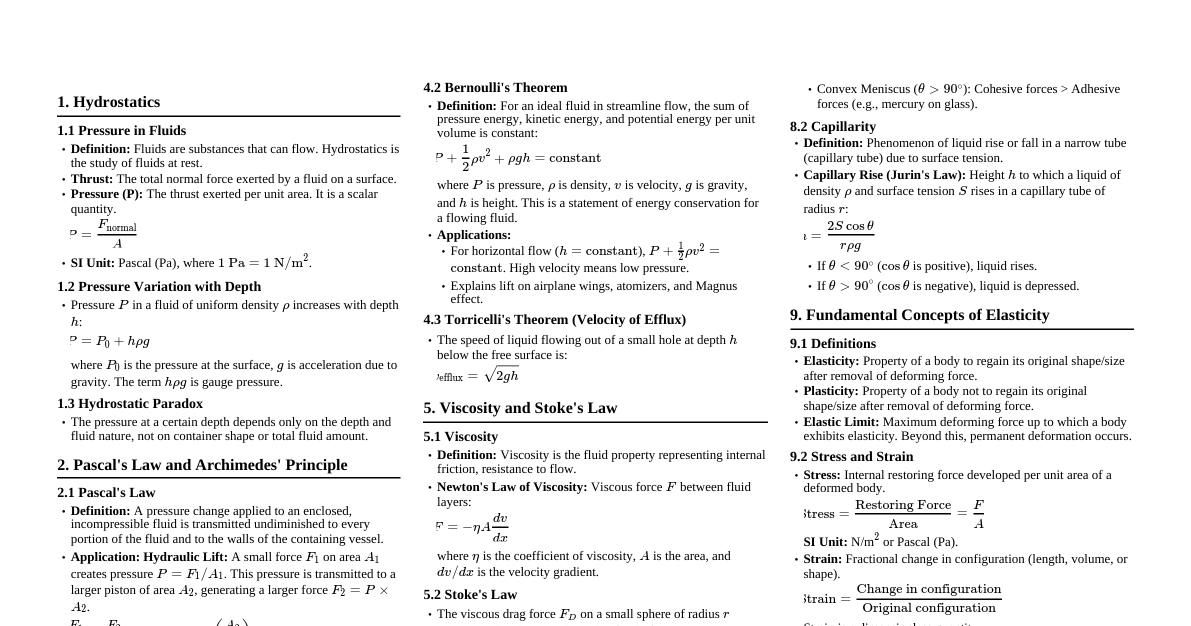
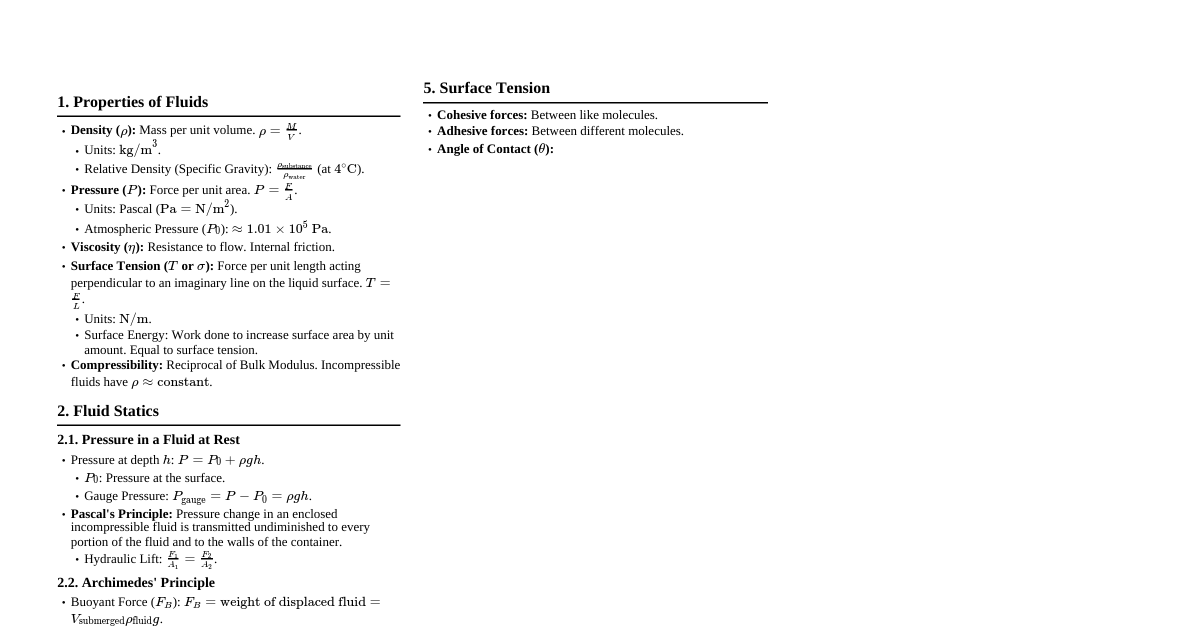
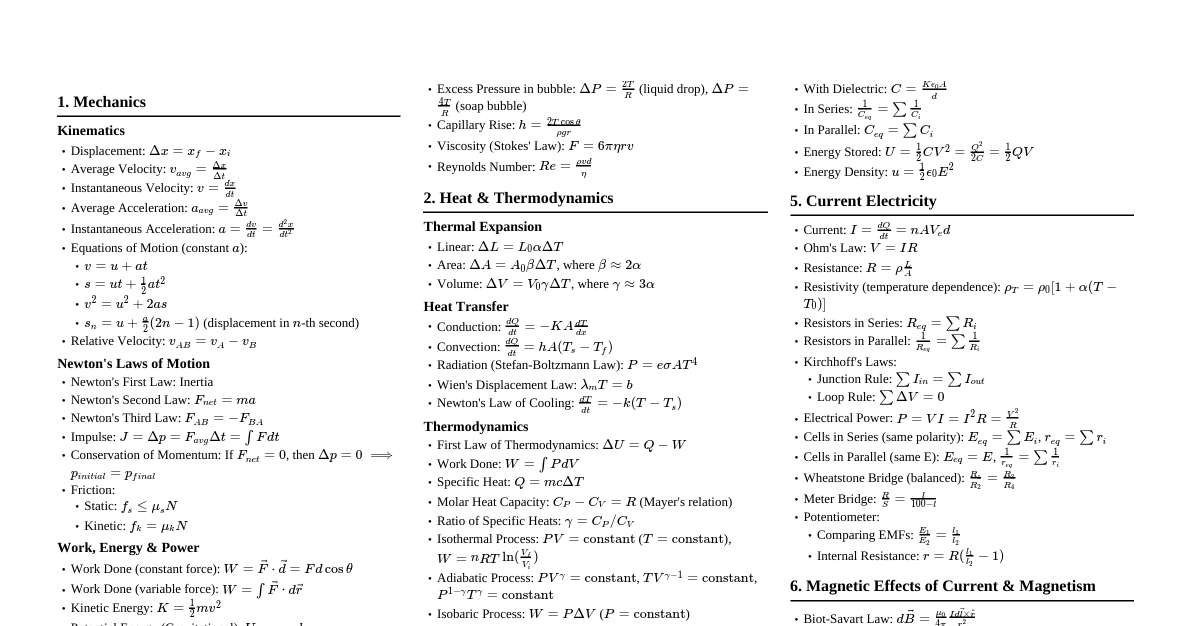
Surface Tension & Pressure in Fluids Excess Pressure in a Bubble: Inside a liquid bubble: $\Delta P = \frac{2S}{R}$ Inside a soap bubble (two surfaces): $\Delta P = \frac{4S}{R}$ Work Done in Changing Bubble Size: For a liquid drop, work $W = S \times \Delta A$ For a soap bubble, work $W = S \times 2 \Delta A$ (since it has two surfaces) Pressure Difference in a Liquid Column: $\Delta P = \rho g h$ Pressure at Depth $h$: $P = P_0 + \rho g h$ Capillarity Capillary Rise/Fall: $h = \frac{2S \cos\theta}{\rho g r}$ $S$: surface tension $\theta$: angle of contact $\rho$: density of liquid $g$: acceleration due to gravity $r$: radius of capillary tube For water in glass, $\theta \approx 0^\circ$, so $\cos\theta \approx 1$. For mercury in glass, $\theta > 90^\circ$, so $\cos\theta$ is negative, leading to capillary fall. Bernoulli's Principle Equation: $P + \rho g h + \frac{1}{2} \rho v^2 = \text{constant}$ $P$: pressure $\rho$: fluid density $g$: acceleration due to gravity $h$: elevation $v$: fluid velocity Represents the conservation of energy for an ideal fluid in steady flow. Viscosity Newton's Law of Viscosity: Shear stress $\tau = \eta \frac{dv}{dy}$ $\eta$: coefficient of viscosity $\frac{dv}{dy}$: velocity gradient Viscous Force: $F = \eta A \frac{dv}{dy}$ Stokes' Law: For a spherical object falling through a fluid, $F_v = 6 \pi \eta r v$ Fluid Dynamics Concepts Equation of Continuity: $A_1 v_1 = A_2 v_2 = \text{constant}$ (for incompressible fluids) Pressure in a Hydraulic Press: $P = \frac{F_1}{A_1} = \frac{F_2}{A_2}$ Work and Energy in Fluids Work done in splitting a large drop into smaller drops: If a large drop of radius $R$ is split into $N$ smaller drops of radius $r$: $R^3 = N r^3$. Change in surface area $\Delta A = N(4\pi r^2) - 4\pi R^2$. Work done $W = S \times \Delta A$. This work is stored as surface energy in the smaller drops. Heat generated: If this work is converted to heat, $Q = W/J$, where $J$ is the mechanical equivalent of heat. Forces and Motion Newton's Second Law: $F = ma$ Tension in a String: For two masses $m_1$ and $m_2$ connected by a string over a pulley, with $m_1 > m_2$: Acceleration $a = \frac{(m_1 - m_2)g}{m_1 + m_2}$ Tension $T = \frac{2 m_1 m_2 g}{m_1 + m_2}$ Apparent Weight: For an accelerating system, $T = m(g \pm a)$