Structure of Atom
Cheatsheet Content
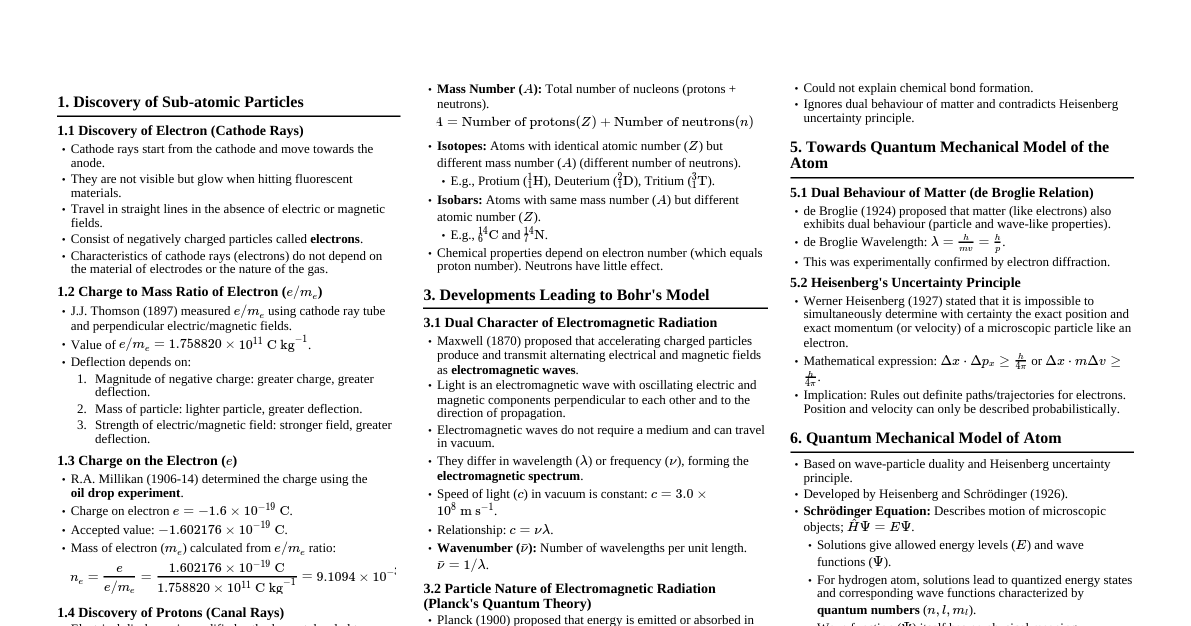
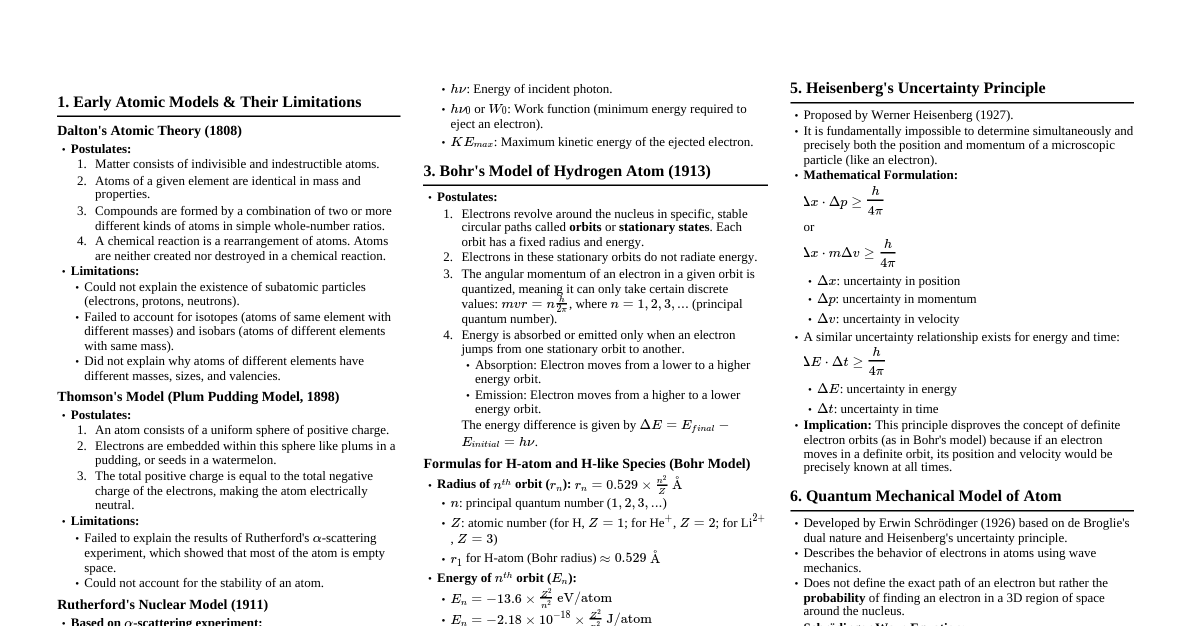
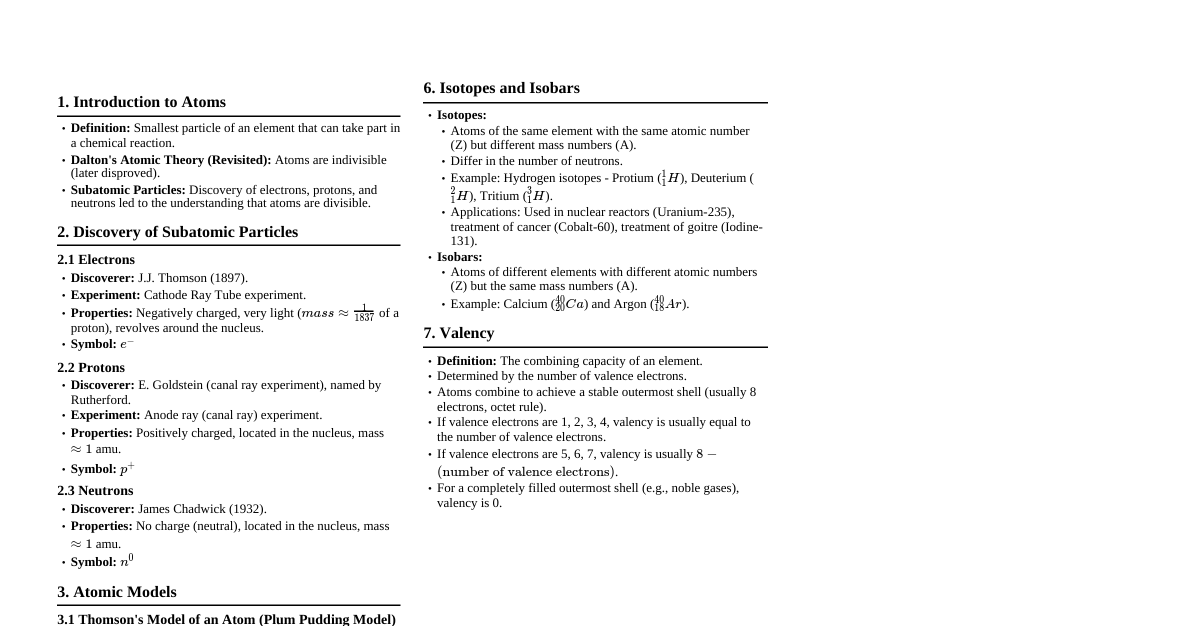
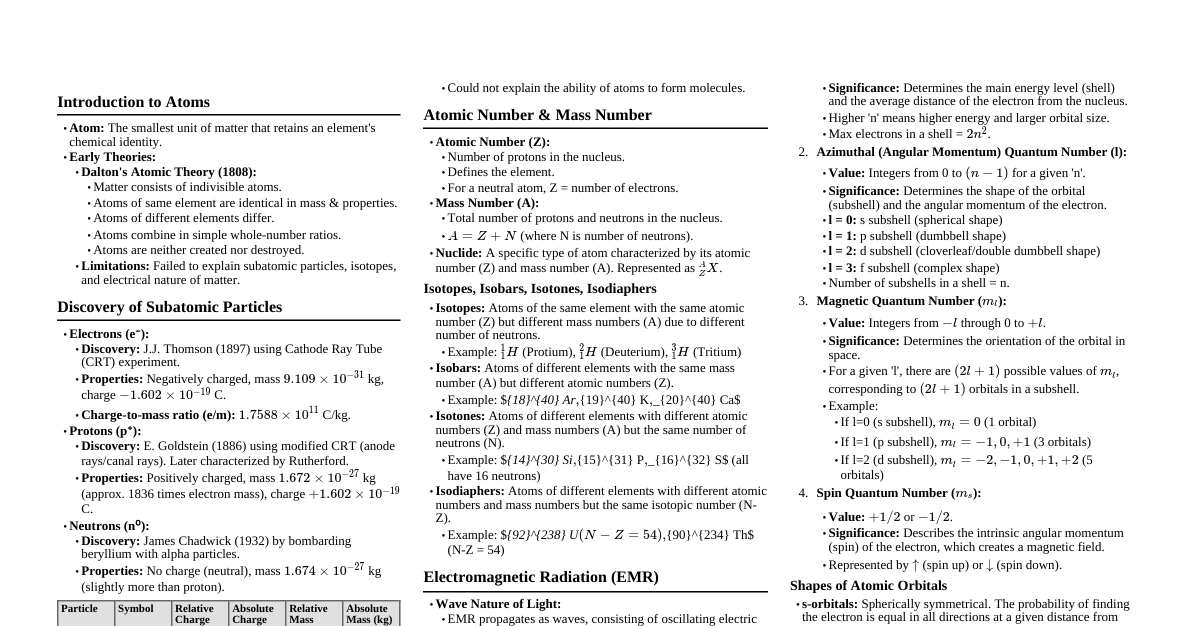
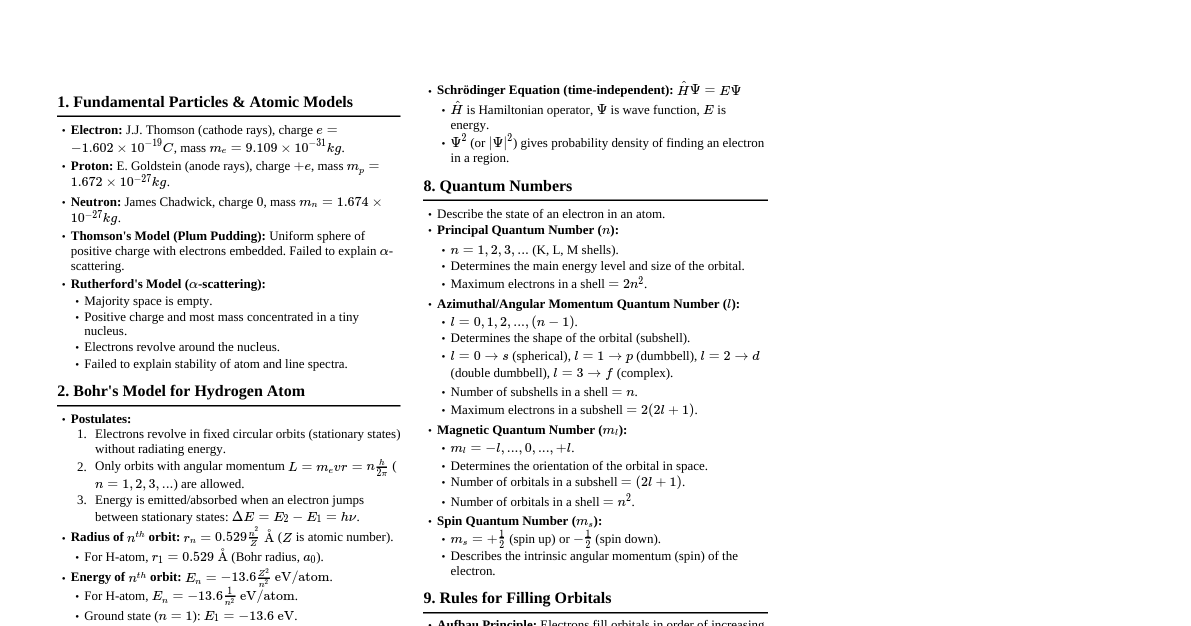
### Atomic Models - **Dalton's Atomic Theory (1808):** Atoms are indivisible, indestructible particles. All atoms of an element are identical. - **Thomson's Plum Pudding Model (1897):** Atom is a sphere of uniform positive charge with electrons embedded in it. - **Rutherford's Nuclear Model (1911):** Based on $\alpha$-particle scattering experiment. - Most of the atom is empty space. - Positive charge and mass concentrated in a small, dense nucleus. - Electrons revolve around the nucleus in circular orbits. - **Drawbacks:** Could not explain stability of atom or atomic spectra. ### Bohr's Model of Hydrogen Atom - **Postulates:** 1. Electrons revolve around the nucleus in fixed circular orbits (stationary states) without radiating energy. 2. Only those orbits are permitted in which angular momentum of electron is an integral multiple of $h/2\pi$ ($L = n \frac{h}{2\pi}$, where $n = 1, 2, 3, ...$ is the principal quantum number). 3. Energy is emitted or absorbed only when an electron jumps from one stationary state to another. $\Delta E = E_2 - E_1 = h\nu$. - **Formulas for H-like species ($Z$ = atomic number):** - **Radius of nth orbit ($r_n$):** $r_n = 0.529 \frac{n^2}{Z} \text{ Å}$ - **Energy of nth orbit ($E_n$):** $E_n = -13.6 \frac{Z^2}{n^2} \text{ eV/atom}$ - **Velocity of electron ($v_n$):** $v_n = 2.18 \times 10^6 \frac{Z}{n} \text{ m/s}$ - **Energy Level Diagram:** - Ground state: $n=1$ - Excited states: $n=2, 3, ...$ - Ionization energy: energy required to remove electron from ground state ($n=1 \to \infty$) - **Drawbacks:** - Failed to explain spectra of multi-electron atoms. - Could not explain fine structure of spectral lines (Zeeman & Stark effect). - Did not account for dual nature of matter or Heisenberg's uncertainty principle. ### Quantum Numbers - Describe the state of an electron in an atom. - **1. Principal Quantum Number ($n$):** - Determines the main energy shell and size of the orbit. - $n = 1, 2, 3, ...$ (K, L, M, ...) - **2. Azimuthal (Angular Momentum) Quantum Number ($l$):** - Determines the shape of the subshell and angular momentum. - $l = 0, 1, 2, ..., (n-1)$ - $l=0 \implies s$ subshell (spherical) - $l=1 \implies p$ subshell (dumbbell) - $l=2 \implies d$ subshell (double dumbbell) - $l=3 \implies f$ subshell (complex) - **3. Magnetic Quantum Number ($m_l$):** - Determines the orientation of the orbital in space. - $m_l = -l, ..., 0, ..., +l$ (Total $2l+1$ values) - **4. Spin Quantum Number ($m_s$):** - Describes the intrinsic angular momentum (spin) of the electron. - $m_s = +1/2$ (spin up) or $-1/2$ (spin down) ### Electronic Configuration Rules - **Aufbau Principle:** Electrons fill orbitals in order of increasing energy. - Order: $1s ### Dual Nature of Matter & Uncertainty - **de Broglie Hypothesis (1924):** Matter exhibits wave-like properties. - $\lambda = h/mv = h/p$ (where $h$ = Planck's constant, $m$ = mass, $v$ = velocity, $p$ = momentum) - For an electron: $\lambda = \frac{12.27}{\sqrt{V}} \text{ Å}$ (where $V$ is accelerating potential in Volts) - **Heisenberg's Uncertainty Principle (1927):** It is impossible to simultaneously and precisely determine both the position and momentum of a subatomic particle. - $\Delta x \cdot \Delta p \ge h/4\pi$ - $\Delta E \cdot \Delta t \ge h/4\pi$ ### Schrödinger Wave Equation - Describes the wave-like properties of electrons in an atom. - $\hat{H}\psi = E\psi$ (Time-independent equation) - $\hat{H}$ is the Hamiltonian operator. - $\psi$ (psi) is the wave function, describing the amplitude of the electron wave. - $\psi^2$ gives the probability density of finding an electron at a particular point in space. - **Atomic Orbitals:** Regions of space around the nucleus where the probability of finding an electron is maximum. - **Nodes:** Regions where the probability of finding an electron is zero ($\psi^2 = 0$). - Radial nodes = $n - l - 1$ - Angular nodes = $l$ - Total nodes = $n - 1$ ### Photoelectric Effect - Emission of electrons when light of suitable frequency falls on a metal surface. - **Key observations:** - Electrons are ejected only if the incident light has frequency greater than a threshold frequency ($\nu_0$). - Kinetic energy of ejected electrons increases linearly with frequency of incident light. - Number of ejected electrons depends on intensity of light. - Instantaneous process. - **Einstein's Equation:** $h\nu = h\nu_0 + KE_{max}$ - $h\nu$: Energy of incident photon - $h\nu_0$ (or $W_0$): Work function (minimum energy required to eject an electron) - $KE_{max}$: Maximum kinetic energy of ejected electron ($1/2 mv_{max}^2$) ### Atomic Spectra (Hydrogen) - Emission of light when excited electrons return to lower energy levels. - **Rydberg Formula:** $\frac{1}{\lambda} = R_H Z^2 \left( \frac{1}{n_1^2} - \frac{1}{n_2^2} \right)$ - $R_H = 109677 \text{ cm}^{-1}$ (Rydberg constant) - $n_1$ = lower energy level, $n_2$ = higher energy level - **Spectral Series:** - **Lyman Series:** $n_1 = 1$, $n_2 = 2, 3, ...$ (UV region) - **Balmer Series:** $n_1 = 2$, $n_2 = 3, 4, ...$ (Visible region) - **Paschen Series:** $n_1 = 3$, $n_2 = 4, 5, ...$ (IR region) - **Brackett Series:** $n_1 = 4$, $n_2 = 5, 6, ...$ (IR region) - **Pfund Series:** $n_1 = 5$, $n_2 = 6, 7, ...$ (IR region)