Structure of Atom (CBSE Class 9)
Cheatsheet Content
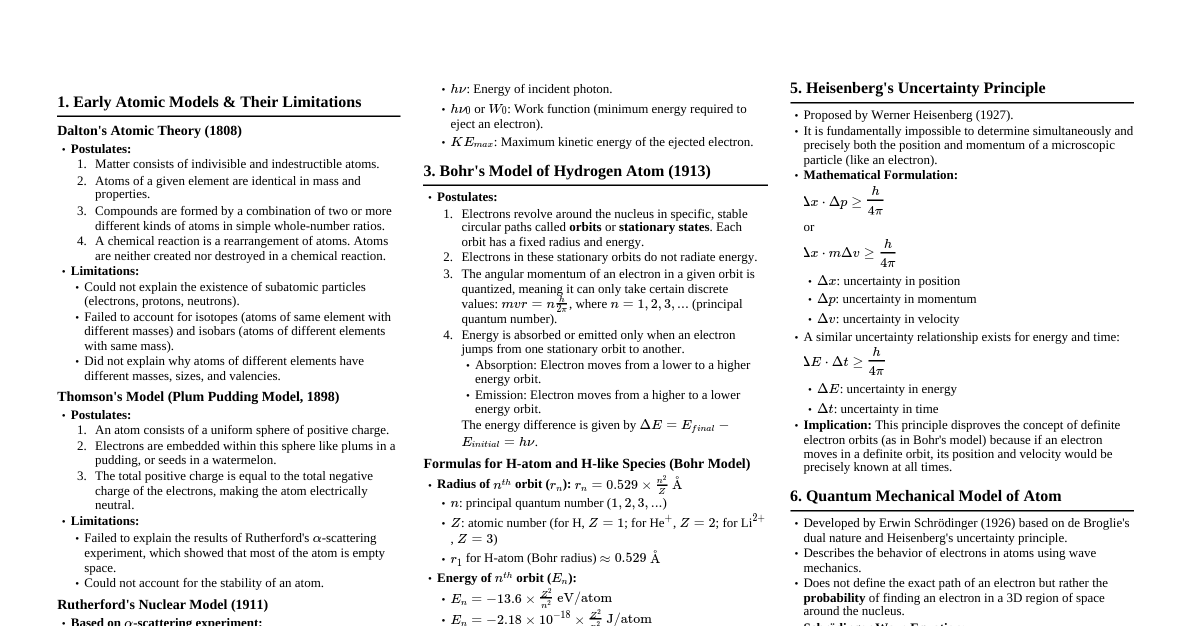
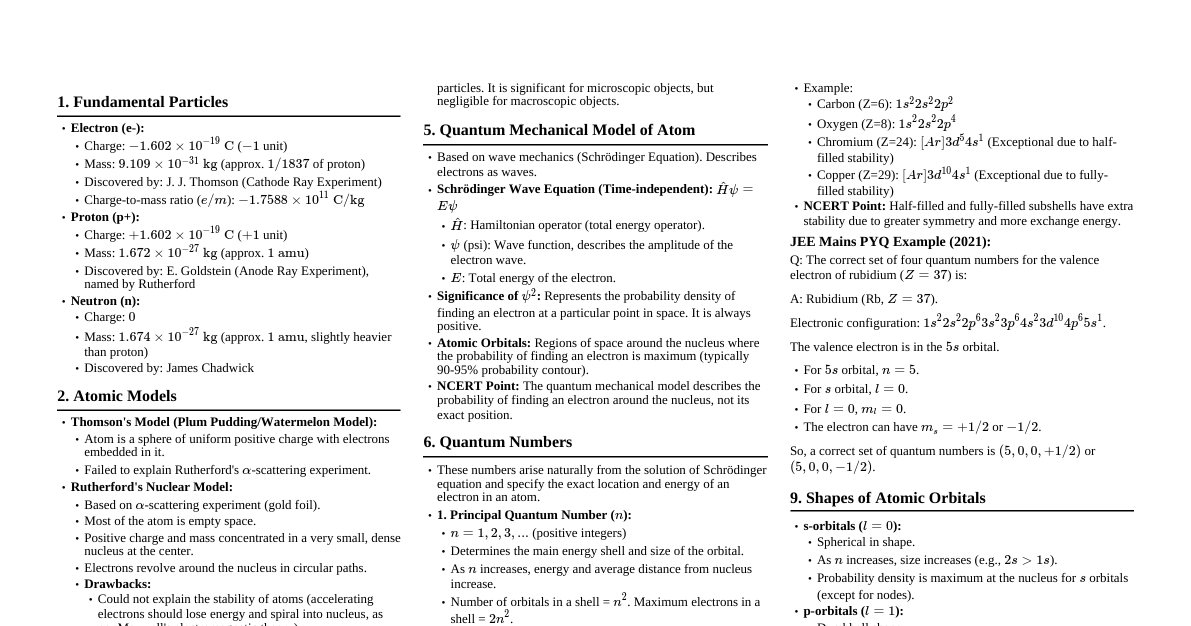
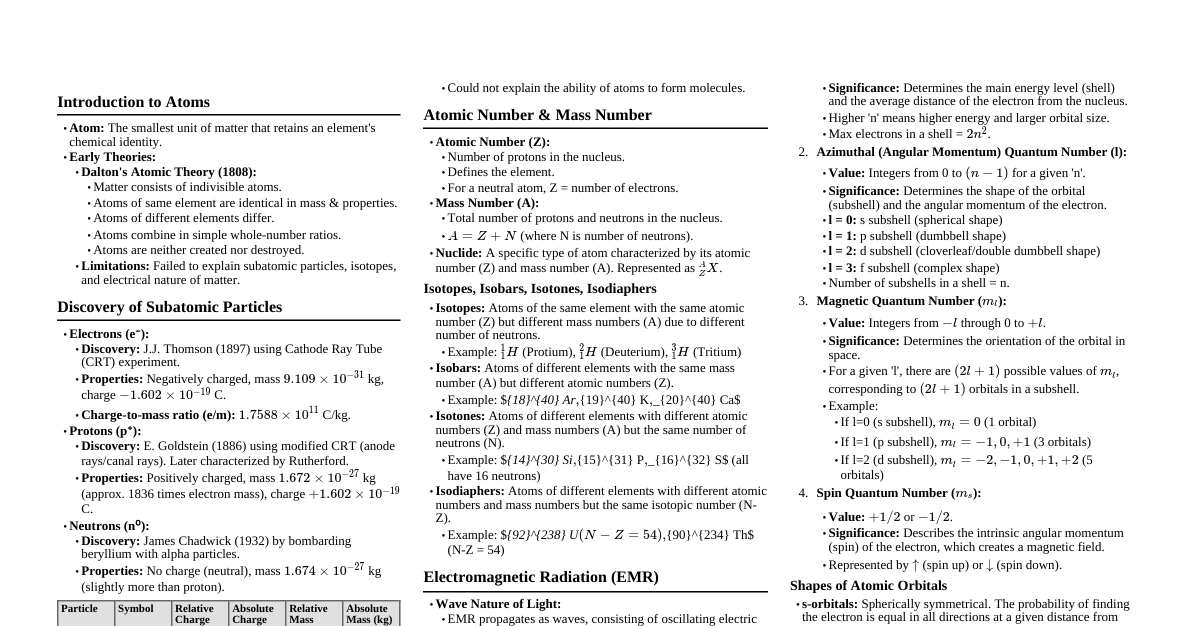
1. Introduction to Atoms Definition: Smallest particle of an element that can take part in a chemical reaction. Dalton's Atomic Theory (Revisited): Atoms are indivisible (later disproved). Subatomic Particles: Discovery of electrons, protons, and neutrons led to the understanding that atoms are divisible. 2. Discovery of Subatomic Particles 2.1 Electrons Discoverer: J.J. Thomson (1897). Experiment: Cathode Ray Tube experiment. Properties: Negatively charged, very light ($mass \approx \frac{1}{1837}$ of a proton), revolves around the nucleus. Symbol: $e^-$ 2.2 Protons Discoverer: E. Goldstein (canal ray experiment), named by Rutherford. Experiment: Anode ray (canal ray) experiment. Properties: Positively charged, located in the nucleus, mass $\approx 1$ amu. Symbol: $p^+$ 2.3 Neutrons Discoverer: James Chadwick (1932). Properties: No charge (neutral), located in the nucleus, mass $\approx 1$ amu. Symbol: $n^0$ 3. Atomic Models 3.1 Thomson's Model of an Atom (Plum Pudding Model) Postulates: Atom is a sphere of positive charge. Electrons are embedded in it like plums in a pudding. Positive and negative charges are equal in magnitude, making the atom electrically neutral. Limitations: Failed to explain Rutherford's $\alpha$-scattering experiment. 3.2 Rutherford's Model of an Atom ($\alpha$-Particle Scattering Experiment) Experiment: Bombarded thin gold foil with fast-moving $\alpha$-particles. Observations: Most $\alpha$-particles passed straight through. Some were deflected by small angles. A very few bounced back. Conclusions: Most space in an atom is empty. There is a small, dense, positively charged center called the nucleus . Electrons revolve around the nucleus in circular paths. Limitations: Electrons accelerating in circular orbits would lose energy and fall into the nucleus, making the atom unstable. Did not explain the discrete spectrum of atoms. 3.3 Bohr's Model of an Atom Postulates: Electrons revolve in specific, fixed orbits called discrete orbits or energy shells/levels . While in these orbits, electrons do not radiate energy. Energy is absorbed or emitted only when an electron jumps from one orbit to another. Orbits are designated as K, L, M, N shells or 1, 2, 3, 4, ... energy levels. Successes: Explained the stability of atoms and the discrete spectra. 4. Distribution of Electrons in Different Orbits (Shells) Bohr-Bury Rules: Maximum number of electrons in a shell is given by $2n^2$, where $n$ is the shell number. K-shell ($n=1$): $2(1)^2 = 2$ electrons L-shell ($n=2$): $2(2)^2 = 8$ electrons M-shell ($n=3$): $2(3)^2 = 18$ electrons The outermost shell cannot hold more than 8 electrons (octet rule). Electrons are not filled in an inner shell unless the previous shells are filled (stepwise filling). Valence Electrons: The electrons present in the outermost shell of an atom. 5. Atomic Number and Mass Number Atomic Number (Z): Number of protons in the nucleus of an atom. Also, number of electrons in a neutral atom. Defines the element. Mass Number (A): Sum of the number of protons and neutrons in the nucleus. $A = \text{number of protons} + \text{number of neutrons}$. Representation: $^A_Z X$ (where X is the symbol of the element). 6. Isotopes and Isobars Isotopes: Atoms of the same element with the same atomic number (Z) but different mass numbers (A). Differ in the number of neutrons. Example: Hydrogen isotopes - Protium ($^1_1 H$), Deuterium ($^2_1 H$), Tritium ($^3_1 H$). Applications: Used in nuclear reactors (Uranium-235), treatment of cancer (Cobalt-60), treatment of goitre (Iodine-131). Isobars: Atoms of different elements with different atomic numbers (Z) but the same mass numbers (A). Example: Calcium ($^{40}_{20}Ca$) and Argon ($^{40}_{18}Ar$). 7. Valency Definition: The combining capacity of an element. Determined by the number of valence electrons. Atoms combine to achieve a stable outermost shell (usually 8 electrons, octet rule). If valence electrons are 1, 2, 3, 4, valency is usually equal to the number of valence electrons. If valence electrons are 5, 6, 7, valency is usually $8 - (\text{number of valence electrons})$. For a completely filled outermost shell (e.g., noble gases), valency is 0.