12 class Chemistry
Cheatsheet Content
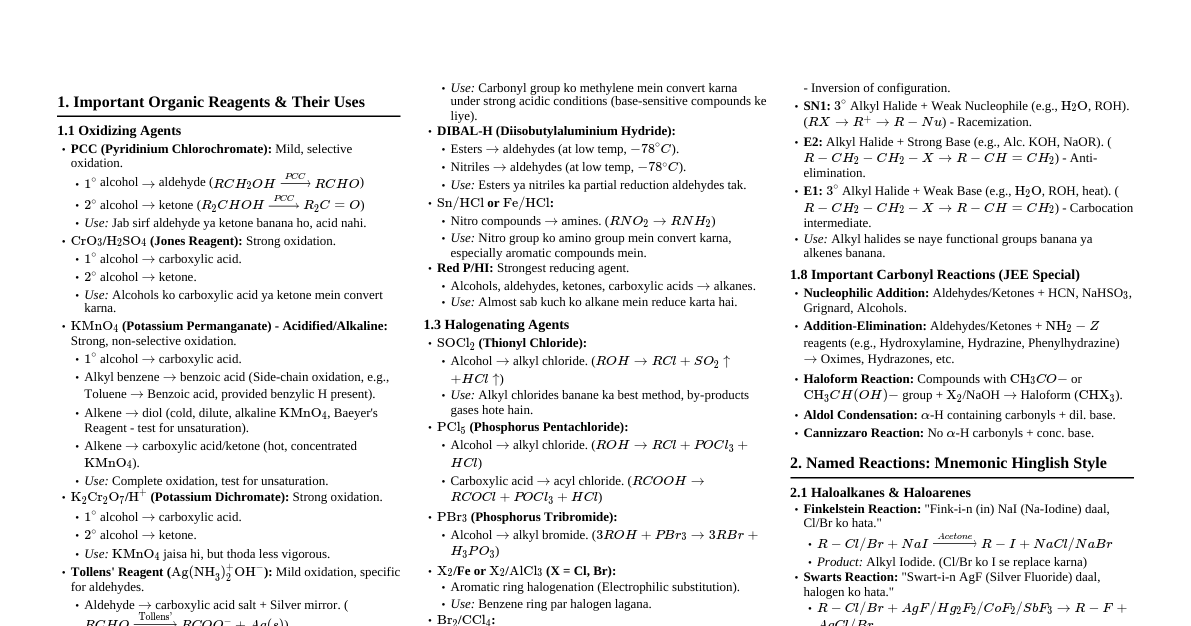
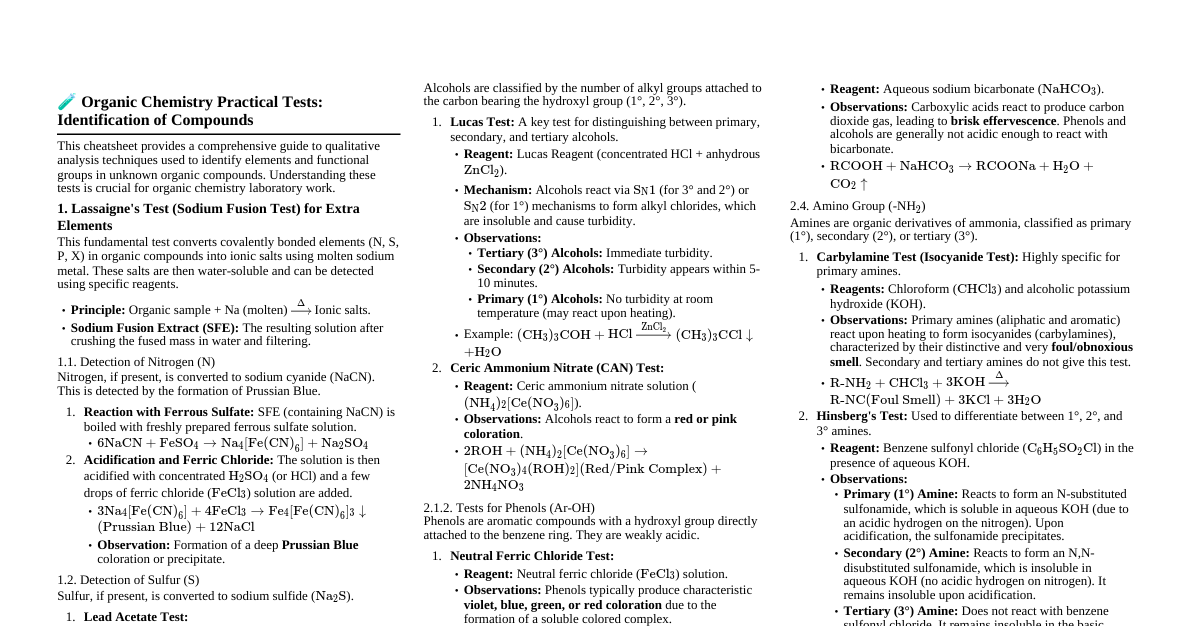
### Unit 1: Solutions #### 1.1 Types of Solutions - **Homogeneous vs. Heterogeneous:** Based on uniformity of composition. - **Aqueous vs. Non-aqueous:** Based on solvent type (water or other). - **Solid, Liquid, Gaseous Solutions:** Solute and solvent states. #### 1.2 Expressing Concentration of Solutions - **Mass Percentage (w/w%):** $\frac{\text{Mass of solute}}{\text{Mass of solution}} \times 100$ - **Volume Percentage (v/v%):** $\frac{\text{Volume of solute}}{\text{Volume of solution}} \times 100$ - **Mass by Volume Percentage (w/v%):** $\frac{\text{Mass of solute}}{\text{Volume of solution}} \times 100$ - **Parts per Million (ppm):** $\frac{\text{Mass of solute}}{\text{Mass of solution}} \times 10^6$ (for very dilute solutions) - **Mole Fraction ($X$):** $\frac{\text{Moles of component}}{\text{Total moles of all components}}$. Sum of mole fractions is 1. - **Molarity (M):** $\frac{\text{Moles of solute}}{\text{Volume of solution (L)}}$. Temperature dependent. - **Molality (m):** $\frac{\text{Moles of solute}}{\text{Mass of solvent (kg)}}$. Temperature independent. #### 1.3 Solubility - **Solubility of Solids in Liquids:** - **Effect of Temperature:** Generally increases with temperature for endothermic dissolution, decreases for exothermic. - **Effect of Pressure:** Negligible for solids. - **Solubility of Gases in Liquids:** - **Henry's Law:** $P = K_H X$, where $P$ is partial pressure of gas, $X$ is mole fraction of gas in solution, $K_H$ is Henry's constant. - **Effect of Temperature:** Decreases with increasing temperature (exothermic process). #### 1.4 Vapour Pressure of Liquid Solutions - **Raoult's Law (for volatile solute):** $P_A = X_A P_A^\circ$, where $P_A$ is partial vapor pressure of component A, $X_A$ is its mole fraction in solution, and $P_A^\circ$ is vapor pressure of pure A. - **Raoult's Law (for non-volatile solute):** $P_{solution} = X_{solvent} P_{solvent}^\circ$. - **Ideal Solutions:** Obey Raoult's law over entire range of concentrations. $\Delta H_{mix} = 0$, $\Delta V_{mix} = 0$. - **Non-Ideal Solutions:** - **Positive Deviation:** $P_{actual} > P_{Raoult's}$. $\Delta H_{mix} > 0$, $\Delta V_{mix} > 0$. Weaker A-B interactions than A-A or B-B. Example: Ethanol + Acetone. - **Negative Deviation:** $P_{actual} ### Unit 2: Electrochemistry #### 2.1 Electrochemical Cells - **Definition:** Devices that convert chemical energy into electrical energy (galvanic/voltaic cells) or vice versa (electrolytic cells). - **Galvanic Cell:** Spontaneous redox reaction produces electricity. Anode (-ve) is oxidation, Cathode (+ve) is reduction. Salt bridge maintains electrical neutrality. - **Electrolytic Cell:** Non-spontaneous redox reaction driven by external electrical energy. Anode (+ve) is oxidation, Cathode (-ve) is reduction. #### 2.2 Galvanic Cells - **Components:** Two half-cells (electrodes in electrolyte), salt bridge, external circuit. - **Cell Notation:** Anode | Anode electrolyte || Cathode electrolyte | Cathode. Example: Zn(s) | Zn²⁺(aq) || Cu²⁺(aq) | Cu(s). - **Electrode Potential:** Potential difference between electrode and its electrolyte. - **Standard Electrode Potential ($E^\circ$):** Measured at 298 K, 1 atm, 1 M concentration. - **Standard Hydrogen Electrode (SHE):** Reference electrode, $E^\circ = 0.00$ V. #### 2.3 Nernst Equation - **Equation:** $E_{cell} = E_{cell}^\circ - \frac{RT}{nF} \ln Q$ or $E_{cell} = E_{cell}^\circ - \frac{0.0591}{n} \log Q$ (at 298 K). - $E_{cell}$: Cell potential under non-standard conditions. - $E_{cell}^\circ$: Standard cell potential. - $R$: Gas constant (8.314 J/mol·K). - $T$: Temperature in Kelvin. - $n$: Number of moles of electrons transferred in balanced reaction. - $F$: Faraday constant (96485 C/mol). - $Q$: Reaction quotient. - **Equilibrium Constant ($K$):** At equilibrium, $E_{cell} = 0$, so $E_{cell}^\circ = \frac{0.0591}{n} \log K$. - **Gibbs Free Energy ($\Delta G$):** $\Delta G = -nFE_{cell}$ and $\Delta G^\circ = -nFE_{cell}^\circ$. - For spontaneous reaction, $\Delta G 0$. #### 2.4 Conductance of Electrolytic Solutions - **Resistance ($R$):** $R = \rho \frac{l}{A}$, where $\rho$ is resistivity. - **Conductance ($G$):** $G = \frac{1}{R} = \kappa \frac{A}{l}$, where $\kappa$ is conductivity. Unit: Siemens (S). - **Conductivity ($\kappa$):** Specific conductance. Unit: S cm⁻¹ or S m⁻¹. - **Molar Conductivity ($\Lambda_m$):** $\Lambda_m = \frac{\kappa \times 1000}{C}$ (C in mol/L, $\kappa$ in S cm⁻¹). Unit: S cm² mol⁻¹. - **Equivalent Conductivity ($\Lambda_{eq}$):** $\Lambda_{eq} = \frac{\kappa \times 1000}{\text{Normality}}$. #### 2.5 Electrolytic Cells and Electrolysis - **Faraday's Laws of Electrolysis:** - **First Law:** Mass of substance deposited/liberated is proportional to quantity of electricity passed ($W \propto Q = It$). - **Second Law:** When same quantity of electricity is passed through different electrolytes, masses of substances deposited are proportional to their equivalent masses ($W_1/W_2 = E_1/E_2$). - **Products of Electrolysis:** Depend on nature of electrolyte, electrodes, and overpotential. - **Electrochemical Series:** Determines relative reactivity and electrode potentials. #### 2.6 Batteries - **Primary Batteries (Non-rechargeable):** - **Dry Cell (Leclanché cell):** Zn anode, Carbon rod cathode, NH₄Cl paste electrolyte. - **Mercury Cell:** Zn-Hg amalgam anode, HgO-C paste cathode, KOH/ZnO paste electrolyte. - **Secondary Batteries (Rechargeable):** - **Lead-Acid Battery:** Lead anode, Lead dioxide cathode, H₂SO₄ electrolyte. - **Nickel-Cadmium Cell:** Cadmium anode, NiO₂ cathode, KOH electrolyte. - **Fuel Cells:** Convert chemical energy of fuel directly into electrical energy. Example: H₂-O₂ fuel cell. #### 2.7 Fuel Cells - **Hydrogen-Oxygen Fuel Cell:** - Anode: $2H_{2(g)} + 4OH^-_{(aq)} \rightarrow 4H_2O_{(l)} + 4e^-$ - Cathode: $O_{2(g)} + 2H_2O_{(l)} + 4e^- \rightarrow 4OH^-_{(aq)}$ - Overall: $2H_{2(g)} + O_{2(g)} \rightarrow 2H_2O_{(l)}$ - **Advantages:** High efficiency, low pollution. #### 2.8 Corrosion - **Definition:** Deterioration of metal by electrochemical process. - **Rusting of Iron:** Anode: $Fe_{(s)} \rightarrow Fe^{2+}_{(aq)} + 2e^-$. Cathode: $O_{2(g)} + 4H^+_{(aq)} + 4e^- \rightarrow 2H_2O_{(l)}$. - **Prevention:** Barrier protection (paint, oil), sacrificial protection (galvanization), cathodic protection, anti-rust solutions. ### Unit 3: Chemical Kinetics #### 3.1 Rate of a Chemical Reaction - **Definition:** Change in concentration of reactants or products per unit time. - **Average Rate:** $\text{Average rate} = -\frac{\Delta[R]}{\Delta t} = +\frac{\Delta[P]}{\Delta t}$ - **Instantaneous Rate:** $\text{Instantaneous rate} = -\frac{d[R]}{dt} = +\frac{d[P]}{dt}$ - **Stoichiometry:** For $aA + bB \rightarrow cC + dD$, Rate $= -\frac{1}{a}\frac{d[A]}{dt} = -\frac{1}{b}\frac{d[B]}{dt} = +\frac{1}{c}\frac{d[C]}{dt} = +\frac{1}{d}\frac{d[D]}{dt}$ #### 3.2 Factors Influencing Rate of a Reaction - **Concentration of Reactants:** Generally increases with concentration. - **Temperature:** Rate increases with temperature (Arrhenius equation). - **Pressure:** Significant for gaseous reactants. - **Catalyst:** Increases reaction rate by lowering activation energy. - **Surface Area:** For heterogeneous reactions, larger surface area increases rate. - **Nature of Reactants:** Depends on bond strengths and type of reaction. #### 3.3 Integrated Rate Equations - **Zero Order Reaction:** $R \rightarrow P$ - Rate $= k[R]^0 = k$ - Integrated Rate Law: $[R] = [R]_0 - kt$ - Half-life ($t_{1/2}$): $t_{1/2} = \frac{[R]_0}{2k}$ - Units of $k$: mol L⁻¹ s⁻¹ - **First Order Reaction:** $R \rightarrow P$ - Rate $= k[R]^1$ - Integrated Rate Law: $\ln[R] = \ln[R]_0 - kt$ or $kt = \ln\frac{[R]_0}{[R]}$ - Half-life ($t_{1/2}$): $t_{1/2} = \frac{0.693}{k}$ - Units of $k$: s⁻¹ - **Second Order Reaction:** $R \rightarrow P$ (or $2R \rightarrow P$) - Rate $= k[R]^2$ - Integrated Rate Law: $\frac{1}{[R]} = \frac{1}{[R]_0} + kt$ - Half-life ($t_{1/2}$): $t_{1/2} = \frac{1}{k[R]_0}$ - Units of $k$: L mol⁻¹ s⁻¹ - **Pseudo First Order Reaction:** A higher order reaction that behaves as first order when one reactant is in large excess. #### 3.4 Temperature Dependence of the Rate of a Reaction - **Arrhenius Equation:** $k = A e^{-E_a/RT}$ - $k$: Rate constant. - $A$: Arrhenius factor (frequency factor/pre-exponential factor). - $E_a$: Activation energy. - $R$: Gas constant. - $T$: Temperature in Kelvin. - **Logarithmic Form:** $\ln k = \ln A - \frac{E_a}{RT}$ - **Plot of $\ln k$ vs. $\frac{1}{T}$:** Straight line with slope $= -\frac{E_a}{R}$. - **Effect of Catalyst:** Lowers $E_a$, thus increasing $k$. #### 3.5 Collision Theory of Chemical Reactions - **Postulates:** - Reactant molecules must collide for a reaction to occur. - Collisions must have sufficient energy (activation energy, $E_a$). - Collisions must have proper orientation (steric factor, $P$). - **Rate of Reaction:** $Rate = P Z_{AB} e^{-E_a/RT}$ - $Z_{AB}$: Collision frequency of reactants A and B. - $P$: Probability factor (steric factor). ### Unit 4: The d- and f-Block Elements #### 4.1 Position in the Periodic Table - **d-Block:** Groups 3-12, elements with partially filled d-orbitals. Known as Transition Elements. - **f-Block:** Lanthanoids (4f) and Actinoids (5f). Known as Inner Transition Elements. #### 4.2 Electronic Configurations of the d-Block Elements - **General Configuration:** $(n-1)d^{1-10} ns^{1-2}$. - **Exceptions:** Cr ($[Ar]3d^5 4s^1$), Cu ($[Ar]3d^{10} 4s^1$) due to stability of half-filled and fully-filled d-orbitals. - **Common Oxidation States:** Exhibit variable oxidation states (due to small energy difference between (n-1)d and ns electrons). #### 4.3 General Properties of the Transition Elements (d-Block) - **Metallic Character:** High melting/boiling points, good conductors, high tensile strength. - **Atomic and Ionic Radii:** Generally decrease across a period (due to increasing nuclear charge) but increase down a group. Lanthanoid contraction in 5d series. - **Ionisation Enthalpy:** Higher than s-block, lower than p-block. - **Oxidation States:** Variable oxidation states. Max oxidation state in middle of series. - **Colour:** Form coloured ions/compounds due to d-d transitions. - **Magnetic Properties:** Paramagnetic (unpaired electrons), Diamagnetic (all electrons paired). - **Catalytic Properties:** Due to variable oxidation states and ability to form coordination compounds. - **Interstitial Compounds:** Formed when small atoms (H, C, N) are trapped in interstitial sites of metal lattice. - **Alloy Formation:** Form alloys readily due to similar atomic sizes. #### 4.4 Some Important Compounds of Transition Elements - **Potassium Dichromate ($K_2Cr_2O_7$):** - Preparation: Chromite ore $\rightarrow Na_2CrO_4 \rightarrow Na_2Cr_2O_7 \rightarrow K_2Cr_2O_7$. - Properties: Orange solid, strong oxidizing agent. - Reactions: $Cr_2O_7^{2-} + 14H^+ + 6e^- \rightarrow 2Cr^{3+} + 7H_2O$. - **Potassium Permanganate ($KMnO_4$):** - Preparation: Pyrolusite ore $\rightarrow K_2MnO_4 \rightarrow KMnO_4$. - Properties: Dark purple solid, strong oxidizing agent in acidic, alkaline, and neutral media. - Reactions (acidic): $MnO_4^- + 8H^+ + 5e^- \rightarrow Mn^{2+} + 4H_2O$. #### 4.5 The Lanthanoids - **Electronic Configuration:** $[Xe]4f^{1-14} 5d^{0-1} 6s^2$. - **Oxidation States:** Primarily +3. Some show +2 and +4. - **Lanthanoid Contraction:** Steady decrease in atomic/ionic radii with increasing atomic number due to poor shielding of 4f electrons. - **Consequences:** Similar radii of 4d and 5d series elements, difficulty in separation, basicity of hydroxides decreases. - **Chemical Reactivity:** Generally reactive, similar chemical properties. - **Colour and Magnetic Properties:** Most are coloured and paramagnetic. #### 4.6 The Actinoids - **Electronic Configuration:** $[Rn]5f^{1-14} 6d^{0-1} 7s^2$. - **Oxidation States:** Exhibit higher range of oxidation states (e.g., U, Np, Pu show +3, +4, +5, +6). Due to comparable energies of 5f, 6d, and 7s orbitals. - **Actinoid Contraction:** Similar to lanthanoid contraction but more pronounced. - **Radioactivity:** All actinoids are radioactive. - **Chemical Reactivity:** More reactive than lanthanoids. - **Colour and Magnetic Properties:** Ions are generally coloured and paramagnetic. #### 4.7 Some Applications of d- and f-Block Elements - **d-Block:** Catalysts (Fe in Haber, Ni in hydrogenation), construction materials (Fe, steel), coinage metals (Cu, Ag, Au), pigments, batteries. - **f-Block:** Mischmetal (alloy of lanthanoids, used in lighter flints), nuclear energy (U, Pu), phosphors (Eu, Gd). ### Unit 5: Coordination Compounds #### 5.1 Werner's Theory of Coordination Compounds - **Postulates:** 1. Metals exhibit two types of valencies: primary (ionizable, satisfies oxidation state) and secondary (non-ionizable, satisfies coordination number). 2. Secondary valencies are directional, giving definite geometry to the complex. 3. Counter ions satisfy primary valencies, ligands satisfy secondary valencies. #### 5.2 Definitions of Some Important Terms Pertaining to Coordination Compounds - **Central Metal Atom/Ion:** Lewis acid, accepts electron pairs from ligands. - **Ligands:** Lewis base, donate electron pairs to central metal. Can be monodentate, bidentate, polydentate, ambidentate. - **Coordination Number:** Number of ligand donor atoms directly bonded to central metal ion. - **Coordination Sphere:** Central metal ion and ligands directly attached to it, enclosed in square brackets. - **Coordination Polyhedron:** Spatial arrangement of ligand atoms directly attached to central atom. - **Oxidation State:** Charge on central metal atom if all ligands are removed along with electron pairs. - **Homoleptic/Heteroleptic Complexes:** Homoleptic (only one type of ligand), Heteroleptic (more than one type of ligand). #### 5.3 Nomenclature of Coordination Compounds - **IUPAC Rules:** 1. Cation first, then anion. 2. Ligands named first (alphabetically), then metal. 3. Ligand names: Anionic ligands end in '-o' (chloro, cyano); neutral ligands have special names (aqua, ammine, carbonyl, nitrosyl); cationic ligands end in '-ium'. 4. Prefixes: di-, tri-, tetra- for simple ligands; bis-, tris-, tetrakis- for complex ligands (e.g., ethylenediamine). 5. Oxidation state of metal in Roman numerals in parentheses. 6. If complex is anion, metal name ends in '-ate' (ferrate, cuprate). #### 5.4 Isomerism in Coordination Compounds - **Structural Isomerism:** - **Linkage Isomerism:** Ambidentate ligand coordinates through different atoms (e.g., -NO₂ vs. -ONO). - **Coordination Isomerism:** Exchange of ligands between cationic and anionic entities of different metal ions in a complex. - **Ionisation Isomerism:** Counter ion acts as a ligand and a ligand acts as a counter ion. - **Solvate (Hydrate) Isomerism:** Water molecules are either ligands or solvent of crystallisation. - **Stereoisomerism:** - **Geometrical (cis-trans) Isomerism:** Different spatial arrangement of ligands around the central metal ion (e.g., square planar $MA_2B_2$, octahedral $MA_4B_2$). - **Optical Isomerism (Enantiomerism):** Non-superimposable mirror images (chiral complexes). Found in complexes like $M(AA)_3$, $M(AA)_2B_2$. #### 5.5 Bonding in Coordination Compounds - **Valence Bond Theory (VBT):** - Metal orbital hybridization (sp³, dsp², d²sp³, sp³d²). - Inner orbital complexes (using inner d-orbitals) vs. Outer orbital complexes (using outer d-orbitals). - Prediction of magnetic properties (diamagnetic for paired, paramagnetic for unpaired electrons). - **Crystal Field Theory (CFT):** - Ligands are treated as point charges. - Explains splitting of d-orbitals in presence of ligand field (crystal field splitting energy, $\Delta_o$ for octahedral, $\Delta_t$ for tetrahedral). - **Octahedral Field:** d-orbitals split into $t_{2g}$ (lower energy) and $e_g$ (higher energy). - **Tetrahedral Field:** d-orbitals split into $e$ (lower energy) and $t_2$ (higher energy). $\Delta_t = \frac{4}{9}\Delta_o$. - **Spectrochemical Series:** Order of ligands increasing crystal field splitting strength: $I^- ### Unit 6: Haloalkanes and Haloarenes #### 6.1 Classification - **Based on number of halogen atoms:** - Monohaloalkanes: One halogen (e.g., CH₃Cl) - Dihaloalkanes: Two halogens (e.g., CH₂Cl₂) - Polyhaloalkanes: More than two halogens - **Based on hybridization of carbon atom to which halogen is attached:** - **Alkyl halides (Haloalkanes):** Halogen attached to sp³ hybridized carbon. - Primary (1°): Halogen attached to a primary carbon. - Secondary (2°): Halogen attached to a secondary carbon. - Tertiary (3°): Halogen attached to a tertiary carbon. - **Allylic halides:** Halogen attached to sp³ hybridized carbon, next to C=C (e.g., CH₂=CH-CH₂-X). - **Benzylic halides:** Halogen attached to sp³ hybridized carbon, next to aromatic ring (e.g., C₆H₅-CH₂-X). - **Vinylic halides:** Halogen attached to sp² hybridized carbon of C=C (e.g., CH₂=CH-X). - **Aryl halides (Haloarenes):** Halogen attached to sp² hybridized carbon of an aromatic ring (e.g., C₆H₅-X). #### 6.2 Nomenclature - **Common Names:** Alkyl halide (e.g., methyl chloride, isopropyl bromide). - **IUPAC Names:** Haloalkane (e.g., chloromethane, 2-bromopropane). - **For Haloarenes:** Ortho, meta, para prefixes or numbering (e.g., 1-chlorobenzene). #### 6.3 Nature of C-X Bond - **Polarity:** Carbon-halogen bond is polar due to electronegativity difference (Halogen > Carbon). $\delta^+$C - X$\delta^-$. - **Bond Length and Strength:** Bond length increases and bond strength decreases down the group (C-F 2^\circ > 1^\circ$. - **With PCl₃/PCl₅:** $ROH + PCl_3 \rightarrow RCl + H_3PO_3$. $ROH + PCl_5 \rightarrow RCl + POCl_3 + HCl$. - **With SOCl₂ (Thionyl Chloride - Darzens process):** $ROH + SOCl_2 \xrightarrow{Pyridine} RCl + SO_2 \uparrow + HCl \uparrow$. Best method as products are gases. - **From Hydrocarbons:** - **Free Radical Halogenation (Alkanes):** $CH_4 + Cl_2 \xrightarrow{hv \text{ or heat}} CH_3Cl + HCl$. Non-selective, mixture of products. - **Electrophilic Addition (Alkenes):** - $CH_2=CH_2 + HCl \rightarrow CH_3CH_2Cl$. - Markovnikov's Rule: H adds to carbon with more H, X adds to carbon with fewer H. (e.g., $CH_3CH=CH_2 + HBr \rightarrow CH_3CHBrCH_3$). - Anti-Markovnikov's Rule (Peroxide effect for HBr): $CH_3CH=CH_2 + HBr \xrightarrow{Peroxide} CH_3CH_2CH_2Br$. - **Halogen Exchange Reactions:** - **Finkelstein Reaction:** $R-Cl/Br + NaI \xrightarrow{Acetone} R-I + NaCl/NaBr$. (For preparing alkyl iodides). - **Swarts Reaction:** $R-Br/Cl + AgF/Hg_2F_2/CoF_2/SbF_3 \rightarrow R-F + Metal Halide$. (For preparing alkyl fluorides). - **From Silver Salts of Carboxylic Acids (Hunsdiecker Reaction):** - $RCOOAg + Br_2 \xrightarrow{CCl_4, \text{ reflux}} R-Br + CO_2 + AgBr$. #### 6.5 Preparation of Haloarenes - **From Benzene (Electrophilic Substitution):** - $C_6H_6 + Cl_2 \xrightarrow{FeCl_3} C_6H_5Cl + HCl$. (Requires Lewis acid catalyst). - **From Diazonium Salts (Sandmeyer Reaction):** - $Ar-N_2^+X^- + CuCl/HCl \rightarrow Ar-Cl + N_2$. - $Ar-N_2^+X^- + CuBr/HBr \rightarrow Ar-Br + N_2$. - **Gattermann Reaction:** $Ar-N_2^+X^- + Cu/HCl \rightarrow Ar-Cl + N_2$. (Uses Cu powder instead of CuX). - For iodobenzene: $Ar-N_2^+X^- + KI \rightarrow Ar-I + N_2 + KX$. - **From Phenol (not direct):** Can convert phenol to chlorobenzene via reaction with PCl₅, but yield is poor. #### 6.6 Physical Properties - **Boiling Points:** Increase with increasing molecular mass (R-I > R-Br > R-Cl > R-F). For isomers, straight chain > branched chain. - **Density:** R-I > R-Br > R-Cl. Dihaloalkanes > Monohaloalkanes. - **Solubility:** Immiscible with water, soluble in organic solvents. - **Dipole Moment:** C-Cl > C-F > C-Br > C-I (due to competing effects of bond length and electronegativity). #### 6.7 Chemical Reactions of Haloalkanes - **Nucleophilic Substitution Reactions (S_N1 and S_N2):** - **S_N2 (Substitution Nucleophilic Bimolecular):** - **Mechanism:** Concerted, one-step reaction. Nucleophile attacks from back side, leaving group departs from front. Inversion of configuration (Walden inversion). - **Rate:** Rate $= k[RX][Nu^-]$. - **Order of Reactivity:** $1^\circ > 2^\circ > 3^\circ$ alkyl halides. - **Steric Hindrance:** Primary halides undergo S_N2 readily due to less steric hindrance. - **Solvent:** Polar aprotic solvents (DMSO, acetone, DMF) favor S_N2. - **Nucleophile:** Strong nucleophiles favor S_N2. - **S_N1 (Substitution Nucleophilic Unimolecular):** - **Mechanism:** Two-step reaction. Step 1: Formation of carbocation (slow, rate-determining). Step 2: Nucleophilic attack on carbocation. Racemization (loss of stereochemistry). - **Rate:** Rate $= k[RX]$. - **Order of Reactivity:** $3^\circ > 2^\circ > 1^\circ$ alkyl halides. (Stability of carbocation). - **Solvent:** Polar protic solvents (water, alcohols) favor S_N1 (stabilize carbocation). - **Leaving Group:** Good leaving group (I⁻ > Br⁻ > Cl⁻ > F⁻). - **Common Nucleophiles:** OR⁻, CN⁻, I⁻, NH₃, H₂O, OH⁻, RCOO⁻, SH⁻. - **Elimination Reactions (E1 and E2):** - **Dehydrohalogenation (β-elimination):** Removal of HX to form an alkene. - **E2 (Elimination Bimolecular):** - **Mechanism:** Concerted, one-step. Strong base abstracts a proton from $\beta$-carbon, halogen leaves from $\alpha$-carbon. Anti-periplanar geometry preferred. - **Rate:** Rate $= k[RX][Base]$. - **Order of Reactivity:** $3^\circ > 2^\circ > 1^\circ$ alkyl halides. - **Saytzeff's Rule:** Major product is the more substituted alkene (more stable). - **E1 (Elimination Unimolecular):** - **Mechanism:** Two-step. Step 1: Formation of carbocation (slow). Step 2: Base abstracts proton from $\beta$-carbon to form alkene. - **Rate:** Rate $= k[RX]$. - **Order of Reactivity:** $3^\circ > 2^\circ > 1^\circ$ alkyl halides. - **Competition:** S_N1 and E1 often compete in protic solvents with weak bases. S_N2 and E2 compete in aprotic solvents with strong bases. - **Reaction with Metals:** - **Wurtz Reaction:** $2RX + 2Na \xrightarrow{Dry Ether} R-R + 2NaX$. (For coupling alkyl halides). - **Wurtz-Fittig Reaction:** $ArX + RX + 2Na \xrightarrow{Dry Ether} Ar-R + 2NaX$. - **Grignard Reagents:** $RX + Mg \xrightarrow{Dry Ether} RMgX$. (Highly reactive, used to prepare many organic compounds). - **Frankland Reaction:** $2RX + 2Zn \rightarrow R-R + ZnX_2$. #### 6.8 Chemical Reactions of Haloarenes - **Nucleophilic Aromatic Substitution (SNAr):** - Generally difficult due to: - Resonance stabilization of C-X bond (partial double bond character). - Halogen attached to sp² carbon (more electronegative, shorter bond). - Instability of phenyl carbocation (if S_N1 type). - Repulsion between nucleophile and electron-rich aromatic ring. - **Conditions:** Requires harsh conditions (high temperature, high pressure) or presence of electron-withdrawing groups (EWG) at ortho/para positions. - **Example (Dow's Process):** Chlorobenzene $\xrightarrow{NaOH, 623K, 300atm}$ Sodium Phenoxide $\xrightarrow{H^+} $ Phenol. - **With EWG:** $o/p$-nitrophenol are readily formed. - **Electrophilic Aromatic Substitution:** - Halogens are deactivating but ortho-para directing. - **Halogenation:** $C_6H_5Cl + Cl_2 \xrightarrow{FeCl_3} o/p$-dichlorobenzene. - **Nitration:** $C_6H_5Cl + HNO_3 \xrightarrow{Conc. H_2SO_4} o/p$-chloronitrobenzene. - **Sulphonation:** $C_6H_5Cl + Conc. H_2SO_4 \xrightarrow{Heat} o/p$-chlorobenzenesulphonic acid. - **Friedel-Crafts Alkylation:** $C_6H_5Cl + CH_3Cl \xrightarrow{Anhyd. AlCl_3} o/p$-chlorotoluene. - **Friedel-Crafts Acylation:** $C_6H_5Cl + CH_3COCl \xrightarrow{Anhyd. AlCl_3} o/p$-chloroacetophenone. - **Reaction with Metals:** - **Wurtz-Fittig Reaction:** (Already discussed) - **Fittig Reaction:** $2ArX + 2Na \xrightarrow{Dry Ether} Ar-Ar + 2NaX$. (For coupling two aryl halides). - **Ullmann Reaction:** $2ArI + 2Cu \xrightarrow{Heat} Ar-Ar + 2CuI$. (Specifically for iodoarenes). #### 6.9 Polyhalogen Compounds - **Dichloromethane (CH₂Cl₂):** Solvent, paint remover. - **Chloroform (CHCl₃):** Solvent, anesthetic (now less used). Oxidizes to phosgene ($COCl_2$) in presence of light and air. - **Iodoform (CHI₃):** Antiseptic. - **Carbon Tetrachloride (CCl₄):** Solvent, fire extinguisher (phosgene risk). - **Freons (CFCs):** Refrigerants, propellants. Deplete ozone layer. - **DDT (Dichlorodiphenyltrichloroethane):** Insecticide (banned due to environmental persistence). ### Unit 7: Alcohols, Phenols and Ethers #### 7.1 Classification - **Alcohols:** Compounds containing -OH group attached to an alkyl or substituted alkyl group. - **Monohydric:** One -OH group. - Primary (1°), Secondary (2°), Tertiary (3°): Based on the type of carbon atom bearing the -OH group. - Allylic: -OH on sp³ carbon next to C=C. - Benzylic: -OH on sp³ carbon next to aromatic ring. - **Dihydric:** Two -OH groups (Glycols). - **Polyhydric:** More than two -OH groups. - **Phenols:** Compounds containing -OH group directly attached to an aromatic ring. - Monohydric, Dihydric, Trihydric: Based on number of -OH groups. - **Ethers:** Compounds in which an oxygen atom is bonded to two alkyl or aryl groups (R-O-R', Ar-O-R, Ar-O-Ar'). - **Simple/Symmetrical:** Both R groups are identical. - **Mixed/Unsymmetrical:** R groups are different. #### 7.2 Nomenclature - **Alcohols:** - Common: Alkyl alcohol (e.g., Methyl alcohol). - IUPAC: Alkanol (e.g., Methanol). - **Phenols:** - Common: Phenol, cresols (methylphenols). - IUPAC: Benzenol, or substituted phenols (e.g., 2-methylphenol). - **Ethers:** - Common: Dialkyl ether (e.g., Diethyl ether), Alkyl aryl ether (e.g., Anisole - methyl phenyl ether). - IUPAC: Alkoxyalkane (e.g., Methoxyethane). #### 7.3 Structures of Functional Groups - **Alcohols and Phenols:** Oxygen is sp³ hybridized. Bond angle is slightly less than tetrahedral due to lone pair repulsion. C-O-H bond angle in alcohols is ~108.9°. C-O bond length is shorter in phenols due to partial double bond character (resonance). - **Ethers:** Oxygen is sp³ hybridized. C-O-C bond angle is ~111.7° in dimethyl ether. #### 7.4 Alcohols and Phenols ##### **Preparation of Alcohols:** 1. **From Alkenes:** * **Acid-catalyzed hydration:** $CH_2=CH_2 + H_2O \xrightarrow{H^+} CH_3CH_2OH$. (Markovnikov's addition, carbocation intermediate, rearrangements possible). * **Hydroboration-oxidation (HBO):** $RCH=CH_2 \xrightarrow{BH_3, THF} (RCH_2CH_2)_3B \xrightarrow{H_2O_2, OH^-} RCH_2CH_2OH$. (Anti-Markovnikov's addition, syn addition of H and OH). * **Oxymercuration-demercuration (OMDM):** $RCH=CH_2 \xrightarrow{Hg(OAc)_2, H_2O / NaBH_4, OH^-} R-CH(OH)CH_3$. (Markovnikov's addition, no rearrangements, anti addition of H and OH). 2. **From Carbonyl Compounds (Aldehydes, Ketones, Carboxylic Acids, Esters):** * **Reduction (with NaBH₄ or LiAlH₄):** * Aldehydes $\xrightarrow{NaBH_4 \text{ or } LiAlH_4}$ Primary alcohols. * Ketones $\xrightarrow{NaBH_4 \text{ or } LiAlH_4}$ Secondary alcohols. * Carboxylic acids $\xrightarrow{LiAlH_4}$ Primary alcohols (NaBH₄ does not reduce acids). * Esters $\xrightarrow{LiAlH_4}$ Primary alcohols. * **Grignard Reagents (RMgX):** * Formaldehyde $\xrightarrow{RMgX / H_3O^+}$ Primary alcohol. * Aldehyde (other than formaldehyde) $\xrightarrow{RMgX / H_3O^+}$ Secondary alcohol. * Ketone $\xrightarrow{RMgX / H_3O^+}$ Tertiary alcohol. * Esters $\xrightarrow{2RMgX / H_3O^+}$ Tertiary alcohol (except formate esters give secondary alcohols). 3. **From Primary Amines (limited use):** $R-NH_2 + HNO_2 \xrightarrow{NaNO_2/HCl} R-OH + N_2 + H_2O$. (Rearrangements possible for longer chains). ##### **Preparation of Phenols:** 1. **From Haloarenes (Dow's Process):** Chlorobenzene $\xrightarrow{NaOH, 623K, 300atm}$ Sodium Phenoxide $\xrightarrow{H^+} $ Phenol. (SNAr mechanism with benzyne intermediate for unactivated haloarenes). 2. **From Benzene Sulphonic Acid:** $C_6H_5SO_3H \xrightarrow{NaOH, heat} C_6H_5ONa \xrightarrow{H^+} C_6H_5OH$. 3. **From Diazonium Salts:** $Ar-N_2^+Cl^- + H_2O \xrightarrow{Warm} Ar-OH + N_2 + HCl$. 4. **From Cumene (Isopropylbenzene):** Cumene $\xrightarrow{O_2, heat} \text{Cumene hydroperoxide} \xrightarrow{H_3O^+} \text{Phenol + Acetone}$. (Industrial method). ##### **Physical Properties (Alcohols and Phenols):** - **Boiling Point:** High due to intermolecular hydrogen bonding. Increases with molecular mass. For isomers, branching decreases boiling point. - **Solubility:** Lower molecular weight alcohols are water soluble due to H-bonding with water. Solubility decreases with increasing alkyl chain length. Phenols are sparingly soluble in water. - **Acidity:** Phenols are more acidic than alcohols due to resonance stabilization of phenoxide ion. - **Effect of substituents on Phenol Acidity:** Electron-withdrawing groups (EWG) increase acidity (e.g., nitro groups at ortho/para positions). Electron-donating groups (EDG) decrease acidity (e.g., alkyl groups). - **Order of acidity:** Picric acid > p-nitrophenol > m-nitrophenol > phenol > ethanol. ##### **Chemical Reactions of Alcohols:** 1. **Reactions involving cleavage of O-H bond (Acidic nature):** * **Reaction with active metals:** $2ROH + 2Na \rightarrow 2RONa + H_2$. * **Esterification:** $ROH + R'COOH \xrightarrow{H^+} R'COOR + H_2O$. (Fischer esterification). * **Acylation:** $ROH + (R'CO)_2O \xrightarrow{Pyridine} R'COOR + R'COOH$. * **Reaction with Grignard Reagents:** $ROH + RMgX \rightarrow R-H + ROMgX$. 2. **Reactions involving cleavage of C-O bond:** * **Reaction with HX (Lucas Test):** $ROH + HX \xrightarrow{ZnX_2} RX + H_2O$. * $3^\circ$ alcohols react instantly (turbidity). * $2^\circ$ alcohols react in 5-10 min. * $1^\circ$ alcohols react only on heating. * **Reaction with PCl₃/PCl₅/SOCl₂:** (Already discussed in Haloalkanes). * **Dehydration to Alkenes (E1/E2):** $ROH \xrightarrow{Conc. H_2SO_4, heat} Alkene + H_2O$. * $3^\circ > 2^\circ > 1^\circ$ reactivity. Follows Saytzeff's rule. * Mechanism involves carbocation formation (E1). * **Dehydration to Ethers (Intermolecular dehydration):** $2ROH \xrightarrow{Conc. H_2SO_4, 413K} R-O-R + H_2O$. (S_N2 mechanism, primarily for 1° alcohols). 3. **Oxidation Reactions:** * **1° Alcohol:** $RCH_2OH \xrightarrow{PCC} RCHO$ (aldehyde). $RCH_2OH \xrightarrow{KMnO_4, CrO_3} RCOOH$ (carboxylic acid). * **2° Alcohol:** $R_2CHOH \xrightarrow{PCC \text{ or } CrO_3} R_2C=O$ (ketone). * **3° Alcohol:** Resistant to oxidation under mild conditions. Under strong conditions, C-C bond cleavage occurs. * **Catalytic Dehydrogenation:** $ROH \xrightarrow{Cu, 573K}$. * $1^\circ \rightarrow$ Aldehyde. * $2^\circ \rightarrow$ Ketone. * $3^\circ \rightarrow$ Alkene (dehydration). ##### **Chemical Reactions of Phenols:** 1. **Electrophilic Aromatic Substitution (Phenol is activating and o,p-directing):** * **Halogenation:** Phenol $\xrightarrow{Br_2/CS_2 \text{ or } Br_2/CHCl_3} p$-bromophenol (monobromination). Phenol $\xrightarrow{Br_2/H_2O} 2,4,6$-tribromophenol (white ppt). * **Nitration:** Phenol $\xrightarrow{Dil. HNO_3} o/p$-nitrophenol. Phenol $\xrightarrow{Conc. HNO_3} 2,4,6$-trinitrophenol (Picric acid). * **Sulphonation:** Phenol $\xrightarrow{Conc. H_2SO_4, 298K} o$-phenolsulphonic acid. Phenol $\xrightarrow{Conc. H_2SO_4, 373K} p$-phenolsulphonic acid. * **Friedel-Crafts Reaction:** Phenol does not undergo Friedel-Crafts reaction readily due to coordination of -OH with Lewis acid. 2. **Kolbe's Reaction (Carboxylation):** Phenol $\xrightarrow{NaOH / CO_2, 400K, 4-7atm / H^+} \text{Salicylic acid}$. 3. **Reimer-Tiemann Reaction:** Phenol $\xrightarrow{CHCl_3/NaOH \text{ (or } CCl_4/NaOH) / H^+} \text{Salicylaldehyde (or Salicylic acid)}$. (Dichlorocarbene intermediate). 4. **Reaction with Zinc Dust:** Phenol $\xrightarrow{Zn \text{ dust, heat}} \text{Benzene}$. 5. **Oxidation:** Phenol $\xrightarrow{Na_2Cr_2O_7/H_2SO_4} \text{Benzoquinone}$. 6. **Coupling Reaction (with Diazonium Salts):** Phenol $\xrightarrow{Benzene diazonium chloride, NaOH} \text{p-Hydroxyazobenzene (orange dye)}$. #### 7.5 Some Commercially Important Alcohols - **Methanol (CH₃OH):** "Wood spirit." Highly toxic, causes blindness and death. Used as solvent, fuel. - **Ethanol (C₂H₅OH):** "Grain alcohol." Produced by fermentation of sugars. Used in beverages, solvent, fuel. - **Denatured Alcohol:** Ethanol made unfit for drinking by adding poisonous substances (e.g., methanol, pyridine). #### 7.6 Ethers ##### **Preparation of Ethers:** 1. **By Dehydration of Alcohols:** $2ROH \xrightarrow{Conc. H_2SO_4, 413K} R-O-R + H_2O$. (S_N2 pathway, good for 1° alcohols. For 2°/3° alcohols, elimination (alkene formation) predominates). 2. **Williamson Synthesis:** $R-X + R'-ONa \rightarrow R-O-R' + NaX$. * Best for preparing unsymmetrical ethers. * Primary alkyl halides react with sodium alkoxides (or phenoxides) by S_N2 mechanism. * If $3^\circ$ alkyl halide is used, elimination (alkene) is the major product. 3. **From Alkenes (Alkoxymercuration-demercuration):** $RCH=CH_2 \xrightarrow{Hg(OAc)_2, R'OH / NaBH_4} R-CH(OR')-CH_3$. (Markovnikov's addition of R'OH). ##### **Physical Properties of Ethers:** - **Boiling Point:** Lower than isomeric alcohols (no H-bonding). Comparable to alkanes of similar molecular mass. - **Solubility:** Slightly soluble in water (can form H-bonds with water). Soluble in organic solvents. - **Polarity:** Slight dipole moment due to bent structure. ##### **Chemical Reactions of Ethers:** 1. **Cleavage of C-O bond (with HX):** $R-O-R' + HX \rightarrow RX + R'OH$. * Reactivity of HX: HI > HBr > HCl. * Mechanism: Protonation of ether, then nucleophilic attack by halide ion. * If one group is $1^\circ$/$2^\circ$ and other is $1^\circ$/$2^\circ$, reaction proceeds by S_N2, smaller alkyl group forms alkyl halide. * If one group is $3^\circ$, reaction proceeds by S_N1, $3^\circ$ alkyl group forms alkyl halide. * **For anisole (methyl phenyl ether):** $C_6H_5-O-CH_3 + HI \rightarrow C_6H_5OH + CH_3I$. (Phenyl-oxygen bond is stronger due to resonance). 2. **Electrophilic Substitution (in aromatic ethers, e.g., Anisole):** * -OR group is activating and o,p-directing. * **Halogenation:** Anisole $\xrightarrow{Br_2/CH_3COOH} p$-bromoanisole (major). * **Nitration:** Anisole $\xrightarrow{Conc. HNO_3/H_2SO_4} o/p$-nitroanisole. * **Friedel-Crafts Alkylation/Acylation:** Anisole $\xrightarrow{RCl/RCOCl, Anhyd. AlCl_3} o/p$-alkyl/acyl anisole. ### Unit 8: Aldehydes, Ketones and Carboxylic Acids #### 8.1 Nomenclature and Structure of Carbonyl Group - **Carbonyl Group:** C=O. Carbon is sp² hybridized, trigonal planar geometry. Polar due to electronegativity of oxygen. - **Aldehydes:** RCHO (R can be H or alkyl/aryl). - Common: Formaldehyde, Acetaldehyde, Benzaldehyde. - IUPAC: Alkanal (e.g., Methanal, Ethanal, Benzenecarbaldehyde). - **Ketones:** RCOR' (R, R' are alkyl/aryl). - Common: Acetone, Acetophenone, Benzophenone. - IUPAC: Alkanone (e.g., Propanone, Phenylethanone). - **Carboxylic Acids:** RCOOH (R can be H or alkyl/aryl). - Common: Formic acid, Acetic acid, Benzoic acid. - IUPAC: Alkanoic acid (e.g., Methanoic acid, Ethanoic acid, Benzoic acid). #### 8.2 Preparation of Aldehydes and Ketones ##### **Preparation of Aldehydes:** 1. **Oxidation of primary alcohols:** $RCH_2OH \xrightarrow{PCC} RCHO$. 2. **Dehydrogenation of primary alcohols:** $RCH_2OH \xrightarrow{Cu, 573K} RCHO$. 3. **From Carboxylic Acids (distillation of calcium salts):** (less common) 4. **From Acyl Chlorides (Acid Chlorides):** * **Rosenmund Reduction:** $RCOCl + H_2 \xrightarrow{Pd-BaSO_4} RCHO + HCl$. (BaSO₄ poisons Pd, preventing further reduction to alcohol). 5. **From Nitriles and Esters (Stephen Reaction):** $RCN \xrightarrow{SnCl_2/HCl / H_3O^+} RCHO$. * **DIBAL-H Reduction:** $RCN \xrightarrow{DIBAL-H / H_3O^+} RCHO$. (Also reduces esters to aldehydes). 6. **From Hydrocarbons:** * **Etard Reaction:** Toluene $\xrightarrow{CrO_2Cl_2 / CS_2 / H_3O^+} \text{Benzaldehyde}$. (Chromyl chloride oxidizes methyl group to a chromium complex, then hydrolyzes). * **Gattermann-Koch Reaction:** Benzene $\xrightarrow{CO, HCl / Anhyd. AlCl_3/CuCl} \text{Benzaldehyde}$. * **Side-chain chlorination of Toluene:** Toluene $\xrightarrow{Cl_2, hv} C_6H_5CHCl_2 \xrightarrow{H_2O, heat} \text{Benzaldehyde}$. * **Oxidation of Methylbenzene:** Toluene $\xrightarrow{CrO_3/(CH_3CO)_2O / H_3O^+} \text{Benzaldehyde}$. ##### **Preparation of Ketones:** 1. **Oxidation of secondary alcohols:** $R_2CHOH \xrightarrow{CrO_3 \text{ or } PCC} R_2C=O$. 2. **Dehydrogenation of secondary alcohols:** $R_2CHOH \xrightarrow{Cu, 573K} R_2C=O$. 3. **From Acyl Chlorides (with Dialkylcadmium):** $2RCOCl + R'_2Cd \rightarrow 2RCOR' + CdCl_2$. 4. **From Nitriles (with Grignard Reagents):** $RCN + R'MgX \xrightarrow{Ether / H_3O^+} RCOR'$. 5. **Friedel-Crafts Acylation:** Benzene $\xrightarrow{RCOCl \text{ or } (RCO)_2O / Anhyd. AlCl_3} \text{Aryl Ketone}$. #### 8.3 Physical Properties (Aldehydes and Ketones) - **Boiling Point:** Higher than hydrocarbons and ethers of comparable molecular mass due to dipole-dipole interactions. Lower than alcohols due to absence of H-bonding. - **Solubility:** Lower members (up to 4 carbons) are water soluble due to H-bonding with water. Solubility decreases with increasing alkyl chain length. - **Dipole Moment:** Significant due to polar C=O bond. #### 8.4 Chemical Reactions of Aldehydes and Ketones - **Nucleophilic Addition Reactions (Characteristic reaction):** - **Reactivity:** Aldehydes > Ketones. (Steric hindrance and electronic effects). Formaldehyde > other aldehydes > ketones. - **Addition of HCN:** $RCHO/R_2C=O + HCN \rightarrow \text{Cyanohydrin}$. - **Addition of NaHSO₃:** Forms crystalline bisulphite addition product. - **Addition of Grignard Reagent (RMgX):** (Already discussed under alcohols). - **Addition of Alcohols:** - Aldehyde $\xrightarrow{R'OH / H^+} \text{Hemiacetal} \xrightarrow{R'OH / H^+} \text{Acetal}$. - Ketone $\xrightarrow{R'OH / H^+} \text{Hemiketal} \xrightarrow{R'OH / H^+} \text{Ketal}$. (Acetals/Ketals are protecting groups for carbonyl). - **Addition of Ammonia Derivatives (Nucleophilic Addition-Elimination):** - With NH₂-Z (Z = -OH, -NH₂, -C₆H₅, -NHC₆H₅, etc.) - Forms oximes, hydrazones, phenylhydrazones, semicarbazones. - **Example:** $R_2C=O + NH_2OH \rightarrow R_2C=N-OH + H_2O$ (Oxime). - **Reduction Reactions:** - **Reduction to Alcohols:** - $RCHO \xrightarrow{LiAlH_4 \text{ or } NaBH_4} RCH_2OH$ (Primary alcohol). - $R_2C=O \xrightarrow{LiAlH_4 \text{ or } NaBH_4} R_2CHOH$ (Secondary alcohol). - **Reduction to Hydrocarbons:** * **Clemmensen Reduction:** $R_2C=O \xrightarrow{Zn-Hg/Conc. HCl} R_2CH_2$. (Acidic conditions). * **Wolff-Kishner Reduction:** $R_2C=O \xrightarrow{NH_2NH_2, KOH/Ethylene Glycol, heat} R_2CH_2$. (Basic conditions). - **Oxidation Reactions:** - **Aldehydes:** Easily oxidized to carboxylic acids. * **Tollens' Test:** $RCHO + 2[Ag(NH_3)_2]^+ + 3OH^- \rightarrow RCOO^- + 2Ag \downarrow + 2H_2O + 4NH_3$. (Silver mirror test for aldehydes). * **Fehling's Test:** $RCHO + 2Cu^{2+} + 5OH^- \rightarrow RCOO^- + Cu_2O \downarrow + 3H_2O$. (Red precipitate for aldehydes). * **Benedict's Test:** Similar to Fehling's. - **Ketones:** Generally resistant to oxidation under mild conditions. Under strong conditions (e.g., hot conc. HNO₃), C-C bond cleavage occurs, forming a mixture of carboxylic acids. - **Reactions due to $\alpha$-hydrogen:** - **Aldol Condensation:** Carbonyl compounds with $\alpha$-hydrogen undergo self-condensation in presence of dilute base to form $\beta$-hydroxy aldehydes/ketones (aldols), which on heating lose water to form $\alpha,\beta$-unsaturated carbonyl compounds. * **Cross Aldol Condensation:** Between two different carbonyl compounds. - **Cannizzaro Reaction:** Aldehydes *without* $\alpha$-hydrogen (e.g., HCHO, C₆H₅CHO) undergo disproportionation in presence of concentrated base to yield an alcohol and a carboxylic acid salt. - **Haloform Reaction (Iodoform Test):** Carbonyl compounds containing $CH_3CO-$ group (or alcohols that can be oxidized to this group) react with $X_2/NaOH$ to form haloform ($CHX_3$). * $CH_3COR \xrightarrow{X_2/NaOH} CHX_3 \downarrow + RCOONa$. (Iodoform test gives yellow ppt of CHI₃). - **Other Reactions:** - **Electrophilic Substitution (in aromatic aldehydes/ketones):** Carbonyl group is deactivating and meta-directing. (e.g., Benzaldehyde nitration gives m-nitrobenzaldehyde). #### 8.5 Nomenclature and Structure of Carboxyl Group - **Carboxyl Group:** -COOH. Carbonyl carbon is sp² hybridized. Planar structure. - **Carboxylic Acids:** RCOOH. - Common: Formic acid, Acetic acid, Benzoic acid. - IUPAC: Alkanoic acid. #### 8.6 Methods of Preparation of Carboxylic Acids 1. **From Primary Alcohols and Aldehydes (Oxidation):** * $RCH_2OH \xrightarrow{KMnO_4 \text{ or } K_2Cr_2O_7/H_2SO_4} RCOOH$. * $RCHO \xrightarrow{Mild oxidizing agents (Tollens', Fehling's) \text{ or } KMnO_4} RCOOH$. 2. **From Alkylbenzenes (Oxidation):** Alkylbenzene $\xrightarrow{KMnO_4/KOH, heat / H^+} \text{Benzoic acid}$. (Regardless of alkyl chain length, as long as it has a benzylic hydrogen). 3. **From Nitriles and Amides (Hydrolysis):** * $RCN \xrightarrow{H_2O/H^+ \text{ or } OH^-} RCONH_2 \xrightarrow{H_2O/H^+ \text{ or } OH^-} RCOOH$. (Stepwise hydrolysis). 4. **From Grignard Reagents:** $RMgX + CO_2 \xrightarrow{Dry Ether / H_3O^+} RCOOH$. (Increases carbon chain by one). 5. **From Acyl Halides and Anhydrides (Hydrolysis):** $RCOCl \xrightarrow{H_2O} RCOOH$. $(RCO)_2O \xrightarrow{H_2O} 2RCOOH$. 6. **From Esters (Hydrolysis):** $RCOOR' \xrightarrow{H_2O/H^+ \text{ or } OH^-} RCOOH + R'OH$. #### 8.7 Physical Properties (Carboxylic Acids) - **Boiling Point:** Highest among comparable organic compounds (alcohols, aldehydes, ketones) due to strong intermolecular hydrogen bonding forming stable dimers. - **Solubility:** Lower members are water soluble due to H-bonding. Solubility decreases with increasing alkyl chain length. - **Acidity:** Weak acids, but stronger than phenols and alcohols. #### 8.8 Chemical Reactions of Carboxylic Acids - **Acidity (Reactions involving cleavage of O-H bond):** * **Reaction with active metals:** $2RCOOH + 2Na \rightarrow 2RCOONa + H_2$. * **Reaction with bases:** $RCOOH + NaOH \rightarrow RCOONa + H_2O$. * **Reaction with carbonates/bicarbonates:** $RCOOH + NaHCO_3 \rightarrow RCOONa + H_2O + CO_2 \uparrow$. (Used to detect carboxylic acids). * **Effect of Substituents on Acidity:** * Electron-withdrawing groups (EWG) increase acidity (stabilize carboxylate anion). e.g., FCH₂COOH > ClCH₂COOH > BrCH₂COOH > CH₃COOH. * Electron-donating groups (EDG) decrease acidity. - **Reactions involving cleavage of C-OH bond:** * **Formation of Anhydrides:** $2RCOOH \xrightarrow{P_2O_5, heat} (RCO)_2O + H_2O$. * **Esterification:** $RCOOH + R'OH \xrightarrow{H^+} RCOOR' + H_2O$. (Reversible, acid-catalyzed). * **Formation of Acyl Chlorides:** $RCOOH \xrightarrow{PCl_5 \text{ or } PCl_3 \text{ or } SOCl_2} RCOCl$. * **Formation of Amides:** $RCOOH \xrightarrow{NH_3, heat} RCOONH_4 \xrightarrow{heat} RCONH_2 + H_2O$. - **Reduction:** $RCOOH \xrightarrow{LiAlH_4 / H_3O^+} RCH_2OH$. (NaBH₄ does not reduce carboxylic acids). - **Decarboxylation:** $RCOOH \xrightarrow{NaOH/CaO, heat} R-H + Na_2CO_3$. (Soda-lime decarboxylation). - **Hell-Volhard-Zelinsky (HVZ) Reaction:** $RCH_2COOH \xrightarrow{X_2/Red P / H_2O} RCH(X)COOH$. (Halogenation at $\alpha$-carbon). - **Electrophilic Substitution (in aromatic carboxylic acids):** -COOH group is deactivating and meta-directing. (e.g., Benzoic acid nitration gives m-nitrobenzoic acid). #### 8.9 Some Important Carboxylic Acids - **Formic Acid (HCOOH):** Strongest monocarboxylic acid. Found in ant stings. - **Acetic Acid (CH₃COOH):** Vinegar. - **Oxalic Acid ((COOH)₂):** Dicarboxylic acid. - **Adipic Acid (HOOC(CH₂)₄COOH):** Used in nylon-6,6 synthesis. - **Phthalic Acid (o-C₆H₄(COOH)₂):** Used in plasticizers. #### 8.10 Uses of Aldehydes, Ketones and Carboxylic Acids - **Formaldehyde:** Formalin (preservative), Bakelite (polymer). - **Acetaldehyde:** Solvent, precursor for other chemicals. - **Acetone:** Solvent, nail polish remover. - **Benzaldehyde:** Flavouring agent, perfumery. - **Acetic Acid:** Vinegar, solvent, raw material for polymers. - **Benzoic Acid:** Food preservative. - **Higher Fatty Acids:** Soaps and detergents. ### Unit 9: Amines #### 9.1 Structure of Amines - **Amines:** Derivatives of ammonia where one or more hydrogen atoms are replaced by alkyl or aryl groups. - **Nitrogen Atom:** sp³ hybridized, pyramidal shape. Lone pair of electrons on nitrogen, making amines basic and nucleophilic. - **Classification:** - **Primary (1°):** One alkyl/aryl group attached to nitrogen (R-NH₂). - **Secondary (2°):** Two alkyl/aryl groups attached to nitrogen (R₂NH). - **Tertiary (3°):** Three alkyl/aryl groups attached to nitrogen (R₃N). - **Quaternary Ammonium Salts:** R₄N⁺X⁻. #### 9.2 Classification - **Aliphatic Amines:** Alkyl groups attached to nitrogen. - **Aromatic Amines:** Aryl groups attached to nitrogen (e.g., Aniline). #### 9.3 Nomenclature - **Common Names:** Alkyl amine (e.g., Methylamine, Dimethylamine, Trimethylamine). For aromatic: Aniline. - **IUPAC Names:** Alkanamine (e.g., Methanamine, N-methylmethanamine, N,N-dimethylmethanamine). For aromatic: Benzenamine (Aniline). #### 9.4 Preparation of Amines 1. **Reduction of Nitro Compounds:** * $R-NO_2 \xrightarrow{H_2/Pd \text{ or } Sn/HCl \text{ or } Fe/HCl} R-NH_2$. (For both aliphatic and aromatic nitro compounds). 2. **Ammonolysis of Alkyl Halides:** $R-X + NH_3 \rightarrow R-NH_2 + HX$. (Can lead to mixture of 1°, 2°, 3° amines and quaternary ammonium salts). * The reactivity of alkyl halides: RI > RBr > RCl. * Excess ammonia is used to favor primary amine formation. 3. **Reduction of Nitriles:** $R-C \equiv N \xrightarrow{LiAlH_4 \text{ or } H_2/Ni} R-CH_2NH_2$. (Increases carbon chain by one). 4. **Reduction of Amides:** $RCONH_2 \xrightarrow{LiAlH_4 / H_2O} RCH_2NH_2$. (No change in carbon chain length). 5. **Gabriel Phthalimide Synthesis:** * Phthalimide $\xrightarrow{KOH} \text{Potassium phthalimide} \xrightarrow{R-X} \text{N-Alkylphthalimide} \xrightarrow{H_2O/H^+ \text{ or } OH^-} R-NH_2 + \text{Phthalic acid/salt}$. * Used for preparing primary aliphatic amines. Aromatic primary amines cannot be prepared this way (aryl halides do not undergo S_N2). 6. **Hoffmann Bromamide Degradation Reaction:** $RCONH_2 + Br_2 + 4NaOH \rightarrow R-NH_2 + Na_2CO_3 + 2NaBr + 2H_2O$. * Used for preparing primary amines. Product amine has one carbon less than the amide. #### 9.5 Physical Properties - **Boiling Point:** - Primary and secondary amines have higher boiling points than non-polar compounds of comparable molecular mass due to intermolecular H-bonding. - Tertiary amines do not have H-bonding (no N-H bond), so their boiling points are lower than primary and secondary amines. - Order: Primary > Secondary > Tertiary. - **Solubility:** Lower molecular weight amines are soluble in water due to H-bonding with water. Solubility decreases with increasing alkyl chain length. - **Odour:** Lower aliphatic amines have fishy odor. Aniline has a characteristic odor. #### 9.6 Chemical Reactions - **Basic Character:** Amines are basic due to the lone pair on nitrogen. They react with acids to form salts. - **Order of basicity (in aqueous solution):** - **Aliphatic amines:** $2^\circ > 1^\circ > 3^\circ > NH_3$ (due to inductive effect, solvation, and steric hindrance). - **Aromatic amines:** Aniline is less basic than ammonia due to resonance (lone pair delocalized into ring). - **Substituent effects on aromatic amines:** EWG decrease basicity, EDG increase basicity. - **Alkylation:** $R-NH_2 + R'X \rightarrow RNHR' \rightarrow R_2NR' \rightarrow R_3N^+R'X^-$. (Exhaustive alkylation, forms quaternary ammonium salt). - **Acylation:** $R-NH_2 + R'COCl \xrightarrow{Pyridine} RNHCOR' + HCl$. (Forms amides. Pyridine removes HCl). - Primary and secondary amines undergo acylation. Tertiary amines do not (no H on nitrogen). - **Carbylamine Reaction (Isocyanide Test):** $R-NH_2 + CHCl_3 + 3KOH \xrightarrow{Heat} R-NC + 3KCl + 3H_2O$. - Only primary amines (aliphatic and aromatic) give this test. Forms foul-smelling isocyanides. - **Reaction with Nitrous Acid ($HNO_2$ - from $NaNO_2/HCl$):** * **Primary Aliphatic Amines:** $R-NH_2 \xrightarrow{HNO_2} ROH + N_2 \uparrow + H_2O$. (Quantitative evolution of N₂ used for estimation). * **Primary Aromatic Amines (Diazotisation):** $Ar-NH_2 \xrightarrow{NaNO_2/HCl, 0-5^\circ C} Ar-N_2^+Cl^-$. (Diazonium salt formation, important intermediate). * **Secondary Amines:** $R_2NH \xrightarrow{HNO_2} R_2N-N=O$ (N-Nitrosamine, yellow oily compound). * **Tertiary Amines:** React differently (aliphatic give soluble salts, aromatic give p-nitroso compound). - **Hinsberg's Test (Reaction with Benzenesulphonyl Chloride, C₆H₅SO₂Cl):** Used to distinguish between 1°, 2°, 3° amines. * **1° Amine:** Forms N-alkylbenzenesulphonamide, which is soluble in KOH (due to acidic H on N). * **2° Amine:** Forms N,N-dialkylbenzenesulphonamide, which is insoluble in KOH (no acidic H on N). * **3° Amine:** Does not react with Hinsberg's reagent. - **Electrophilic Substitution (in Aniline):** -NH₂ group is strongly activating and o,p-directing. * **Bromination:** Aniline $\xrightarrow{Br_2/H_2O} 2,4,6$-tribromoaniline (white ppt). To get monobromination, amino group must be protected by acetylation first. * **Nitration:** Direct nitration leads to oxidation and tar formation. Protection of -NH₂ group by acetylation is necessary. * **Sulphonation:** Aniline $\xrightarrow{Conc. H_2SO_4} \text{Anilinium Hydrogen Sulphate} \xrightarrow{heat} \text{Sulphanilic acid}$. * **Friedel-Crafts Reaction:** Aniline does not undergo Friedel-Crafts reaction due to salt formation with Lewis acid catalyst ($AlCl_3$). #### 9.7 Method of Preparation of Diazonium Salts - **Diazotisation:** Primary aromatic amines react with nitrous acid (generated in situ from $NaNO_2$ and HCl) at 0-5°C to form arene diazonium salts. - $Ar-NH_2 + NaNO_2 + 2HCl \xrightarrow{0-5^\circ C} Ar-N_2^+Cl^- + NaCl + 2H_2O$. #### 9.8 Chemical Reactions of Diazonium Salts - **Reactions involving replacement of Nitrogen:** * **Sandmeyer Reaction:** $Ar-N_2^+Cl^- \xrightarrow{CuCl/HCl \text{ or } CuBr/HBr \text{ or } CuCN/KCN} Ar-Cl/Ar-Br/Ar-CN + N_2$. * **Gattermann Reaction:** $Ar-N_2^+Cl^- \xrightarrow{Cu/HCl \text{ or } Cu/HBr} Ar-Cl/Ar-Br + N_2$. * **Replacement by I (Iodination):** $Ar-N_2^+Cl^- + KI \rightarrow Ar-I + N_2 + KCl$. * **Replacement by F (Balz-Schiemann Reaction):** $Ar-N_2^+Cl^- \xrightarrow{HBF_4} Ar-N_2^+BF_4^- \xrightarrow{heat} Ar-F + N_2 + BF_3$. * **Replacement by H:** $Ar-N_2^+Cl^- \xrightarrow{H_3PO_2/H_2O \text{ or } CH_3CH_2OH} Ar-H + N_2 + H_3PO_3/CH_3CHO + HCl$. * **Replacement by OH:** $Ar-N_2^+Cl^- \xrightarrow{H_2O, warm} Ar-OH + N_2 + HCl$. * **Replacement by NO₂:** $Ar-N_2^+Cl^- \xrightarrow{HBF_4 / NaNO_2/Cu, heat} Ar-NO_2$. - **Reactions involving retention of Nitrogen (Coupling Reactions):** * Diazonium salts react with electron-rich aromatic compounds (phenols, anilines) to form azo dyes. * $Ar-N_2^+Cl^- + C_6H_5OH \xrightarrow{NaOH} Ar-N=N-C_6H_4-OH \text{ (p-hydroxyazobenzene, orange dye)}$. * $Ar-N_2^+Cl^- + C_6H_5NH_2 \xrightarrow{Acidic medium} Ar-N=N-C_6H_4-NH_2 \text{ (p-aminoazobenzene, yellow dye)}$. #### 9.9 Importance of Diazonium Salts in Synthesis of Aromatic Compounds - Diazonium salts are highly versatile intermediates for preparing a wide variety of aromatic compounds that cannot be directly prepared by electrophilic substitution (e.g., iodobenzene, fluorobenzene, cyanobenzene). ### Unit 10: Biomolecules #### 10.1 Carbohydrates - **Definition:** Optically active polyhydroxy aldehydes or ketones, or compounds which produce such units on hydrolysis. - **Classification:** - **Monosaccharides:** Simple sugars, cannot be hydrolyzed (e.g., Glucose, Fructose, Ribose). - **Aldoses:** Contain aldehyde group (e.g., Glucose). - **Ketoses:** Contain ketone group (e.g., Fructose). - **Trioses, Tetroses, Pentoses, Hexoses:** Based on number of carbon atoms. - **Oligosaccharides:** Yield 2-10 monosaccharide units on hydrolysis (e.g., Sucrose, Maltose, Lactose). - **Polysaccharides:** Yield a large number of monosaccharide units on hydrolysis (e.g., Starch, Cellulose, Glycogen). - **Glucose:** Aldohexose. Cyclic structure (pyranose form - 6-membered ring) formed by hemiacetal formation. $\alpha$- and $\beta$-anomers (due to C-1 anomeric carbon). Mutarotation. - **Fructose:** Ketohexose. Cyclic structure (furanose form - 5-membered ring) formed by hemiketal formation. - **Disaccharides:** - **Sucrose:** Glucose + Fructose (α-D-glucopyranose and β-D-fructofuranose). Non-reducing sugar. - **Maltose:** Glucose + Glucose (α-D-glucopyranose and α-D-glucopyranose, C1-C4 glycosidic linkage). Reducing sugar. - **Lactose:** Galactose + Glucose (β-D-galactopyranose and β-D-glucopyranose, C1-C4 glycosidic linkage). Reducing sugar. - **Polysaccharides:** - **Starch:** Polymer of α-glucose. Amylose (linear) and Amylopectin (branched). Storage polysaccharide in plants. - **Cellulose:** Polymer of β-glucose. Linear structure. Structural polysaccharide in plants. - **Glycogen:** Highly branched polymer of α-glucose. Animal starch. - **Reducing vs. Non-reducing Sugars:** Reducing sugars have a free aldehyde/ketone group (or convertible to one) and can reduce Tollens' or Fehling's reagent. Non-reducing sugars do not. #### 10.2 Proteins - **Definition:** Polymers of α-amino acids. Essential for structure and function of living organisms. - **Amino Acids:** Contain both an amino (-NH₂) group and a carboxyl (-COOH) group attached to the same carbon atom (α-carbon). - **Zwitterionic form:** Exist as dipolar ions, with both positive and negative charges ($NH_3^+ - CH(R) - COO^-$). - **Isoelectric Point:** pH at which amino acid exists as a zwitterion and has no net charge. - **Peptide Bond:** Amide linkage (-CO-NH-) formed between the carboxyl group of one amino acid and the amino group of another. - **Structure of Proteins:** - **Primary Structure:** Sequence of amino acids in a polypeptide chain. - **Secondary Structure:** Local spatial arrangement of polypeptide backbone (α-helix, β-pleated sheet) stabilized by hydrogen bonding. - **Tertiary Structure:** Overall 3D folding of the polypeptide chain, stabilized by various interactions (H-bonds, ionic, disulfide, hydrophobic). - **Quaternary Structure:** Arrangement of multiple polypeptide subunits. - **Denaturation of Proteins:** Loss of 3D structure (secondary, tertiary, quaternary) due to physical or chemical changes (heat, pH changes), leading to loss of biological activity. Primary structure remains intact. #### 10.3 Enzymes - **Definition:** Biological catalysts. Mostly globular proteins. - **Mechanism of Action:** Lower activation energy of reactions. Highly specific (lock and key mechanism, induced fit model). - **Factors Affecting Enzyme Activity:** Temperature, pH, concentration of substrate, presence of inhibitors. #### 10.4 Vitamins - **Definition:** Organic compounds required in small amounts for normal growth and metabolic functions. - **Classification:** - **Fat-soluble vitamins:** A, D, E, K. Stored in adipose tissue and liver. - **Water-soluble vitamins:** B complex (B₁, B₂, B₃, B₅, B₆, B₇, B₉, B₁₂) and C. Cannot be stored in body (except B₁₂). - **Deficiency Diseases:** Each vitamin deficiency leads to specific diseases (e.g., Vitamin A - night blindness, Vitamin C - scurvy, Vitamin D - rickets). #### 10.5 Nucleic Acids - **Definition:** Biopolymers responsible for heredity and protein synthesis. DNA (Deoxyribonucleic acid) and RNA (Ribonucleic acid). - **Components:** - **Pentose Sugar:** D-ribose (in RNA) or 2-deoxy-D-ribose (in DNA). - **Nitrogenous Bases:** - **Purines:** Adenine (A), Guanine (G). - **Pyrimidines:** Cytosine (C), Thymine (T - in DNA), Uracil (U - in RNA). - **Phosphate Group:** $H_3PO_4$. - **Nucleoside:** Base + Sugar. - **Nucleotide:** Base + Sugar + Phosphate. - **DNA Double Helix:** - Two polynucleotide strands coiled around each other. - Sugar-phosphate backbone on outside, bases on inside. - Base pairing: A with T (two H-bonds), G with C (three H-bonds). - Antiparallel strands. - **RNA:** Single-stranded. Uracil replaces Thymine. Three types: mRNA (messenger), tRNA (transfer), rRNA (ribosomal). #### 10.6 Hormones - **Definition:** Chemical messengers produced by endocrine glands, secreted directly into blood, transported to target organs to exert specific physiological actions. - **Classification:** - **Steroid hormones:** Derived from cholesterol (e.g., Estrogen, Progesterone, Testosterone). - **Polypeptide hormones:** (e.g., Insulin, Glucagon). - **Amino acid derivatives:** (e.g., Adrenaline, Thyroxine). - **Function:** Regulate metabolism, growth, reproduction, mood, etc.