IGCSE Biology (0610)
Cheatsheet Content
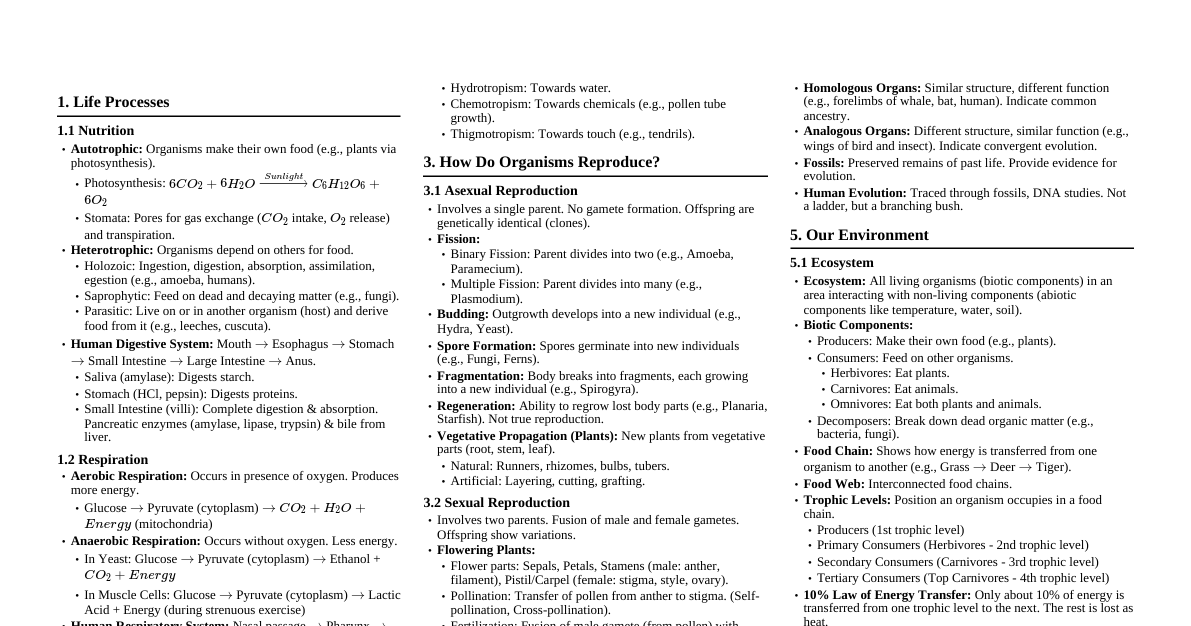
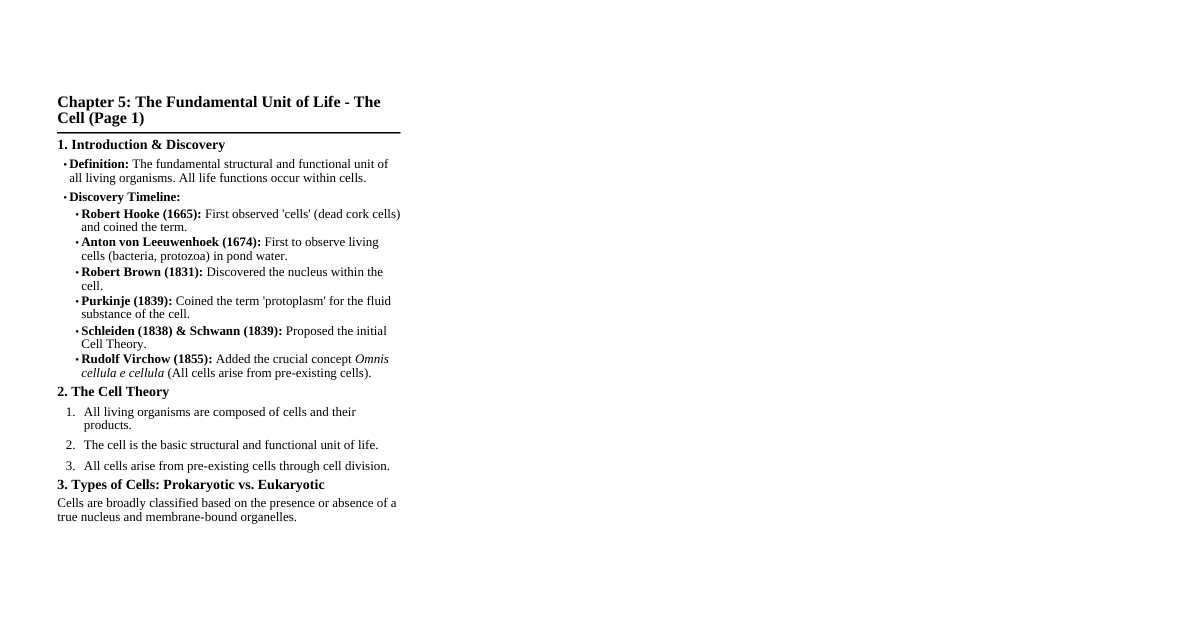
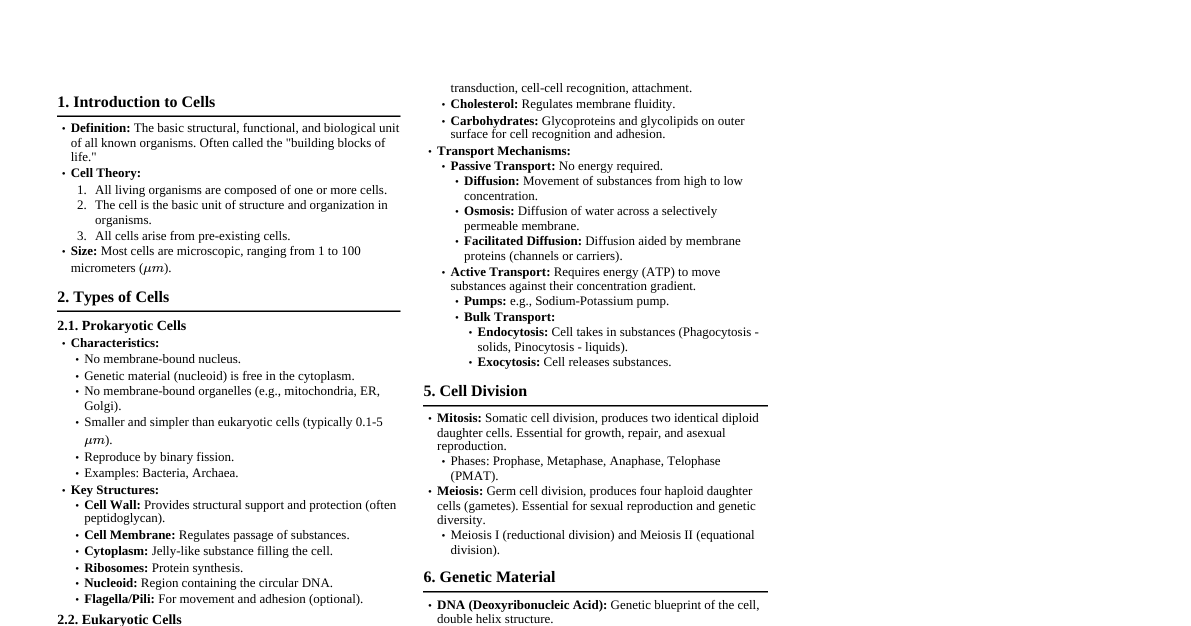
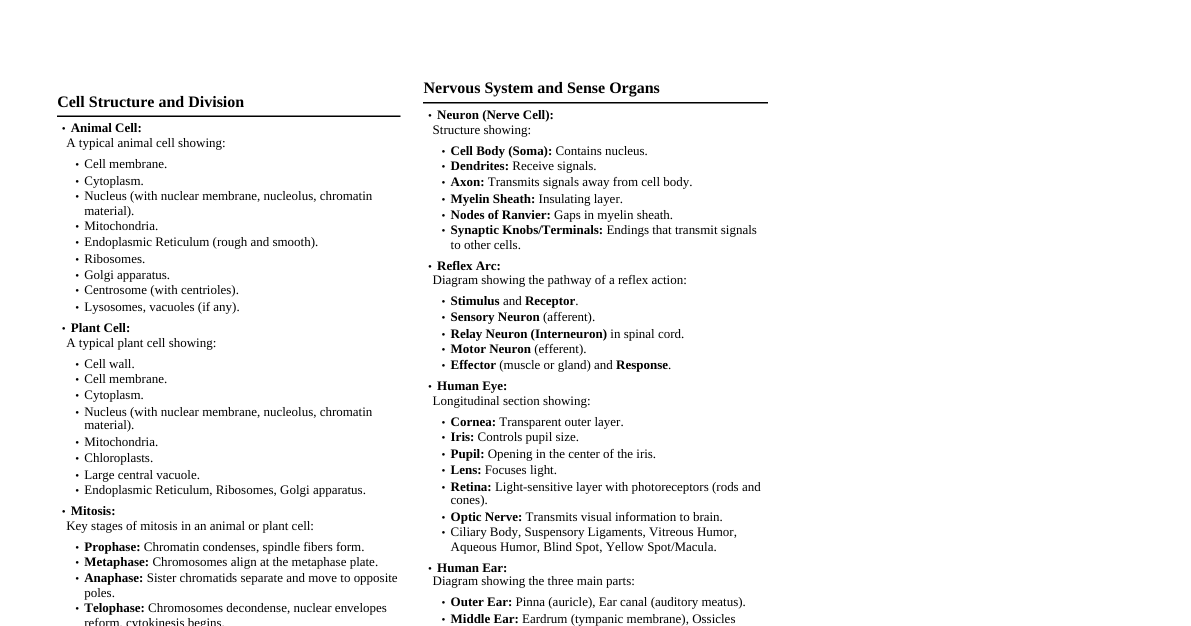
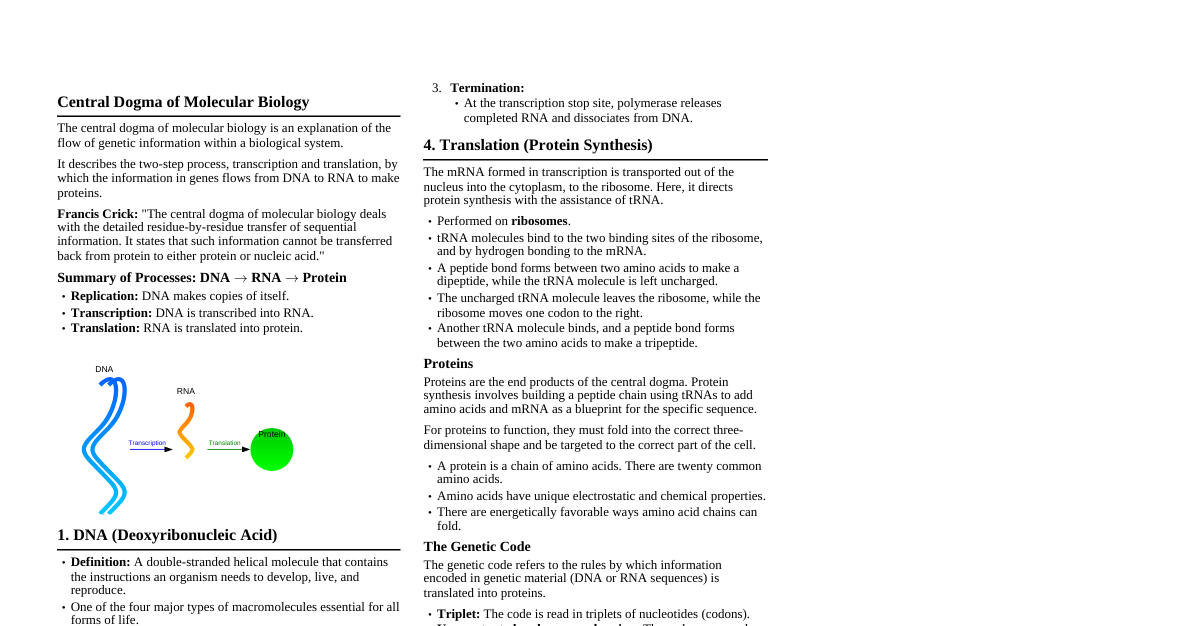
### Characteristics of Living Organisms Living things share seven key characteristics, often remembered by the acronym **MRS GREN**: - **M**ovement: Change in position. - **R**espiration: Chemical reactions that break down nutrient molecules to release energy for metabolism. - **S**ensitivity: Ability to detect and respond to stimuli (changes in the environment). - **G**rowth: Permanent increase in size and dry mass. - **R**eproduction: Processes that make more of the same kind of organism. - **E**xcretion: Removal of waste products of metabolism and toxic materials. - **N**utrition: Taking in of materials for energy, growth, and development. ### Classification Organisms are grouped based on similarities. The main groups (taxa) are: - **Kingdom** (e.g., Animals, Plants, Fungi, Prokaryotes, Protoctists) - **Phylum** - **Class** - **Order** - **Family** - **Genus** - **Species** (a group of organisms that can reproduce to produce fertile offspring). **Binomial system:** Each species has a unique two-part name (Genus species), e.g., *Homo sapiens*. ### Cells The basic unit of life. #### Animal Cell - **Cell membrane:** Controls what enters and leaves the cell. - **Cytoplasm:** Jelly-like substance where most chemical reactions happen. - **Nucleus:** Contains genetic material (DNA), controls cell activities. - **Mitochondria:** Where aerobic respiration occurs (releases energy). - **Ribosomes:** Site of protein synthesis. #### Plant Cell All of the above, plus: - **Cell wall:** Rigid outer layer made of cellulose, provides support. - **Chloroplasts:** Contain chlorophyll, site of photosynthesis. - **Vacuole:** Large central sac containing cell sap, maintains turgor pressure. #### Specialised Cells Cells are adapted for specific functions, e.g., root hair cells for absorption, red blood cells for oxygen transport. ### Diffusion, Osmosis & Active Transport - **Diffusion:** Net movement of particles from a region of higher concentration to a region of lower concentration (e.g., oxygen into cells). - **Osmosis:** Net movement of water molecules from a region of higher water potential to a region of lower water potential across a partially permeable membrane (e.g., water absorption by roots). - **Active Transport:** Movement of particles against a concentration gradient, using energy from respiration (e.g., mineral ion uptake by roots). ### Enzymes Biological catalysts (speed up reactions) made of protein. - **Specificity:** Each enzyme acts on a specific substrate due to its unique active site (lock and key model). - **Factors affecting activity:** - **Temperature:** Optimal temperature (usually around 37°C for human enzymes); high temperatures denature enzymes (active site changes shape). - **pH:** Optimal pH; extreme pH denatures enzymes. ### Plant Nutrition (Photosynthesis) Process by which plants make their own food using light energy. $$ \text{Carbon dioxide} + \text{Water} \xrightarrow{\text{light energy, chlorophyll}} \text{Glucose} + \text{Oxygen} $$ $$ 6CO_2 + 6H_2O \xrightarrow{\text{light energy, chlorophyll}} C_6H_{12}O_6 + 6O_2 $$ - **Chlorophyll:** Green pigment in chloroplasts that absorbs light energy. - **Factors affecting rate:** Light intensity, CO2 concentration, temperature. - **Uses of glucose:** Respiration, converted to starch for storage, cellulose for cell walls, proteins, fats. ### Human Nutrition #### Diet A balanced diet provides all necessary nutrients: - **Carbohydrates:** Energy (e.g., bread, pasta). - **Fats:** Energy, insulation, protection (e.g., oils, butter). - **Proteins:** Growth and repair (e.g., meat, fish, beans). - **Vitamins:** Small amounts needed for health (e.g., Vitamin C for immunity, D for bones). - **Minerals:** Small amounts needed (e.g., Calcium for bones, Iron for blood). - **Fibre (roughage):** Prevents constipation. - **Water:** Solvent, transport, temperature regulation. #### Digestion Breakdown of large insoluble food molecules into small soluble molecules. - **Mouth:** Mechanical digestion (chewing), chemical digestion (salivary amylase for starch). - **Oesophagus:** Peristalsis (wave-like muscle contractions) moves food. - **Stomach:** Mechanical digestion (churning), chemical digestion (protease for protein, HCl kills bacteria). - **Small Intestine:** Chemical digestion (amylase, protease, lipase), absorption of digested food into bloodstream. Villi increase surface area for absorption. - **Large Intestine:** Water absorption. - **Anus:** Egestion of undigested food. #### Liver functions Detoxification, production of bile, breakdown of hormones, storage of glycogen. ### Transport in Plants - **Xylem:** Transports water and mineral ions from roots to leaves (transpiration stream). - **Phloem:** Transports sugars (sucrose) from leaves to other parts of the plant (translocation). - **Transpiration:** Evaporation of water from leaves through stomata. Affected by temperature, humidity, wind, light intensity. ### Transport in Humans (Circulatory System) - **Heart:** Pumps blood around the body. Four chambers: right atrium, right ventricle, left atrium, left ventricle. - **Blood vessels:** - **Arteries:** Carry oxygenated blood away from the heart (thick, muscular walls, narrow lumen, high pressure). - **Veins:** Carry deoxygenated blood towards the heart (thin walls, wide lumen, low pressure, valves to prevent backflow). - **Capillaries:** Tiny vessels for exchange of substances between blood and cells (one-cell thick walls). - **Blood:** - **Red blood cells:** Transport oxygen (contain haemoglobin, no nucleus). - **White blood cells:** Fight infection (phagocytes engulf pathogens, lymphocytes produce antibodies). - **Platelets:** Blood clotting. - **Plasma:** Transports blood cells, nutrients, hormones, waste products. ### Respiration Process of releasing energy from food. - **Aerobic Respiration:** With oxygen. $$ \text{Glucose} + \text{Oxygen} \rightarrow \text{Carbon dioxide} + \text{Water} + \text{Energy} $$ $$ C_6H_{12}O_6 + 6O_2 \rightarrow 6CO_2 + 6H_2O + \text{Energy} $$ Occurs in mitochondria. Releases a large amount of energy. - **Anaerobic Respiration:** Without oxygen. - **In animals (e.g., during vigorous exercise):** $$ \text{Glucose} \rightarrow \text{Lactic acid} + \text{Energy} $$ Releases less energy, causes oxygen debt. - **In yeast (fermentation):** $$ \text{Glucose} \rightarrow \text{Ethanol} + \text{Carbon dioxide} + \text{Energy} $$ Used in bread making and alcohol production. ### Gas Exchange in Humans - Occurs in the **lungs**, specifically in the **alveoli**. - **Alveoli:** Tiny air sacs with thin walls, rich blood supply (capillaries), large surface area, moist surface – all adaptations for efficient gas exchange. - **Inhalation:** Diaphragm contracts and flattens, intercostal muscles contract, rib cage moves up and out, volume of thorax increases, pressure decreases, air rushes in. - **Exhalation:** Diaphragm relaxes and domes, intercostal muscles relax, rib cage moves down and in, volume of thorax decreases, pressure increases, air rushes out. ### Coordination and Response - **Nervous System:** - **Central Nervous System (CNS):** Brain and spinal cord. - **Peripheral Nervous System (PNS):** Nerves connecting CNS to rest of body. - **Reflex arc:** Stimulus $\rightarrow$ Receptor $\rightarrow$ Sensory neuron $\rightarrow$ Relay neuron (in CNS) $\rightarrow$ Motor neuron $\rightarrow$ Effector $\rightarrow$ Response. - **Synapse:** Gap between neurons where neurotransmitters transmit impulses. - **Hormonal System (Endocrine System):** - Glands secrete hormones (chemical messengers) into the blood. - Slower, longer-lasting effects than nervous system. - E.g., Insulin (pancreas) controls blood sugar, Adrenaline (adrenal glands) prepares body for 'fight or flight'. ### Homeostasis Maintenance of a constant internal environment. - **Blood glucose regulation:** Insulin lowers blood glucose, Glucagon raises it. - **Temperature regulation:** Sweating (cooling), shivering (warming), vasodilation/vasoconstriction. ### Reproduction #### Asexual Reproduction - One parent, no gametes, offspring are genetically identical (clones). - E.g., budding in yeast, runners in plants. #### Sexual Reproduction - Two parents, involves fusion of gametes, offspring show genetic variation. #### Human Reproduction - **Male:** Testes produce sperm and testosterone. - **Female:** Ovaries produce eggs (ova) and oestrogen, progesterone. - **Menstrual cycle:** Monthly cycle involving ovulation and preparation of uterus for pregnancy. - **Fertilisation:** Fusion of sperm and egg, usually in the oviduct. - **Gestation:** Development of embryo/foetus in uterus. Placenta provides nutrients and removes waste. #### Plant Reproduction - **Flower:** Reproductive organ. - **Stamen:** Male part (anther produces pollen, filament supports anther). - **Carpel/Pistil:** Female part (stigma receives pollen, style connects stigma to ovary, ovary contains ovules). - **Pollination:** Transfer of pollen from anther to stigma. - **Self-pollination:** Within same flower or plant. - **Cross-pollination:** Between different plants of same species. - **Agents:** Wind, insects. - **Fertilisation:** Pollen nucleus fuses with ovule nucleus. - **Seed dispersal:** Spreading of seeds away from parent plant (wind, animals, water, explosion). ### Inheritance - **Chromosomes:** Structures in nucleus carrying genetic information (DNA). - **Gene:** A section of DNA that codes for a specific protein, determining a characteristic. - **Allele:** Different forms of a gene (e.g., for height, tall or dwarf). - **Dominant allele:** Always expressed if present (represented by capital letter, e.g., T). - **Recessive allele:** Only expressed if two copies are present (represented by lowercase letter, e.g., t). - **Genotype:** Genetic makeup (e.g., TT, Tt, tt). - **Phenotype:** Observable characteristics (e.g., Tall, Dwarf). - **Homozygous:** Two identical alleles (e.g., TT, tt). - **Heterozygous:** Two different alleles (e.g., Tt). - **Punnett squares:** Used to predict offspring genotypes and phenotypes. - **Mutation:** A change in the genetic material (DNA). Can be spontaneous or caused by mutagens. ### Ecology Study of interactions between organisms and their environment. - **Ecosystem:** A community of organisms interacting with their physical environment. - **Food chain:** Shows feeding relationships (e.g., Grass $\rightarrow$ Rabbit $\rightarrow$ Fox). - **Producers:** Make their own food (e.g., plants). - **Consumers:** Obtain food by eating other organisms. - **Decomposers:** Break down dead organic matter (e.g., bacteria, fungi). - **Carbon cycle:** Movement of carbon through atmosphere, oceans, land, and living things. - **Nitrogen cycle:** Movement of nitrogen through atmosphere, soil, and living things. - **Human impact:** Deforestation, pollution (air, water, land), global warming, conservation.