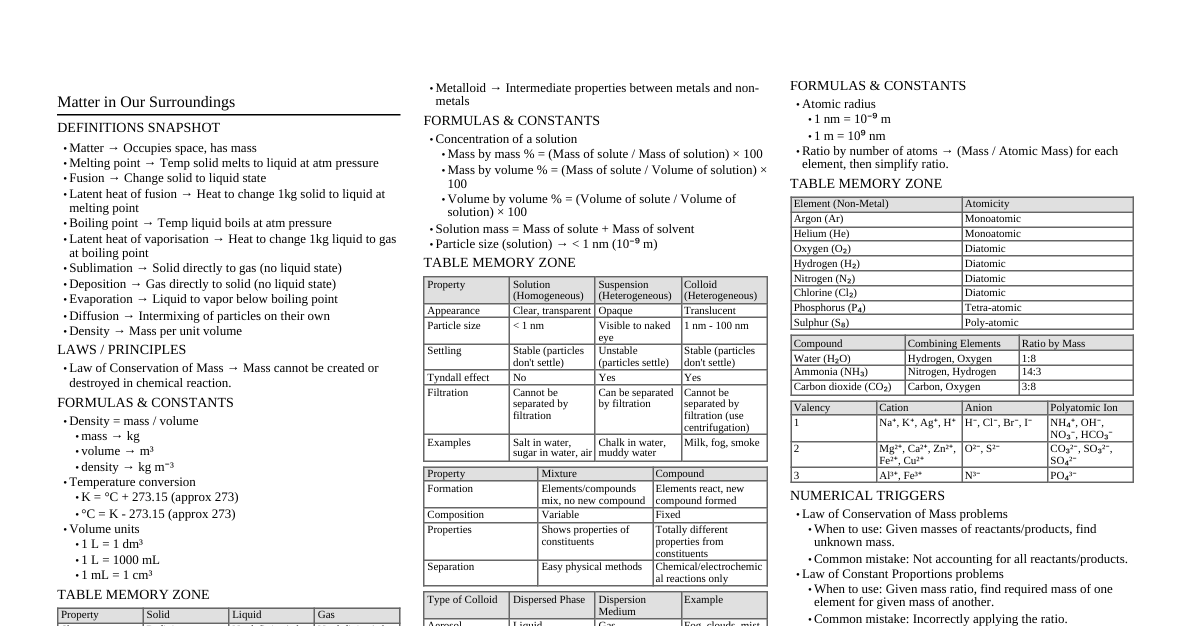
NEET Chemistry Cheatsheet
Cheatsheet Content
### Basic Concepts of Chemistry - **Mole Concept:** 1 mole = $6.022 \times 10^{23}$ particles = Gram Atomic/Molecular Mass. - **Molar Mass:** Sum of atomic masses of all atoms in a molecule. - **Percentage Composition:** $\% \text{Element} = (\frac{\text{Mass of element in compound}}{\text{Molar mass of compound}}) \times 100$. - **Empirical Formula:** Simplest whole number ratio of atoms in a compound. - **Molecular Formula:** Actual number of atoms of each element in a molecule. Molecular Formula = $n \times$ Empirical Formula. - **Stoichiometry:** Relates quantities of reactants and products in a chemical reaction. - **Limiting Reagent:** Reactant that is completely consumed and limits the amount of product formed. - **Molarity (M):** Moles of solute / Volume of solution (in L). - **Molality (m):** Moles of solute / Mass of solvent (in kg). - **Mole Fraction (X):** Moles of component / Total moles of all components. - **Mass Percentage:** $(\frac{\text{Mass of component}}{\text{Total mass of solution}}) \times 100$. ### Atomic Structure - **Bohr's Model:** - Energy of electron in $n^{th}$ orbit: $E_n = -13.6 \frac{Z^2}{n^2}$ eV. - Radius of $n^{th}$ orbit: $r_n = 0.529 \frac{n^2}{Z}$ Å. - **Quantum Numbers:** - **Principal (n):** Shell, energy, size ($1, 2, 3, ...$). - **Azimuthal (l):** Subshell, shape ($0$ to $n-1$; $s, p, d, f$). - **Magnetic ($m_l$):** Orientation ($-l$ to $+l$). - **Spin ($m_s$):** Electron spin ($+1/2, -1/2$). - **Heisenberg's Uncertainty Principle:** $\Delta x \cdot \Delta p \ge \frac{h}{4\pi}$. - **De Broglie Wavelength:** $\lambda = \frac{h}{mv}$. - **Aufbau Principle:** Electrons fill lowest energy orbitals first. - **Pauli's Exclusion Principle:** No two electrons can have all four quantum numbers same. - **Hund's Rule:** Orbitals of same energy are first singly occupied before pairing. ### Classification of Elements & Periodicity - **Periodic Law:** Properties of elements are periodic functions of their atomic numbers. - **Atomic Radius:** Decreases across a period, increases down a group. - **Ionic Radius:** Cations are smaller, anions are larger than parent atoms. - **Ionization Enthalpy:** Energy required to remove an electron. Increases across a period, decreases down a group. - **Electron Gain Enthalpy:** Energy released when an electron is added. Generally increases across a period (more negative), decreases down a group. - **Electronegativity:** Tendency of an atom to attract shared electrons. Increases across a period, decreases down a group. - **Metallic Character:** Decreases across a period, increases down a group. ### Chemical Bonding & Molecular Structure - **Lewis Structures:** Representation of valence electrons using dots. - **Octet Rule:** Atoms tend to gain, lose or share electrons to achieve 8 valence electrons. - **Formal Charge:** $FC = (\text{Valence e}^-) - (\text{Non-bonding e}^-) - (\frac{1}{2} \text{Bonding e}^-)$. - **Bond Parameters:** Bond length, bond angle, bond enthalpy, bond order. - **VSEPR Theory:** Explains molecular geometry based on repulsion between electron pairs. - **Hybridization:** Mixing of atomic orbitals to form new hybrid orbitals (e.g., $sp, sp^2, sp^3$). - **Molecular Orbital Theory (MOT):** - Bond Order = $\frac{1}{2} (\text{Number of electrons in bonding MO} - \text{Number of electrons in anti-bonding MO})$. - Explains paramagnetism/diamagnetism. - **Hydrogen Bonding:** Strong dipole-dipole interaction involving H and highly electronegative atoms (F, O, N). ### States of Matter - **Gas Laws:** - **Boyle's Law:** $P_1V_1 = P_2V_2$ (at constant T, n). - **Charles's Law:** $\frac{V_1}{T_1} = \frac{V_2}{T_2}$ (at constant P, n). - **Gay-Lussac's Law:** $\frac{P_1}{T_1} = \frac{P_2}{T_2}$ (at constant V, n). - **Avogadro's Law:** $\frac{V_1}{n_1} = \frac{V_2}{n_2}$ (at constant T, P). - **Ideal Gas Equation:** $PV = nRT$. - **Dalton's Law of Partial Pressures:** $P_{total} = P_1 + P_2 + ...$ - **Kinetic Molecular Theory of Gases:** - Average Kinetic Energy: $KE_{avg} = \frac{3}{2} RT$. - Root Mean Square Velocity: $u_{rms} = \sqrt{\frac{3RT}{M}}$. - **Van der Waals Equation (Real Gases):** $(P + \frac{an^2}{V^2})(V - nb) = nRT$. - **Liquid State:** Vapor pressure, surface tension, viscosity. - **Solid State:** Crystalline vs. Amorphous solids. Unit cells, packing efficiency. ### Thermodynamics - **First Law:** $\Delta U = Q + W$ (Internal Energy = Heat + Work). - **Work done (expansion):** $W = -P_{ext} \Delta V$. - **Enthalpy (H):** $H = U + PV$. $\Delta H = Q_p$ (at constant P). - **Heat Capacity:** $C = \frac{q}{\Delta T}$. $C_p - C_v = R$. - **Hess's Law:** Enthalpy change for a reaction is independent of the path. - **Standard Enthalpies:** Formation, combustion, neutralization. - **Second Law:** $\Delta S_{total} = \Delta S_{system} + \Delta S_{surroundings} > 0$ for spontaneous process. - **Gibbs Free Energy (G):** $G = H - TS$. - $\Delta G = \Delta H - T\Delta S$. - $\Delta G 0$: Non-spontaneous. - $\Delta G = 0$: Equilibrium. - $\Delta G^\circ = -RT \ln K_{eq}$. ### Equilibrium - **Law of Chemical Equilibrium:** For $aA + bB \rightleftharpoons cC + dD$, $K_c = \frac{[C]^c[D]^d}{[A]^a[B]^b}$. - **Relation between $K_p$ and $K_c$:** $K_p = K_c (RT)^{\Delta n_g}$. - **Le Chatelier's Principle:** A system at equilibrium will counteract a stress. - **Ionic Equilibrium:** - **Acids and Bases:** Arrhenius, Brønsted-Lowry, Lewis concepts. - **pH Scale:** $pH = -\log[H^+]$. $pH + pOH = 14$. - **Dissociation Constants:** $K_a$ (acids), $K_b$ (bases). $K_w = K_a \times K_b = 10^{-14}$. - **Hydrolysis of Salts:** Salts of strong acid/weak base, weak acid/strong base, weak acid/weak base. - **Buffer Solutions:** Resist change in pH upon addition of small amounts of acid/base. - Henderson-Hasselbalch Equation: $pH = pK_a + \log \frac{[\text{Salt}]}{[\text{Acid}]}$. - **Solubility Product ($K_{sp}$):** Product of ion concentrations in a saturated solution. ### Redox Reactions - **Oxidation:** Loss of electrons, increase in oxidation number. - **Reduction:** Gain of electrons, decrease in oxidation number. - **Oxidizing Agent:** Causes oxidation, gets reduced. - **Reducing Agent:** Causes reduction, gets oxidized. - **Balancing Redox Reactions:** Oxidation number method or half-reaction method. ### Electrochemistry - **Electrochemical Cell:** Converts chemical energy to electrical energy. - **Electrolytic Cell:** Converts electrical energy to chemical energy. - **Standard Electrode Potential ($E^\circ$):** Potential of an electrode under standard conditions. - **Nernst Equation:** $E = E^\circ - \frac{0.0591}{n} \log Q$ (at 298 K). - **Gibbs Free Energy and Cell Potential:** $\Delta G^\circ = -nFE^\circ_{cell}$. - **Faraday's Laws of Electrolysis:** - **First Law:** Mass deposited $\propto$ Quantity of electricity. - **Second Law:** For same quantity of electricity, mass deposited $\propto$ Equivalent weight. - 1 Faraday ($F$) = 96485 C/mol. - **Conductivity:** $\kappa = G \times \frac{l}{A}$. - **Molar Conductivity ($\Lambda_m$):** $\Lambda_m = \frac{\kappa \times 1000}{Molarity}$. - **Kohlrausch's Law:** At infinite dilution, $\Lambda^\circ_m = x\lambda^\circ_A + y\lambda^\circ_B$. ### Chemical Kinetics - **Rate of Reaction:** Change in concentration of reactant/product per unit time. - **Rate Law:** Rate $= k[A]^x[B]^y$. - **Order of Reaction:** Sum of powers of concentration terms in rate law ($x+y$). - **Molecularity:** Number of reacting species in an elementary step. - **Integrated Rate Equations:** - **Zero Order:** $[A]_t = [A]_0 - kt$. Half-life ($t_{1/2}$) = $\frac{[A]_0}{2k}$. - **First Order:** $\ln[A]_t = \ln[A]_0 - kt$. Half-life ($t_{1/2}$) = $\frac{0.693}{k}$. - **Arrhenius Equation:** $k = A e^{-E_a/RT}$. $\ln \frac{k_2}{k_1} = \frac{E_a}{R} (\frac{1}{T_1} - \frac{1}{T_2})$. - **Activation Energy ($E_a$):** Minimum energy required for a reaction to occur. ### Surface Chemistry - **Adsorption:** Accumulation of molecular species at the surface. - **Physisorption:** Weak van der Waals forces, reversible. - **Chemisorption:** Chemical bond formation, irreversible. - **Catalysis:** Substance that alters the rate of reaction without being consumed. - **Homogeneous:** Catalyst and reactants in same phase. - **Heterogeneous:** Catalyst and reactants in different phases. - **Colloids:** Heterogeneous systems with particle size 1 nm - 1000 nm. - **Types:** Sol, emulsion, foam, gel etc. - **Properties:** Tyndall effect, Brownian movement, electrophoresis, coagulation. ### Hydrogen - **Isotopes:** Protium ($^1H$), Deuterium ($^2H$ or D), Tritium ($^3H$ or T). - **Preparation:** Electrolysis of water, reaction of metals with acid/water. - **Properties:** Reducing agent, forms hydrides. - **Heavy Water (D$_2$O):** Used as moderator in nuclear reactors. ### s-Block Elements - **Group 1 (Alkali Metals):** Li, Na, K, Rb, Cs, Fr. Highly reactive, form +1 ions, soft metals. - **Group 2 (Alkaline Earth Metals):** Be, Mg, Ca, Sr, Ba, Ra. Reactive, form +2 ions, harder metals. - **Trends:** - Atomic/ionic radii increase down the group. - Ionization enthalpy decreases down the group. - Metallic character increases down the group. - Reactivity increases down the group. - **Important Compounds:** NaOH, NaHCO$_3$, Na$_2$CO$_3$, CaO, CaCO$_3$, CaSO$_4 \cdot \frac{1}{2}H_2O$ (Plaster of Paris). ### p-Block Elements - **Group 13 (Boron Family):** B, Al, Ga, In, Tl. Oxidation states +3. - **Boron:** Non-metal, forms electron-deficient compounds (e.g., BF$_3$, Diborane B$_2$H$_6$). - **Aluminium:** Metal, amphoteric oxide. - **Group 14 (Carbon Family):** C, Si, Ge, Sn, Pb. Oxidation states +4, +2. - **Carbon:** Allotropes (diamond, graphite, fullerenes). Catenation. - **Silicon:** Forms silicates, silicones. - **Group 15 (Nitrogen Family):** N, P, As, Sb, Bi. Oxidation states -3 to +5. - **Nitrogen:** Forms N$_2$ (inert), NH$_3$, HNO$_3$. - **Phosphorus:** Allotropes (white, red, black). Forms PCl$_3$, PCl$_5$, H$_3$PO$_4$. - **Group 16 (Oxygen Family/Chalcogens):** O, S, Se, Te, Po. Oxidation states -2 to +6. - **Oxygen:** O$_2$, O$_3$ (ozone). - **Sulphur:** Allotropes (rhombic, monoclinic). Forms SO$_2$, H$_2$SO$_4$. - **Group 17 (Halogens):** F, Cl, Br, I, At. Highly reactive non-metals, form -1 ions. - **Trends:** Electronegativity decreases down the group. Oxidizing power decreases down the group. - **Important Compounds:** HCl, Interhalogen compounds. - **Group 18 (Noble Gases):** He, Ne, Ar, Kr, Xe, Rn. Inert, full octet. - **Xenon Compounds:** XeF$_2$, XeF$_4$, XeF$_6$. ### d- and f-Block Elements - **d-Block (Transition Elements):** - High melting/boiling points, variable oxidation states, form colored ions, paramagnetic, good catalysts. - **Lanthanoid Contraction:** Poor shielding by 4f electrons leads to decrease in atomic/ionic radii from La to Lu. - **f-Block (Inner Transition Elements):** - **Lanthanoids:** Ce to Lu. +3 oxidation state common. - **Actinoids:** Th to Lr. Show higher range of oxidation states, radioactive. ### Coordination Compounds - **Ligands:** Electron pair donors. Types: monodentate, bidentate, polydentate. - **Coordination Number:** Number of ligand donor atoms bonded to central metal ion. - **Oxidation State:** Charge on the central metal ion. - **Nomenclature:** IUPAC rules for naming complexes. - **Isomerism:** - **Structural Isomerism:** Linkage, coordination, ionization, hydrate. - **Stereoisomerism:** Geometrical (cis/trans), Optical (enantiomers). - **Valence Bond Theory (VBT):** Explains bonding, geometry, and magnetic properties using hybridization. - **Crystal Field Theory (CFT):** Explains bonding and color based on crystal field splitting. - $\Delta_o$ (octahedral), $\Delta_t$ (tetrahedral). - Pairing energy vs. Crystal Field Stabilization Energy (CFSE). ### Organic Chemistry: Basic Principles & Techniques - **Hybridization:** $sp^3$ (single bond, tetrahedral), $sp^2$ (double bond, trigonal planar), $sp$ (triple bond, linear). - **Homologous Series:** Series of compounds with same functional group, differing by -CH$_2$ unit. - **Nomenclature:** IUPAC rules for naming organic compounds. - **Isomerism:** - **Structural:** Chain, position, functional, metamerism, tautomerism. - **Stereoisomerism:** Geometrical (cis-trans), Optical (enantiomers, diastereomers). - **Electronic Effects:** - **Inductive Effect (+I, -I):** Electron displacement along a sigma bond. - **Resonance Effect (+R, -R) / Mesomeric Effect:** Delocalization of pi electrons. - **Hyperconjugation:** Delocalization of sigma electrons (no bond resonance). - **Reaction Intermediates:** Carbocations, Carbanions, Free Radicals (stability order). - **Types of Reactions:** Substitution, Addition, Elimination, Rearrangement. ### Hydrocarbons - **Alkanes:** Saturated, C-C single bonds. General formula C$_n$H$_{2n+2}$. - **Reactions:** Free radical substitution (halogenation). - **Alkenes:** Unsaturated, C=C double bond. General formula C$_n$H$_{2n}$. - **Reactions:** Electrophilic addition (Markovnikov's rule, anti-Markovnikov's rule), ozonolysis. - **Alkynes:** Unsaturated, C≡C triple bond. General formula C$_n$H$_{2n-2}$. - **Reactions:** Electrophilic addition, acidic nature of terminal alkynes. - **Aromatic Hydrocarbons (Benzene):** - **Structure:** Planar, cyclic, conjugated, (4n+2) pi electrons (Hückel's Rule). - **Reactions:** Electrophilic Aromatic Substitution (nitration, halogenation, sulfonation, Friedel-Crafts alkylation/acylation). - **Directing Groups:** Ortho-para directors (+R, +I), Meta directors (-R, -I). ### Haloalkanes & Haloarenes - **Haloalkanes:** R-X (alkyl halides). - **Preparation:** Alcohols + HX, Alkenes + HX/X$_2$, Free radical halogenation. - **Reactions:** - **Nucleophilic Substitution (S$_N$1, S$_N$2):** - S$_N$1: Carbocation intermediate, 3° > 2° > 1°, racemization. - S$_N$2: Concerted, 1° > 2° > 3°, inversion of configuration. - **Elimination (E1, E2):** Saytzeff's rule. - Wurtz reaction, Grignard reagents. - **Haloarenes:** Ar-X (aryl halides). - Less reactive towards nucleophilic substitution due to resonance. - Show Electrophilic Aromatic Substitution (halogenation, nitration, etc.). ### Alcohols, Phenols & Ethers - **Alcohols (R-OH):** - **Preparation:** From alkenes (hydration), carbonyl compounds (reduction), Grignard reagents. - **Reactions:** Oxidation, dehydration, esterification, reaction with Na. - **Acidity:** Primary ### Aldehydes, Ketones & Carboxylic Acids - **Aldehydes (R-CHO) & Ketones (R-CO-R'):** - **Preparation:** Oxidation of alcohols, ozonolysis of alkenes. - **Reactions:** - **Nucleophilic Addition:** Reactivity: Aldehydes > Ketones. - **Aldol Condensation:** α-hydrogens required. - **Cannizzaro Reaction:** No α-hydrogens. - **Reduction:** To alcohols, Clemmensen, Wolff-Kishner. - Test: Tollen's (silver mirror), Fehling's. - **Carboxylic Acids (R-COOH):** - **Preparation:** Oxidation of alcohols/aldehydes, Grignard reagents. - **Reactions:** Esterification, reduction, HVZ reaction. - **Acidity:** More acidic than phenols. Electron-withdrawing groups increase acidity. ### Amines - **Classification:** Primary (1°), Secondary (2°), Tertiary (3°). - **Preparation:** Reduction of nitro compounds, nitriles, amides (Hofmann bromamide degradation). - **Reactions:** Basicity (gas phase: 3° > 2° > 1° > NH$_3$; aqueous: 2° > 1° > 3° > NH$_3$), acylation, carbylamine reaction, Hinsberg test. - **Diazonium Salts (Ar-N$_2^+$X$^-$):** Important intermediates for preparing substituted aromatic compounds. ### Biomolecules - **Carbohydrates:** Glucose, Fructose, Sucrose, Starch, Cellulose. - **Monosaccharides:** Glucose, fructose. - **Disaccharides:** Sucrose (glucose + fructose), Lactose (glucose + galactose), Maltose (glucose + glucose). - **Polysaccharides:** Starch, Cellulose, Glycogen. - **Proteins:** Polymers of α-amino acids. - **Peptide bond:** -CO-NH-. - **Structure:** Primary, Secondary (α-helix, β-pleated sheet), Tertiary, Quaternary. - **Denaturation:** Loss of biological activity due to change in 3D structure. - **Vitamins:** Organic compounds required in small amounts for good health. - **Fat-soluble:** A, D, E, K. - **Water-soluble:** B, C. - **Nucleic Acids:** DNA, RNA. Polymers of nucleotides (sugar + base + phosphate). - **DNA:** Double helix, A-T, G-C pairing. - **RNA:** Single strand, A-U, G-C pairing. - **Hormones:** Chemical messengers. ### Polymers - **Monomers:** Repeating units forming polymers. - **Classification:** Addition vs. Condensation, Natural vs. Synthetic. - **Addition Polymers:** Polyethylene, Polypropylene, PVC, Teflon, Buna-S, Buna-N. - **Condensation Polymers:** Nylon-6,6, Nylon-6, Polyesters (Dacron), Bakelite, Melamine. - **Biodegradable Polymers:** PHBV, Nylon 2-Nylon 6. ### Chemistry in Everyday Life - **Drugs:** Analgesics, Antiseptics, Disinfectants, Antibiotics, Antihistamines, Antacids, Tranquilizers. - **Food Preservatives:** Sodium benzoate. - **Artificial Sweetening Agents:** Saccharin, Aspartame, Sucralose. - **Soaps and Detergents:** Cleansing action. ### Environmental Chemistry - **Atmospheric Pollution:** Tropospheric (smog, acid rain) and Stratospheric (ozone depletion). - **Water Pollution:** BOD (Biological Oxygen Demand), Eutrophication. - **Soil Pollution:** Pesticides, industrial wastes. - **Green Chemistry:** Sustainable chemical processes.