Geometry Cheatsheet
Cheatsheet Content
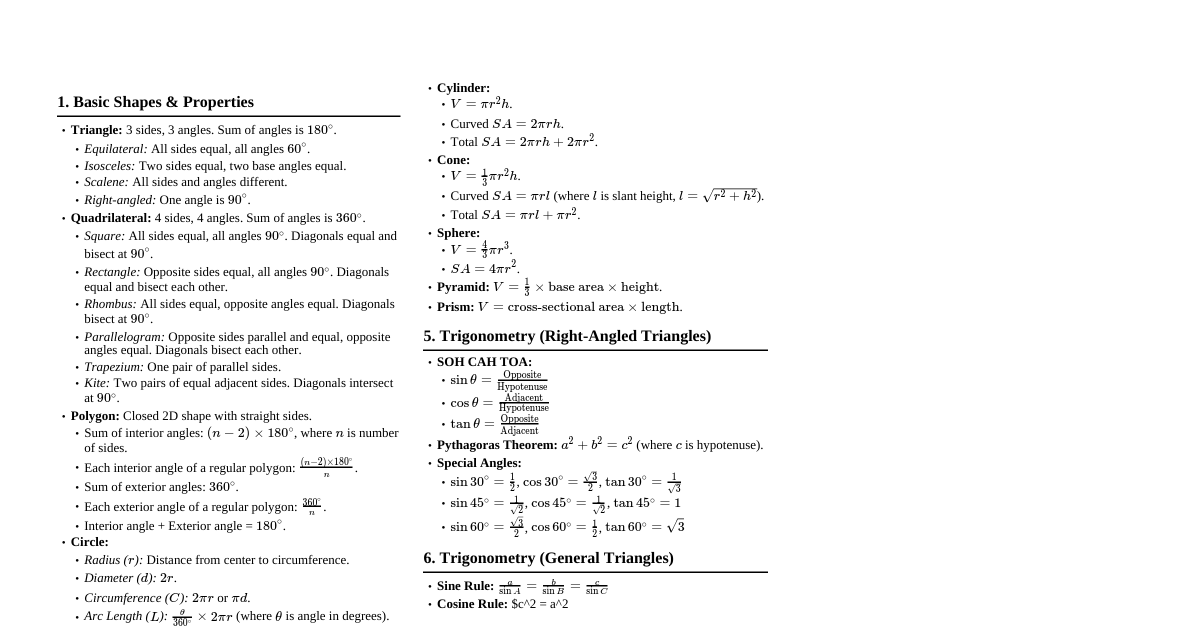
### Defined and Undefined Terms - **Undefined Terms:** Basic concepts that are accepted without formal definition. These include: - **Point:** A location with no size or dimension. Represented by a dot. - **Line:** A straight path that extends infinitely in two opposite directions. Has no thickness. - **Plane:** A flat surface that extends infinitely in all directions. Has no thickness. - **Defined Terms:** Concepts built upon undefined terms and other defined terms. Examples include: - **Space:** The set of all points. - **Collinear Points:** Points that lie on the same line. - **Coplanar Points/Lines:** Points or lines that lie on the same plane. ### Points, Lines, and Planes - **Point:** - Represented by a capital letter (e.g., Point A). - Has no dimension. - **Line:** - Represented by two capital letters (e.g., $\vec{AB}$) or a lowercase script letter (e.g., line $l$). - Contains infinitely many points. - Only one line passes through any two distinct points. - **Plane:** - Represented by three non-collinear points (e.g., Plane ABC) or a capital script letter (e.g., Plane $P$). - Contains infinitely many lines and points. - Only one plane passes through any three non-collinear points. - **Intersection:** - The intersection of two lines is a point. - The intersection of two planes is a line. - The intersection of a line and a plane (not containing the line) is a point. ### Subsets of a Line - **Line Segment:** - Part of a line with two distinct endpoints. - Denoted as $\overline{AB}$. - Includes all points between A and B, plus A and B. - **Ray:** - Part of a line with one endpoint and extending infinitely in one direction. - Denoted as $\vec{AB}$ (starting at A, going through B). - The endpoint is always written first. - **Opposite Rays:** - Two rays that share a common endpoint and form a line. - E.g., $\vec{CA}$ and $\vec{CB}$ are opposite rays if C is between A and B. - **Midpoint of a Segment:** - The point that divides a segment into two congruent segments. - If M is the midpoint of $\overline{AB}$, then $AM = MB$. - **Segment Bisector:** - A line, ray, segment, or plane that intersects a segment at its midpoint. ### Types of Angles - **Angle:** Formed by two rays sharing a common endpoint (vertex). - Denoted as $\angle ABC$, $\angle B$, or $\angle 1$. - **Vertex:** The common endpoint of the two rays. - **Sides:** The two rays forming the angle. - **Angle Measurement:** Measured in degrees ($^\circ$) or radians. - **Types of Angles:** - **Acute Angle:** $0^\circ ### Relationships of Geometric Figures and Angle Pairs - **Adjacent Angles:** Two angles that share a common vertex and a common side, but no common interior points. - **Vertical Angles:** Two non-adjacent angles formed by two intersecting lines. They are always congruent. - If lines $l$ and $m$ intersect, $\angle 1$ and $\angle 3$ are vertical angles; $\angle 2$ and $\angle 4$ are vertical angles. - $\angle 1 \cong \angle 3$ and $\angle 2 \cong \angle 4$. - **Linear Pair:** Two adjacent angles that form a straight line (their non-common sides are opposite rays). Their measures sum to $180^\circ$. - If $\angle 1$ and $\angle 2$ form a linear pair, then $m\angle 1 + m\angle 2 = 180^\circ$. - **Complementary Angles:** Two angles whose measures sum to $90^\circ$. They can be adjacent or non-adjacent. - **Supplementary Angles:** Two angles whose measures sum to $180^\circ$. They can be adjacent or non-adjacent. - **Perpendicular Lines:** Two lines that intersect to form four right angles. Denoted by $\perp$. - If $l \perp m$, then all angles formed at their intersection are $90^\circ$. ### Relationships of Angles Formed by Parallel Lines Cut by a Transversal Line - **Parallel Lines:** Two lines in the same plane that never intersect. Denoted by $\parallel$. - **Transversal Line:** A line that intersects two or more other lines. - When a transversal intersects two parallel lines, special angle relationships are formed: - **Corresponding Angles:** Angles in the same position at each intersection. They are congruent. ($m\angle 1 = m\angle 5$, $m\angle 2 = m\angle 6$, $m\angle 3 = m\angle 7$, $m\angle 4 = m\angle 8$) - *Example:* $\angle 1$ and $\angle 5$. - **Alternate Interior Angles:** Angles between the parallel lines on opposite sides of the transversal. They are congruent. ($m\angle 3 = m\angle 6$, $m\angle 4 = m\angle 5$) - *Example:* $\angle 3$ and $\angle 6$. - **Alternate Exterior Angles:** Angles outside the parallel lines on opposite sides of the transversal. They are congruent. ($m\angle 1 = m\angle 8$, $m\angle 2 = m\angle 7$) - *Example:* $\angle 1$ and $\angle 8$. - **Consecutive Interior Angles (Same-Side Interior Angles):** Angles between the parallel lines on the same side of the transversal. They are supplementary. ($m\angle 3 + m\angle 5 = 180^\circ$, $m\angle 4 + m\angle 6 = 180^\circ$) - *Example:* $\angle 3$ and $\angle 5$. - **Consecutive Exterior Angles (Same-Side Exterior Angles):** Angles outside the parallel lines on the same side of the transversal. They are supplementary. ($m\angle 1 + m\angle 7 = 180^\circ$, $m\angle 2 + m\angle 8 = 180^\circ$) - *Example:* $\angle 1$ and $\angle 7$. ### Polygons - **Definition:** A closed plane figure formed by three or more line segments (sides) that intersect only at their endpoints (vertices). - **Not Polygons:** Figures with curves, open figures, or segments intersecting at non-endpoints. - **Classification by Number of Sides:** - 3 sides: Triangle - 4 sides: Quadrilateral - 5 sides: Pentagon - 6 sides: Hexagon - 7 sides: Heptagon - 8 sides: Octagon - 9 sides: Nonagon - 10 sides: Decagon - 12 sides: Dodecagon - n sides: n-gon - **Convex Polygon:** A polygon where no line segment connecting two points in the interior of the polygon goes outside the polygon. All interior angles are less than $180^\circ$. - **Concave Polygon:** A polygon where at least one line segment connecting two points in the interior of the polygon goes outside the polygon. Has at least one interior angle greater than $180^\circ$ (a reflex angle). - **Regular Polygon:** A polygon that is both equilateral (all sides congruent) and equiangular (all angles congruent). - **Diagonal:** A segment connecting two non-consecutive vertices of a polygon. - Number of diagonals in an n-gon: $D = \frac{n(n-3)}{2}$. ### Exterior and Interior Angles of Convex Polygons - **Interior Angle:** An angle inside a polygon formed by two adjacent sides. - **Exterior Angle:** An angle formed by one side of a polygon and the extension of an adjacent side. An interior angle and its corresponding exterior angle form a linear pair (sum to $180^\circ$). - **Sum of Interior Angles of a Convex n-gon:** - $S_I = (n - 2) \times 180^\circ$ - **Measure of One Interior Angle of a Regular n-gon:** - $I = \frac{(n - 2) \times 180^\circ}{n}$ - **Sum of Exterior Angles of any Convex Polygon:** - $S_E = 360^\circ$ - **Measure of One Exterior Angle of a Regular n-gon:** - $E = \frac{360^\circ}{n}$ - Note: $I + E = 180^\circ$ for any regular polygon. ### Circles and Their Parts/Terms - **Circle:** The set of all points in a plane that are equidistant from a given point (the center). - **Center:** The central point of the circle (e.g., Point C). - **Radius (r):** A segment connecting the center to any point on the circle. All radii in the same circle are congruent. - **Chord:** A segment whose endpoints are on the circle. - **Diameter (d):** A chord that passes through the center of the circle. It is the longest chord. $d = 2r$. - **Secant Line:** A line that intersects a circle at two points. - **Tangent Line:** A line in the plane of a circle that intersects the circle at exactly one point, called the point of tangency. A tangent line is perpendicular to the radius at the point of tangency. - **Arc:** A continuous portion of a circle. - **Minor Arc:** An arc whose measure is less than $180^\circ$. Named by two endpoints (e.g., $\stackrel{\frown}{AB}$). - **Major Arc:** An arc whose measure is greater than $180^\circ$. Named by three points (e.g., $\stackrel{\frown}{ACB}$). - **Semicircle:** An arc whose measure is exactly $180^\circ$. Named by three points. - **Central Angle:** An angle whose vertex is the center of the circle and whose sides are radii. The measure of a central angle is equal to the measure of its intercepted arc. - **Inscribed Angle:** An angle whose vertex is on the circle and whose sides are chords. The measure of an inscribed angle is half the measure of its intercepted arc. - If $\angle ABC$ is inscribed in circle $O$, then $m\angle ABC = \frac{1}{2} m\stackrel{\frown}{AC}$. - **Tangent Segment:** A segment of a tangent line from an external point to the point of tangency. - Two tangent segments from the same external point to a circle are congruent. - **Circumference (C):** The distance around the circle. - $C = 2\pi r$ or $C = \pi d$. - **Area of a Circle (A):** - $A = \pi r^2$.