Mechanical Properties of Solid
Cheatsheet Content
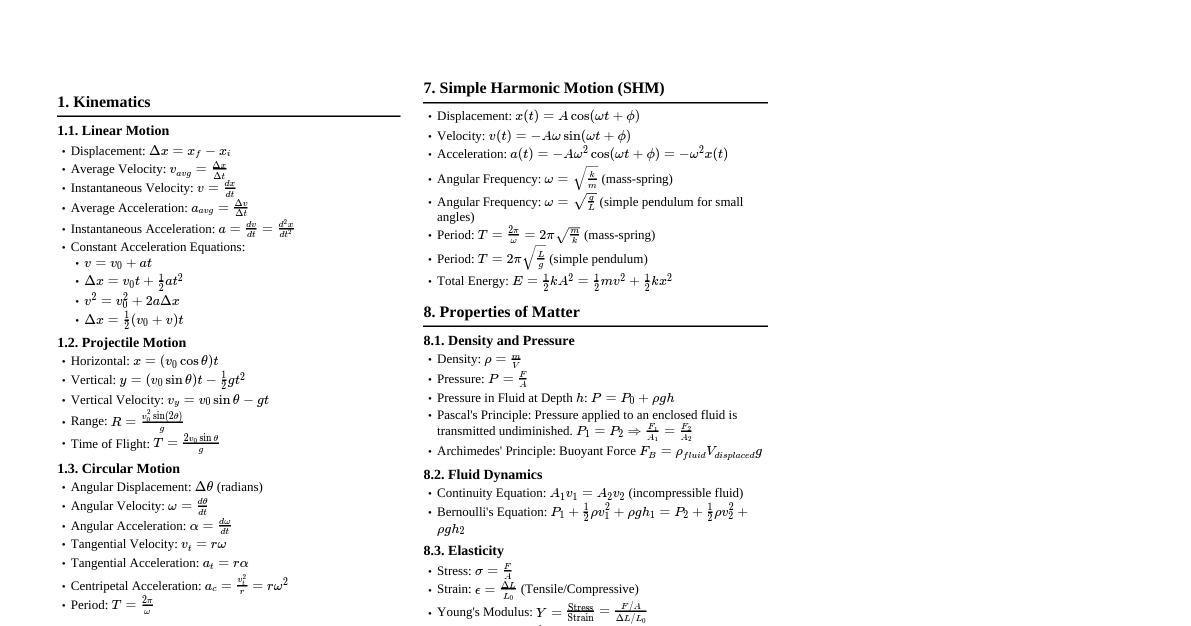
### Introduction Solids are materials with definite shape and volume. Their mechanical properties describe how they respond to applied forces. Key concepts include elasticity, plasticity, stress, and strain. ### Elasticity and Plasticity - **Elasticity:** The property of a material to regain its original shape and size after the deforming force is removed. - **Elastic Limit:** The maximum stress a material can withstand without undergoing permanent deformation. - **Plasticity:** The property of a material to undergo permanent deformation even after the deforming force is removed. ### Stress ($\sigma$) - **Definition:** The internal restoring force per unit area exerted by a body when deformed. - **Formula:** $$\sigma = \frac{F}{A}$$ - $F$: Applied force - $A$: Cross-sectional area - **SI Unit:** Pascal (Pa) or N/m$^2$ - **Types of Stress:** - **Longitudinal Stress:** Normal stress acting along the length of the body. - **Tensile Stress:** When length increases. - **Compressive Stress:** When length decreases. - **Shearing Stress (Tangential Stress):** Stress parallel to the surface. - **Volume Stress (Hydraulic Stress):** Normal stress acting uniformly over the entire surface of a body, usually due to fluid pressure. ### Strain ($\epsilon$) - **Definition:** The ratio of the change in configuration to the original configuration. It is a dimensionless quantity. - **Types of Strain:** - **Longitudinal Strain:** $$\epsilon_L = \frac{\Delta L}{L}$$ - $\Delta L$: Change in length - $L$: Original length - **Shearing Strain:** $$\epsilon_S = \frac{\Delta x}{L} = \tan \theta \approx \theta$$ - $\Delta x$: Relative displacement of parallel layers - $L$: Distance between layers - $\theta$: Shear angle - **Volume Strain:** $$\epsilon_V = \frac{\Delta V}{V}$$ - $\Delta V$: Change in volume - $V$: Original volume ### Hooke's Law - **Statement:** Within the elastic limit, stress is directly proportional to strain. - **Formula:** $$\sigma \propto \epsilon \implies \sigma = E \epsilon$$ - $E$: Modulus of Elasticity (constant of proportionality) - **Stress-Strain Curve:** - **Proportional Limit (P):** Point up to which stress is directly proportional to strain. ($\sigma \propto \epsilon$) - **Elastic Limit (E):** Point up to which material regains original state after removal of deforming force. - **Yield Point (Y):** Point where material begins to deform plastically. After this point, even a small increase in stress causes a large increase in strain. - **Ultimate Tensile Strength (UTS):** Maximum stress a material can withstand before fracturing. Necking (reduction in cross-sectional area) begins here. - **Fracture Point (F):** Point where material breaks. ### Moduli of Elasticity - **Young's Modulus ($Y$):** Ratio of longitudinal stress to longitudinal strain. - **Formula:** $$Y = \frac{\text{Longitudinal Stress}}{\text{Longitudinal Strain}} = \frac{F/A}{\Delta L/L} = \frac{FL}{A\Delta L}$$ - Applicable to solids for changes in length. - **Bulk Modulus ($B$):** Ratio of volume stress to volume strain. - **Formula:** $$B = \frac{\text{Volume Stress}}{\text{Volume Strain}} = \frac{P}{\Delta V/V} = -\frac{P V}{\Delta V}$$ - $P$: Pressure (volume stress) - Applicable to solids, liquids, and gases. - **Compressibility ($K$):** Reciprocal of Bulk Modulus ($K = 1/B$). - **Shear Modulus (Modulus of Rigidity, $G$ or $\eta$):** Ratio of shearing stress to shearing strain. - **Formula:** $$G = \frac{\text{Shearing Stress}}{\text{Shearing Strain}} = \frac{F_t/A}{\Delta x/L} = \frac{F_t L}{A\Delta x}$$ - Applicable to solids for changes in shape. ### Poisson's Ratio ($\nu$) - **Definition:** Within the elastic limit, the ratio of lateral strain to longitudinal strain. - **Formula:** $$\nu = -\frac{\text{Lateral Strain}}{\text{Longitudinal Strain}} = -\frac{\Delta D/D}{\Delta L/L}$$ - $\Delta D / D$: Fractional change in diameter - $\Delta L / L$: Fractional change in length - **Range:** Theoretically, $-1 ### Elastic Potential Energy - **Energy Stored in a Stretched Wire:** - **Formula:** $$U = \frac{1}{2} \text{Stress} \times \text{Strain} \times \text{Volume} = \frac{1}{2} Y \epsilon^2 V$$ - Also, $U = \frac{1}{2} F \Delta L$ - **Energy Density (Energy per unit volume):** - **Formula:** $$u = \frac{U}{V} = \frac{1}{2} \text{Stress} \times \text{Strain} = \frac{1}{2} Y \epsilon^2$$ ### Applications - **Design of structures:** Bridges, buildings, and cranes use knowledge of elastic limits and moduli. - **Material selection:** Choosing materials with appropriate strength and elasticity for specific purposes. - **Estimation of maximum loads:** Calculating the maximum force a material can withstand without permanent damage.