Electrochemistry Formulas
Cheatsheet Content
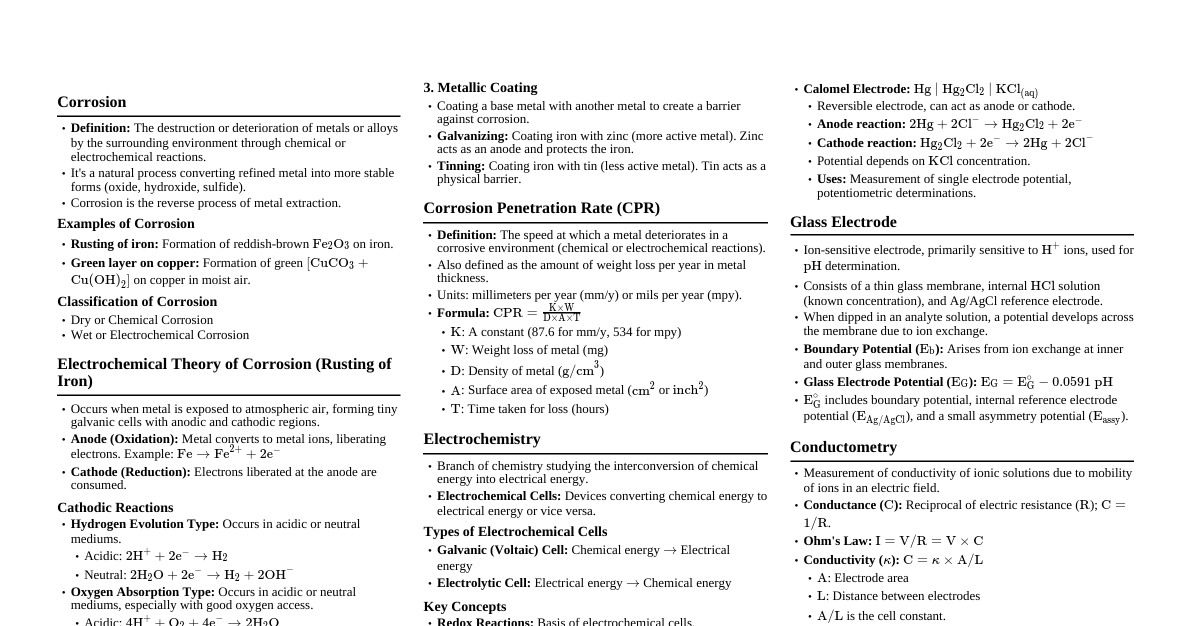
### Galvanic Cells - **Daniell Cell Reaction:** $Zn(s) + Cu^{2+}(aq) \rightarrow Zn^{2+}(aq) + Cu(s)$ - **Cell Potential (E_cell):** $E_{cell} = E_{right} - E_{left}$ Where $E_{right}$ is the reduction potential of the cathode and $E_{left}$ is the reduction potential of the anode. - **Standard Electrode Potential:** When concentrations of all species are unity. Defined with respect to the Standard Hydrogen Electrode (SHE), $E^\circ_{SHE} = 0 \, V$. $H^+(aq) + e^- \rightarrow \frac{1}{2} H_2(g)$ ### Nernst Equation - **For a half-cell reaction:** $M^{n+}(aq) + ne^- \rightarrow M(s)$ $E_{(M^{n+}/M)} = E^\circ_{(M^{n+}/M)} - \frac{RT}{nF} \ln \frac{1}{[M^{n+}]}$ Where: - $R = 8.314 \, J K^{-1} mol^{-1}$ (gas constant) - $T$ (temperature in Kelvin) - $F = 96487 \, C mol^{-1}$ (Faraday constant) - $n$ (number of electrons transferred) - **At 298 K (25°C):** $E_{(M^{n+}/M)} = E^\circ_{(M^{n+}/M)} - \frac{0.059}{n} \log \frac{1}{[M^{n+}]}$ - **For a general cell reaction:** $aA + bB \rightarrow cC + dD$ $E_{cell} = E^\circ_{cell} - \frac{RT}{nF} \ln \frac{[C]^c [D]^d}{[A]^a [B]^b}$ - **At 298 K:** $E_{cell} = E^\circ_{cell} - \frac{0.059}{n} \log \frac{[C]^c [D]^d}{[A]^a [B]^b}$ ### Gibbs Energy & Equilibrium Constant - **Relationship between Gibbs Energy and Cell Potential:** $\Delta_r G = -nFE_{cell}$ For standard conditions: $\Delta_r G^\circ = -nFE^\circ_{cell}$ - **Relationship between Gibbs Energy and Equilibrium Constant ($K_c$):** $\Delta_r G^\circ = -RT \ln K_c$ - **Relationship between Cell Potential and Equilibrium Constant (at 298 K):** $E^\circ_{cell} = \frac{0.059}{n} \log K_c$ ### Conductance and Resistivity - **Resistance ($R$):** $R = \rho \frac{l}{A}$ - $\rho$ (resistivity) - $l$ (length) - $A$ (cross-sectional area) - Units: Ohm ($\Omega$) - **Conductance ($G$):** $G = \frac{1}{R} = \frac{1}{\rho} \frac{A}{l} = \kappa \frac{A}{l}$ - $\kappa$ (conductivity) - Units: Siemens ($S = \Omega^{-1}$) - **Cell Constant ($G^*$):** $G^* = \frac{l}{A}$ $G^* = R \kappa$ - Units: $m^{-1}$ or $cm^{-1}$ - **Conductivity ($\kappa$):** $\kappa = G \times G^* = \frac{G^*}{R}$ - Units: $S m^{-1}$ or $S cm^{-1}$ ### Molar Conductivity - **Molar Conductivity ($\Lambda_m$):** $\Lambda_m = \frac{\kappa}{c}$ - $\kappa$ (conductivity) - $c$ (concentration in $mol \, m^{-3}$ or $mol \, cm^{-3}$) - Units: $S m^2 mol^{-1}$ or $S cm^2 mol^{-1}$ - **Relationship between units:** $1 \, S m^2 mol^{-1} = 10^4 \, S cm^2 mol^{-1}$ $1 \, S cm^2 mol^{-1} = 10^{-4} \, S m^2 mol^{-1}$ - **For strong electrolytes (Debye-Hückel-Onsager equation):** $\Lambda_m = \Lambda_m^\circ - A c^{1/2}$ - $\Lambda_m^\circ$ (limiting molar conductivity or molar conductivity at infinite dilution) - $A$ (constant dependent on solvent and temperature) ### Kohlrausch's Law of Independent Migration of Ions - **For a strong electrolyte:** $\Lambda_m^\circ = \nu_+ \lambda_+^\circ + \nu_- \lambda_-^\circ$ - $\nu_+$ and $\nu_-$ are the number of cations and anions respectively - $\lambda_+^\circ$ and $\lambda_-^\circ$ are the limiting molar conductivities of the cation and anion respectively. - **For weak electrolytes (Degree of Dissociation, $\alpha$):** $\alpha = \frac{\Lambda_m}{\Lambda_m^\circ}$ - **Dissociation Constant ($K_a$ for weak acid $HA$):** $HA \rightleftharpoons H^+ + A^-$ $K_a = \frac{c\alpha^2}{1-\alpha} = \frac{c(\Lambda_m/\Lambda_m^\circ)^2}{1-\Lambda_m/\Lambda_m^\circ}$ ### Faraday's Laws of Electrolysis - **First Law:** Amount of chemical reaction proportional to quantity of electricity passed. $Q = It$ - $Q$ (charge in Coulombs) - $I$ (current in Amperes) - $t$ (time in seconds) - **Charge of one mole of electrons (Faraday constant, $F$):** $F = 96487 \, C \, mol^{-1} \approx 96500 \, C \, mol^{-1}$ - **For a reaction involving $n$ electrons:** $nF$ Coulombs of charge required to deposit 1 mole of substance. - **Second Law:** Amounts of different substances liberated by the same quantity of electricity are proportional to their chemical equivalent weights. $\frac{m_1}{m_2} = \frac{E_1}{E_2}$ - $m$ (mass of substance) - $E$ (equivalent weight) ### Batteries and Fuel Cells - **Dry Cell (Leclanche Cell):** - Anode: $Zn(s) \rightarrow Zn^{2+} + 2e^-$ - Cathode: $MnO_2 + NH_4^+ + e^- \rightarrow MnO(OH) + NH_3$ - **Mercury Cell:** - Anode: $Zn(Hg) + 2OH^- \rightarrow ZnO(s) + H_2O + 2e^-$ - Cathode: $HgO + H_2O + 2e^- \rightarrow Hg(l) + 2OH^-$ - Overall: $Zn(Hg) + HgO(s) \rightarrow ZnO(s) + Hg(l)$ - **Lead Storage Battery (Discharging):** - Anode: $Pb(s) + SO_4^{2-}(aq) \rightarrow PbSO_4(s) + 2e^-$ - Cathode: $PbO_2(s) + SO_4^{2-}(aq) + 4H^+(aq) + 2e^- \rightarrow PbSO_4(s) + 2H_2O(l)$ - Overall: $Pb(s) + PbO_2(s) + 2H_2SO_4(aq) \rightarrow 2PbSO_4(s) + 2H_2O(l)$ - **Nickel-Cadmium Cell (Discharging):** - Overall: $Cd(s) + 2Ni(OH)_3(s) \rightarrow CdO(s) + 2Ni(OH)_2(s) + H_2O(l)$ - **Hydrogen-Oxygen Fuel Cell:** - Anode: $2H_2(g) + 4OH^-(aq) \rightarrow 4H_2O(l) + 4e^-$ - Cathode: $O_2(g) + 2H_2O(l) + 4e^- \rightarrow 4OH^-(aq)$ - Overall: $2H_2(g) + O_2(g) \rightarrow 2H_2O(l)$ ### Corrosion - **Iron Rusting (Electrochemical Process):** - Anode (Oxidation): $Fe(s) \rightarrow Fe^{2+}(aq) + 2e^-$ - Cathode (Reduction): $O_2(g) + 4H^+(aq) + 4e^- \rightarrow 2H_2O(l)$ - Overall (initial): $2Fe(s) + O_2(g) + 4H^+(aq) \rightarrow 2Fe^{2+}(aq) + 2H_2O(l)$ - Further oxidation of $Fe^{2+}$: $2Fe^{2+}(aq) + 2H_2O(l) + \frac{1}{2}O_2(g) \rightarrow Fe_2O_3(s) + 4H^+(aq)$ - Rust: Hydrated ferric oxide $Fe_2O_3 \cdot xH_2O$ ## Important Reactions Summary #### Galvanic Cells - **Daniell Cell:** $Zn(s) + Cu^{2+}(aq) \rightarrow Zn^{2+}(aq) + Cu(s)$ - **Standard Hydrogen Electrode (SHE):** $2H^+(aq) + 2e^- \rightarrow H_2(g)$ #### Electrolysis - **Copper Refining:** - Anode (impure Cu): $Cu(s) \rightarrow Cu^{2+}(aq) + 2e^-$ - Cathode (pure Cu): $Cu^{2+}(aq) + 2e^- \rightarrow Cu(s)$ - **Electrolysis of Molten NaCl:** - Cathode: $Na^+ + e^- \rightarrow Na(l)$ - Anode: $2Cl^- \rightarrow Cl_2(g) + 2e^-$ - **Electrolysis of Aqueous NaCl:** - Cathode: $2H_2O(l) + 2e^- \rightarrow H_2(g) + 2OH^-(aq)$ - Anode: $2Cl^-(aq) \rightarrow Cl_2(g) + 2e^-$ - (Note: $O_2$ oxidation is thermodynamically preferred but kinetically hindered due to overpotential) - **Electrolysis of Acidified Water:** - Cathode: $2H^+(aq) + 2e^- \rightarrow H_2(g)$ - Anode: $2H_2O(l) \rightarrow O_2(g) + 4H^+(aq) + 4e^-$ #### Batteries - **Dry Cell (Leclanche Cell):** $Zn(s) + MnO_2(s) + NH_4^+(aq) \rightarrow Zn^{2+}(aq) + MnO(OH)(s) + NH_3(g)$ - **Mercury Cell:** $Zn(Hg) + HgO(s) \rightarrow ZnO(s) + Hg(l)$ - **Lead Storage Battery:** - Discharging: $Pb(s) + PbO_2(s) + 2H_2SO_4(aq) \rightarrow 2PbSO_4(s) + 2H_2O(l)$ - Charging: $2PbSO_4(s) + 2H_2O(l) \rightarrow Pb(s) + PbO_2(s) + 2H_2SO_4(aq)$ - **Nickel-Cadmium Cell:** $Cd(s) + 2Ni(OH)_3(s) \rightarrow CdO(s) + 2Ni(OH)_2(s) + H_2O(l)$ #### Fuel Cells - **Hydrogen-Oxygen Fuel Cell:** $2H_2(g) + O_2(g) \rightarrow 2H_2O(l)$ #### Corrosion - **Rusting of Iron:** $2Fe(s) + \frac{3}{2}O_2(g) + xH_2O(l) \rightarrow Fe_2O_3 \cdot xH_2O(s)$