Wireless Sensor Networks Cheatsheet
Cheatsheet Content
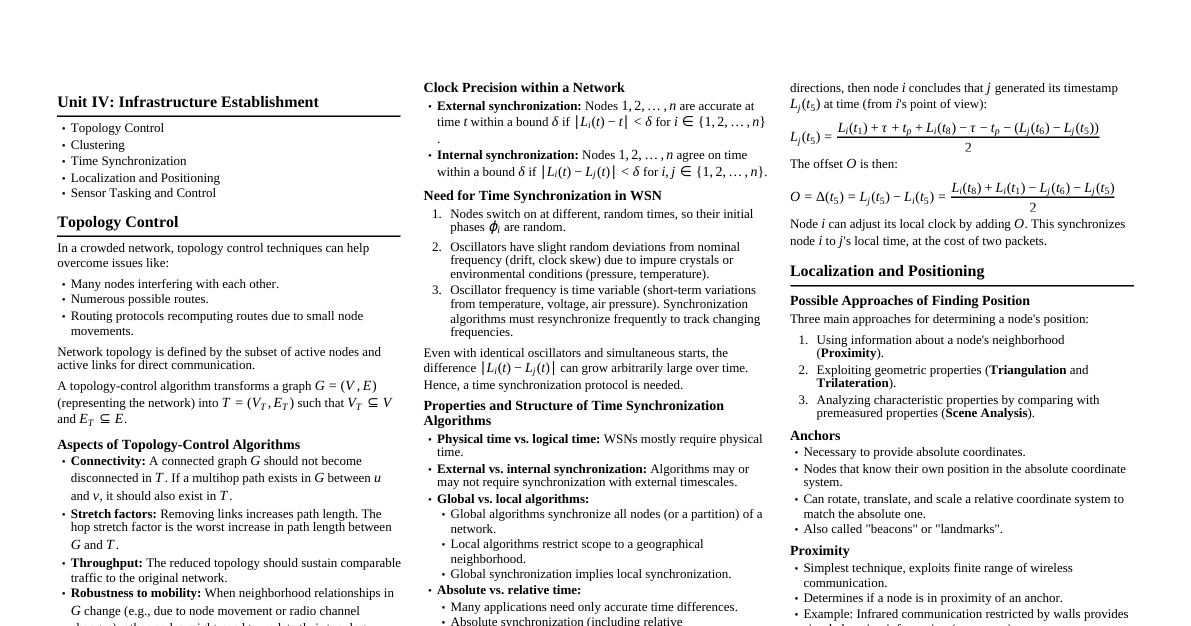
Topology Control Goal: Manage network connectivity and energy consumption. Methods: Power Control: Adjusting transmission power to control neighbor count and link quality. Reduces interference, saves energy. Trade-off: connectivity vs. energy. Node Scheduling (Duty Cycling): Turning nodes ON/OFF to save energy. Synchronous vs. Asynchronous. Impacts latency and throughput. Geographic Routing: Routing based on node locations. Metrics: Connectivity, network lifetime, latency, throughput, energy efficiency. Challenges: Dynamic network conditions, node failures, limited resources. Clustering Goal: Organize nodes into groups (clusters) to improve scalability and energy efficiency. Key Concepts: Cluster Head (CH): Node responsible for managing its cluster (data aggregation, communication with base station). Member Nodes: Nodes within a cluster that send data to their CH. Advantages: Reduced communication overhead. Better resource management. Improved network lifetime (CH rotation). Common Algorithms: LEACH (Low-Energy Adaptive Clustering Hierarchy): Randomized rotation of CHs. Each node elects itself as CH with probability $P$. CHs collect data, aggregate, and send to base station. PEGASIS (Power-Efficient Gathering in Sensor Information Systems): Forms a chain of nodes. Nodes communicate only with nearest neighbors. One node (randomly chosen) sends aggregated data to base station. HEED (Hybrid Energy-Efficient Distributed clustering): Considers residual energy and node degree for CH selection. Time Synchronization Goal: Ensure all nodes in the network have a common understanding of time. Importance: Data fusion and correlation (e.g., event detection). Duty cycling and scheduled operations. Localization and target tracking. Secure communication. Challenges: Clock Drift: Inherent difference in clock rates among nodes. Propagation Delay: Time taken for signals to travel. Asymmetric Delays: Different delays for uplink/downlink. Limited Resources: Energy and computational constraints. Methods: Sender-Receiver Synchronization: One node sends time, receiver adjusts. e.g., RBS (Reference Broadcast Synchronization): Reference beacon from a common sender. Receiver-Receiver Synchronization: Nodes synchronize by exchanging messages with each other. Network-Wide Synchronization: Gradient-based: Time propagates like a gradient. Flooding-based: Time information floods the network. Metrics: Synchronization accuracy, energy consumption, message overhead, robustness. Localization and Positioning Goal: Determine the physical location of sensor nodes. Types: Absolute Localization: Determining global coordinates (e.g., latitude/longitude). Relative Localization: Determining positions relative to other nodes. Key Concepts: Anchors (Beacons): Nodes with known locations (e.g., GPS-enabled). Unknown Nodes: Nodes whose locations need to be determined. Measurement Techniques: RSSI (Received Signal Strength Indicator): Signal strength inversely proportional to distance. Prone to environmental noise and fading. ToA (Time of Arrival): Time taken for signal to travel from sender to receiver. Requires precise time synchronization. $d = c \cdot t$. TDoA (Time Difference of Arrival): Difference in arrival times from multiple senders. Eliminates need for sender synchronization. AoA (Angle of Arrival): Angle at which signal arrives. Requires directional antennas. Localization Algorithms: Triangulation/Trilateration: Using distances/angles from multiple anchors. Multilateration: Using TDoA measurements. Centroid Algorithm: Simple average of anchor positions. DV-Hop (Distance Vector-Hop): Estimates distance based on hop count to anchors. Each anchor broadcasts its location and hop count. MDS (Multi-dimensional Scaling): Uses relative distances to construct a map. Challenges: Accuracy, energy consumption, anchor node density, NLOS (Non-Line-Of-Sight) propagation. Sensor Tasking and Control Goal: Efficiently manage and coordinate sensor nodes to achieve application-specific objectives. Key Aspects: Deployment: How sensors are placed (random, deterministic). Coverage: Ensuring the area of interest is adequately monitored. Area coverage, point coverage, barrier coverage. Target Tracking: Coordinating sensors to follow moving objects. Centralized vs. Distributed tracking. Data Aggregation: Combining data from multiple sensors to reduce redundancy and transmission. In-network processing, data compression. Query Processing: Responding to user queries about the environment. Directed diffusion, TinyDB. Resource Allocation: Managing energy, bandwidth, and computational power. Control Paradigms: Centralized: A central entity (base station) controls all nodes. Simple, but single point of failure, not scalable. Distributed: Nodes make decisions cooperatively. Robust, scalable, but complex coordination. Hybrid: Combination of centralized and distributed (e.g., clustering with CHs). Challenges: Dynamic environment, limited node capabilities, fault tolerance, security.