Fluid Mechanics for JEE
Cheatsheet Content
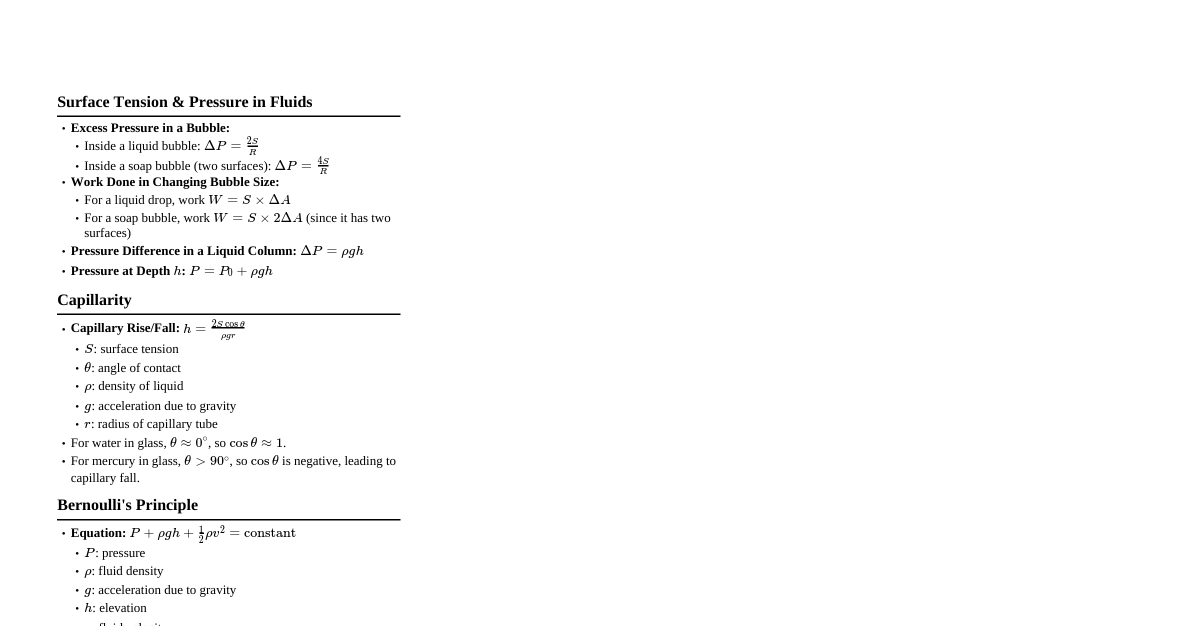
1. Properties of Fluids Density ($\rho$): Mass per unit volume. $\rho = \frac{M}{V}$. Units: $\text{kg/m}^3$. Relative Density (Specific Gravity): $\frac{\rho_{\text{substance}}}{\rho_{\text{water}}}$ (at $4^\circ\text{C}$). Pressure ($P$): Force per unit area. $P = \frac{F}{A}$. Units: Pascal ($\text{Pa} = \text{N/m}^2$). Atmospheric Pressure ($P_0$): $\approx 1.01 \times 10^5 \text{ Pa}$. Viscosity ($\eta$): Resistance to flow. Internal friction. Surface Tension ($T$ or $\sigma$): Force per unit length acting perpendicular to an imaginary line on the liquid surface. $T = \frac{F}{L}$. Units: $\text{N/m}$. Surface Energy: Work done to increase surface area by unit amount. Equal to surface tension. Compressibility: Reciprocal of Bulk Modulus. Incompressible fluids have $\rho \approx \text{constant}$. 2. Fluid Statics 2.1. Pressure in a Fluid at Rest Pressure at depth $h$: $P = P_0 + \rho g h$. $P_0$: Pressure at the surface. Gauge Pressure: $P_{\text{gauge}} = P - P_0 = \rho g h$. Pascal's Principle: Pressure change in an enclosed incompressible fluid is transmitted undiminished to every portion of the fluid and to the walls of the container. Hydraulic Lift: $\frac{F_1}{A_1} = \frac{F_2}{A_2}$. 2.2. Archimedes' Principle Buoyant Force ($F_B$): $F_B = \text{weight of displaced fluid} = V_{\text{submerged}} \rho_{\text{fluid}} g$. An object floats if $F_B = \text{weight of object}$. Condition for floating: $\rho_{\text{object}} Fraction submerged: $\frac{V_{\text{submerged}}}{V_{\text{total}}} = \frac{\rho_{\text{object}}}{\rho_{\text{fluid}}}$. 2.3. Manometers & Barometers Simple Manometer: Measures gauge pressure. $P_{\text{gauge}} = \rho g h$. Barometer: Measures atmospheric pressure. $P_0 = \rho g h_{\text{mercury}}$. 3. Fluid Dynamics 3.1. Types of Flow Steady Flow: Velocity at any point does not change with time. Unsteady Flow: Velocity at a point changes with time. Laminar Flow: Fluid particles move in smooth layers. Turbulent Flow: Irregular, chaotic motion of fluid particles. Incompressible Flow: Density of fluid remains constant. Rotational/Irrotational Flow: Fluid elements do/do not rotate about their own axis. 3.2. Equation of Continuity For an incompressible, steady flow through a pipe: $A_1 v_1 = A_2 v_2 = \text{constant}$ (Volume Flow Rate). $A$: Cross-sectional area, $v$: Fluid speed. 3.3. Bernoulli's Principle For ideal fluid (incompressible, non-viscous, steady, irrotational flow) along a streamline: $P + \frac{1}{2}\rho v^2 + \rho g h = \text{constant}$ Terms: $P$: Pressure energy per unit volume. $\frac{1}{2}\rho v^2$: Kinetic energy per unit volume (dynamic pressure). $\rho g h$: Potential energy per unit volume (hydrostatic pressure). Applications: Venturi meter, Aerofoil lift, Torricelli's Law. 3.4. Torricelli's Law (Efflux Velocity) Speed of efflux from an orifice at depth $h$ below the free surface: $v = \sqrt{2gh}$. Range of efflux: $R = v t = \sqrt{2gh} \sqrt{\frac{2(H-h)}{g}} = 2\sqrt{h(H-h)}$. $H$: Total height of liquid. 4. Viscosity Newton's Law of Viscosity: Shear stress $\tau = \eta \frac{dv}{dy}$. $\eta$: Coefficient of viscosity. Units: $\text{Pa} \cdot \text{s}$ or Poise ($\text{P}$). $1 \text{P} = 0.1 \text{ Pa} \cdot \text{s}$. Stokes' Law: Viscous drag force on a spherical object of radius $r$ moving with velocity $v$ in a fluid of viscosity $\eta$: $F_D = 6\pi \eta r v$. Terminal Velocity ($v_T$): When $F_D = \text{weight} - F_B$. $v_T = \frac{2 r^2 (\rho_{\text{object}} - \rho_{\text{fluid}}) g}{9 \eta}$. Poiseuille's Formula: Volume flow rate through a cylindrical tube of radius $R$ and length $L$ under pressure difference $\Delta P$: $Q = \frac{\pi R^4 \Delta P}{8 \eta L}$. Reynolds Number ($Re$): Predicts flow type. $Re = \frac{\rho v D}{\eta}$. $Re $2000 $Re > 3000$: Turbulent flow. 5. Surface Tension Cohesive forces: Between like molecules. Adhesive forces: Between different molecules. Angle of Contact ($\theta$): Angle between tangent to liquid surface and tangent to solid surface inside the liquid. $\theta $\theta > 90^\circ$: Convex meniscus, liquid does not wet surface (e.g., mercury on glass). Excess Pressure: Liquid drop: $\Delta P = \frac{2T}{R}$. Soap bubble: $\Delta P = \frac{4T}{R}$. Liquid film: $\Delta P = \frac{T}{R}$. Capillary Rise/Fall: Height $h = \frac{2T \cos\theta}{\rho g r}$. $r$: radius of capillary tube.