EM1 Cheatsheet
Cheatsheet Content
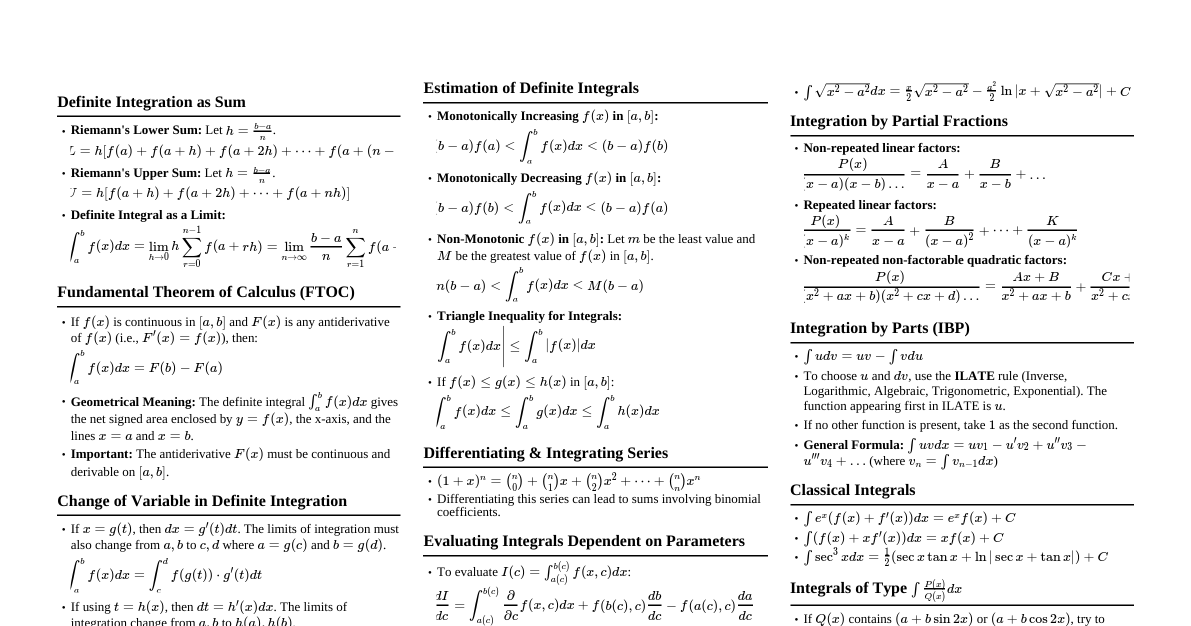
### Vectors - **Definition:** A quantity having magnitude and direction. Represented as $\vec{A}$ or $\mathbf{A}$. - **Components:** $\vec{A} = A_x \hat{i} + A_y \hat{j} + A_z \hat{k}$ - **Magnitude:** $|\vec{A}| = \sqrt{A_x^2 + A_y^2 + A_z^2}$ - **Unit Vector:** $\hat{a} = \frac{\vec{A}}{|\vec{A}|}$ (direction only) - **Dot Product (Scalar Product):** - $\vec{A} \cdot \vec{B} = |\vec{A}||\vec{B}|\cos\theta$ - $\vec{A} \cdot \vec{B} = A_x B_x + A_y B_y + A_z B_z$ - If $\vec{A} \cdot \vec{B} = 0$, vectors are perpendicular. - **Cross Product (Vector Product):** - $\vec{A} \times \vec{B} = |\vec{A}||\vec{B}|\sin\theta \hat{n}$ (where $\hat{n}$ is unit vector perpendicular to both $\vec{A}$ and $\vec{B}$) - $\vec{A} \times \vec{B} = \begin{vmatrix} \hat{i} & \hat{j} & \hat{k} \\ A_x & A_y & A_z \\ B_x & B_y & B_z \end{vmatrix}$ - If $\vec{A} \times \vec{B} = 0$, vectors are parallel. ### Vector Calculus - **Gradient of a Scalar Field ($\phi$):** - $\nabla \phi = \frac{\partial \phi}{\partial x} \hat{i} + \frac{\partial \phi}{\partial y} \hat{j} + \frac{\partial \phi}{\partial z} \hat{k}$ - Points in the direction of the greatest rate of increase of $\phi$. - Magnitude is the maximum rate of change. - **Divergence of a Vector Field ($\vec{F}$):** - $\nabla \cdot \vec{F} = \frac{\partial F_x}{\partial x} + \frac{\partial F_y}{\partial y} + \frac{\partial F_z}{\partial z}$ - Measures the outward flux per unit volume. - If $\nabla \cdot \vec{F} = 0$, the field is solenoidal. - **Curl of a Vector Field ($\vec{F}$):** - $\nabla \times \vec{F} = \begin{vmatrix} \hat{i} & \hat{j} & \hat{k} \\ \frac{\partial}{\partial x} & \frac{\partial}{\partial y} & \frac{\partial}{\partial z} \\ F_x & F_y & F_z \end{vmatrix}$ - Measures the rotation or circulation of the field. - If $\nabla \times \vec{F} = 0$, the field is irrotational (conservative). - **Line Integral:** $\int_C \vec{F} \cdot d\vec{r}$ (Work done by a force field) - **Surface Integral:** $\iint_S \vec{F} \cdot d\vec{S}$ (Flux through a surface) - **Volume Integral:** $\iiint_V \phi dV$ or $\iiint_V \vec{F} dV$ ### Integral Theorems - **Green's Theorem (2D):** - $\oint_C (P dx + Q dy) = \iint_R \left(\frac{\partial Q}{\partial x} - \frac{\partial P}{\partial y}\right) dA$ - Relates a line integral around a simple closed curve C to a double integral over the plane region R bounded by C. - **Stokes' Theorem:** - $\oint_C \vec{F} \cdot d\vec{r} = \iint_S (\nabla \times \vec{F}) \cdot d\vec{S}$ - Relates a line integral of a vector field around a closed curve C to the surface integral of the curl of the field over any surface S bounded by C. - **Divergence Theorem (Gauss's Theorem):** - $\iint_S \vec{F} \cdot d\vec{S} = \iiint_V (\nabla \cdot \vec{F}) dV$ - Relates the flux of a vector field through a closed surface S to the triple integral of the divergence of the field over the volume V enclosed by S. ### Differential Equations #### First Order Differential Equations - **Separable Equations:** $g(y) dy = f(x) dx \implies \int g(y) dy = \int f(x) dx + C$ - **Homogeneous Equations:** $\frac{dy}{dx} = f\left(\frac{y}{x}\right)$. Substitute $y=vx \implies \frac{dv}{dx}x+v=f(v)$. - **Exact Equations:** $M(x,y)dx + N(x,y)dy = 0$. Exact if $\frac{\partial M}{\partial y} = \frac{\partial N}{\partial x}$. - Solution is $\int M dx + \int (N - \frac{\partial}{\partial y} \int M dx) dy = C$. - **Linear Equations:** $\frac{dy}{dx} + P(x)y = Q(x)$. - Integrating Factor: $IF = e^{\int P(x) dx}$ - Solution: $y \cdot IF = \int Q(x) \cdot IF dx + C$ - **Bernoulli's Equation:** $\frac{dy}{dx} + P(x)y = Q(x)y^n$. - Substitute $z = y^{1-n}$. Then $\frac{dz}{dx} + (1-n)P(x)z = (1-n)Q(x)$, which is linear. #### Second Order Linear Differential Equations - **Homogeneous Equation (Constant Coefficients):** $ay'' + by' + cy = 0$ - **Characteristic Equation:** $am^2 + bm + c = 0$ - **Case 1: Distinct Real Roots ($m_1, m_2$):** $y_h(x) = C_1 e^{m_1 x} + C_2 e^{m_2 x}$ - **Case 2: Repeated Real Roots ($m_1 = m_2 = m$):** $y_h(x) = (C_1 + C_2 x) e^{m x}$ - **Case 3: Complex Conjugate Roots ($m = \alpha \pm i\beta$):** $y_h(x) = e^{\alpha x} (C_1 \cos(\beta x) + C_2 \sin(\beta x))$ - **Non-Homogeneous Equation:** $ay'' + by' + cy = f(x)$ - **General Solution:** $y(x) = y_h(x) + y_p(x)$ (homogeneous + particular solution) - **Method of Undetermined Coefficients:** - If $f(x)$ is polynomial, try $y_p(x)$ as polynomial. - If $f(x)$ is $e^{ax}$, try $y_p(x) = A e^{ax}$. - If $f(x)$ is $\sin(ax)$ or $\cos(ax)$, try $y_p(x) = A \cos(ax) + B \sin(ax)$. - **Modification Rule:** If a term in $y_p(x)$ is already a solution to the homogeneous equation, multiply by $x$ (or $x^2$ if repeated root). - **Variation of Parameters:** - For $y'' + P(x)y' + Q(x)y = R(x)$ - $y_p(x) = -y_1 \int \frac{y_2 R(x)}{W(y_1, y_2)} dx + y_2 \int \frac{y_1 R(x)}{W(y_1, y_2)} dx$ - Wronskian: $W(y_1, y_2) = y_1 y_2' - y_2 y_1'$ ### Laplace Transforms - **Definition:** $\mathcal{L}\{f(t)\} = F(s) = \int_0^\infty e^{-st} f(t) dt$ - **Inverse Laplace Transform:** $\mathcal{L}^{-1}\{F(s)\} = f(t)$ - **Properties:** - Linearity: $\mathcal{L}\{af(t) + bg(t)\} = aF(s) + bG(s)$ - First Shifting Theorem: $\mathcal{L}\{e^{at} f(t)\} = F(s-a)$ - Derivative of a Function: $\mathcal{L}\{f'(t)\} = sF(s) - f(0)$ - Derivative of a Function (second order): $\mathcal{L}\{f''(t)\} = s^2 F(s) - sf(0) - f'(0)$ - Integral of a Function: $\mathcal{L}\left\{\int_0^t f(\tau) d\tau\right\} = \frac{F(s)}{s}$ - Multiplication by $t^n$: $\mathcal{L}\{t^n f(t)\} = (-1)^n \frac{d^n}{ds^n} F(s)$ - Division by $t$: $\mathcal{L}\left\{\frac{f(t)}{t}\right\} = \int_s^\infty F(u) du$ - **Common Transforms:** | $f(t)$ | $F(s) = \mathcal{L}\{f(t)\}$ | |-----------------------|-----------------------------| | $1$ | $1/s$ | | $t^n$ | $n!/s^{n+1}$ | | $e^{at}$ | $1/(s-a)$ | | $\sin(at)$ | $a/(s^2+a^2)$ | | $\cos(at)$ | $s/(s^2+a^2)$ | | $\sinh(at)$ | $a/(s^2-a^2)$ | | $\cosh(at)$ | $s/(s^2-a^2)$ | | $u(t-a)$ (Unit Step) | $e^{-as}/s$ | | $\delta(t-a)$ (Dirac) | $e^{-as}$ | ### Fourier Series - **Periodic Function:** $f(x)$ is periodic with period $2L$ if $f(x+2L) = f(x)$. - **Fourier Series Expansion:** For $f(x)$ defined on $[-L, L]$: $$f(x) = a_0 + \sum_{n=1}^\infty (a_n \cos\left(\frac{n\pi x}{L}\right) + b_n \sin\left(\frac{n\pi x}{L}\right))$$ - **Fourier Coefficients:** - $a_0 = \frac{1}{2L} \int_{-L}^L f(x) dx$ - $a_n = \frac{1}{L} \int_{-L}^L f(x) \cos\left(\frac{n\pi x}{L}\right) dx$ - $b_n = \frac{1}{L} \int_{-L}^L f(x) \sin\left(\frac{n\pi x}{L}\right) dx$ - **Even Function:** $f(-x) = f(x)$. Only $a_0$ and $a_n$ terms exist ($b_n=0$). - $a_0 = \frac{1}{L} \int_{0}^L f(x) dx$ - $a_n = \frac{2}{L} \int_{0}^L f(x) \cos\left(\frac{n\pi x}{L}\right) dx$ - **Odd Function:** $f(-x) = -f(x)$. Only $b_n$ terms exist ($a_0=0, a_n=0$). - $b_n = \frac{2}{L} \int_{0}^L f(x) \sin\left(\frac{n\pi x}{L}\right) dx$ - **Half-Range Series:** Extend a function defined on $[0, L]$ as either even or odd to get cosine or sine series. ### Complex Numbers - **Definition:** $z = x + iy$, where $i = \sqrt{-1}$. - **Conjugate:** $\bar{z} = x - iy$ - **Modulus:** $|z| = \sqrt{x^2 + y^2}$ - **Argument (Phase):** $\theta = \arg(z) = \tan^{-1}(y/x)$ - **Polar Form:** $z = r(\cos\theta + i\sin\theta) = r e^{i\theta}$ (Euler's Formula) - **De Moivre's Theorem:** $(r(\cos\theta + i\sin\theta))^n = r^n(\cos(n\theta) + i\sin(n\theta))$ - **Roots of Unity:** $z^n = 1 \implies z_k = e^{i \frac{2\pi k}{n}}$ for $k=0, 1, ..., n-1$. ### Complex Functions - **Analytic Function:** A function $f(z)$ is analytic at a point $z_0$ if it is differentiable at $z_0$ and in some neighborhood of $z_0$. - **Cauchy-Riemann Equations:** For $f(z) = u(x,y) + iv(x,y)$ to be analytic: - $\frac{\partial u}{\partial x} = \frac{\partial v}{\partial y}$ - $\frac{\partial u}{\partial y} = -\frac{\partial v}{\partial x}$ - **Harmonic Function:** A function $\phi(x,y)$ is harmonic if it satisfies Laplace's equation: $\nabla^2 \phi = \frac{\partial^2 \phi}{\partial x^2} + \frac{\partial^2 \phi}{\partial y^2} = 0$. - If $f(z) = u+iv$ is analytic, then $u$ and $v$ are harmonic functions. $u$ and $v$ are called harmonic conjugates. ### Complex Integration - **Cauchy's Integral Theorem:** If $f(z)$ is analytic inside and on a simple closed contour $C$, then $\oint_C f(z) dz = 0$. - **Cauchy's Integral Formula:** If $f(z)$ is analytic inside and on a simple closed contour $C$ and $z_0$ is any point inside $C$, then: - $f(z_0) = \frac{1}{2\pi i} \oint_C \frac{f(z)}{z-z_0} dz$ - For derivatives: $f^{(n)}(z_0) = \frac{n!}{2\pi i} \oint_C \frac{f(z)}{(z-z_0)^{n+1}} dz$ - **Laurent Series:** For a function $f(z)$ analytic in an annulus $R_1