Thermal Physics
Cheatsheet Content
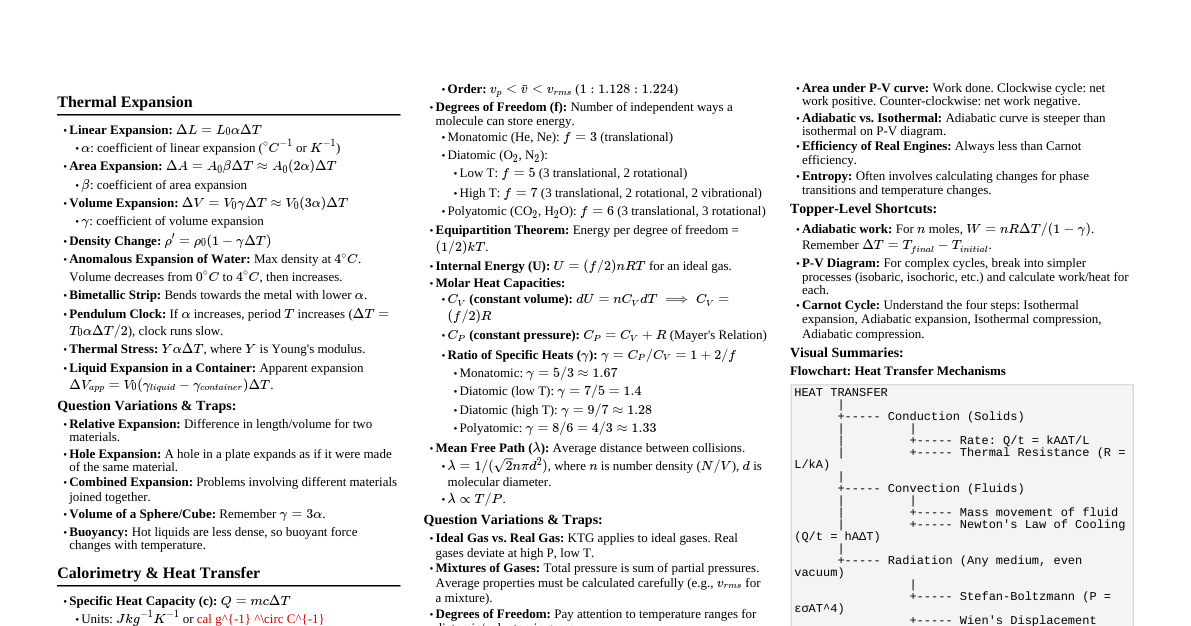
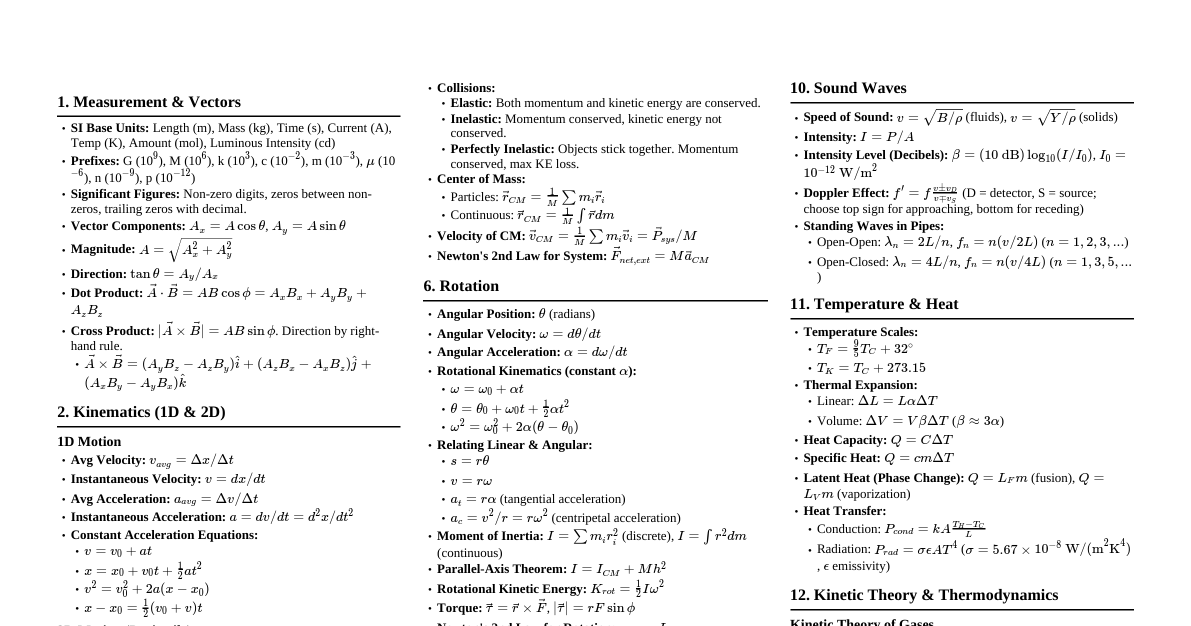
### Introduction to Thermal Physics - **Thermal Physics:** The study of heat, temperature, and related phenomena. It encompasses thermodynamics, statistical mechanics, and kinetic theory. - **Key Concepts:** - **Temperature:** A measure of the average kinetic energy of the particles in a system. - **Heat:** Energy transferred between systems due to a temperature difference. - **Internal Energy (U):** The total energy contained within a thermodynamic system. - **Entropy (S):** A measure of the disorder or randomness of a system. - **Branches:** - **Thermodynamics:** Deals with macroscopic properties and energy transfers without considering microscopic details. - **Statistical Mechanics:** Connects macroscopic thermodynamic properties to the microscopic behavior of atoms and molecules. - **Kinetic Theory:** Explains the macroscopic properties of gases in terms of the motion of their constituent molecules. ### Thermodynamic Systems and Variables - **System:** The part of the universe under consideration. - **Open System:** Exchanges both energy and matter with its surroundings. - **Closed System:** Exchanges energy but not matter with its surroundings. - **Isolated System:** Exchanges neither energy nor matter with its surroundings. - **Surroundings:** Everything outside the system. - **Boundary:** The interface between the system and surroundings. - **Thermodynamic Variables:** Properties that describe the state of a system. - **Intensive Variables:** Independent of the amount of substance (e.g., Temperature (T), Pressure (P), Density ($\rho$)). - **Extensive Variables:** Dependent on the amount of substance (e.g., Volume (V), Mass (m), Internal Energy (U), Entropy (S)). - **State Function:** A property whose value depends only on the current state of the system, not on the path taken to reach that state (e.g., U, S, P, V, T). ### Temperature and Heat #### Temperature Scales - **Celsius ($^\circ$C):** $0^\circ$C (freezing point of water), $100^\circ$C (boiling point of water). - **Fahrenheit ($^\circ$F):** $32^\circ$F (freezing point), $212^\circ$F (boiling point). - **Kelvin (K):** Absolute temperature scale. $0$ K is absolute zero. - Relationship: $T(K) = T(^\circ C) + 273.15$ - $\Delta T(K) = \Delta T(^\circ C)$ #### Heat Transfer - **Heat (Q):** Energy transferred due to a temperature difference. - **Units:** Joules (J), calories (cal). $1$ cal = $4.184$ J. - **Specific Heat Capacity (c):** Amount of heat required to raise the temperature of 1 kg of a substance by 1 K. - $Q = mc\Delta T$ - **Molar Heat Capacity (C):** Amount of heat required to raise the temperature of 1 mole of a substance by 1 K. $C = Mc$ (where M is molar mass). - **Latent Heat (L):** Heat absorbed or released during a phase change at constant temperature. - $Q = mL$ - **Latent Heat of Fusion ($L_f$):** For melting/freezing. - **Latent Heat of Vaporization ($L_v$):** For boiling/condensation. - **Mechanisms of Heat Transfer:** - **Conduction:** Transfer through direct contact (e.g., metal rod). - Fourier's Law: $P = \frac{dQ}{dt} = -kA\frac{dT}{dx}$ (where k is thermal conductivity, A is area, $\frac{dT}{dx}$ is temperature gradient). - **Convection:** Transfer through fluid motion (e.g., boiling water). - **Radiation:** Transfer via electromagnetic waves (e.g., sunlight). - Stefan-Boltzmann Law: $P = \sigma A e T^4$ (where $\sigma$ is Stefan-Boltzmann constant, A is area, e is emissivity, T is absolute temperature). ### Laws of Thermodynamics #### Zeroth Law of Thermodynamics - If two systems are each in thermal equilibrium with a third system, then they are in thermal equilibrium with each other. - Basis for temperature measurement. #### First Law of Thermodynamics - **Conservation of Energy:** The change in internal energy of a system ($\Delta U$) is equal to the heat added to the system (Q) minus the work done by the system (W). - $\Delta U = Q - W$ - **Work done by a gas:** $W = \int P dV$ - **Work done on a gas:** $W = -\int P dV$ - **Sign Conventions:** - Q > 0: Heat added to the system - Q 0: Work done *by* the system - W ### Ideal Gases #### Ideal Gas Law - $PV = nRT = Nk_BT$ - P = Pressure, V = Volume, n = number of moles, R = ideal gas constant ($8.314$ J/mol·K), T = absolute temperature, N = number of molecules, $k_B$ = Boltzmann constant ($1.38 \times 10^{-23}$ J/K). - $R = N_A k_B$ (where $N_A$ is Avogadro's number $6.022 \times 10^{23}$ mol$^{-1}$). #### Gas Processes - **Isobaric Process:** Constant Pressure ($P = const$). - $W = P\Delta V$ - $Q = nC_P\Delta T$ - **Isochoric Process:** Constant Volume ($V = const$). - $W = 0$ - $Q = nC_V\Delta T = \Delta U$ - **Isothermal Process:** Constant Temperature ($T = const$). - $\Delta U = 0$ (for ideal gas) - $Q = W = nRT \ln(\frac{V_f}{V_i})$ - **Adiabatic Process:** No heat exchange ($Q = 0$). - $\Delta U = -W$ - $PV^\gamma = const$ - $T V^{\gamma-1} = const$ - $T^\gamma P^{1-\gamma} = const$ - $\gamma = \frac{C_P}{C_V}$ (adiabatic index) #### Molar Heat Capacities of Ideal Gases - **Monatomic Gas:** (e.g., He, Ne, Ar) - $C_V = \frac{3}{2}R$ - $C_P = C_V + R = \frac{5}{2}R$ - $\gamma = \frac{5}{3}$ - **Diatomic Gas:** (e.g., $O_2, N_2, H_2$ at moderate temperatures) - $C_V = \frac{5}{2}R$ - $C_P = C_V + R = \frac{7}{2}R$ - $\gamma = \frac{7}{5}$ - **Equipartition Theorem:** Each degree of freedom contributes $\frac{1}{2}k_BT$ to the average energy of a molecule, or $\frac{1}{2}RT$ to the molar internal energy. - Degrees of freedom: - Translational: 3 for all gases. - Rotational: 2 for linear molecules (diatomic), 3 for non-linear molecules. - Vibrational: 2 per mode (kinetic + potential), significant at high temperatures. ### Kinetic Theory of Gases - **Assumptions:** - Large number of identical molecules. - Molecules are in random, continuous motion. - Collisions are perfectly elastic. - Molecules exert no forces on each other except during collisions. - Volume of molecules is negligible compared to container volume. - **Pressure:** Arises from collisions of molecules with container walls. - $P = \frac{1}{3}\frac{N}{V}m\overline{v^2}$ - **Average Kinetic Energy per Molecule:** - $\overline{KE} = \frac{1}{2}m\overline{v^2} = \frac{3}{2}k_BT$ - **Root-Mean-Square (RMS) Speed:** - $v_{rms} = \sqrt{\overline{v^2}} = \sqrt{\frac{3k_BT}{m}} = \sqrt{\frac{3RT}{M}}$ (where M is molar mass in kg/mol) - **Maxwell-Boltzmann Distribution:** Describes the distribution of speeds of molecules in a gas at a given temperature. - $f(v) = 4\pi (\frac{m}{2\pi k_B T})^{3/2} v^2 e^{-mv^2/(2k_B T)}$ - **Most Probable Speed:** $v_p = \sqrt{\frac{2k_BT}{m}}$ - **Average Speed:** $\overline{v} = \sqrt{\frac{8k_BT}{\pi m}}$ ### Entropy and Statistical Mechanics #### Entropy Definition - **Thermodynamic Definition:** $\Delta S = \int \frac{dQ_{rev}}{T}$ - For a reversible process, $dS = \frac{dQ_{rev}}{T}$ - **Statistical Definition (Boltzmann's Equation):** - $S = k_B \ln \Omega$ - $\Omega$ = number of microstates corresponding to a given macrostate (multiplicity). - A system naturally evolves towards macrostates with higher multiplicity (higher entropy). #### Microstates and Macrostates - **Microstate:** A specific configuration of all particles in a system (e.g., exact position and momentum of every molecule). - **Macrostate:** A description of the system in terms of macroscopic variables (P, V, T, U, S). Many microstates can correspond to a single macrostate. #### Free Energy - **Helmholtz Free Energy (A):** $A = U - TS$ - For a process at constant T and V, $\Delta A \le 0$. A system tends towards minimum A. - Maximum work obtainable from a system at constant T and V is $-\Delta A$. - **Gibbs Free Energy (G):** $G = H - TS = U + PV - TS$ - For a process at constant T and P, $\Delta G \le 0$. A system tends towards minimum G. - Maximum non-PV work obtainable from a system at constant T and P is $-\Delta G$. - **Enthalpy (H):** $H = U + PV$ - Heat exchanged at constant pressure: $Q_P = \Delta H$. #### Partition Function - **Canonical Partition Function (Z):** Describes the statistical properties of a system in thermal equilibrium with a heat reservoir at constant temperature T. - $Z = \sum_i e^{-E_i/(k_BT)}$ (sum over all microstates i with energy $E_i$) - Or $Z = \sum_j \Omega_j e^{-E_j/(k_BT)}$ (sum over energy levels j with degeneracy $\Omega_j$) - **Thermodynamic quantities from Z:** - Internal Energy: $U = - (\frac{\partial \ln Z}{\partial \beta})_V$ where $\beta = 1/(k_BT)$ - Entropy: $S = k_B \ln Z + \frac{U}{T}$ - Pressure: $P = k_B T (\frac{\partial \ln Z}{\partial V})_T$ - Helmholtz Free Energy: $A = -k_B T \ln Z$ ### Phase Transitions - **Phases of Matter:** Solid, Liquid, Gas, Plasma. - **Phase Transition:** A change from one phase to another (e.g., melting, boiling, sublimation). - **Phase Diagram:** A graph showing the conditions (P, T) under which different phases exist and coexist. - **Triple Point:** The unique combination of temperature and pressure at which all three phases (solid, liquid, gas) coexist in equilibrium. - **Critical Point:** The temperature and pressure above which a distinct liquid and gas phase no longer exist; instead, there is a supercritical fluid. - **Clapeyron Equation:** Describes the slope of coexistence curves in a P-T phase diagram. - $\frac{dP}{dT} = \frac{L}{T\Delta V}$ (where L is latent heat, $\Delta V$ is change in volume during phase transition). - **First Order Phase Transition:** Involves latent heat and discontinuous changes in entropy and volume (e.g., melting, boiling). - **Second Order Phase Transition:** No latent heat, continuous entropy and volume, but discontinuous specific heat (e.g., ferromagnetic to paramagnetic). ### Real Gases - **Deviations from Ideal Gas Law:** Real gases deviate from ideal behavior at high pressures and low temperatures. - Ideal gas assumes point particles and no intermolecular forces. - **Van der Waals Equation of State:** - $(P + \frac{an^2}{V^2})(V - nb) = nRT$ - **'a' term:** Accounts for attractive intermolecular forces (reduces effective pressure). - **'b' term:** Accounts for the finite volume of gas molecules (reduces effective volume).