Class 12 Chemistry Quick Revis
Shared 2/27/2026•100 views
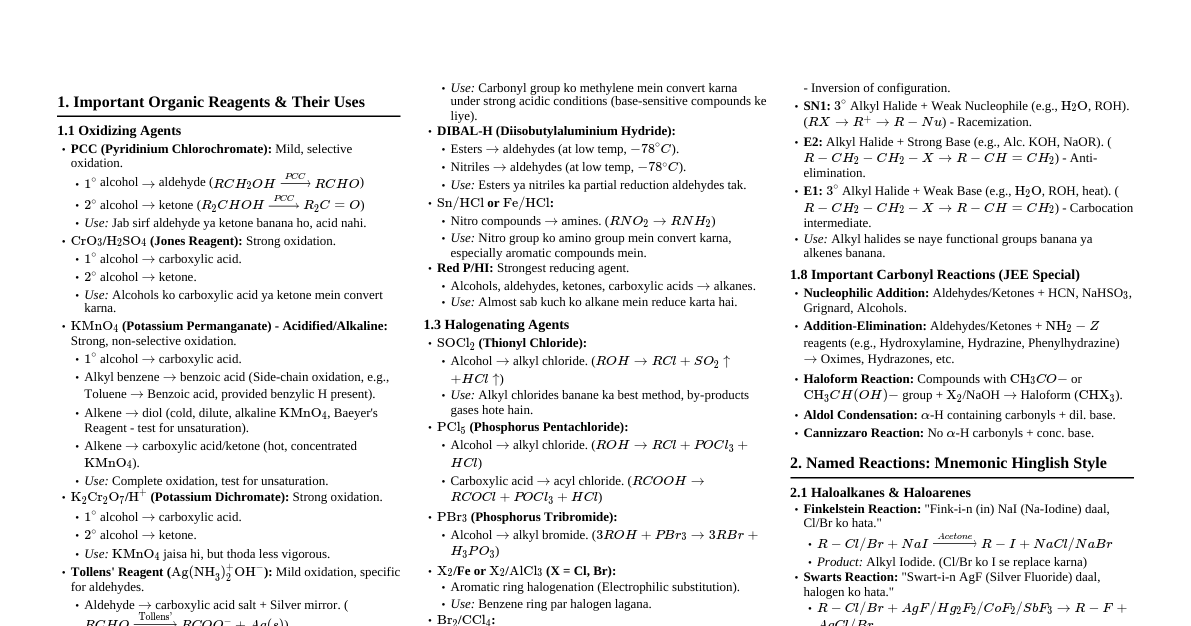
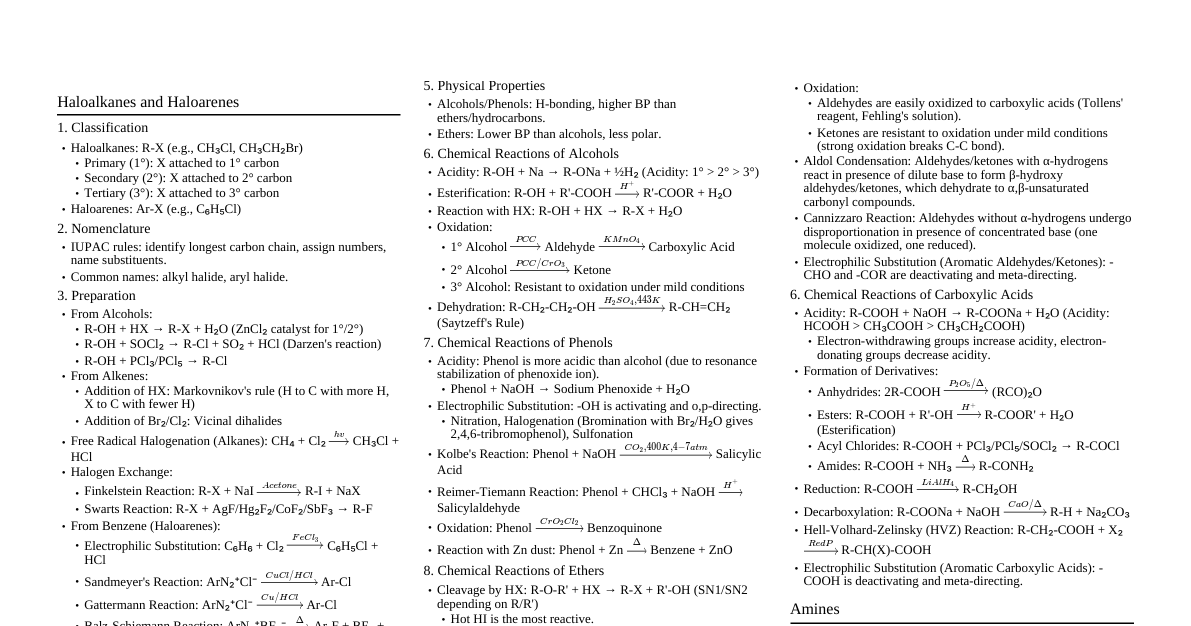
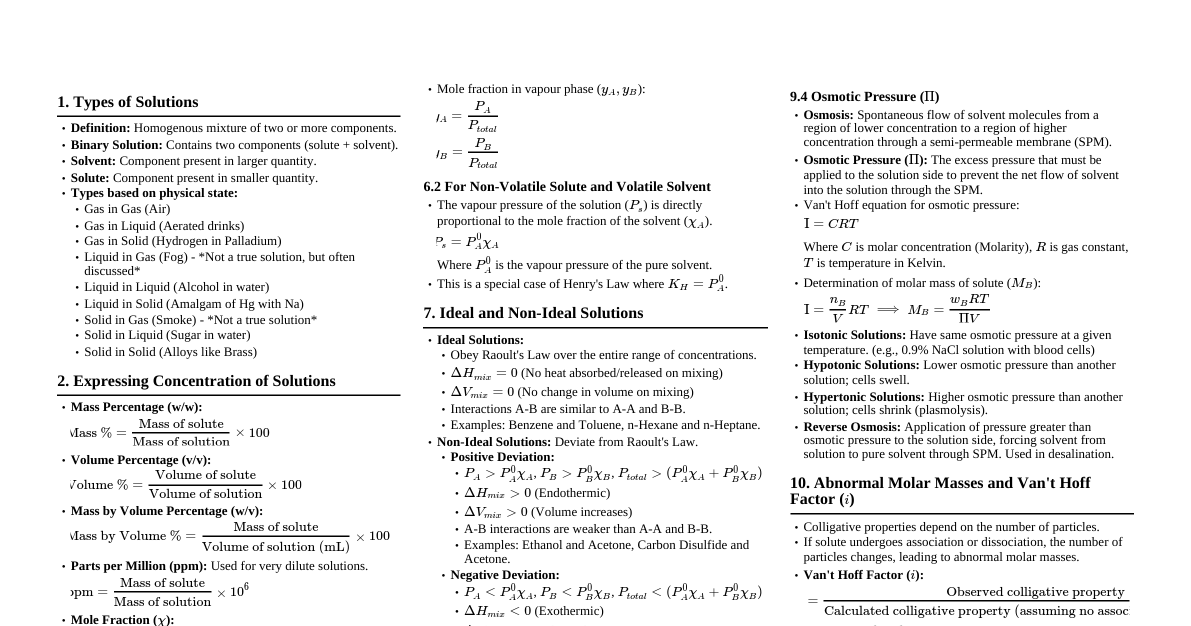
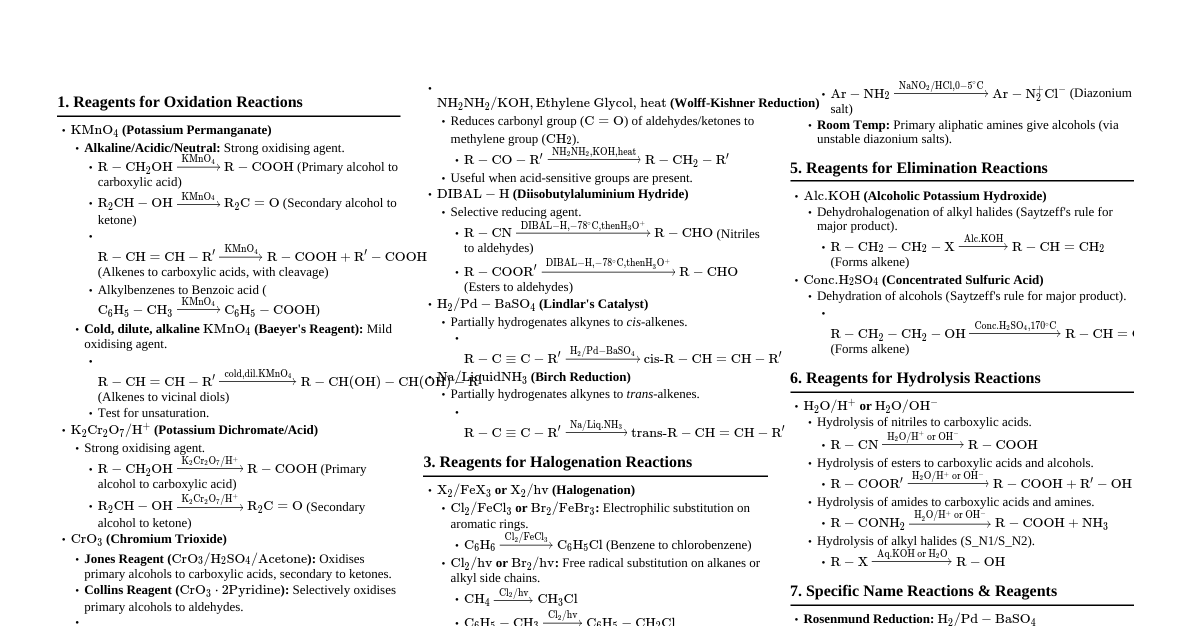
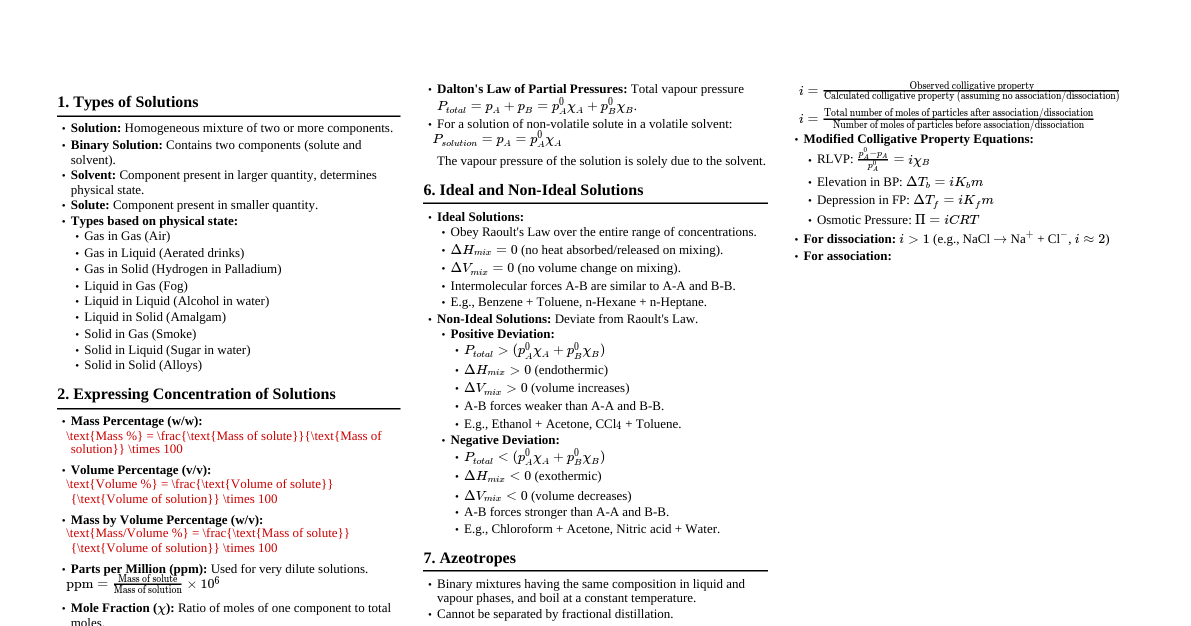
### 1. The Solid State - **Types of Solids:** - **Amorphous:** Irregular arrangement, short-range order, isotropic, soften over a range of temp. (e.g., glass, plastic) - **Crystalline:** Regular arrangement, long-range order, anisotropic, sharp melting point. - **Molecular:** Weak intermolecular forces (H-bonding, van der Waals). Soft, low MP, non-conductors. (e.g., Ice, Solid CO2) - **Ionic:** Electrostatic forces between ions. Hard, brittle, high MP, conductors in molten state/solution. (e.g., NaCl, MgO) - **Metallic:** Metallic bonds (delocalized electrons). Hard, malleable, ductile, high MP, good conductors. (e.g., Fe, Cu) - **Covalent/Network:** Covalent bonds. Very hard, high MP, insulators (except graphite). (e.g., Diamond, SiO2) - **Unit Cells:** Smallest repeating unit in crystal lattice. - **Primitive (Simple Cubic - SC):** Atoms at corners. $Z=1$. - **Body-Centred Cubic (BCC):** Atoms at corners + one at body centre. $Z=2$. - **Face-Centred Cubic (FCC)/Cubic Close Packing (CCP):** Atoms at corners + one at each face centre. $Z=4$. - **Close Packing:** - **1D:** Row of spheres. - **2D:** Square close packing (AAAA type) or Hexagonal close packing (ABAB type). - **3D:** - From 2D HCP: HCP (ABABAB...) - $Z=6$ - From 2D HCP: CCP (ABCABC...) - $Z=4$ (same as FCC) - **Voids:** - **Tetrahedral Void:** Surrounded by 4 spheres. Number = $2N$ (where $N$ is number of close-packed spheres). - **Octahedral Void:** Surrounded by 6 spheres. Number = $N$. - **Density of Unit Cell:** $\rho = \frac{Z \times M}{a^3 \times N_A}$ - $Z$ = number of atoms per unit cell - $M$ = molar mass - $a$ = edge length - $N_A$ = Avogadro's number - **Defects:** - **Stoichiometric Defects:** Maintain stoichiometry. - **Vacancy Defect:** Some lattice sites vacant. Decreases density. - **Interstitial Defect:** Atoms occupy interstitial sites. Increases density. - **Frenkel Defect:** Ion leaves lattice site and occupies interstitial site. Density unchanged. (e.g., AgCl, AgBr) - **Schottky Defect:** Equal number of cations and anions missing. Decreases density. (e.g., NaCl, KCl, AgBr) - **Non-Stoichiometric Defects:** Alter stoichiometry. - **Metal Excess Defect:** Anion vacancies (F-centres) or interstitial cations. (e.g., NaCl with Na vapor) - **Metal Deficiency Defect:** Cation vacancies. (e.g., FeO) - **Impurity Defects:** Foreign atoms present. (e.g., SrCl2 in NaCl) ### 2. Solutions - **Concentration Terms:** - **Mass %:** $\frac{\text{Mass of solute}}{\text{Mass of solution}} \times 100$ - **Volume %:** $\frac{\text{Volume of solute}}{\text{Volume of solution}} \times 100$ - **Mass by Volume %:** $\frac{\text{Mass of solute}}{\text{Volume of solution (mL)}} \times 100$ - **ppm (parts per million):** $\frac{\text{Mass of solute}}{\text{Mass of solution}} \times 10^6$ - **Mole Fraction ($x_i$):** $\frac{\text{Moles of component}}{\text{Total moles of all components}}$ - **Molarity (M):** $\frac{\text{Moles of solute}}{\text{Volume of solution (L)}}$ - **Molality (m):** $\frac{\text{Moles of solute}}{\text{Mass of solvent (kg)}}$ - **Henry's Law:** $p = K_H x$ (Partial pressure of gas $\propto$ mole fraction in solution). - $K_H$ (Henry's Law constant) increases with temperature, decreasing solubility of gas. - **Raoult's Law:** - **For volatile solute + volatile solvent:** $P_{total} = P_A^0 x_A + P_B^0 x_B$ - **For non-volatile solute + volatile solvent:** $P_A = P_A^0 x_A$ - **Ideal Solutions:** Obey Raoult's Law, $\Delta H_{mix}=0$, $\Delta V_{mix}=0$. (e.g., benzene + toluene) - **Non-Ideal Solutions:** - **Positive Deviation:** $P_{total} > P_A^0 x_A + P_B^0 x_B$. $\Delta H_{mix}>0$, $\Delta V_{mix}>0$. (e.g., ethanol + acetone) - **Negative Deviation:** $P_{total} 1$. $i = 1 + (n-1)\alpha$ ($n$ = number of ions, $\alpha$ = degree of dissociation) - For association: $i ### 3. Electrochemistry - **Electrochemical Cell:** Converts chemical energy to electrical energy. (Galvanic/Voltaic cell) - **Anode:** Oxidation occurs (negative electrode). - **Cathode:** Reduction occurs (positive electrode). - **Salt bridge:** Maintains electrical neutrality. - **Electrolytic Cell:** Converts electrical energy to chemical energy. - **Standard Electrode Potential ($E^0$):** Reduction potential of a half-cell under standard conditions (1 M, 1 atm, 298 K). - **Standard Hydrogen Electrode (SHE):** Reference electrode, $E^0 = 0.00 V$. - **Cell Potential ($E_{cell}$):** $E_{cell} = E_{cathode} - E_{anode}$ (using standard reduction potentials). - **Nernst Equation:** For a general reaction $aA + bB \rightarrow cC + dD$: $E_{cell} = E_{cell}^0 - \frac{RT}{nF} \ln Q = E_{cell}^0 - \frac{0.0592}{n} \log Q$ (at 298 K) $Q = \frac{[C]^c[D]^d}{[A]^a[B]^b}$ - **Relationship between $E^0$, $\Delta G^0$, K:** - $\Delta G^0 = -nFE_{cell}^0$ - $\Delta G^0 = -RT \ln K_{eq}$ - $E_{cell}^0 = \frac{RT}{nF} \ln K_{eq} = \frac{0.0592}{n} \log K_{eq}$ (at 298 K) - **Conductance (G):** $G = \frac{1}{R}$ (Siemens, S). - **Conductivity ($\kappa$):** $\kappa = G \frac{l}{A} = \frac{1}{R} \frac{l}{A}$ (S cm$^{-1}$ or S m$^{-1}$). $l/A$ is cell constant. - **Molar Conductivity ($\Lambda_m$):** $\Lambda_m = \frac{\kappa \times 1000}{M}$ (S cm$^2$ mol$^{-1}$). - **Kohlrausch's Law:** $\Lambda_m^0 = \nu_+ \lambda_+^0 + \nu_- \lambda_-^0$ (for weak electrolytes, used to calculate $\Lambda_m^0$ by extrapolation). - **Degree of Dissociation ($\alpha$):** $\alpha = \frac{\Lambda_m}{\Lambda_m^0}$. - **Faraday's Laws of Electrolysis:** - **1st Law:** $W \propto Q = It$ ($W$ = mass deposited, $Q$ = charge, $I$ = current, $t$ = time) - **2nd Law:** $W_1/W_2 = E_1/E_2$ ($E$ = equivalent weight) - $1 \text{ Faraday (F)} = 96487 \text{ C mol}^{-1}$ ### 4. Chemical Kinetics - **Rate of Reaction:** Change in concentration of reactant/product per unit time. - For $aA + bB \rightarrow cC + dD$: Rate $= -\frac{1}{a}\frac{d[A]}{dt} = -\frac{1}{b}\frac{d[B]}{dt} = \frac{1}{c}\frac{d[C]}{dt} = \frac{1}{d}\frac{d[D]}{dt}$ - **Rate Law:** Rate $= k[A]^x[B]^y$ - $k$ = Rate constant - $x, y$ = Order of reaction with respect to A and B (experimentally determined). - Order of reaction = $x+y$. Molecularity = number of reacting species in elementary step. - **Integrated Rate Laws:** - **Zero Order:** - $[A]_t = -kt + [A]_0$ - $t_{1/2} = \frac{[A]_0}{2k}$ - Units of $k$: mol L$^{-1}$ s$^{-1}$ - **First Order:** - $\ln[A]_t = -kt + \ln[A]_0$ or $kt = \ln\frac{[A]_0}{[A]_t}$ - $t_{1/2} = \frac{0.693}{k}$ (independent of initial concentration) - Units of $k$: s$^{-1}$ - **Second Order:** (for $A \rightarrow P$) - $\frac{1}{[A]_t} = kt + \frac{1}{[A]_0}$ - $t_{1/2} = \frac{1}{k[A]_0}$ - Units of $k$: L mol$^{-1}$ s$^{-1}$ - **Arrhenius Equation:** $k = A e^{-E_a/RT}$ - $\ln k = \ln A - \frac{E_a}{RT}$ - $\log \frac{k_2}{k_1} = \frac{E_a}{2.303R} (\frac{1}{T_1} - \frac{1}{T_2})$ - $A$ = Arrhenius factor/Pre-exponential factor - $E_a$ = Activation energy - **Collision Theory:** For a reaction to occur, molecules must collide with sufficient energy (activation energy) and proper orientation. ### 5. Surface Chemistry - **Adsorption:** Accumulation of molecular species at the surface rather than in the bulk. - **Adsorbate:** Substance adsorbed. - **Adsorbent:** Surface on which adsorption occurs. - **Physisorption (Physical Adsorption):** Weak van der Waals forces. Reversible, low $\Delta H$, multilayer, decreases with temp. - **Chemisorption (Chemical Adsorption):** Strong chemical bonds. Irreversible, high $\Delta H$, monolayer, increases then decreases with temp. - **Freundlich Adsorption Isotherm:** $\frac{x}{m} = kP^{1/n}$ (at constant temp) - $\log \frac{x}{m} = \log k + \frac{1}{n} \log P$ - $x/m$ = mass of adsorbate per unit mass of adsorbent. - **Catalysis:** Substance that changes the rate of reaction without being consumed. - **Homogeneous:** Reactants and catalyst in same phase. (e.g., $SO_2 \rightarrow SO_3$ with NO catalyst) - **Heterogeneous:** Reactants and catalyst in different phases. (e.g., Haber process for NH3) - **Enzyme Catalysis:** Highly efficient and specific biological catalysts. - **Colloids:** Heterogeneous systems where one substance is dispersed as very fine particles in another substance. - **Particle size:** 1 nm to 1000 nm. - **Dispersion Phase:** Dispersed substance. - **Dispersion Medium:** Medium in which dispersed phase is present. - **Lyophilic Colloids:** Solvent-loving. Stable, reversible. (e.g., starch, gum) - **Lyophobic Colloids:** Solvent-hating. Less stable, irreversible. (e.g., metallic sols) - **Properties of Colloids:** - **Tyndall Effect:** Scattering of light by colloidal particles. - **Brownian Movement:** Zig-zag motion of colloidal particles. - **Electrophoresis:** Movement of colloidal particles under electric field. - **Coagulation/Flocculation:** Precipitation of colloidal particles. - **Hardy-Schulze Rule:** Greater the charge on the flocculating ion, greater its coagulating power. - **Emulsions:** Colloids of liquids dispersed in liquids. - **Oil in water (O/W):** Oil dispersed in water. (e.g., milk, vanishing cream) - **Water in oil (W/O):** Water dispersed in oil. (e.g., butter, cold cream) - **Emulsifying agent:** Stabilizes emulsion. ### 6. General Principles and Processes of Isolation of Elements - **Metallurgy:** Science and technology of metal extraction from ores. - **Minerals:** Naturally occurring chemical substances in the earth's crust. - **Ores:** Minerals from which metals can be extracted economically. - **Important Ores:** - **Aluminium:** Bauxite ($Al_2O_3 \cdot xH_2O$) - **Iron:** Haematite ($Fe_2O_3$), Magnetite ($Fe_3O_4$), Siderite ($FeCO_3$) - **Copper:** Copper pyrite ($CuFeS_2$), Cuprite ($Cu_2O$), Copper glance ($Cu_2S$) - **Zinc:** Zinc blend ($ZnS$), Calamine ($ZnCO_3$), Zincite ($ZnO$) - **Steps in Metallurgy:** 1. **Crushing and Grinding:** Breaking ore into fine powder. 2. **Concentration of Ore (Benefaction):** Removal of gangue (impurities). - **Hydraulic Washing:** For heavier ore particles (e.g., oxides of Fe, Sn). - **Magnetic Separation:** For magnetic ores (e.g., magnetite, chromite). - **Froth Floatation:** For sulphide ores. (Collectors, Froth stabilisers, Depressants). - **Leaching:** Chemical method, ore soluble in reagent. (e.g., Bauxite leaching using NaOH - Bayer's process). 3. **Extraction of Crude Metal from Concentrated Ore:** - **Calcination:** Heating ore below its MP in absence of air. (Removes volatile impurities, converts carbonates/hydroxides to oxides). - **Roasting:** Heating ore below its MP in presence of air. (Sulphide ores to oxides). - **Reduction:** Converting metal oxide to metal. - **Smelting:** Reduction with carbon (coke, CO). (e.g., Blast furnace for Fe). - **Auto-reduction:** For less electropositive metals (Cu, Pb, Hg). (e.g., $Cu_2S + 2Cu_2O \rightarrow 6Cu + SO_2$). - **Electrolytic Reduction:** For highly electropositive metals (Al, Na, Mg). (e.g., Hall-Heroult process for Al). - **Thermite Process:** Reduction using Al powder. - **Other reducing agents:** CO, H2, metal displacement. 4. **Refining of Metals:** Purification of crude metal. - **Distillation:** For low boiling point metals (Zn, Cd, Hg). - **Liquation:** For low melting point metals (Sn, Pb, Bi). - **Electrolytic Refining:** For Cu, Zn, Al. Anode (impure metal), Cathode (pure metal). - **Zone Refining:** For semiconductors (Ge, Si, Ga). Based on difference in solubility of impurities in molten and solid state. - **Vapour Phase Refining:** Metal forms volatile compound, then decomposes to pure metal. - **Mond Process:** For Ni ($Ni(CO)_4$). - **Van Arkel Method:** For Zr, Ti ($ZrI_4$). - **Chromatographic Methods:** For highly pure metals. - **Thermodynamic Principles of Metallurgy:** - **Ellingham Diagram:** Graph of $\Delta G^0$ vs T for formation of oxides. - Lower line in diagram means more stable oxide. - Metal can reduce oxide of metal whose line is above it. - ($C \rightarrow CO$) line slopes downwards, ($CO \rightarrow CO_2$) line slopes upwards. ### 7. The p-Block Elements - **Group 15 (Nitrogen Family):** N, P, As, Sb, Bi - **General electronic configuration:** $ns^2 np^3$. - **Oxidation states:** -3, +3, +5. (Stability of +5 decreases down the group, +3 increases due to inert pair effect). - **Nitrogen:** Forms triple bond, diatomic ($N_2$). Inert, high bond enthalpy. - **Ammonia ($NH_3$):** Haber process ($N_2 + 3H_2 \rightleftharpoons 2NH_3$). Trigonal pyramidal, basic. - **Nitric Acid ($HNO_3$):** Ostwald process. Strong oxidizing agent. - **Phosphorus:** Exists as P4 (white, red, black allotropes). - **Phosphine ($PH_3$):** Highly poisonous, prepared from $Ca_3P_2 + H_2O$. - **Halides:** $PCl_3$ (pyramidal), $PCl_5$ (trigonal bipyramidal). - **Oxoacids of Phosphorus:** Hypophosphorous acid ($H_3PO_2$), Phosphorous acid ($H_3PO_3$), Orthophosphoric acid ($H_3PO_4$). - **Group 16 (Oxygen Family - Chalcogens):** O, S, Se, Te, Po - **General electronic configuration:** $ns^2 np^4$. - **Oxidation states:** -2, +2, +4, +6. (+4 and +6 common for S, Se, Te). - **Oxygen:** Diatomic ($O_2$), paramagnetic. Allotropes: $O_2$, $O_3$. - **Ozone ($O_3$):** Strong oxidizing agent. - **Sulphur:** Exists as $S_8$ (rhombic, monoclinic). - **Sulphur Dioxide ($SO_2$):** Reducing agent, bleaching agent. - **Sulphuric Acid ($H_2SO_4$):** Contact process. Strong acid, dehydrating agent, oxidizing agent. - **Group 17 (Halogens):** F, Cl, Br, I, At - **General electronic configuration:** $ns^2 np^5$. - **Oxidation states:** -1 (most common), +1, +3, +5, +7 (except F). - **Reactivity:** $F_2 > Cl_2 > Br_2 > I_2$. F is most electronegative. - **Acids:** HF, HCl, HBr, HI. Acidity increases down the group. - **Interhalogen Compounds:** $XX'$, $XX_3'$, $XX_5'$, $XX_7'$. (e.g., $ClF_3$, $IF_7$). - **Group 18 (Noble Gases):** He, Ne, Ar, Kr, Xe, Rn - **General electronic configuration:** $ns^2 np^6$ (He has $1s^2$). - **Inertness:** Full valence shell, high ionization enthalpy, positive electron gain enthalpy. - **Xenon Compounds:** Xe forms compounds with F and O. (e.g., $XeF_2$, $XeF_4$, $XeF_6$, $XeO_3$, $XeOF_4$). - $XeF_2$: Linear. - $XeF_4$: Square planar. - $XeF_6$: Distorted octahedral. - $XeO_3$: Pyramidal. - $XeOF_4$: Square pyramidal. ### 8. The d- and f-Block Elements - **d-Block Elements (Transition Elements):** Elements with partially filled d-orbitals in their atomic or ionic states. - **General electronic configuration:** $(n-1)d^{1-10} ns^{1-2}$. - **Properties:** - **Metallic character:** High tensile strength, ductility, malleability. - **High melting and boiling points:** Due to strong metallic bonding. - **Variable oxidation states:** Due to participation of both $(n-1)d$ and $ns$ electrons. Max OS in middle ($Mn$), then decreases. - **Formation of coloured ions:** Due to d-d transitions. (Exception: $Sc^{3+}$, $Ti^{4+}$, $Zn^{2+}$ are colourless). - **Paramagnetism:** Due to unpaired electrons. $\mu = \sqrt{n(n+2)}$ BM ($n$ = number of unpaired electrons). - **Catalytic properties:** Due to variable oxidation states and large surface area. - **Formation of interstitial compounds:** Small atoms (H, C, N) trapped in crystal lattice. Non-stoichiometric, hard, high MP. - **Alloy formation:** Similar atomic sizes. - **Important Compounds:** - **Potassium Dichromate ($K_2Cr_2O_7$):** Orange. Strong oxidizing agent in acidic medium. - $Cr_2O_7^{2-} + 14H^+ + 6e^- \rightarrow 2Cr^{3+} + 7H_2O$ - Interconverts with chromate ($CrO_4^{2-}$ - yellow) in acidic/basic medium. - **Potassium Permanganate ($KMnO_4$):** Purple. Strong oxidizing agent. - Acidic: $MnO_4^- + 8H^+ + 5e^- \rightarrow Mn^{2+} + 4H_2O$ - Neutral/weakly alkaline: $MnO_4^- + 2H_2O + 3e^- \rightarrow MnO_2 + 4OH^-$ - Strongly alkaline: $MnO_4^- + e^- \rightarrow MnO_4^{2-}$ - **f-Block Elements (Inner Transition Elements):** - **Lanthanoids (4f series):** Ce to Lu. - **General electronic configuration:** $[Xe] 4f^{1-14} 5d^{0-1} 6s^2$. - **Oxidation state:** +3 most common. +2 and +4 also seen. - **Lanthanoid Contraction:** Steady decrease in atomic/ionic radii with increasing atomic number. (Due to poor shielding of 4f electrons). - **Consequences:** Similar radii of 4d and 5d series elements (e.g., Zr and Hf). - **Actinoids (5f series):** Th to Lr. - **General electronic configuration:** $[Rn] 5f^{1-14} 6d^{0-1} 7s^2$. - **Oxidation states:** +3 most common, but higher oxidation states (+4, +5, +6, +7) are more common than in lanthanoids. - **Actinoid Contraction:** Less pronounced than lanthanoid contraction. - **Radioactive:** All are radioactive. - **Complex formation:** More tendency to form complexes than lanthanoids. ### 9. Coordination Compounds - **Definition:** Compounds containing a central metal atom/ion bonded to a number of ions or molecules (ligands) by coordinate bonds. - **Ligands:** Electron pair donors. - **Monodentate:** Donates one pair (e.g., $NH_3$, $Cl^-$, $H_2O$). - **Bidentate:** Donates two pairs (e.g., ethylenediamine (en), oxalate ($C_2O_4^{2-}$)). - **Polydentate:** Donates more than two pairs (e.g., EDTA$^{4-}$). - **Ambidentate:** Can coordinate through two different atoms (e.g., $NO_2^-$, $SCN^-$). - **Chelating Ligand:** Bidentate or polydentate ligand forming rings with central atom. - **Coordination Number:** Number of ligand donor atoms directly bonded to the central metal ion. - **Oxidation State of Central Metal:** Charge on the complex minus total charge of ligands. - **IUPAC Nomenclature:** - Cation named first, then anion. - Ligands named first (alphabetical order, with prefixes di, tri, tetra or bis, tris, tetrakis for complex ligands). - Anionic ligands end in '-o' (e.g., chloro, hydroxo). Neutral ligands are named as molecule (e.g., aqua, ammine). - Metal name followed by oxidation state in Roman numerals. - If complex is anionic, metal name ends in '-ate' (e.g., ferrate, cuprate). - **Isomerism:** - **Structural Isomerism:** - **Ionisation Isomerism:** Different ions produced in solution. (e.g., $[Co(NH_3)_5Br]SO_4$ and $[Co(NH_3)_5SO_4]Br$). - **Hydrate Isomerism:** Different number of water molecules inside/outside coordination sphere. (e.g., $[Cr(H_2O)_6]Cl_3$ and $[Cr(H_2O)_5Cl]Cl_2 \cdot H_2O$). - **Linkage Isomerism:** Ambidentate ligand coordinates through different atoms. (e.g., $[Co(NH_3)_5NO_2]^{2+}$ (nitro) and $[Co(NH_3)_5ONO]^{2+}$ (nitrito)). - **Coordination Isomerism:** Exchange of ligands between cationic and anionic complexes. (e.g., $[Co(NH_3)_6][Cr(CN)_6]$ and $[Cr(NH_3)_6][Co(CN)_6]$). - **Stereoisomerism:** Same connections, different spatial arrangement. - **Geometrical Isomerism (cis-trans):** - Square Planar ($MA_2B_2$, $MA_2BC$, $MABCD$). - Octahedral ($MA_4B_2$, $MA_3B_3$ (fac-mer), $M(AA)_2B_2$). - **Optical Isomerism (Enantiomers):** Non-superimposable mirror images. - Octahedral complexes with bidentate ligands (e.g., $[Co(en)_3]^{3+}$). - **Bonding in Coordination Compounds:** - **Valence Bond Theory (VBT):** - Hybridization ($sp^3$, $dsp^2$, $d^2sp^3$, $sp^3d^2$). - Inner orbital complex ($d^2sp^3$) vs. Outer orbital complex ($sp^3d^2$). - Magnetic character (paired/unpaired electrons). - **Crystal Field Theory (CFT):** - Ligands are point charges. - Explains splitting of d-orbitals in presence of ligands. - **Octahedral:** $t_{2g}$ (lower energy, 3 orbitals) and $e_g$ (higher energy, 2 orbitals). $\Delta_o$. - **Tetrahedral:** $e$ (lower energy, 2 orbitals) and $t_2$ (higher energy, 3 orbitals). $\Delta_t = \frac{4}{9}\Delta_o$. - **Strong field ligands:** Large splitting, low spin complexes (pairing occurs). (e.g., CN-, CO, en). - **Weak field ligands:** Small splitting, high spin complexes (pairing does not occur until all orbitals are singly occupied). (e.g., F-, Cl-, H2O). - **Spectrochemical Series:** Arrangement of ligands in increasing order of crystal field splitting energy. $I^- ### 10. Haloalkanes and Haloarenes - **Classification:** - **Haloalkanes:** - **Based on number of halogen atoms:** Mono-, di-, tri-haloalkanes. - **Based on hybridization of C-X bond:** $sp^3$ (primary, secondary, tertiary), Allylic, Benzylic. - **Haloarenes:** Halogen directly attached to benzene ring. - **Preparation of Haloalkanes:** 1. **From Alcohols:** - $ROH + HX \xrightarrow{ZnCl_2 \text{ (Lucas Reagent)}} RX + H_2O$ (Order of reactivity: $3^\circ > 2^\circ > 1^\circ$) - $ROH + PCl_3 \rightarrow RCl + H_3PO_3$ - $ROH + PCl_5 \rightarrow RCl + POCl_3 + HCl$ - $ROH + SOCl_2 \rightarrow RCl + SO_2 + HCl$ (Darzen's process, best method) 2. **From Hydrocarbons:** - **Free radical halogenation:** (e.g., $CH_4 + Cl_2 \xrightarrow{hv} CH_3Cl + HCl$). Non-selective. - **Addition of HX to alkenes:** (Markovnikov's rule). $CH_3CH=CH_2 + HBr \rightarrow CH_3CH(Br)CH_3$. - **Addition of $Br_2$/$Cl_2$ to alkenes:** Anti-addition. 3. **Halogen Exchange:** - **Finkelstein Reaction:** $R-Cl/Br + NaI \xrightarrow{\text{acetone}} R-I + NaCl/NaBr$ - **Swarts Reaction:** $R-Br/Cl + AgF/Hg_2F_2/CoF_2/SbF_3 \rightarrow R-F + AgBr/Cl$ - **Preparation of Haloarenes:** 1. **Electrophilic Substitution:** - Benzene + $Cl_2 \xrightarrow{FeCl_3} Chlorobenzene$ 2. **Sandmeyer's Reaction:** - Aniline $\xrightarrow{NaNO_2/HCl, 0-5^\circ C} \text{Diazonium salt} \xrightarrow{CuCl/HCl \text{ or } CuBr/HBr} \text{Chlorobenzene/Bromobenzene}$ 3. **Gattermann Reaction:** - Diazonium salt $\xrightarrow{Cu/HCl \text{ or } Cu/HBr} \text{Chlorobenzene/Bromobenzene}$ - **Chemical Properties of Haloalkanes:** 1. **Nucleophilic Substitution Reactions ($S_N1$, $S_N2$):** - **$S_N1$ (Unimolecular):** Two steps, carbocation intermediate, racemisation (partial), $3^\circ > 2^\circ > 1^\circ$. Polar protic solvents. - **$S_N2$ (Bimolecular):** One step, transition state, inversion of configuration, $1^\circ > 2^\circ > 3^\circ$. Polar aprotic solvents. 2. **Elimination Reactions (E1, E2):** - **Dehydrohalogenation (Beta-elimination):** Alkyl halide + alc. KOH $\rightarrow$ Alkene. (Saytzeff's rule: more substituted alkene is major product). - Competition with $S_N$: Strong base favors E, bulky base favors E. 3. **Reaction with Metals:** - **Wurtz Reaction:** $2RX + 2Na \xrightarrow{\text{dry ether}} R-R + 2NaX$ - **Wurtz-Fittig Reaction:** $RX + ArX + 2Na \xrightarrow{\text{dry ether}} R-Ar + 2NaX$ - **Grignard Reagent:** $RX + Mg \xrightarrow{\text{dry ether}} RMgX$ - **Chemical Properties of Haloarenes:** - **Low reactivity towards Nucleophilic Substitution:** Due to resonance stabilization, partial double bond character of C-X bond, $sp^2$ hybridized carbon. - **Electrophilic Substitution:** Halogen is deactivating but o,p-directing. - Nitration, Halogenation, Sulphonation, Friedel-Crafts alkylation/acylation. - **Wurtz-Fittig Reaction:** (mentioned above). - **Fittig Reaction:** $2ArX + 2Na \xrightarrow{\text{dry ether}} Ar-Ar + 2NaX$ - **Polyhalogen Compounds:** - **Dichloromethane ($CH_2Cl_2$):** Solvent, paint remover. - **Chloroform ($CHCl_3$):** Solvent, anesthetic (now less used). Oxidizes to phosgene ($COCl_2$) in air/light. - **Iodoform ($CHI_3$):** Antiseptic. - **Carbon Tetrachloride ($CCl_4$):** Fire extinguisher (pyrene), solvent, refrigerant. - **DDT (Dichlorodiphenyltrichloroethane):** Insecticide (now banned). ### 11. Alcohols, Phenols and Ethers - **Alcohols:** R-OH - **Classification:** $1^\circ$, $2^\circ$, $3^\circ$. - **Preparation:** 1. **From Alkenes:** - Acid catalysed hydration ($H_2SO_4/H_2O$): Markovnikov's addition. - Hydroboration-oxidation ($BH_3/H_2O_2, OH^-$): Anti-Markovnikov's addition. 2. **From Carbonyl Compounds (Reduction):** - Aldehydes $\xrightarrow{LiAlH_4 \text{ or } NaBH_4} 1^\circ \text{ alcohol}$ - Ketones $\xrightarrow{LiAlH_4 \text{ or } NaBH_4} 2^\circ \text{ alcohol}$ 3. **From Grignard Reagents:** - Formaldehyde + $RMgX \rightarrow 1^\circ \text{ alcohol}$ - Aldehyde + $RMgX \rightarrow 2^\circ \text{ alcohol}$ - Ketone + $RMgX \rightarrow 3^\circ \text{ alcohol}$ - **Chemical Properties:** 1. **Acidity:** Alcohols are weaker acids than water. Acidity order: $1^\circ > 2^\circ > 3^\circ$. 2. **Reaction with HX:** $ROH + HX \rightarrow RX + H_2O$ (Lucas Test: $3^\circ$ immediate turbidity, $2^\circ$ 5-10 min, $1^\circ$ no turbidity at RT). 3. **Dehydration:** $ROH \xrightarrow{conc. H_2SO_4, \Delta} \text{Alkene}$ (Saytzeff's rule). 4. **Oxidation:** - $1^\circ \text{ alcohol} \xrightarrow{PCC} \text{Aldehyde}$ - $1^\circ \text{ alcohol} \xrightarrow{K_2Cr_2O_7/H^+} \text{Carboxylic acid}$ - $2^\circ \text{ alcohol} \xrightarrow{PCC \text{ or } K_2Cr_2O_7/H^+} \text{Ketone}$ - $3^\circ \text{ alcohol}$: Resistant to oxidation under mild conditions. - **Phenols:** Ar-OH - **Preparation:** 1. **From Haloarenes (Dow's Process):** Chlorobenzene $\xrightarrow{NaOH, 623K, 300atm} \text{Sodium phenoxide} \xrightarrow{H^+} \text{Phenol}$ 2. **From Benzene Sulphonic Acid:** Benzene sulphonic acid $\xrightarrow{NaOH, \Delta} \text{Sodium phenoxide} \xrightarrow{H^+} \text{Phenol}$ 3. **From Diazonium Salts:** Benzene diazonium chloride $\xrightarrow{H_2O, \Delta} \text{Phenol}$ 4. **From Cumene:** Cumene $\xrightarrow{O_2} \text{Cumene hydroperoxide} \xrightarrow{H_3O^+} \text{Phenol + Acetone}$ (Commercial method) - **Chemical Properties:** 1. **Acidity:** Phenols are more acidic than alcohols (resonance stabilization of phenoxide ion). Electron withdrawing groups (EWG) increase acidity, electron donating groups (EDG) decrease it. 2. **Electrophilic Aromatic Substitution:** -OH is activating and o,p-directing. - Nitration, Halogenation (Bromination with $Br_2/CS_2$ for monobromination, $Br_2/H_2O$ for tribromination), Sulphonation. 3. **Kolbe's Reaction:** Phenol $\xrightarrow{NaOH} \text{Sodium phenoxide} \xrightarrow{CO_2, H^+} \text{Salicylic acid}$ 4. **Reimer-Tiemann Reaction:** Phenol $\xrightarrow{CHCl_3/NaOH} \text{Salicylaldehyde}$ 5. **Reaction with Zinc Dust:** Phenol $\xrightarrow{Zn \text{ dust}} \text{Benzene}$ 6. **Oxidation:** Phenol $\xrightarrow{K_2Cr_2O_7} \text{Benzoquinone}$ - **Ethers:** R-O-R' - **Preparation:** 1. **Dehydration of Alcohols:** $2ROH \xrightarrow{conc. H_2SO_4, 413K} R-O-R + H_2O$ (for $1^\circ$ alcohols, $S_N2$ mechanism). 2. **Williamson Synthesis:** $R-X + R'-ONa \rightarrow R-O-R' + NaX$ (Best for $1^\circ$ alkyl halides, $S_N2$ mechanism). - **Chemical Properties:** 1. **Cleavage of C-O bond by HX:** $R-O-R' + HX \rightarrow RX + R'OH$. Reactivity of HX: $HI > HBr > HCl$. - If one alkyl group is $3^\circ$, then $3^\circ$ alkyl halide formed. - If both are $1^\circ$ or $2^\circ$, then smaller alkyl group forms halide. 2. **Electrophilic Substitution:** Alkoxy group is activating and o,p-directing. - Nitration, Halogenation, Friedel-Crafts alkylation/acylation. ### 12. Aldehydes, Ketones and Carboxylic Acids - **Aldehydes (RCHO) & Ketones (RCOR'):** Contain carbonyl group ($C=O$). - **Preparation of Aldehydes:** 1. **Oxidation of $1^\circ$ Alcohols:** $RCH_2OH \xrightarrow{PCC} RCHO$. 2. **Dehydrogenation of $1^\circ$ Alcohols:** $RCH_2OH \xrightarrow{Cu, 573K} RCHO$. 3. **From Carboxylic Acids (Rosenmund Reduction):** $RCOCl + H_2 \xrightarrow{Pd/BaSO_4} RCHO$. 4. **From Nitriles (Stephen Reaction):** $R-C \equiv N \xrightarrow{SnCl_2/HCl} RCH=NH \xrightarrow{H_3O^+} RCHO$. 5. **From Esters (DIBAL-H):** $RCOOR' \xrightarrow{DIBAL-H} RCHO$. 6. **From Hydrocarbons:** - Etard reaction: Toluene $\xrightarrow{CrO_2Cl_2} \text{Chromium complex} \xrightarrow{H_3O^+} \text{Benzaldehyde}$. - Gattermann-Koch reaction: Benzene $\xrightarrow{CO/HCl, Anhydrous AlCl_3/CuCl} \text{Benzaldehyde}$. - **Preparation of Ketones:** 1. **Oxidation of $2^\circ$ Alcohols:** $R_2CHOH \xrightarrow{K_2Cr_2O_7 \text{ or } PCC} R_2C=O$. 2. **Dehydrogenation of $2^\circ$ Alcohols:** $R_2CHOH \xrightarrow{Cu, 573K} R_2C=O$. 3. **From Nitriles:** $R-C \equiv N + R'MgX \xrightarrow{H_3O^+} R-CO-R'$. 4. **Friedel-Crafts Acylation:** Benzene $\xrightarrow{RCOCl, Anhydrous AlCl_3} \text{Ketone}$. - **Reactions of Aldehydes and Ketones:** 1. **Nucleophilic Addition Reactions:** (Aldehydes are more reactive than ketones due to steric and electronic reasons). - HCN (cyanohydrin), $NaHSO_3$ (bisulphite adduct), Grignard reagents (alcohols), alcohols (acetals/ketals), ammonia derivatives (imine, oxime, hydrazone, semicarbazone). 2. **Reduction:** - To alcohols: $\xrightarrow{LiAlH_4 \text{ or } NaBH_4}$. - To hydrocarbons: - Clemmensen reduction: $\xrightarrow{Zn-Hg/conc. HCl}$. - Wolff-Kishner reduction: $\xrightarrow{NH_2NH_2/KOH, \text{ethylene glycol}}$. 3. **Oxidation:** - Aldehydes readily oxidize to carboxylic acids. - Ketones are resistant to oxidation (require vigorous conditions, C-C bond cleavage). - **Tollens' Test:** Aldehydes (positive, silver mirror), Ketones (negative). $RCHO + 2[Ag(NH_3)_2]^+ + 3OH^- \rightarrow RCOO^- + 2Ag \downarrow + 2H_2O + 4NH_3$. - **Fehling's Test:** Aldehydes (positive, red ppt), Ketones (negative). $RCHO + 2Cu^{2+} + 5OH^- \rightarrow RCOO^- + Cu_2O \downarrow + 3H_2O$. 4. **Reactions due to $\alpha$-hydrogen:** - **Aldol Condensation:** Aldehydes/ketones with $\alpha$-hydrogens $\xrightarrow{\text{dilute alkali}} \beta$-hydroxy aldehyde/ketone. - **Cross Aldol Condensation:** Between two different carbonyl compounds. - **Cannizzaro Reaction:** Aldehydes without $\alpha$-hydrogens $\xrightarrow{\text{conc. alkali}} \text{alcohol + carboxylic acid salt}$. (e.g., Formaldehyde, Benzaldehyde). 5. **Haloform Reaction (Iodoform Test):** For compounds with $CH_3CO-$ group or $CH_3CH(OH)-$ group. $\xrightarrow{I_2/NaOH} CHI_3 \downarrow \text{ (yellow ppt)}$. - **Carboxylic Acids (RCOOH):** - **Preparation:** 1. **From $1^\circ$ Alcohols and Aldehydes:** $RCH_2OH \text{ or } RCHO \xrightarrow{KMnO_4 \text{ or } K_2Cr_2O_7} RCOOH$. 2. **From Alkylbenzenes:** Toluene $\xrightarrow{KMnO_4} \text{Benzoic acid}$. 3. **From Nitriles and Amides:** $R-C \equiv N \text{ or } RCONH_2 \xrightarrow{H_3O^+} RCOOH$. 4. **From Grignard Reagents:** $RMgX + CO_2 \xrightarrow{H_3O^+} RCOOH$. 5. **From Acyl Halides and Anhydrides:** Hydrolysis. 6. **From Esters:** Hydrolysis. - **Chemical Properties:** 1. **Acidity:** Carboxylic acids are stronger acids than phenols and alcohols. - EWG increase acidity (e.g., $F_3CCOOH > Cl_3CCOOH$). - EDG decrease acidity. 2. **Reactions involving cleavage of O-H bond:** - Formation of salts with metals, alkalis, carbonates, bicarbonates. - Esterification: $RCOOH + R'OH \xrightarrow{H^+} RCOOR' + H_2O$. 3. **Reactions involving cleavage of C-OH bond:** - Formation of anhydride: $2RCOOH \xrightarrow{\Delta, P_2O_5} (RCO)_2O$. - Formation of acyl chloride: $RCOOH \xrightarrow{PCl_5 \text{ or } SOCl_2} RCOCl$. - Formation of amide: $RCOOH + NH_3 \xrightarrow{\Delta} RCONH_2$. 4. **Reactions involving -COOH group:** - Reduction: $RCOOH \xrightarrow{LiAlH_4} RCH_2OH$. - Decarboxylation: $RCOOH \xrightarrow{NaOH/CaO, \Delta} R-H + Na_2CO_3$. 5. **Reactions involving alkyl group:** - **Hell-Volhard-Zelinsky (HVZ) Reaction:** $RCH_2COOH \xrightarrow{X_2/\text{red P}} RCH(X)COOH$. ### 13. Amines - **Classification:** $1^\circ$ ($RNH_2$), $2^\circ$ ($R_2NH$), $3^\circ$ ($R_3N$). - **Preparation:** 1. **Reduction of Nitro Compounds:** $RNO_2 \xrightarrow{Sn/HCl \text{ or } Fe/HCl \text{ or } H_2/Pd} RNH_2$. 2. **Ammonolysis of Alkyl Halides:** $R-X + NH_3 \rightarrow RNH_2 + HX$. (Mixture of $1^\circ, 2^\circ, 3^\circ$ amines and quaternary ammonium salt). 3. **Reduction of Nitriles:** $R-C \equiv N \xrightarrow{LiAlH_4 \text{ or } H_2/Ni} RCH_2NH_2$. 4. **Reduction of Amides:** $RCONH_2 \xrightarrow{LiAlH_4} RCH_2NH_2$. 5. **Gabriel Phthalimide Synthesis:** For $1^\circ$ amines only. Phthalimide $\xrightarrow{KOH} \text{Potassium phthalimide} \xrightarrow{R-X} N-\text{alkylphthalimide} \xrightarrow{NaOH/H_2O} RNH_2 + \text{Phthalic acid}$. 6. **Hoffmann Bromamide Degradation Reaction:** $RCONH_2 + Br_2 + 4NaOH \rightarrow RNH_2 + Na_2CO_3 + 2NaBr + 2H_2O$. (Amine has one carbon less than amide). - **Chemical Properties:** 1. **Basicity:** Amines are basic due to lone pair on N. - **Alkylamines:** More basic than ammonia due to +I effect. - Gas phase: $3^\circ > 2^\circ > 1^\circ > NH_3$. - Aqueous phase (due to solvation effects): $2^\circ > 1^\circ > 3^\circ > NH_3$ (for methyl amines); $2^\circ > 3^\circ > 1^\circ > NH_3$ (for ethyl amines). - **Arylamines:** Less basic than ammonia due to resonance (lone pair delocalized). EWG decrease basicity, EDG increase basicity. 2. **Alkylation:** Amines react with alkyl halides to form mixture of $2^\circ, 3^\circ$ amines and quaternary ammonium salts. 3. **Acylation:** $1^\circ$ and $2^\circ$ amines react with acid chlorides/anhydrides to form amides. (H atom on N replaced by acyl group). 4. **Carbylamine Reaction (Isocyanide Test):** For $1^\circ$ amines only. $RNH_2 + CHCl_3 + 3KOH \xrightarrow{\Delta} RNC (\text{foul smelling}) + 3KCl + 3H_2O$. 5. **Reaction with Nitrous Acid ($HNO_2$):** - $1^\circ$ aliphatic amine $\xrightarrow{NaNO_2/HCl, 0-5^\circ C} \text{Diazonium salt} \rightarrow \text{Alcohol} + N_2 \uparrow$. - $1^\circ$ aromatic amine $\xrightarrow{NaNO_2/HCl, 0-5^\circ C} \text{Diazonium salt (stable at low temp.)}$. - $2^\circ$ amine $\rightarrow N-\text{nitrosoamine (yellow oily product)}$. - $3^\circ$ amine $\rightarrow$ no reaction. 6. **Test for $1^\circ, 2^\circ, 3^\circ$ Amines (Hinsberg's Test):** - React with Benzene Sulphonyl Chloride ($C_6H_5SO_2Cl$). - $1^\circ \text{ amine}$: Forms N-alkylbenzenesulphonamide, soluble in KOH. - $2^\circ \text{ amine}$: Forms N,N-dialkylbenzenesulphonamide, insoluble in KOH. - $3^\circ \text{ amine}$: No reaction. - **Diazonium Salts:** Ar-N$_2^+$X$^-$ - **Preparation:** Aromatic $1^\circ$ amine $\xrightarrow{NaNO_2/HCl, 0-5^\circ C} \text{Diazonium salt}$. - **Reactions:** - **Replacement Reactions (N$_2$ removed):** - $\xrightarrow{CuCl/HCl} Ar-Cl$ (Sandmeyer) - $\xrightarrow{CuBr/HBr} Ar-Br$ (Sandmeyer) - $\xrightarrow{CuCN/KCN} Ar-CN$ (Sandmeyer) - $\xrightarrow{Cu/HCl} Ar-Cl$ (Gattermann) - $\xrightarrow{Cu/HBr} Ar-Br$ (Gattermann) - $\xrightarrow{KI} Ar-I$ - $\xrightarrow{HBF_4, \Delta} Ar-F$ (Balz-Schiemann) - $\xrightarrow{H_2O, \Delta} Ar-OH$ - $\xrightarrow{H_3PO_2 \text{ or } CH_3CH_2OH} Ar-H$ - **Coupling Reactions (N$_2$ retained):** Forms azo dyes. - With Phenol: $\xrightarrow{\text{Phenol, pH 9-10}} \text{p-Hydroxyazobenzene (orange dye)}$. - With Aniline: $\xrightarrow{\text{Aniline, pH 4-5}} \text{p-Aminoazobenzene (yellow dye)}$. ### 14. Biomolecules - **Carbohydrates:** Polyhydroxy aldehydes or ketones. - **Classification:** - **Monosaccharides:** Simple sugars (glucose, fructose, ribose). Cannot be hydrolysed. - **Glucose:** Aldohexose. Structure (open chain and cyclic - pyranose). $\alpha$-D-glucose and $\beta$-D-glucose (anomers). - **Fructose:** Ketohexose. Structure (open chain and cyclic - furanose). - **Oligosaccharides:** Yield 2-10 monosaccharide units on hydrolysis. - **Disaccharides:** Sucrose (glucose + fructose), Maltose (glucose + glucose), Lactose (glucose + galactose). - **Sucrose:** Non-reducing sugar (aldehyde/ketone groups involved in glycosidic bond). - **Maltose, Lactose:** Reducing sugars. - **Polysaccharides:** Yield large number of monosaccharide units. (Starch, Cellulose, Glycogen, Gums). - **Starch:** Polymer of $\alpha$-glucose. Amylose (linear) and Amylopectin (branched). - **Cellulose:** Polymer of $\beta$-glucose. Linear. - **Proteins:** Polymers of $\alpha$-amino acids. - **Amino Acids:** Contain both amino ($-NH_2$) and carboxyl ($-COOH$) groups. - **Zwitterion:** In aqueous solution, amino acids exist as dipolar ions. - **Isoelectric Point:** pH at which amino acid exists as zwitterion and has no net charge. - **Peptide Bond:** $-CO-NH-$ linkage between two amino acids. - **Classification:** - **Fibrous Proteins:** Linear, insoluble in water (keratin, myosin). - **Globular Proteins:** Spherical, soluble in water (insulin, albumins). - **Structure:** - **Primary:** Sequence of amino acids. - **Secondary:** $\alpha$-helix and $\beta$-pleated sheet (H-bonding). - **Tertiary:** 3D folding (disulphide, H-bonds, van der Waals, electrostatic). - **Quaternary:** Arrangement of multiple polypeptide units. - **Denaturation:** Loss of biological activity due to change in 2°, 3°, 4° structure (by heat, pH change). Primary structure remains intact. - **Vitamins:** Organic compounds required in small amounts for specific biological functions. - **Fat-soluble:** A, D, E, K. Stored in adipose tissue and liver. - **Water-soluble:** B complex, C. Excreted in urine, must be supplied regularly. - **Nucleic Acids:** DNA and RNA. Polymers of nucleotides. - **Nucleotide:** Sugar (ribose/deoxyribose) + Nitrogenous base (A, T, C, G, U) + Phosphate group. - **Nitrogenous Bases:** - **Purines:** Adenine (A), Guanine (G). - **Pyrimidines:** Cytosine (C), Thymine (T) (in DNA), Uracil (U) (in RNA). - **DNA (Deoxyribonucleic Acid):** Double helix structure. Sugar-phosphate backbone, bases paired A-T, C-G. Genetic material. - **RNA (Ribonucleic Acid):** Single strand. Bases A-U, C-G. Involved in protein synthesis. - **Hormones:** Chemical messengers produced by endocrine glands. - **Steroid hormones:** (e.g., estrogen, testosterone). - **Peptide hormones:** (e.g., insulin, glucagon). - **Amine hormones:** (e.g., adrenaline). ### 15. Polymers - **Definition:** Large molecules formed by repeating structural units (monomers) joined by covalent bonds. - **Classification:** - **Based on Source:** - **Natural:** Starch, cellulose, proteins, natural rubber. - **Semi-synthetic:** Cellulose acetate, cellulose nitrate. - **Synthetic:** Polyethylene, PVC, Nylon, Bakelite. - **Based on Structure:** - **Linear:** PVC, HDPE. - **Branched chain:** LDPE. - **Cross-linked/Network:** Bakelite, Melamine. - **Based on Mode of Polymerisation:** - **Addition Polymerisation:** Monomers add to each other without loss of molecules. (e.g., Polyethylene, PVC, Teflon, Polypropylene). - **Homopolymers:** Single type of monomer (e.g., polyethylene). - **Copolymers:** Two or more different monomers (e.g., Buna-S, Buna-N). - **Condensation Polymerisation:** Monomers combine with elimination of small molecules (H2O, HCl, NH3). (e.g., Nylon-6,6, Nylon-6, Terylene, Bakelite). - **Based on Molecular Forces:** - **Elastomers:** Rubber-like solids, weak intermolecular forces (e.g., Buna-S, Buna-N, Neoprene). - **Fibres:** Strong intermolecular forces (H-bonding, dipole-dipole), high tensile strength (e.g., Nylon-6,6, Terylene). - **Thermoplastics:** Soften on heating, harden on cooling, can be remoulded (e.g., Polyethylene, PVC, Polystyrene). - **Thermosetting Plastics:** Undergo extensive cross-linking on heating, become infusible, cannot be remoulded (e.g., Bakelite, Urea-formaldehyde resin). - **Important Polymers:** - **Polyethylene:** - **LDPE (Low Density Polyethylene):** Highly branched, free radical polymerisation, low tensile strength. (Plastic bags, squeeze bottles). - **HDPE (High Density Polyethylene):** Linear, Ziegler-Natta catalyst, high tensile strength. (Buckets, pipes). - **Teflon (Polytetrafluoroethene):** Non-stick coatings, chemical resistant. - **Polyacrylonitrile (PAN):** Orlon, Acrilan. (Wool substitute). - **Nylon-6,6:** Hexamethylenediamine + Adipic acid. (Fibres, sheets). - **Nylon-6:** Caprolactam. (Tyre cords, fabrics). - **Polyesters (Terylene/Dacron):** Ethylene glycol + Terephthalic acid. (Fabrics, safety belts). - **Bakelite:** Phenol + Formaldehyde. (Switches, electrical fittings). - **Natural Rubber:** cis-1,4-polyisoprene. Elastic. - **Vulcanisation:** Heating rubber with sulphur to improve properties (cross-linking). - **Synthetic Rubbers:** - **Buna-S:** Butadiene + Styrene. (Tyres). - **Buna-N:** Butadiene + Acrylonitrile. (Oil seals, tank linings). - **Neoprene:** Chloroprene. (Hoses, gaskets). - **Biodegradable Polymers:** - **PHBV (Poly-$\beta$-hydroxybutyrate-co-$\beta$-hydroxyvalerate):** For packaging, orthopedic devices. - **Nylon-2-Nylon-6:** Glycine + Aminocaproic acid. ### 16. Chemistry in Everyday Life - **Drugs and their Classification:** Chemicals used for diagnosis, prevention, and treatment of disease. - **Antacids:** Neutralize excess acid in stomach. (e.g., Cimetidine, Ranitidine, Milk of Magnesia). - **Antihistamines:** Counteract effect of histamine (causes allergies). (e.g., Brompheniramine, Terfenadine). - **Tranquilizers:** Reduce anxiety, stress. (e.g., Equanil, Valium, Barbiturates). - **Analgesics (Pain relievers):** - **Non-narcotic:** Aspirin, Paracetamol. - **Narcotic:** Morphine, Codeine. - **Antimicrobials:** Kill or inhibit growth of microorganisms. - **Antibiotics:** Penicillin, Ampicillin, Chloramphenicol. - **Antiseptics:** Applied to living tissues. (e.g., Dettol, Savlon, Bithional, Iodine tincture). - **Disinfectants:** Applied to inanimate objects. (e.g., Chlorine, SO2, dilute phenol). - **Antifertility Drugs:** Birth control. (e.g., Norethindrone, Ethynylestradiol). - **Chemicals in Food:** - **Food Preservatives:** Prevent spoilage. (e.g., Sodium benzoate, Sodium metabisulphite, Salts, Sugar, Oils). - **Artificial Sweetening Agents:** Saccharin, Aspartame, Sucralose, Alitame. - **Antioxidants:** Prevent oxidation of food. (e.g., BHT, BHA). - **Cleansing Agents:** - **Soaps:** Sodium or potassium salts of long chain fatty acids. - **Hard water:** Forms scum with Ca2+, Mg2+. - **Synthetic Detergents:** Can be used in hard water. - **Anionic:** Alkylbenzene sulphonates. (e.g., Sodium lauryl sulphate). - **Cationic:** Quaternary ammonium salts. (e.g., Cetyltrimethylammonium bromide). - **Non-ionic:** Esters of polyethylene glycol. (e.g., Liquid dishwashing detergents). - **Biodegradable vs. Non-biodegradable Detergents:** Branching in alkyl chain makes them non-biodegradable.