Class 10 Maths Formulae
Cheatsheet Content
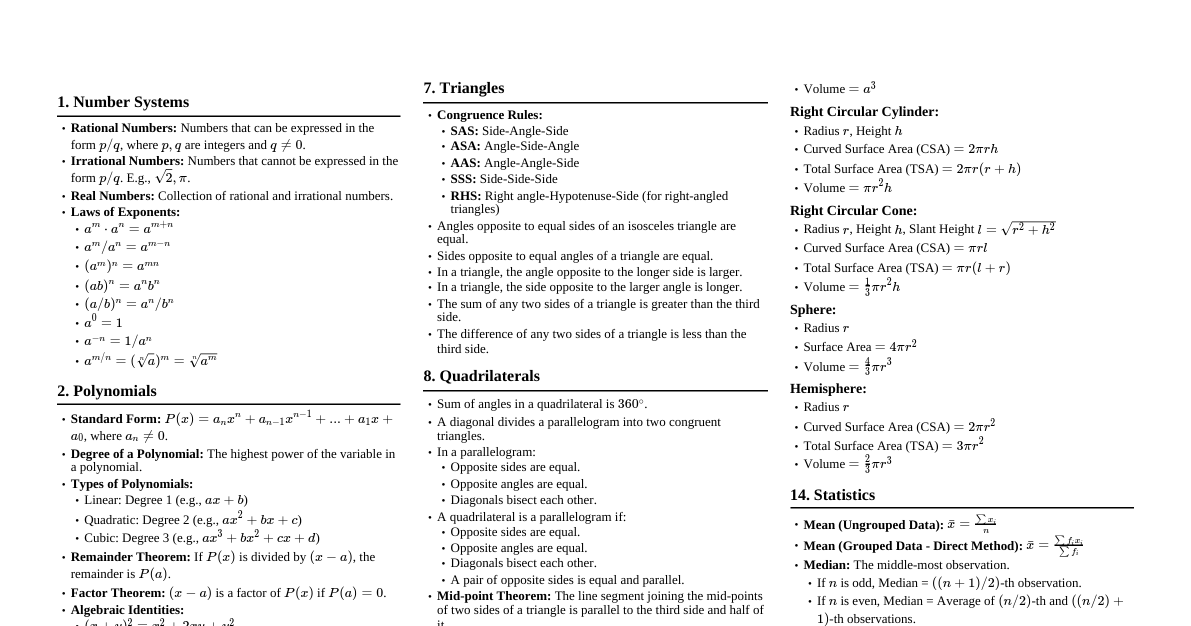
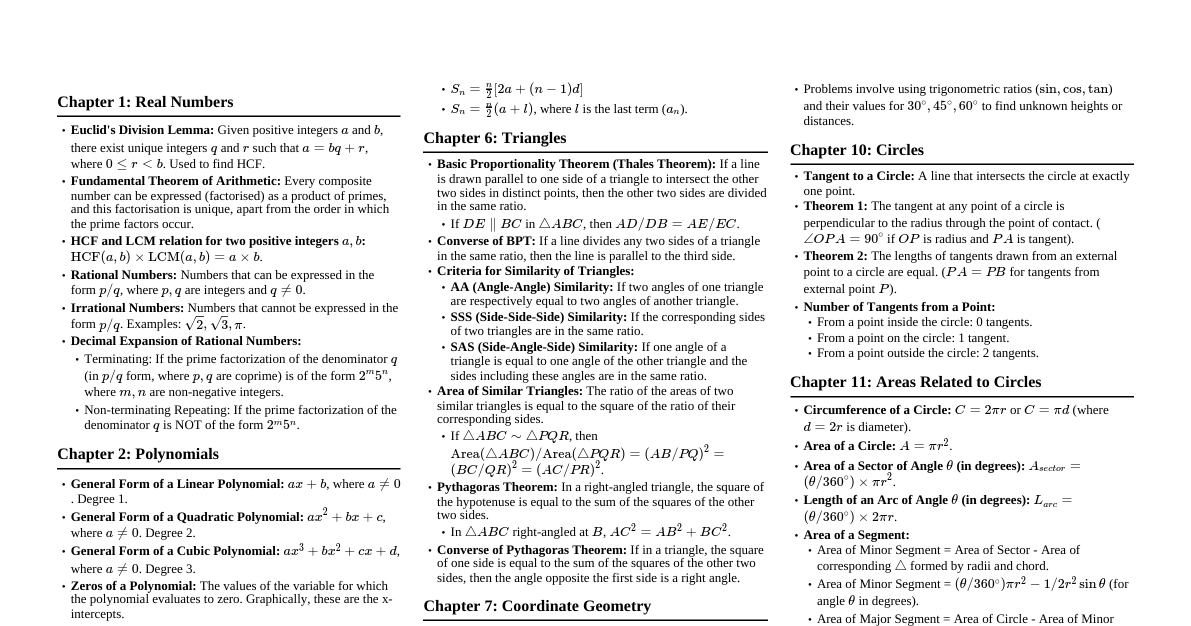
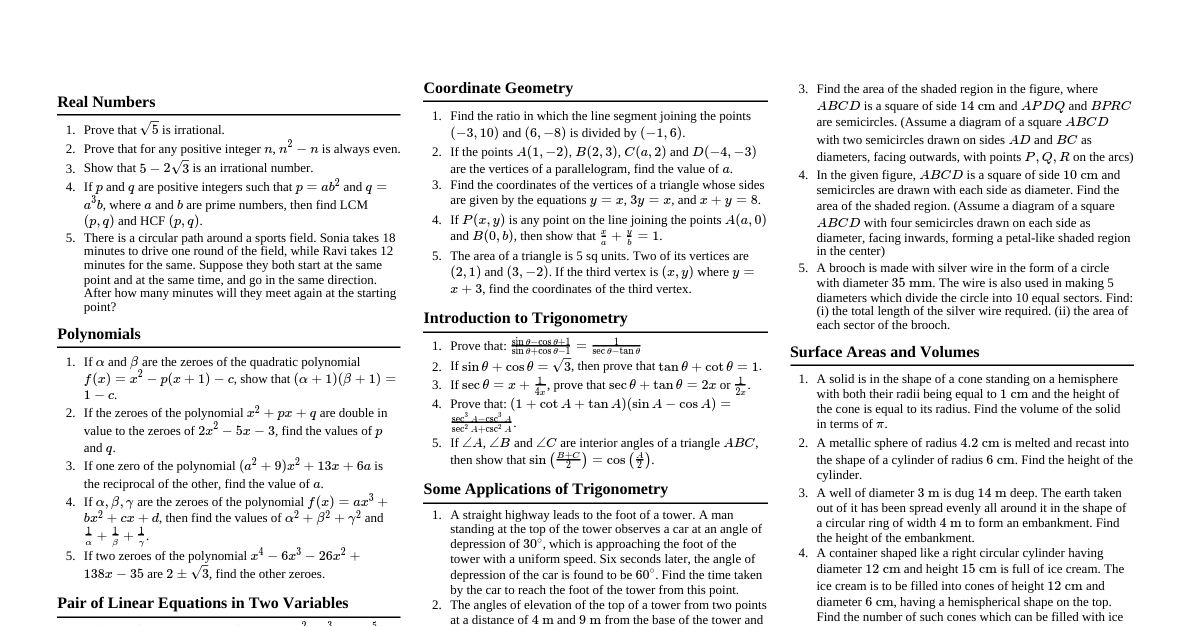
### 1. Real Numbers - **Euclid's Division Lemma:** $a = bq + r$, where $0 \le r ### 2. Polynomials - **General Form of a Quadratic Polynomial:** $ax^2 + bx + c$, where $a \ne 0$. - **Zeros of a Polynomial:** Values of $x$ for which $P(x) = 0$. - **Relationship between Zeros and Coefficients (for Quadratic Polynomial $ax^2 + bx + c$):** - Sum of zeros ($\alpha + \beta$) = $-b/a$ - Product of zeros ($\alpha \beta$) = $c/a$ - **Forming a Quadratic Polynomial:** $x^2 - (\text{sum of zeros})x + (\text{product of zeros})$ - **General Form of a Cubic Polynomial:** $ax^3 + bx^2 + cx + d$, where $a \ne 0$. - **Relationship between Zeros and Coefficients (for Cubic Polynomial $ax^3 + bx^2 + cx + d$):** - Sum of zeros ($\alpha + \beta + \gamma$) = $-b/a$ - Sum of products of zeros taken two at a time ($\alpha\beta + \beta\gamma + \gamma\alpha$) = $c/a$ - Product of zeros ($\alpha\beta\gamma$) = $-d/a$ - **Division Algorithm:** $P(x) = G(x) \cdot Q(x) + R(x)$, where $R(x) = 0$ or $\text{deg}(R(x)) ### 3. Pair of Linear Equations in Two Variables - **General Form:** $a_1x + b_1y + c_1 = 0$ and $a_2x + b_2y + c_2 = 0$. - **Conditions for Solutions:** - **Intersecting Lines (Unique Solution):** $\mathbf{a_1/a_2 \ne b_1/b_2}$ - **Coincident Lines (Infinitely Many Solutions):** $\mathbf{a_1/a_2 = b_1/b_2 = c_1/c_2}$ - **Parallel Lines (No Solution):** $\mathbf{a_1/a_2 = b_1/b_2 \ne c_1/c_2}$ - **Methods of Solving:** Substitution, Elimination, Cross-Multiplication. - **Cross-Multiplication Formula:** $\frac{x}{b_1c_2 - b_2c_1} = \frac{y}{c_1a_2 - c_2a_1} = \frac{1}{a_1b_2 - a_2b_1}$ ### 4. Quadratic Equations - **General Form:** $ax^2 + bx + c = 0$, where $a \ne 0$. - **Quadratic Formula (Shreedharacharya's Formula):** $\mathbf{x = \frac{-b \pm \sqrt{b^2 - 4ac}}{2a}}$ - **Discriminant (D):** $\mathbf{D = b^2 - 4ac}$ - **Nature of Roots:** - If $\mathbf{D > 0}$: Two distinct real roots. - If $\mathbf{D = 0}$: Two equal real roots. - If $\mathbf{D ### 5. Arithmetic Progressions (AP) - **General Form:** $a, a+d, a+2d, ...$ - **$n^{th}$ Term ($a_n$):** $\mathbf{a_n = a + (n-1)d}$ - $a$: first term, $d$: common difference, $n$: number of terms. - **Sum of First $n$ Terms ($S_n$):** - $\mathbf{S_n = \frac{n}{2}[2a + (n-1)d]}$ - $\mathbf{S_n = \frac{n}{2}[a + l]}$ (where $l = a_n$ is the last term) - **Common Difference ($d$):** $a_2 - a_1$ or $a_n - a_{n-1}$ - **$n^{th}$ term from the end:** $l - (n-1)d$ ### 6. Triangles - **Similarity Criteria:** - **AAA (Angle-Angle-Angle):** If corresponding angles are equal. - **SSS (Side-Side-Side):** If corresponding sides are proportional. - **SAS (Side-Angle-Side):** If one angle is equal and sides including the angle are proportional. - **Basic Proportionality Theorem (BPT) / Thales Theorem:** If a line is drawn parallel to one side of a triangle to intersect the other two sides in distinct points, the other two sides are divided in the same ratio. - If DE || BC, then $\mathbf{AD/DB = AE/EC}$ - **Area of Similar Triangles:** If $\triangle ABC \sim \triangle PQR$, then $\mathbf{\frac{Area(\triangle ABC)}{Area(\triangle PQR)} = (\frac{AB}{PQ})^2 = (\frac{BC}{QR})^2 = (\frac{CA}{RP})^2}$ - **Pythagoras Theorem:** In a right-angled triangle, $\mathbf{(\text{Hypotenuse})^2 = (\text{Base})^2 + (\text{Perpendicular})^2}$. - Converse also true. ### 7. Coordinate Geometry - **Distance Formula:** Distance between $P(x_1, y_1)$ and $Q(x_2, y_2)$ is $\mathbf{\sqrt{(x_2 - x_1)^2 + (y_2 - y_1)^2}}$. - **Section Formula (Internal Division):** Coordinates of point $P(x, y)$ that divides the line segment joining $A(x_1, y_1)$ and $B(x_2, y_2)$ in the ratio $m_1:m_2$ are: - $\mathbf{x = \frac{m_1x_2 + m_2x_1}{m_1 + m_2}}$ - $\mathbf{y = \frac{m_1y_2 + m_2y_1}{m_1 + m_2}}$ - **Mid-point Formula:** Coordinates of the mid-point are $\mathbf{(\frac{x_1 + x_2}{2}, \frac{y_1 + y_2}{2})}$. - **Area of a Triangle:** For a triangle with vertices $(x_1, y_1)$, $(x_2, y_2)$, and $(x_3, y_3)$: - $\mathbf{\text{Area} = \frac{1}{2} |x_1(y_2 - y_3) + x_2(y_3 - y_1) + x_3(y_1 - y_2)|}$ - If area = 0, the points are collinear. ### 8. Introduction to Trigonometry - **Trigonometric Ratios (SOH CAH TOA):** - $\mathbf{\sin \theta = \frac{\text{Opposite}}{\text{Hypotenuse}}}$ - $\mathbf{\cos \theta = \frac{\text{Adjacent}}{\text{Hypotenuse}}}$ - $\mathbf{\tan \theta = \frac{\text{Opposite}}{\text{Adjacent}}}$ - $\mathbf{\csc \theta = \frac{1}{\sin \theta}}$ - $\mathbf{\sec \theta = \frac{1}{\cos \theta}}$ - $\mathbf{\cot \theta = \frac{1}{\tan \theta}}$ - **Relationship between Ratios:** - $\mathbf{\tan \theta = \frac{\sin \theta}{\cos \theta}}$ - $\mathbf{\cot \theta = \frac{\cos \theta}{\sin \theta}}$ - **Trigonometric Ratios of Complementary Angles:** - $\sin(90^\circ - \theta) = \cos \theta$ - $\cos(90^\circ - \theta) = \sin \theta$ - $\tan(90^\circ - \theta) = \cot \theta$ - $\cot(90^\circ - \theta) = \tan \theta$ - $\sec(90^\circ - \theta) = \csc \theta$ - $\csc(90^\circ - \theta) = \sec \theta$ - **Standard Trigonometric Values:** | $\theta$ | $0^\circ$ | $30^\circ$ | $45^\circ$ | $60^\circ$ | $90^\circ$ | |-----------------|-----------|------------------------|------------------------|------------------------|------------| | $\sin \theta$ | $0$ | $1/2$ | $1/\sqrt{2}$ | $\sqrt{3}/2$ | $1$ | | $\cos \theta$ | $1$ | $\sqrt{3}/2$ | $1/\sqrt{2}$ | $1/2$ | $0$ | | $\tan \theta$ | $0$ | $1/\sqrt{3}$ | $1$ | $\sqrt{3}$ | Undefined | ### 9. Trigonometric Identities - $\mathbf{\sin^2 \theta + \cos^2 \theta = 1}$ - $\mathbf{1 + \tan^2 \theta = \sec^2 \theta}$ (for $0^\circ \le \theta ### 10. Some Applications of Trigonometry (Heights and Distances) - **Angle of Elevation:** Angle formed by the line of sight with the horizontal when looking UP. - **Angle of Depression:** Angle formed by the line of sight with the horizontal when looking DOWN. - **Key Idea:** Use $\sin, \cos, \tan$ ratios to find unknown heights or distances, forming right-angled triangles. ### 11. Circles - **Tangent to a Circle:** A line that intersects the circle at exactly one point. - **Theorem 1:** The tangent at any point of a circle is perpendicular to the radius through the point of contact. ($\mathbf{OP \perp AB}$) - **Theorem 2:** The lengths of tangents drawn from an external point to a circle are equal. ($\mathbf{PA = PB}$) - Number of tangents: - From a point inside: 0 - From a point on the circle: 1 - From a point outside: 2 ### 12. Constructions - **Key Ideas:** - Division of a line segment in a given ratio (internally). - Construction of a triangle similar to a given triangle with a given scale factor. - Construction of tangents to a circle from an external point. - **Steps:** Involve using ruler and compass accurately. No formulas, but understanding the steps is crucial. ### 13. Areas Related to Circles - **Circumference of a Circle:** $\mathbf{2\pi r}$ - **Area of a Circle:** $\mathbf{\pi r^2}$ - **Area of a Sector of Angle $\theta$:** $\mathbf{\frac{\theta}{360^\circ} \times \pi r^2}$ - **Length of an Arc of a Sector of Angle $\theta$:** $\mathbf{\frac{\theta}{360^\circ} \times 2\pi r}$ - **Area of a Segment:** Area of sector - Area of corresponding triangle. - For angle $\theta$ in degrees: $\frac{\theta}{360^\circ} \pi r^2 - \frac{1}{2} r^2 \sin \theta$ - **Area of a Quadrant:** $\frac{1}{4} \pi r^2$ ### 14. Surface Areas and Volumes - **Cuboid:** - Lateral Surface Area (LSA): $2h(l+b)$ - Total Surface Area (TSA): $2(lb + bh + hl)$ - Volume: $lbh$ - **Cube:** - LSA: $4a^2$ - TSA: $6a^2$ - Volume: $a^3$ - **Cylinder:** - Curved Surface Area (CSA): $2\pi rh$ - TSA: $2\pi r(r+h)$ - Volume: $\pi r^2 h$ - **Cone:** - CSA: $\pi rl$ (where $l = \sqrt{r^2 + h^2}$ is slant height) - TSA: $\pi r(r+l)$ - Volume: $\frac{1}{3}\pi r^2 h$ - **Sphere:** - Surface Area: $4\pi r^2$ - Volume: $\frac{4}{3}\pi r^3$ - **Hemisphere:** - CSA: $2\pi r^2$ - TSA: $3\pi r^2$ - Volume: $\frac{2}{3}\pi r^3$ - **Frustum of a Cone:** (If applicable, check syllabus for this year) - Volume: $\frac{1}{3}\pi h (R^2 + r^2 + Rr)$ - CSA: $\pi l (R+r)$, where $l = \sqrt{h^2 + (R-r)^2}$ - TSA: $\pi l (R+r) + \pi R^2 + \pi r^2$ ### 15. Statistics - **Mean ($\bar{x}$):** - **Direct Method:** $\mathbf{\bar{x} = \frac{\sum f_ix_i}{\sum f_i}}$ - **Assumed Mean Method:** $\mathbf{\bar{x} = A + \frac{\sum f_id_i}{\sum f_i}}$, where $d_i = x_i - A$ - **Step-Deviation Method:** $\mathbf{\bar{x} = A + (\frac{\sum f_iu_i}{\sum f_i})h}$, where $u_i = \frac{x_i - A}{h}$ - **Median:** - For grouped data: $\mathbf{\text{Median} = l + (\frac{n/2 - cf}{f})h}$ - $l$: lower limit of median class - $n$: total frequency - $cf$: cumulative frequency of class preceding median class - $f$: frequency of median class - $h$: class size - **Mode:** - For grouped data: $\mathbf{\text{Mode} = l + (\frac{f_1 - f_0}{2f_1 - f_0 - f_2})h}$ - $l$: lower limit of modal class - $f_1$: frequency of modal class - $f_0$: frequency of class preceding modal class - $f_2$: frequency of class succeeding modal class - $h$: class size - **Empirical Relationship:** $\mathbf{3 \text{ Median } = \text{ Mode } + 2 \text{ Mean}}$ - **Cumulative Frequency:** 'less than' and 'more than' ogives used to find median graphically. ### 16. Probability - **Definition:** $\mathbf{P(E) = \frac{\text{Number of favourable outcomes}}{\text{Total number of possible outcomes}}}$ - **Range of Probability:** $\mathbf{0 \le P(E) \le 1}$ - **Sum of Probabilities:** The sum of the probabilities of all elementary events of an experiment is 1. - **Complementary Events:** $\mathbf{P(E) + P(\text{not } E) = 1}$ or $\mathbf{P(E) + P(\bar{E}) = 1}$ - **Impossible Event:** Probability is 0. - **Sure Event:** Probability is 1.