Human Values & Ethics Essentials
Cheatsheet Content
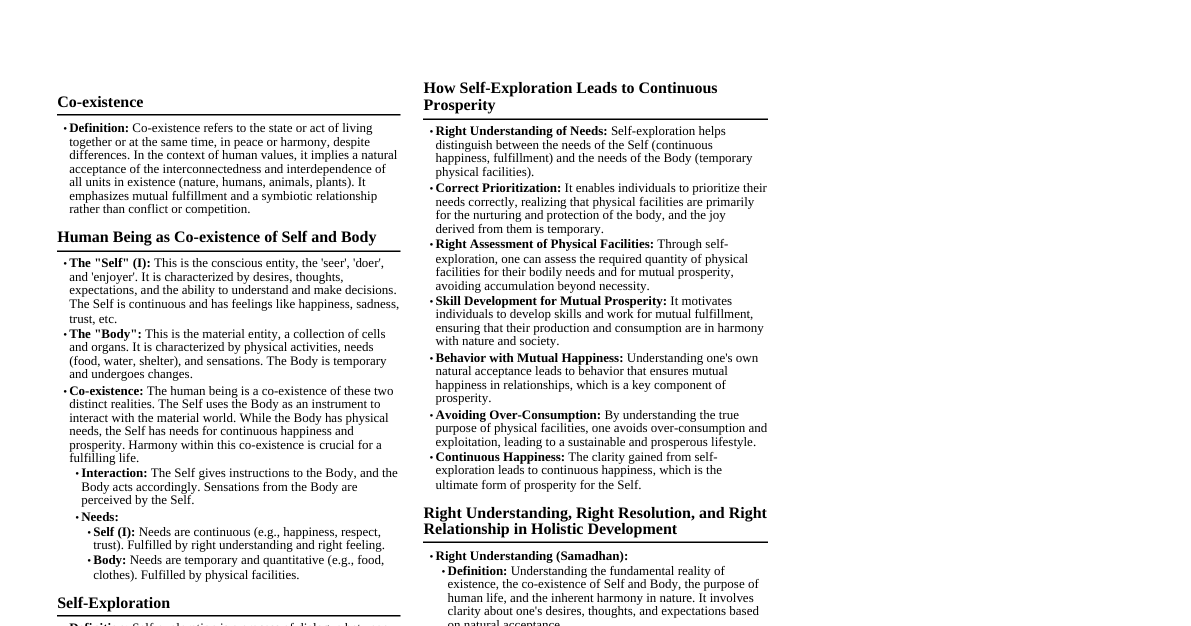
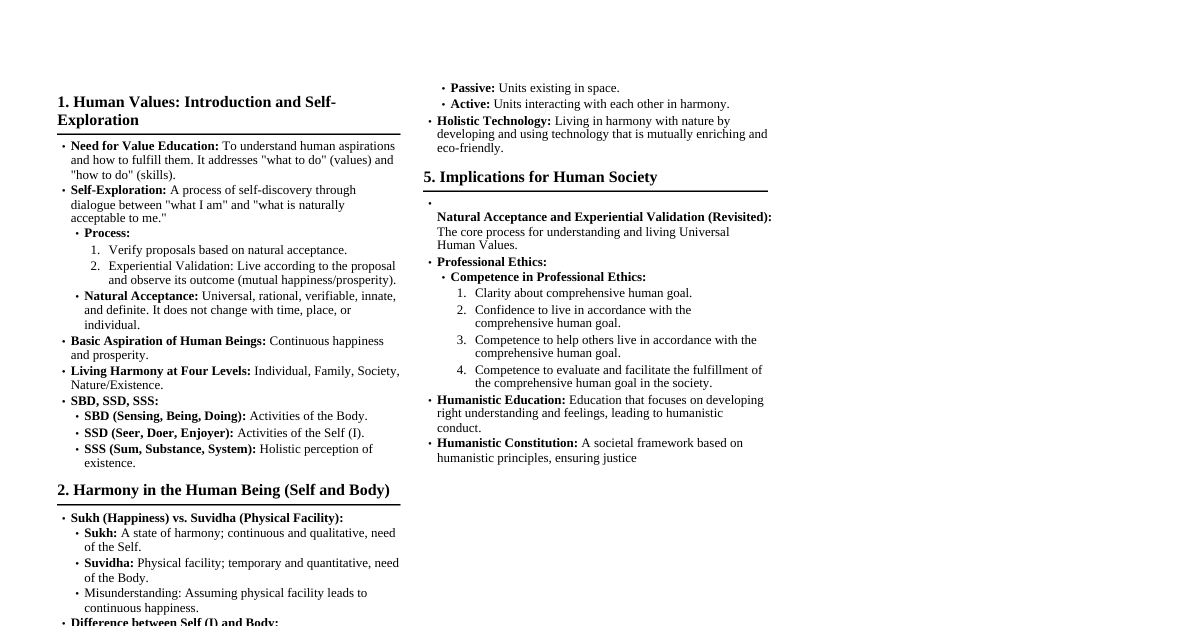
UNIT I: Introduction to Value Education Values, Human Values & Universal Human Values Values: Principles or standards of behavior; one's judgment of what is important in life. Human Values: Values that are conducive to human well-being and happiness (e.g., love, honesty, compassion). Universal Human Values: Values that are true for all human beings, at all times, and in all places (e.g., peace, truth, non-violence, righteousness, love). Need for Value Education: To understand our aspirations and goals. To identify universal values and live in harmony. To ensure peace and prosperity in society. To develop a holistic perspective towards life. Basic Human Aspirations: Happiness & Prosperity Every human being fundamentally desires: Continuous Happiness (सुख): A state of being in harmony, feeling contented and fulfilled. It is a qualitative state. Prosperity (समृद्धि): The feeling of having more than the required physical facilities. It is a quantitative state, but the feeling itself is qualitative. These two are interconnected: right understanding leads to continuous happiness, and prosperity is the feeling of having enough physical facilities, which contributes to happiness. Right Understanding (सही समझ) The process of knowing oneself, the co-existence, and the inherent harmony in existence. It involves understanding the self, the body, and their co-existence, as well as the four orders of nature and their interrelationship. Right understanding is crucial for a correct evaluation of needs and for living in harmony. Self-Exploration (स्व-अनुशीलन) A process of investigating what is true for us, not just what we are told. It is a dialogue between "what I am" and "what I really want to be." Content: Desire (चाहना), Thought (सोचना), Expectation (आशा) – on the basis of natural acceptance. Verification of proposals on the basis of our own natural acceptance. Experiential validation – living according to the proposals and observing the outcome. UNIT II: Understanding Harmony at Various Levels The Knower & The Known Knower: The 'Self' (I) is the knower/seer, as it is the consciousness that experiences and understands. Known: Everything in existence, including the self, the body, and the four orders of nature. Process of Knowing: Contemplation, Understanding, Realization Contemplation (अनुशीलन): Reflecting on proposals, questioning, and mentally exploring them. Understanding (बोध): Achieving clarity and conviction about the truth of a proposal through self-verification and natural acceptance. Realization (अनुभव): Experiencing the truth directly, leading to a definite and unwavering understanding, which becomes part of one's being. Role of Human Being in Existence Human beings have the unique capacity for self-reflection and understanding. Responsible for ensuring harmony at all four levels: self, family, society, and nature. To live with right understanding and fulfill their potential as conscious entities. Need for Co-existence in Four Orders Existence is in the form of co-existence (सह-अस्तित्व) of four orders: Material Order (पदार्थ अवस्था): Soil, minerals, water, air, etc. Plant/Bio Order (प्राण अवस्था): Plants, trees, grass, etc. Animal Order (जीव अवस्था): Animals, birds, insects. Human Order (ज्ञान अवस्था): Human beings. All orders are interconnected and mutually fulfilling. Humans have a responsibility to understand this interdependence and live in harmony with all other orders. UNIT III: Harmony in the Human Being Human Being: Co-existence of Self (I) & Body (शरीर) Human being is a co-existence of two distinct entities: Self (I): The conscious entity, the 'seer', 'doer', and 'experiencer'. It is continuous and unchanging. Body (शरीर): The material entity, an instrument of the Self. It is temporary and undergoes changes. Harmony between the Self and Body is essential for a happy and healthy life. Activities in Self, Body & Both Activities in the Self (I): Desiring (चाहना), Thinking (सोचना), Expecting (आशा करना) Imagining, Understanding, Realizing These are continuous and qualitative. E.g., feeling happy, deciding to learn. Activities in the Body (शरीर): Breathing, digesting, blood circulation. These are physico-chemical, temporary, and quantitative. E.g., eating, walking. Activities involving Both (Self & Body): Seeing (Self sees through eyes), Hearing (Self hears through ears) Walking (Self decides, body walks), Eating (Self desires, body consumes) These are interactions where the body acts as an instrument for the Self. Harmony in the Self (Individual) Harmony in the Self means alignment between one's desires, thoughts, and expectations with one's natural acceptance. It involves achieving "Right Understanding" which leads to a state of inner peace and fulfillment. When there is contradiction in the Self (e.g., desire for peace but act aggressively), it leads to unhappiness. UNIT IV: Harmony in Nature Harmony in Nature & Its Significance Harmony in Nature: The inherent order, balance, and interconnectedness observed in the natural world. Everything in nature is self-regulated and mutually fulfilling. Significance: Ensures sustainability and balance of ecosystems. Provides resources for all orders of existence. Humans need to understand and live in accordance with this harmony to ensure their own well-being and the well-being of the planet. Four Orders of Nature & Their Interdependence Material Order: Non-living things (soil, air, water, metals). Cyclic in nature. Relationship: Composition-Decomposition. Plant/Bio Order: Plants, trees. Cyclic in nature. Relationship: Nurturing-Worsening. Animal Order: Animals, birds. Cyclic, but with consciousness at a basic level. Relationship: Breed-Race. Human Order: Human beings. Both body (cyclic) and self (continuous). Relationship: Right understanding-Right living. All orders are interdependent and mutually enriching. For example, plants purify air for animals and humans, and humans can protect and enrich all other orders. UNIT V: Harmony in Society & Universal Human Order Human Consciousness vs. Animal Consciousness Animal Consciousness: Primarily driven by physical needs and sensations (e.g., hunger, fear, sleep, mating). Programmed for self-preservation and procreation. Absence of "Right Understanding" and "Natural Acceptance". Human Consciousness: Capacity for "Right Understanding" and "Self-realization". Ability to think, analyze, and make choices based on values. Aspirations for continuous happiness and prosperity, not just physical survival. Driven by natural acceptance and the desire for harmony at all levels. Comprehensive Human Goal (सर्वमानव लक्ष्य) The comprehensive human goal encompasses: Right Understanding (सही समझ): In every individual. Prosperity (समृद्धि): In every family. Fearlessness (अभय): In society (trust). Co-existence (सह-अस्तित्व): In nature (with all orders). Comprehensiveness: This goal is comprehensive because: It addresses all dimensions of human existence (individual, family, society, nature). It leads to universal well-being and fulfillment for all. It is naturally acceptable to all human beings. Harmony at All Four Levels 1. Harmony in the Individual: Right understanding in the Self and harmony with the Body. 2. Harmony in the Family: Trust, respect, affection, care, guidance towards mutual fulfillment. 3. Harmony in Society: Fearlessness (trust) among people, leading to an undivided society (अखंड समाज) and universal human order (सार्वभौम व्यवस्था). 4. Harmony in Nature/Existence: Co-existence with all four orders, ensuring mutual enrichment and sustainability. Definitiveness of Ethical Human Conduct Ethical human conduct is that which leads to harmony at all four levels. It is definite, universal, and continuous, based on "right understanding" and "natural acceptance." Ensuring it: Through Value Education and Self-Exploration. Living with right understanding, leading to definite human conduct. Developing competence to live in harmony with self, family, society, and nature.