Chemistry: Equilibrium
Cheatsheet Content
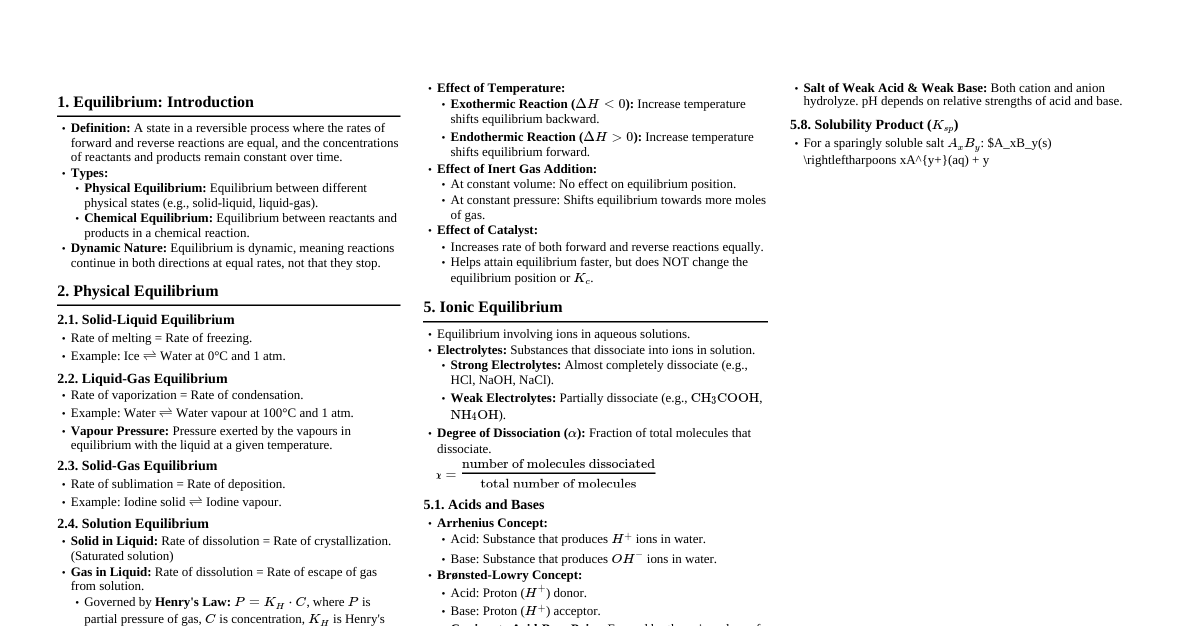
### Introduction to Equilibrium - **Reversible Reactions:** Reactions that proceed in both forward and reverse directions simultaneously. - Represented by double arrows: $A + B \rightleftharpoons C + D$ - **Dynamic Equilibrium:** A state where the rate of the forward reaction equals the rate of the reverse reaction. - Concentrations of reactants and products remain constant, but the reactions are still occurring. ### Law of Mass Action & Equilibrium Constant ($K_c$) - **Law of Mass Action:** At a given temperature, the ratio of product of molar concentrations of products to that of reactants, with each concentration term raised to the power of its stoichiometric coefficient, is constant. - For a general reversible reaction: $aA + bB \rightleftharpoons cC + dD$ - **Equilibrium Constant, $K_c$**: $$K_c = \frac{[C]^c[D]^d}{[A]^a[B]^b}$$ - Square brackets denote molar concentrations (mol/L). - $K_c$ is constant at a given temperature. ### Equilibrium Constant for Gaseous Reactions ($K_p$) - For gaseous reactions, partial pressures can be used instead of molar concentrations. - **Partial Pressure:** Pressure exerted by individual gas in a mixture. - **Relationship between $K_p$ and $K_c$**: $$K_p = K_c(RT)^{\Delta n_g}$$ - $R$ = gas constant ($0.0831 \text{ L bar K}^{-1} \text{ mol}^{-1}$) - $T$ = temperature in Kelvin - $\Delta n_g$ = (moles of gaseous products) - (moles of gaseous reactants) ### Characteristics of Equilibrium Constant - $K_c$ is constant for a reaction at a specific temperature. - If $K_c > 10^3$: Products largely favored, reaction proceeds almost to completion. - If $K_c ### Reaction Quotient ($Q_c$) - **Definition:** Calculated similarly to $K_c$, but using non-equilibrium concentrations. $$Q_c = \frac{[C]^c[D]^d}{[A]^a[B]^b} \text{ (at any time 't')}$$ - **Predicting Reaction Direction:** - If $Q_c K_c$: Net reaction proceeds in the reverse direction. - If $Q_c = K_c$: System is at equilibrium. ### Le Chatelier's Principle - **Statement:** If a change of condition (temperature, pressure, concentration) is applied to a system in equilibrium, the system will shift in a direction that counteracts the change. #### Effect of Concentration Change - **Adding reactant:** Equilibrium shifts to the right (forward direction). - **Removing reactant:** Equilibrium shifts to the left (reverse direction). - **Adding product:** Equilibrium shifts to the left (reverse direction). - **Removing product:** Equilibrium shifts to the right (forward direction). #### Effect of Pressure Change (for gaseous reactions) - **Increasing pressure:** Equilibrium shifts to the side with fewer moles of gas. - **Decreasing pressure:** Equilibrium shifts to the side with more moles of gas. - **Adding inert gas (at constant volume):** No effect on equilibrium. #### Effect of Temperature Change - **For Endothermic Reactions ($\Delta H > 0$):** - Increasing temperature: Equilibrium shifts to the right (forward direction). - Decreasing temperature: Equilibrium shifts to the left (reverse direction). - **For Exothermic Reactions ($\Delta H ### Ionic Equilibrium (Acids, Bases & Salts) #### Acids and Bases - **Arrhenius Concept:** - **Acid:** Substance that produces $H^+$ ions in water. - **Base:** Substance that produces $OH^-$ ions in water. - **Brønsted-Lowry Concept:** - **Acid:** Proton ($H^+$) donor. - **Base:** Proton ($H^+$) acceptor. - **Conjugate Acid-Base Pair:** An acid and a base that differ by a proton. - $HA \rightleftharpoons H^+ + A^-$ (HA is acid, $A^-$ is conjugate base) - $B + H^+ \rightleftharpoons BH^+$ (B is base, $BH^+$ is conjugate acid) - **Lewis Concept:** - **Acid:** Electron pair acceptor. - **Base:** Electron pair donor. #### Ionization of Acids and Bases - **Strong Acids/Bases:** Ionize almost completely in water. - E.g., $HCl \rightarrow H^+ + Cl^-$ - **Weak Acids/Bases:** Ionize partially in water. - **Acid Ionization Constant ($K_a$):** For $HA \rightleftharpoons H^+ + A^-$ $$K_a = \frac{[H^+][A^-]}{[HA]}$$ - **Base Ionization Constant ($K_b$):** For $BOH \rightleftharpoons B^+ + OH^-$ $$K_b = \frac{[B^+][OH^-]}{[BOH]}$$ - **Relationship between $K_a$ and $K_b$ for a conjugate pair:** $K_a \times K_b = K_w$ #### Ionization of Water & pH Scale - **Autoionization of Water:** $H_2O + H_2O \rightleftharpoons H_3O^+ + OH^-$ - **Ionic Product of Water ($K_w$):** At $25^\circ C$, $K_w = [H_3O^+][OH^-] = 1.0 \times 10^{-14}$ - **pH Scale:** - $pH = -\log[H^+]$ - $pOH = -\log[OH^-]$ - $pH + pOH = 14$ (at $25^\circ C$) - **Nature of Solutions:** - $pH 7$: Basic #### Hydrolysis of Salts - **Hydrolysis:** Reaction of a salt with water, leading to acidic, basic, or neutral solutions. - **Salts of Strong Acid & Strong Base:** No hydrolysis, neutral solution ($pH=7$). Ex: NaCl - **Salts of Strong Acid & Weak Base:** Cation hydrolysis, acidic solution ($pH 7$). Ex: $CH_3COONa$ - $CH_3COO^- + H_2O \rightleftharpoons CH_3COOH + OH^-$ - **Salts of Weak Acid & Weak Base:** Both cation and anion hydrolysis. pH depends on relative $K_a$ and $K_b$ of conjugate acid/base. #### Buffer Solutions - **Definition:** Solutions that resist changes in pH upon addition of small amounts of acid or base. - **Types:** - **Acidic Buffer:** Weak acid + its salt with a strong base (e.g., $CH_3COOH + CH_3COONa$) - **Basic Buffer:** Weak base + its salt with a strong acid (e.g., $NH_4OH + NH_4Cl$) - **Henderson-Hasselbalch Equation:** - For acidic buffer: $pH = pK_a + \log \frac{[\text{Salt}]}{[\text{Acid}]}$ - For basic buffer: $pOH = pK_b + \log \frac{[\text{Salt}]}{[\text{Base}]}$ #### Solubility Product ($K_{sp}$) - **Definition:** For a sparingly soluble salt, the product of the concentrations of its ions in a saturated solution, each raised to the power of its stoichiometric coefficient. - For $A_xB_y(s) \rightleftharpoons xA^{y+}(aq) + yB^{x-}(aq)$ $$K_{sp} = [A^{y+}]^x[B^{x-}]^y$$ - **Solubility ($s$):** Molar concentration of the salt in a saturated solution. - **Predicting Precipitation:** - **Ion Product ($Q_{sp}$):** Calculated similarly to $K_{sp}$ using non-equilibrium concentrations. - If $Q_{sp} K_{sp}$: Solution is supersaturated, precipitation occurs. - If $Q_{sp} = K_{sp}$: Solution is saturated, equilibrium exists. - **Common Ion Effect:** The solubility of a sparingly soluble salt decreases when a strong electrolyte containing a common ion is added to the solution.