Physics 12th HSC Maharashtra
Cheatsheet Content
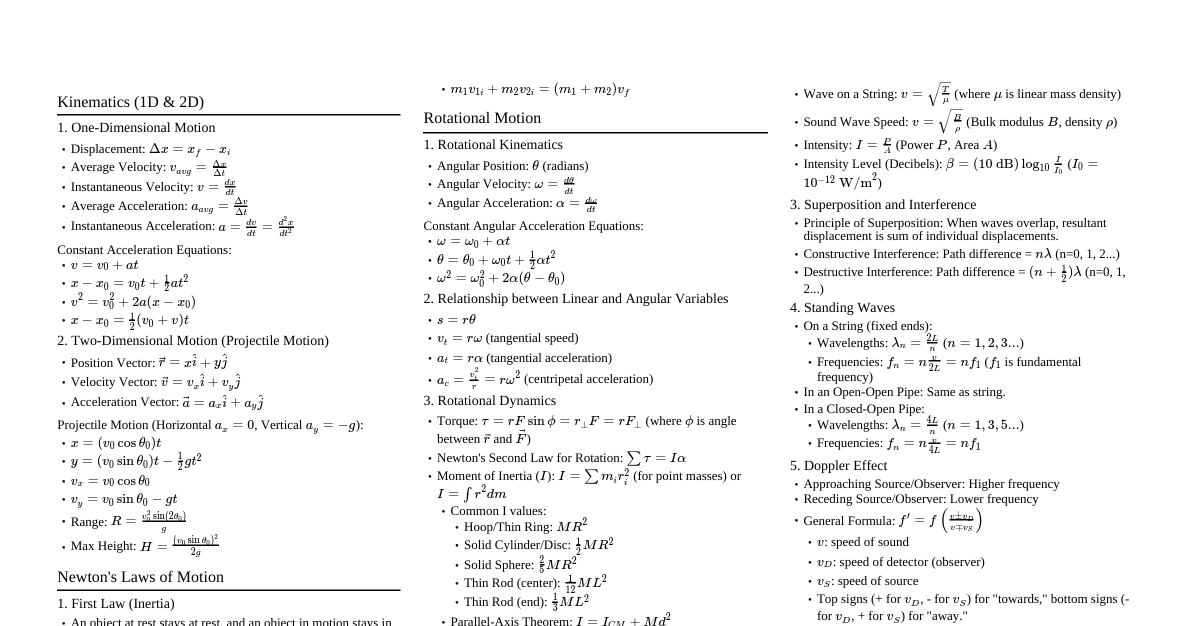
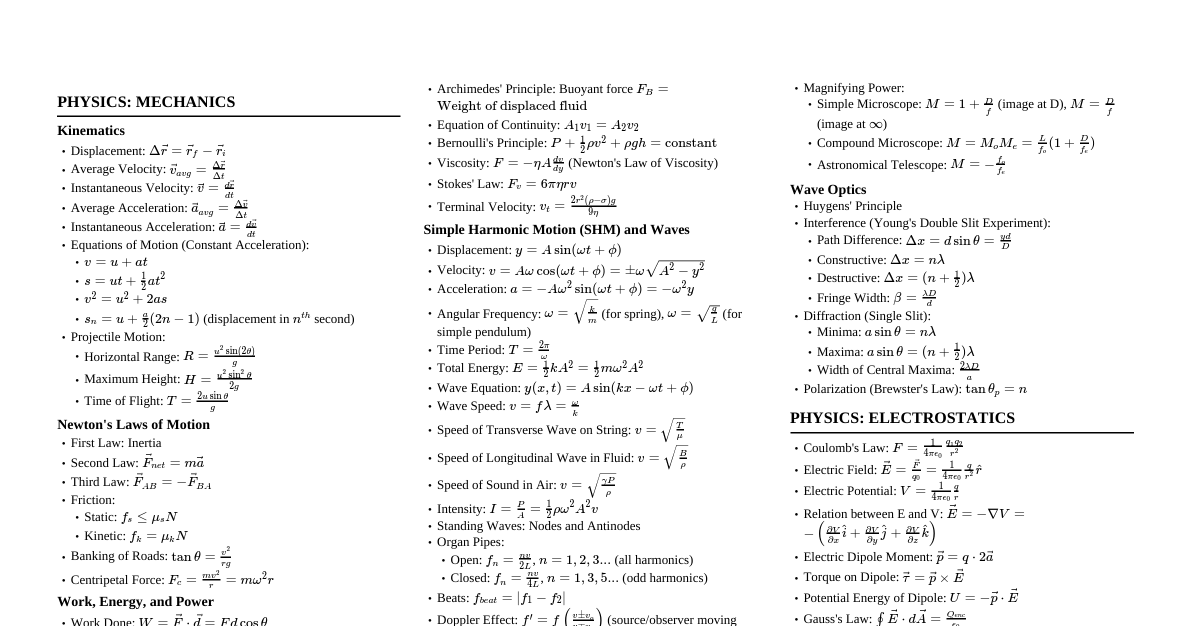
### 1. Rotational Dynamics - **Circular Motion:** - **Angular displacement ($\theta$):** Angle swept by radius vector. - Formula: $\theta = s/r$ (s = arc length, r = radius). Unit: radian (rad). - Use: To describe angular position change. - **Angular velocity ($\omega$):** Rate of change of angular displacement. - Formula: $\omega = d\theta/dt = 2\pi n = 2\pi/T$ (n = frequency, T = period). Unit: rad/s. - Use: To describe how fast an object rotates. - **Angular acceleration ($\alpha$):** Rate of change of angular velocity. - Formula: $\alpha = d\omega/dt$. Unit: rad/s². - Use: To describe how fast angular velocity changes. - **Relations between linear and angular quantities:** - Velocity: $v = r\omega$ - Tangential acceleration: $a_t = r\alpha$ - Centripetal acceleration: $a_c = v^2/r = r\omega^2$ (always directed towards center) - **Dynamics of Circular Motion:** - **Centripetal force ($F_c$):** Force required to keep an object in circular motion. Always directed towards the center. - Formula: $F_c = mv^2/r = m r\omega^2$. Unit: Newton (N). - Use: To calculate the force needed for circular motion (e.g., tension in a string, friction). - **Centrifugal force:** A pseudo force, equal in magnitude and opposite in direction to the centripetal force, experienced in a rotating frame of reference. - Use: Explaining why objects tend to fly outwards. - **Banking of roads:** Tilting the road surface to provide the necessary centripetal force without relying solely on friction. - Formula: $\tan\theta = v^2/(rg)$ (for ideal banking). - Use: To design safe curves for vehicles. - **Conical pendulum:** A mass revolving in a horizontal circle at the end of a string. - Formulas: Vertical component of tension $T\cos\theta = mg$, Horizontal component $T\sin\theta = mv^2/r$. - **Moment of Inertia (I):** A measure of an object's resistance to angular acceleration; rotational analogue of mass. - Definition: $I = \sum m_i r_i^2$ (for discrete particles). Unit: kg·m². - **Parallel axis theorem:** $I = I_{CM} + Mh^2$ (I = moment of inertia about any axis, $I_{CM}$ = moment of inertia about parallel axis through CM, M = total mass, h = distance between axes). - Use: To find moment of inertia about an axis parallel to one passing through the center of mass. - **Perpendicular axis theorem (for planar lamina):** $I_z = I_x + I_y$ (for a planar body, $I_x, I_y$ are MOI about two perpendicular axes in the plane, $I_z$ is MOI about axis perpendicular to plane). - Use: To find moment of inertia of flat objects. - **Torque ($\tau$):** Rotational analogue of force; causes angular acceleration. - Formula: $\tau = rF\sin\theta = I\alpha$. Unit: N·m. - Use: To calculate the rotational effect of a force. - **Angular Momentum (L):** Rotational analogue of linear momentum. - Formula: $L = I\omega = \vec{r} \times \vec{p}$. Unit: kg·m²/s or J·s. - **Conservation of angular momentum:** If net external torque is zero ($\tau_{ext} = 0$), then angular momentum (L) remains constant. - Use: Explaining phenomena like a spinning ice skater. - **Kinetic Energy of Rotation:** Energy associated with rotational motion. - Formula: $KE_{rot} = (1/2)I\omega^2$. Unit: Joule (J). - Use: To calculate energy of rotating objects. - **Rolling Motion:** Combination of translational and rotational motion. - Total Kinetic Energy: $KE_{total} = KE_{trans} + KE_{rot} = (1/2)mv^2 + (1/2)I\omega^2$. - Use: Analyzing motion of wheels, cylinders rolling down inclines. ### 2. Mechanical Properties of Fluids - **Pressure (P):** Force per unit area exerted by a fluid. - Formula: $P = F/A$. Unit: Pascal (Pa) or N/m². - Use: To quantify force exerted by fluids. - **Pascal's Law:** Pressure applied to an enclosed fluid is transmitted undiminished to every portion of the fluid and the walls of the containing vessel. - Use: Principle behind hydraulic brakes and lifts. - **Archimedes' Principle:** When a body is partially or wholly immersed in a fluid, it experiences an upward buoyant force equal to the weight of the fluid displaced by it. - Formula: Buoyant force $F_B = V\rho g$ (V = volume of fluid displaced, $\rho$ = density of fluid, g = acceleration due to gravity). - Use: Explaining flotation, buoyancy. - **Equation of Continuity:** For an incompressible, non-viscous fluid flowing in a pipe, the product of cross-sectional area and fluid speed is constant. - Formula: $A_1v_1 = A_2v_2 = \text{constant}$. - Use: Relating fluid speed to pipe diameter. - **Bernoulli's Principle:** For an ideal fluid in streamline flow, the sum of pressure energy, kinetic energy per unit volume, and potential energy per unit volume is constant. - Formula: $P + (1/2)\rho v^2 + \rho gh = \text{constant}$. - Use: Explaining lift on an airplane wing, fluid flow in pipes. - **Viscosity ($\eta$):** Internal friction within a fluid that resists flow. - Newton's Law of Viscosity: $F = -\eta A (dv/dy)$ (F = viscous force, A = area, $dv/dy$ = velocity gradient). Unit: Poiseuille (Pl) or Pa·s. - **Stokes' Law:** Drag force on a spherical object moving through a viscous fluid. - Formula: $F_v = 6\pi\eta rv$ (r = radius of sphere, v = velocity). - **Terminal velocity ($v_t$):** Constant maximum velocity attained by an object falling through a fluid when viscous drag and buoyant force balance gravitational force. - Formula: $v_t = (2r^2(\rho - \sigma)g)/(9\eta)$ ($\rho$ = density of object, $\sigma$ = density of fluid). - Use: Explaining the fall of raindrops, sedimentation. - **Surface Tension (T):** The property of a liquid surface to behave like a stretched elastic membrane, due to cohesive forces between liquid molecules. - Formula: $T = F/L$ (F = force, L = length). Unit: N/m. - **Surface energy:** Energy stored per unit area of the liquid surface. - Formula: $E = T \cdot A$. - **Angle of contact:** Angle between the tangent to the liquid surface and the solid surface inside the liquid. - **Capillary action:** Rise or fall of a liquid in a narrow tube due to surface tension. - Formula: $h = (2T\cos\theta)/(r\rho g)$ (h = height, r = radius of tube, $\theta$ = angle of contact). - Use: Explaining absorption of water by plants, blotter action. - **Excess Pressure:** Pressure difference across a curved liquid surface. - Liquid drop: $\Delta P = 2T/R$ (R = radius of drop). - Soap bubble: $\Delta P = 4T/R$ (R = radius of bubble). - Use: Explaining why small bubbles are spherical. ### 3. Kinetic Theory of Gases and Radiation - **Kinetic Theory of Gases (K.T.G.):** Explains macroscopic properties of gases based on the motion of their constituent molecules. - **Assumptions:** Gas molecules are point particles, in random motion, collisions are elastic, no intermolecular forces except during collisions. - **Pressure of an ideal gas:** - Formula: $P = (1/3)(\rho \overline{v^2})$ ($\rho$ = density, $\overline{v^2}$ = mean square velocity). - **Average Kinetic Energy per molecule:** Directly proportional to absolute temperature. - Formula: $(1/2)m\overline{v^2} = (3/2)kT$ (k = Boltzmann constant). - **Root mean square (rms) velocity:** Square root of the mean of the squares of the velocities of the individual molecules. - Formula: $v_{rms} = \sqrt{3RT/M_0} = \sqrt{3kT/m}$ (R = gas constant, $M_0$ = molar mass, m = molecular mass). - **Degrees of freedom (f):** Number of independent ways in which a molecule can possess energy (translational, rotational, vibrational). - **Law of equipartition of energy:** For any system in thermal equilibrium, the total energy is distributed equally among its degrees of freedom, with each degree of freedom having an average energy of $(1/2)kT$. - **Internal energy (U):** Total energy of the molecules. - Formula: $U = (f/2)nRT$. - **Specific Heat Capacities:** - **Mayer's relation:** $C_P - C_V = R$ ($C_P$ = specific heat at constant pressure, $C_V$ = specific heat at constant volume, R = gas constant). - **Ratio of specific heats ($\gamma$):** $\gamma = C_P/C_V$. - Values for different gases: - Monatomic gas (f=3): $C_V = (3/2)R$, $C_P = (5/2)R$, $\gamma = 5/3$. - Diatomic gas (f=5): $C_V = (5/2)R$, $C_P = (7/2)R$, $\gamma = 7/5$. - **Radiation:** Energy transfer through electromagnetic waves. - **Blackbody:** An ideal body that absorbs all incident radiation and emits maximum possible radiation at any given temperature. - **Wien's Displacement Law:** The wavelength at which a blackbody emits maximum radiation is inversely proportional to its absolute temperature. - Formula: $\lambda_{max}T = b$ ($b$ = Wien's constant). - Use: Determining surface temperature of stars. - **Stefan-Boltzmann Law:** Total energy radiated per unit surface area of a blackbody per unit time is directly proportional to the fourth power of its absolute temperature. - Formula: $E = \sigma T^4$ (for blackbody), $E = e\sigma T^4$ (for ordinary body, $e$ = emissivity). $\sigma$ = Stefan-Boltzmann constant. - Use: Calculating heat loss from hot bodies. - **Newton's Law of Cooling:** The rate of cooling of a body is directly proportional to the temperature difference between the body and its surroundings, provided the difference is small. - Formula: Rate of cooling $\propto (T - T_0)$. ### 4. Thermodynamics - **Zeroth Law of Thermodynamics:** If two systems are each in thermal equilibrium with a third system, then they are in thermal equilibrium with each other. - Use: Basis for temperature measurement. - **First Law of Thermodynamics:** Energy can neither be created nor destroyed, only transformed from one form to another. It's the law of conservation of energy applied to thermal systems. - Formula: $\Delta U = Q - W$ - $\Delta U$: Change in internal energy of the system. - $Q$: Heat supplied *to* the system (positive if absorbed, negative if released). - $W$: Work done *by* the system (positive if done by system, negative if done on system). - Use: Analyzing energy changes in various thermodynamic processes. - **Thermodynamic Processes:** Changes in the state of a system. - **Isothermal process:** Temperature (T) remains constant. - Characteristics: $\Delta U = 0$, $Q = W$. - Formula for work: $W = nRT \ln(V_f/V_i)$. - Use: Phase changes, slow expansions. - **Adiabatic process:** No heat exchange with surroundings ($Q = 0$). - Characteristics: $\Delta U = -W$. - Formulas: $PV^\gamma = \text{constant}$, $T V^{\gamma-1} = \text{constant}$. - Use: Rapid expansions/compressions (e.g., sound propagation, diesel engine). - **Isobaric process:** Pressure (P) remains constant. - Formula for work: $W = P(V_f - V_i)$. - Use: Heating water in an open container. - **Isochoric process:** Volume (V) remains constant. - Characteristics: $W = 0$, $\Delta U = Q$. - Use: Heating gas in a sealed container. - **Second Law of Thermodynamics:** Defines the direction of spontaneous processes and concept of entropy. - **Clausius statement:** Heat cannot flow spontaneously from a colder body to a hotter body. - **Kelvin-Planck statement:** It is impossible to construct a heat engine that operates in a cycle and produces no other effect than the extraction of heat from a reservoir and the performance of an equivalent amount of work. - Use: Explaining efficiency limits of heat engines and refrigerators. - **Carnot Engine:** A theoretical reversible heat engine, operating between two temperatures, that has the maximum possible efficiency. - **Efficiency ($\eta$):** - Formula: $\eta = 1 - T_C/T_H = 1 - Q_C/Q_H$ ($T_C$ = cold reservoir temp, $T_H$ = hot reservoir temp). - Use: Setting theoretical upper limit for engine efficiency. - **Coefficient of performance (COP) for refrigerator:** - Formula: $COP = Q_C/(Q_H - Q_C) = T_C/(T_H - T_C)$. - Use: Measuring efficiency of refrigerators and heat pumps. ### 5. Oscillations - **Simple Harmonic Motion (SHM):** A periodic motion where the restoring force is directly proportional to the displacement from the equilibrium position and acts in the opposite direction. - **Displacement (x):** Position of the oscillating particle. - Formula: $x = A\sin(\omega t + \phi)$ (A = amplitude, $\omega$ = angular frequency, $\phi$ = initial phase). - **Velocity (v):** Rate of change of displacement. - Formula: $v = A\omega\cos(\omega t + \phi) = \omega\sqrt{A^2 - x^2}$. - **Acceleration (a):** Rate of change of velocity. - Formula: $a = -A\omega^2\sin(\omega t + \phi) = -\omega^2 x$. - **Angular frequency ($\omega$):** Related to the frequency of oscillation. - Formula: $\omega = \sqrt{k/m}$ (k = spring constant, m = mass). - **Time period (T):** Time taken for one complete oscillation. - Formula: $T = 2\pi/\omega = 2\pi\sqrt{m/k}$. - **Frequency (f):** Number of oscillations per unit time. $f = 1/T$. - Use: Describing motion of a mass on a spring, simple pendulum. - **Energy in SHM:** - **Kinetic energy (KE):** - Formula: $KE = (1/2)mv^2 = (1/2)m\omega^2(A^2 - x^2)$. - **Potential energy (PE):** - Formula: $PE = (1/2)kx^2 = (1/2)m\omega^2 x^2$. - **Total energy (E):** Remains constant in ideal SHM. - Formula: $E = KE + PE = (1/2)kA^2 = (1/2)m\omega^2 A^2$. - **Simple Pendulum:** A point mass suspended by an inextensible string from a rigid support, oscillating under gravity. - **Time period:** - Formula: $T = 2\pi\sqrt{L/g}$ (for small angles, L = length of pendulum). - Use: Measuring 'g'. - **Spring-Mass System:** A mass attached to a spring, undergoing SHM. - **Time period:** - Formula: $T = 2\pi\sqrt{m/k}$. - **Series combination of springs:** $1/k_{eq} = 1/k_1 + 1/k_2 + ...$ - **Parallel combination of springs:** $k_{eq} = k_1 + k_2 + ...$ - **Damped Oscillations:** Oscillations where the amplitude gradually decreases over time due to dissipative forces (e.g., air resistance). - **Forced Oscillations and Resonance:** - **Forced oscillations:** An external periodic force drives the oscillation. - **Resonance:** Occurs when the driving frequency of the external force matches the natural frequency of the oscillating system, leading to a large amplitude of oscillation. - Use: Tuning radios, designing musical instruments. ### 6. Wave Optics - **Huygens' Principle:** A geometric construction for finding the position of a new wavefront from an earlier one. - **Statement:** Every point on a wavefront acts as a source of secondary wavelets that spread out in all directions with the speed of light in that medium. The new wavefront is the envelope of these secondary wavelets. - Use: Explaining reflection, refraction, diffraction. - **Interference:** Superposition of two or more waves resulting in a new wave pattern. - **Coherent sources:** Sources that emit waves with a constant phase difference and same frequency. Essential for sustained interference pattern. - **Path difference ($\Delta x$):** Difference in the distances traveled by two waves from their sources to a point. - **Constructive interference:** Waves meet in phase, resulting in maximum intensity (bright fringe). - Condition: $\Delta x = n\lambda$ (n = 0, 1, 2, ...). - **Destructive interference:** Waves meet out of phase, resulting in minimum intensity (dark fringe). - Condition: $\Delta x = (n + 1/2)\lambda$ (n = 0, 1, 2, ...). - **Young's Double Slit Experiment (YDSE):** Demonstrates wave nature of light through interference. - **Fringe width (W):** Distance between two consecutive bright or dark fringes. - Formula: $W = \lambda D/d$ ($\lambda$ = wavelength, D = distance to screen, d = slit separation). - Use: Measuring wavelength of light. - **Diffraction:** The bending of waves around obstacles or through small apertures. - **Single slit diffraction:** Pattern of bright and dark fringes produced when light passes through a narrow slit. - **Minima (dark fringes):** $a\sin\theta = n\lambda$ (n = 1, 2, ...; a = slit width). - **Maxima (approximate positions for secondary maxima):** $a\sin\theta = (n + 1/2)\lambda$ (n = 1, 2, ...). - **Central maximum width:** $2\lambda D/a$. - **Polarization:** The phenomenon where the oscillations of a transverse wave are restricted to a single plane. - **Unpolarized light:** Vibrations occur in all possible planes perpendicular to the direction of propagation. - **Polarized light:** Vibrations are confined to a single plane. - **Brewster's Law:** When unpolarized light is incident at a specific angle (Brewster's angle, $i_p$) on a transparent surface, the reflected light is completely plane-polarized. - Formula: $\tan i_p = n$ (n = refractive index of the medium). - **Malus' Law:** Describes the intensity of light transmitted through a polarizer when polarized light is incident on it. - Formula: $I = I_0 \cos^2\theta$ ($I_0$ = initial intensity, $\theta$ = angle between transmission axes). - Use: Polaroids in sunglasses, 3D glasses. ### 7. Electrostatics - **Coulomb's Law:** Describes the force between two point charges. - Formula: $F = k |q_1 q_2|/r^2$, where $k = 1/(4\pi\epsilon_0)$ (k = Coulomb's constant, $\epsilon_0$ = permittivity of free space). Unit: N. - Use: Calculating force between charges. - **Electric Field (E):** The region around a charged object where another charged object would experience an electric force. Force per unit positive test charge. - Formula: $E = F/q_0$. Unit: N/C or V/m. - For a point charge: $E = k q/r^2$. - **Electric Potential (V):** Work done per unit positive test charge to move it from infinity to a point in an electric field. - Formula: $V = W/q_0$. Unit: Volt (V) or J/C. - For a point charge: $V = k q/r$. - **Relation between E and V:** $E = -dV/dr$ (Electric field is the negative gradient of potential). - **Electric Dipole:** Two equal and opposite point charges ($+q$ and $-q$) separated by a small distance ($2l$). - **Dipole moment ($\vec{p}$):** A vector quantity from negative to positive charge. - Formula: $p = q(2l)$. Unit: C·m. - **Electric field on axial line:** $E_{axial} = (2kp)/r^3$ (for $r >> l$). - **Electric field on equatorial line:** $E_{equatorial} = -(kp)/r^3$ (for $r >> l$). - **Torque on a dipole in uniform E-field:** $\vec{\tau} = \vec{p} \times \vec{E}$. - **Potential energy of a dipole in uniform E-field:** $U = -\vec{p} \cdot \vec{E}$. - **Gauss's Law:** Relates the electric flux through any closed surface to the net electric charge enclosed within that surface. - Formula: $\Phi_E = \oint \vec{E} \cdot d\vec{A} = Q_{enc}/\epsilon_0$. - Use: Calculating electric fields for symmetric charge distributions. - **Applications:** - Infinite line charge: $E = \lambda/(2\pi\epsilon_0 r)$ ($\lambda$ = linear charge density). - Infinite plane sheet: $E = \sigma/(2\epsilon_0)$ ($\sigma$ = surface charge density). - Charged spherical shell: $E_{out} = kQ/r^2$ (outside), $E_{in} = 0$ (inside). - **Capacitance (C):** The ability of a conductor to store electric charge. Ratio of charge stored to potential difference. - Formula: $C = Q/V$. Unit: Farad (F). - **Parallel plate capacitor:** - Formula: $C = \epsilon_0 A/d$ (A = plate area, d = plate separation). - With dielectric: $C' = KC = K\epsilon_0 A/d$ (K = dielectric constant). - **Energy stored in a capacitor:** - Formula: $U = (1/2)CV^2 = (1/2)QV = (1/2)Q^2/C$. - **Series combination of capacitors:** $1/C_{eq} = 1/C_1 + 1/C_2 + ...$ - **Parallel combination of capacitors:** $C_{eq} = C_1 + C_2 + ...$ ### 8. Current Electricity - **Electric Current (I):** Rate of flow of electric charge. - Formula: $I = dQ/dt = nAve$ (n = number of charge carriers per unit volume, A = cross-sectional area, v = drift velocity, e = charge of electron). Unit: Ampere (A). - **Ohm's Law:** For a conductor at constant temperature, the current flowing through it is directly proportional to the potential difference across its ends. - Formula: $V = IR$ (R = resistance). - **Resistance (R):** Opposition offered by a material to the flow of electric current. - Formula: $R = \rho L/A$ ($\rho$ = resistivity, L = length, A = cross-sectional area). Unit: Ohm ($\Omega$). - **Resistivity ($\rho$):** Intrinsic property of a material, its resistance per unit length and unit cross-sectional area. Inverse of conductivity ($\sigma$). - **Temperature dependence of resistance:** - Formula: $R_T = R_0(1 + \alpha(T - T_0))$ ($\alpha$ = temperature coefficient of resistance). - **Kirchhoff's Laws:** Used for analyzing complex circuits. - **Junction Rule (KCL - Kirchhoff's Current Law):** The algebraic sum of currents entering any junction in a circuit is zero (conservation of charge). - Formula: $\sum I = 0$. - **Loop Rule (KVL - Kirchhoff's Voltage Law):** The algebraic sum of changes in potential around any closed loop in a circuit is zero (conservation of energy). - Formula: $\sum \Delta V = 0$. - **Wheatstone Bridge:** A circuit used for precise measurement of unknown resistance. - **Balanced condition:** $P/Q = R/S$ (When no current flows through the galvanometer). - **Metre Bridge:** A practical application of Wheatstone bridge for determining unknown resistance. - Formula: $X = R(L_x/(100-L_x))$ (X = unknown resistance, R = known resistance, $L_x$ = balancing length). - **Potentiometer:** A device used for measuring unknown EMF, comparing EMFs, and determining internal resistance of a cell. - **Comparison of EMFs:** $E_1/E_2 = L_1/L_2$ ($L_1, L_2$ are balancing lengths). - **Internal resistance:** $r = R(L_1/L_2 - 1)$ (R = external resistance, $L_1$ = balancing length with open circuit, $L_2$ = balancing length with R connected). - **Electrical Power:** Rate at which electrical energy is consumed or produced. - Formula: $P = VI = I^2 R = V^2/R$. Unit: Watt (W). - **Joule's Law of Heating:** The heat produced in a conductor is directly proportional to the square of current, resistance, and time. - Formula: Heat produced $H = I^2 Rt$. Unit: Joule (J). ### 9. Magnetic Effects of Electric Current - **Biot-Savart Law:** Describes the magnetic field produced by a current-carrying element. - Formula: $d\vec{B} = (\mu_0/(4\pi)) (I d\vec{l} \times \hat{r})/r^2$ ($\mu_0$ = permeability of free space). Unit: Tesla (T). - **Magnetic field due to a long straight wire:** $B = (\mu_0 I)/(2\pi r)$. - **Magnetic field at center of circular loop:** $B = (\mu_0 I)/(2R)$. - **Magnetic field at axis of circular loop:** $B = (\mu_0 I R^2)/(2(R^2 + x^2)^{3/2})$. - **Ampere's Circuital Law:** Relates the line integral of the magnetic field around a closed loop to the total current enclosed by the loop. - Formula: $\oint \vec{B} \cdot d\vec{l} = \mu_0 I_{enc}$. - Use: Calculating magnetic fields for symmetric current distributions. - **Applications:** - **Solenoid:** A coil of wire wound into a tightly packed helix. - Magnetic field inside: $B = \mu_0 n I$ (n = number of turns per unit length). - **Toroid:** A solenoid bent into a circular shape. - Magnetic field inside: $B = (\mu_0 N I)/(2\pi r)$ (N = total turns). - **Lorentz Force:** The total force experienced by a charged particle moving in both electric and magnetic fields. - Formula: $\vec{F} = q(\vec{v} \times \vec{B}) + q\vec{E}$. - **Magnetic force on a current-carrying conductor:** - Formula: $\vec{F} = I(\vec{L} \times \vec{B})$. - **Force between two parallel current-carrying wires:** Wires carrying current in the same direction attract, opposite directions repel. - Formula: $F/L = (\mu_0 I_1 I_2)/(2\pi d)$ (F/L = force per unit length). - Use: Definition of Ampere. - **Torque on a current loop in magnetic field:** - Formula: $\vec{\tau} = \vec{M} \times \vec{B}$, where $\vec{M} = NI\vec{A}$ (magnetic dipole moment). - Use: Principle of electric motors, galvanometers. - **Moving Coil Galvanometer:** A device used to detect and measure small electric currents. - **Principle:** A current-carrying coil placed in a magnetic field experiences a torque. - **Current sensitivity:** Deflection per unit current. $\phi/I = NBA/(k)$ (N = turns, A = area, B = field, k = torsional constant). - **Voltage sensitivity:** Deflection per unit voltage. $\phi/V = NBA/(kR)$. ### 10. Electromagnetic Induction - **Magnetic Flux ($\Phi_B$):** The number of magnetic field lines passing through a given area. - Formula: $\Phi_B = \int \vec{B} \cdot d\vec{A} = BA\cos\theta$ (B = magnetic field, A = area, $\theta$ = angle between B and normal to A). Unit: Weber (Wb). - **Faraday's Laws of EMI:** - **First Law:** Whenever magnetic flux linked with a coil changes, an electromotive force (EMF) is induced in the coil. - **Second Law:** The magnitude of the induced EMF is directly proportional to the rate of change of magnetic flux linked with the coil. - **Lenz's Law:** The direction of induced EMF (and hence induced current) is such that it opposes the cause producing it. - Formula: $\mathcal{E} = -d\Phi_B/dt$ (negative sign indicates opposition). - Use: Determining the direction of induced current. - **Motional EMF:** EMF induced across a conductor moving in a magnetic field. - Formula: $\mathcal{E} = BLv$ (B = magnetic field, L = length of conductor, v = velocity perpendicular to B and L). - **Self-Inductance (L):** The property of a coil to oppose any change in current flowing through it by inducing an EMF in itself. - Formulas: $\Phi_B = LI$, $\mathcal{E} = -L(dI/dt)$. Unit: Henry (H). - **Inductance of a solenoid:** $L = \mu_0 n^2 A l$. - **Mutual Inductance (M):** The property of two coils whereby a change in current in one coil induces an EMF in the other coil. - Formulas: $\Phi_{21} = MI_1$, $\mathcal{E}_2 = -M(dI_1/dt)$. Unit: Henry (H). - **Energy stored in an inductor:** - Formula: $U_L = (1/2)LI^2$. - **AC Generator:** A device that converts mechanical energy into electrical energy (alternating current). - **Principle:** Electromagnetic induction (rotation of a coil in a magnetic field changes magnetic flux, inducing EMF). ### 11. AC Circuits - **Alternating Current (AC):** Electric current that periodically reverses direction and continuously changes its magnitude. - **Voltage:** $v = V_m\sin(\omega t)$ ($V_m$ = peak voltage, $\omega$ = angular frequency). - **Current:** $i = I_m\sin(\omega t + \phi)$ ($I_m$ = peak current, $\phi$ = phase difference). - **RMS value (Root Mean Square):** Effective value of AC, equivalent to DC that produces same heat. - Formulas: $V_{rms} = V_m/\sqrt{2}$, $I_{rms} = I_m/\sqrt{2}$. - **Reactance:** Opposition to current flow in AC circuits due to inductors or capacitors. - **Inductive reactance ($X_L$):** Opposition due to inductor. - Formula: $X_L = \omega L$. Unit: Ohm ($\Omega$). - **Capacitive reactance ($X_C$):** Opposition due to capacitor. - Formula: $X_C = 1/(\omega C)$. Unit: Ohm ($\Omega$). - **Impedance (Z):** Total opposition to current flow in an AC circuit (combination of resistance and reactance). - **For LR series circuit:** $Z = \sqrt{R^2 + X_L^2}$. - **For RC series circuit:** $Z = \sqrt{R^2 + X_C^2}$. - **For LCR series circuit:** $Z = \sqrt{R^2 + (X_L - X_C)^2}$. - **Phase Angle ($\phi$):** The phase difference between voltage and current in an AC circuit. - Formula: $\tan\phi = (X_L - X_C)/R$. - **Power in AC Circuit:** The average power dissipated or supplied in an AC circuit. - Formula: $P_{avg} = V_{rms}I_{rms}\cos\phi$. - **Power factor ($\cos\phi$):** The cosine of the phase angle. It indicates how much of the apparent power is actually true power. - Formula: $\cos\phi = R/Z$. - **Resonance in LCR series circuit:** Occurs when the inductive reactance equals the capacitive reactance. - Condition: $X_L = X_C \Rightarrow \omega_0 L = 1/(\omega_0 C)$. - **Resonant frequency ($f_0$):** - Formula: $f_0 = 1/(2\pi\sqrt{LC})$. - **At resonance:** $Z = R$, $\phi = 0$, power factor = 1, current is maximum. - Use: Tuning radio receivers. - **Transformers:** Devices used to change AC voltage levels. - **Principle:** Mutual induction. - **Voltage ratio:** $V_s/V_p = N_s/N_p$ ($V_s, V_p$ = secondary/primary voltages, $N_s, N_p$ = secondary/primary turns). - **Current ratio (ideal transformer):** $I_s/I_p = N_p/N_s$. - **Efficiency ($\eta$):** Ratio of output power to input power. - Formula: $\eta = (P_{out}/P_{in}) \times 100\%$. ### 12. Dual Nature of Radiation and Matter - **Photoelectric Effect:** The emission of electrons from a metal surface when light of a suitable frequency falls on it. - **Einstein's Photoelectric Equation:** Explains the photoelectric effect based on the photon theory of light. - Formula: $h\nu = \phi_0 + KE_{max}$ - $h\nu$: Energy of the incident photon (h = Planck's constant, $\nu$ = frequency). - $\phi_0$: Work function of the metal (minimum energy required to eject an electron). - $KE_{max}$: Maximum kinetic energy of the emitted photoelectrons. - **Threshold frequency ($\nu_0$):** Minimum frequency of incident light required to cause photoelectric emission. - Formula: $\phi_0 = h\nu_0$. - Use: Photocell, solar cells. - **De Broglie Wavelength:** Every moving particle (matter) has an associated wave. - Formula: $\lambda = h/p = h/(mv)$ ($\lambda$ = de Broglie wavelength, p = momentum, m = mass, v = velocity). - For an electron accelerated by potential V: $\lambda = h/\sqrt{2meV}$. - Use: Electron microscopy. - **Davisson-Germer Experiment:** Experimentally confirmed the wave nature of electrons by observing diffraction patterns when electrons were scattered from a nickel crystal. - Use: Evidence for wave-particle duality. ### 13. Structure of Atoms and Nuclei - **Bohr's Atomic Model (for Hydrogen-like atoms):** Explains the stability and spectrum of hydrogen atom. - **Postulates:** 1. Electrons revolve in certain stable, non-radiating orbits (stationary states). 2. Angular momentum of an electron in a stationary orbit is quantized: $L = mvr = n(h/2\pi)$ (n = principal quantum number). 3. An atom emits or absorbs energy only when an electron jumps from one stationary orbit to another: $E_2 - E_1 = h\nu$. - **Radius of n-th orbit:** $r_n = (0.529 \text{ Å}) n^2/Z$ (Z = atomic number). - **Energy of n-th orbit:** $E_n = (-13.6 \text{ eV}) Z^2/n^2$. - Use: Explaining line spectra of hydrogen. - **Atomic Nucleus:** The central part of an atom, composed of protons and neutrons. - **Composition:** Protons (positively charged) and Neutrons (neutral), collectively called Nucleons. - **Atomic number (Z):** Number of protons in the nucleus. Determines the element. - **Mass number (A):** Total number of nucleons (protons + neutrons). - **Nuclear size:** Radius of nucleus $R = R_0 A^{1/3}$ ($R_0 \approx 1.2 \times 10^{-15}$ m). - **Mass Defect ($\Delta m$):** The difference between the mass of the constituent nucleons and the actual mass of the nucleus. - Formula: $\Delta m = [Zm_p + (A-Z)m_n] - M_{nucleus}$ ($m_p$ = proton mass, $m_n$ = neutron mass). - **Binding Energy (BE):** The energy equivalent of the mass defect; energy required to separate the nucleons of a nucleus to an infinite distance. - Formula: $BE = \Delta m c^2$ (c = speed of light). - **Binding energy per nucleon:** $BE/A$. Higher $BE/A$ indicates greater nuclear stability. - **Radioactivity:** The spontaneous disintegration of unstable atomic nuclei, accompanied by the emission of radiation. - **Alpha decay:** Emission of an alpha particle ($^4_2 He$ nucleus). - Equation: $^A_Z X \rightarrow ^{A-4}_{Z-2} Y + ^4_2 He$. - **Beta decay:** Emission of a beta particle (electron or positron). - Beta-minus decay: $^A_Z X \rightarrow ^A_{Z+1} Y + e^- + \bar{\nu}$ ($\bar{\nu}$ = antineutrino). - **Gamma decay:** Emission of high-energy photons (gamma rays) from an excited nucleus. - **Half-life ($T_{1/2}$):** Time required for half of the radioactive nuclei in a sample to decay. - Formula: $N = N_0 (1/2)^{t/T_{1/2}} = N_0 e^{-\lambda t}$ (N = remaining nuclei, $N_0$ = initial nuclei, $\lambda$ = decay constant). - **Decay constant ($\lambda$):** Rate of decay. $\lambda = \ln(2)/T_{1/2}$. - **Nuclear Fission:** The process in which a heavy atomic nucleus splits into two or more lighter nuclei, releasing a tremendous amount of energy. - Use: Nuclear power plants, atomic bombs. - **Nuclear Fusion:** The process in which two or more light atomic nuclei combine to form a heavier nucleus, releasing immense energy. - Use: Energy source of the sun and stars, hydrogen bomb. ### 14. Semiconductor Devices - **Conductors, Insulators, Semiconductors:** Classified based on their electrical conductivity, which depends on the energy gap between valence and conduction bands. - **Conductors:** Overlapping valence and conduction bands, electrons move freely. - **Insulators:** Large forbidden energy gap, no free electrons. - **Semiconductors:** Small forbidden energy gap, conductivity between conductors and insulators. - **Intrinsic Semiconductors:** Pure semiconductors (e.g., Silicon (Si), Germanium (Ge)) with equal numbers of electrons and holes. - Formula: $n_e = n_h = n_i$ ($n_e$ = electron concentration, $n_h$ = hole concentration, $n_i$ = intrinsic carrier concentration). - **Extrinsic Semiconductors:** Semiconductors whose conductivity is enhanced by doping with impurities. - **N-type semiconductor:** Doped with pentavalent impurities (e.g., Phosphorus, Arsenic). Majority carriers: electrons. - **P-type semiconductor:** Doped with trivalent impurities (e.g., Boron, Aluminum). Majority carriers: holes. - **P-N Junction Diode:** Formed by joining a P-type and an N-type semiconductor. Allows current flow primarily in one direction. - **Depletion region:** Region near the junction devoid of free charge carriers. - **Forward Bias:** P-side connected to positive terminal, N-side to negative. Depletion region narrows, current flows easily. - **Reverse Bias:** P-side connected to negative terminal, N-side to positive. Depletion region widens, very small current flows (leakage current). - **Diode characteristics:** I-V curve showing current vs. voltage behavior. - **Rectifiers:** Circuits that convert alternating current (AC) to direct current (DC). - **Half-wave rectifier:** Uses one diode, rectifies half of the AC cycle. - **Full-wave rectifier:** Uses multiple diodes (e.g., bridge rectifier), rectifies both halves of the AC cycle. - **Zener Diode:** A heavily doped P-N junction diode designed to operate in the reverse breakdown region without damage. - Use: As a voltage regulator to maintain a constant output voltage. - **Photodiode:** A P-N junction diode that converts light energy into electrical current. - Use: Light detectors, optical communication. - ****LED (Light Emitting Diode):** A P-N junction diode that emits light when forward biased. - Use: Indicators, displays, lighting. - **Solar Cell:** A P-N junction device that converts solar energy directly into electrical energy (photovoltaic effect). - Use: Renewable energy generation. - **Transistor (BJT - Bipolar Junction Transistor):** A semiconductor device used for amplifying or switching electronic signals and electrical power. - **Types:** NPN or PNP. Has three terminals: Emitter, Base, Collector. - **Amplifier:** Can amplify small input signals. - **Current gain ($\beta$ or hfe):** $\beta = I_C/I_B$ ($I_C$ = collector current, $I_B$ = base current). - **Voltage gain ($A_V$):** $A_V = -(R_C/R_B)\beta$ (for common emitter amplifier). - **Switch:** Can turn current flow on or off.