Differential Equations Practic
Cheatsheet Content
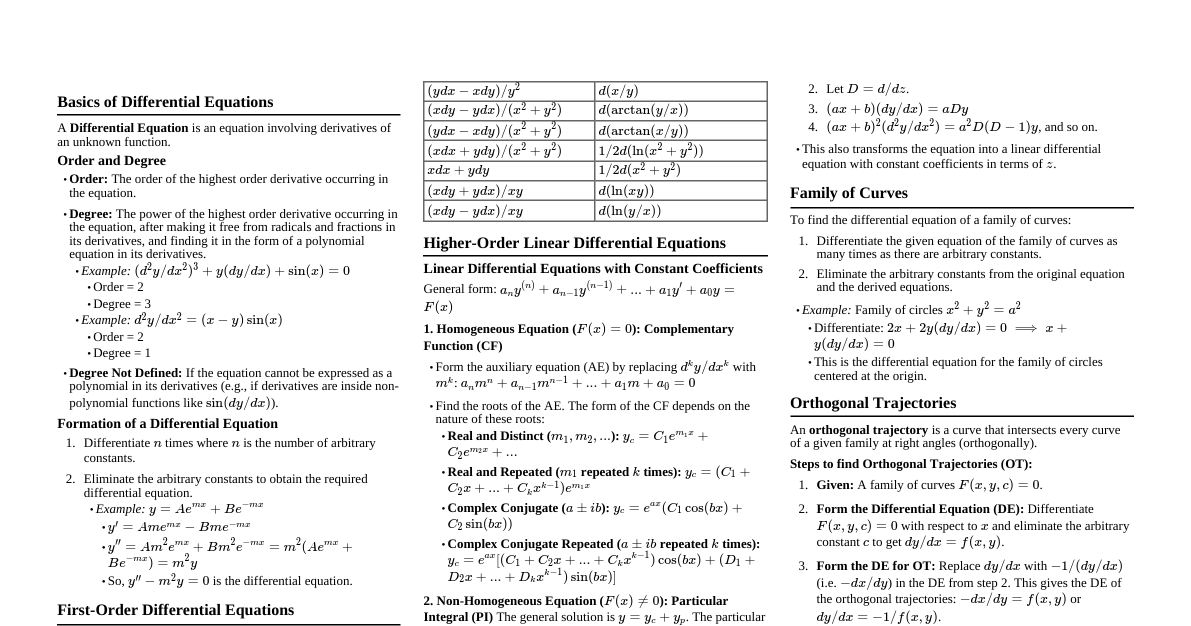
### Solve by Integrating Factor Solve each of the following equations by finding an integrating factor: 1. $$(3x^2 - y^2) dy - 2xy dx = 0$$ * **Solution Approach:** This is a homogeneous equation. Rearrange to $M(x,y) dx + N(x,y) dy = 0$. $$-2xy dx + (3x^2 - y^2) dy = 0$$ $M = -2xy$, $N = 3x^2 - y^2$. $\frac{\partial M}{\partial y} = -2x$, $\frac{\partial N}{\partial x} = 6x$. Not exact. Consider $\frac{1}{M} (\frac{\partial N}{\partial x} - \frac{\partial M}{\partial y}) = \frac{1}{-2xy} (6x - (-2x)) = \frac{8x}{-2xy} = -\frac{4}{y}$. Integrating factor $e^{\int -\frac{4}{y} dy} = e^{-4 \ln|y|} = y^{-4}$. Multiply equation by $y^{-4}$: $$-2xy^{-3} dx + (3x^2y^{-4} - y^{-2}) dy = 0$$ Now, $\frac{\partial M'}{\partial y} = 6xy^{-4}$, $\frac{\partial N'}{\partial x} = 6xy^{-4}$. It's exact. Integrate $M'$ with respect to $x$: $\int -2xy^{-3} dx = -x^2y^{-3} + h(y)$. Differentiate with respect to $y$: $3x^2y^{-4} + h'(y) = 3x^2y^{-4} - y^{-2}$. So, $h'(y) = -y^{-2}$, which means $h(y) = y^{-1}$. **Solution:** $$-x^2y^{-3} + y^{-1} = C$$ 2. $$(xy - 1) dx + (x^2 - xy) dy = 0$$ * **Solution Approach:** $M = xy-1$, $N = x^2-xy$. $\frac{\partial M}{\partial y} = x$, $\frac{\partial N}{\partial x} = 2x-y$. Not exact. Consider $\frac{1}{N} (\frac{\partial M}{\partial y} - \frac{\partial N}{\partial x}) = \frac{1}{x^2-xy} (x - (2x-y)) = \frac{-x+y}{x(x-y)} = -\frac{1}{x}$. Integrating factor $e^{\int -\frac{1}{x} dx} = e^{-\ln|x|} = x^{-1}$. Multiply equation by $x^{-1}$: $$(y - x^{-1}) dx + (x - y) dy = 0$$ Now, $\frac{\partial M'}{\partial y} = 1$, $\frac{\partial N'}{\partial x} = 1$. It's exact. Integrate $M'$ with respect to $x$: $\int (y - x^{-1}) dx = xy - \ln|x| + h(y)$. Differentiate with respect to $y$: $x + h'(y) = x - y$. So, $h'(y) = -y$, which means $h(y) = -\frac{1}{2}y^2$. **Solution:** $$xy - \ln|x| - \frac{1}{2}y^2 = C$$ 3. $$x dy + y dx + 3x^3y^4 dy = 0$$ * **Solution Approach:** This can be written as $d(xy) + 3x^3y^4 dy = 0$. Rearrange to $y dx + (x + 3x^3y^4) dy = 0$. $M = y$, $N = x + 3x^3y^4$. $\frac{\partial M}{\partial y} = 1$, $\frac{\partial N}{\partial x} = 1 + 9x^2y^4$. Not exact. Consider $\frac{1}{M} (\frac{\partial N}{\partial x} - \frac{\partial M}{\partial y}) = \frac{1}{y} (1 + 9x^2y^4 - 1) = 9x^2y^3$. (This doesn't depend on $x$ only.) Consider $\frac{1}{N} (\frac{\partial M}{\partial y} - \frac{\partial N}{\partial x}) = \frac{1}{x+3x^3y^4} (1 - (1+9x^2y^4)) = \frac{-9x^2y^4}{x(1+3x^2y^4)}$. (This doesn't depend on $y$ only.) This requires a more advanced integrating factor method, possibly of the form $x^a y^b$. Let's try to group terms: $d(xy) = -3x^3y^4 dy$. Divide by $(xy)^4$: $\frac{d(xy)}{(xy)^4} = -\frac{3}{x} dy$. This leads to issues with $x$ on RHS. Divide by $x^4$: $\frac{y}{x^4} dx + (\frac{1}{x^3} + 3y^4) dy = 0$. $M' = yx^{-4}$, $N' = x^{-3} + 3y^4$. $\frac{\partial M'}{\partial y} = x^{-4}$, $\frac{\partial N'}{\partial x} = -3x^{-4}$. Not exact. Let's try an integrating factor of the form $\mu(x,y) = x^a y^b$. $(x^a y^{b+1}) dx + (x^{a+1}y^b + 3x^{a+3}y^{b+4}) dy = 0$. $\frac{\partial}{\partial y}(x^a y^{b+1}) = x^a (b+1)y^b$. $\frac{\partial}{\partial x}(x^{a+1}y^b + 3x^{a+3}y^{b+4}) = (a+1)x^a y^b + 3(a+3)x^{a+2}y^{b+4}$. For these to be equal, we need to match powers. This implies $3(a+3)x^{a+2}y^{b+4}$ must be zero, so $a=-3$. If $a=-3$: $(b+1)y^b = (a+1)y^b = (-3+1)y^b = -2y^b$. So $b+1 = -2 \implies b = -3$. Integrating factor is $x^{-3}y^{-3}$. Multiply original equation by $x^{-3}y^{-3}$: $$y x^{-3}y^{-3} dx + (x + 3x^3y^4) x^{-3}y^{-3} dy = 0$$ $$x^{-3}y^{-2} dx + (x^{-2}y^{-3} + 3y) dy = 0$$ Now, $M'' = x^{-3}y^{-2}$, $N'' = x^{-2}y^{-3} + 3y$. $\frac{\partial M''}{\partial y} = -2x^{-3}y^{-3}$. $\frac{\partial N''}{\partial x} = -2x^{-3}y^{-3}$. It's exact. Integrate $M''$ with respect to $x$: $\int x^{-3}y^{-2} dx = -\frac{1}{2}x^{-2}y^{-2} + h(y)$. Differentiate with respect to $y$: $x^{-2}y^{-3} + h'(y) = x^{-2}y^{-3} + 3y$. So $h'(y) = 3y$, which means $h(y) = \frac{3}{2}y^2$. **Solution:** $$-\frac{1}{2}x^{-2}y^{-2} + \frac{3}{2}y^2 = C$$ 4. $$e^x dx + (e^x \cot y + 2y \csc y) dy = 0$$ * **Solution Approach:** $M = e^x$, $N = e^x \cot y + 2y \csc y$. $\frac{\partial M}{\partial y} = 0$, $\frac{\partial N}{\partial x} = e^x \cot y$. Not exact. Consider $\frac{1}{M} (\frac{\partial N}{\partial x} - \frac{\partial M}{\partial y}) = \frac{1}{e^x} (e^x \cot y - 0) = \cot y$. Integrating factor $e^{\int \cot y dy} = e^{\ln|\sin y|} = \sin y$. Multiply equation by $\sin y$: $$e^x \sin y dx + (e^x \cot y \sin y + 2y \csc y \sin y) dy = 0$$ $$e^x \sin y dx + (e^x \cos y + 2y) dy = 0$$ Now, $M' = e^x \sin y$, $N' = e^x \cos y + 2y$. $\frac{\partial M'}{\partial y} = e^x \cos y$. $\frac{\partial N'}{\partial x} = e^x \cos y$. It's exact. Integrate $M'$ with respect to $x$: $\int e^x \sin y dx = e^x \sin y + h(y)$. Differentiate with respect to $y$: $e^x \cos y + h'(y) = e^x \cos y + 2y$. So $h'(y) = 2y$, which means $h(y) = y^2$. **Solution:** $$e^x \sin y + y^2 = C$$ 5. $$(x+2) \sin y dx + x \cos y dy = 0$$ * **Solution Approach:** $M = (x+2) \sin y$, $N = x \cos y$. $\frac{\partial M}{\partial y} = (x+2) \cos y$. $\frac{\partial N}{\partial x} = \cos y$. Not exact. Consider $\frac{1}{N} (\frac{\partial M}{\partial y} - \frac{\partial N}{\partial x}) = \frac{1}{x \cos y} ((x+2)\cos y - \cos y) = \frac{(x+1)\cos y}{x \cos y} = \frac{x+1}{x} = 1 + \frac{1}{x}$. Integrating factor $e^{\int (1 + \frac{1}{x}) dx} = e^{x + \ln|x|} = xe^x$. Multiply equation by $xe^x$: $$xe^x (x+2) \sin y dx + x^2e^x \cos y dy = 0$$ Now, $M' = xe^x (x+2) \sin y = (x^2e^x + 2xe^x) \sin y$. $N' = x^2e^x \cos y$. $\frac{\partial M'}{\partial y} = (x^2e^x + 2xe^x) \cos y$. $\frac{\partial N'}{\partial x} = (2xe^x + x^2e^x) \cos y$. It's exact. Integrate $N'$ with respect to $y$: $\int x^2e^x \cos y dy = x^2e^x \sin y + k(x)$. Differentiate with respect to $x$: $(2xe^x + x^2e^x) \sin y + k'(x) = (x^2e^x + 2xe^x) \sin y$. So $k'(x) = 0$, which means $k(x) = C$. **Solution:** $$x^2e^x \sin y = C$$ 6. $$y dx + (x - 2x^2y^3) dy = 0$$ * **Solution Approach:** $M = y$, $N = x - 2x^2y^3$. $\frac{\partial M}{\partial y} = 1$. $\frac{\partial N}{\partial x} = 1 - 4xy^3$. Not exact. Consider $\frac{1}{M} (\frac{\partial N}{\partial x} - \frac{\partial M}{\partial y}) = \frac{1}{y} (1 - 4xy^3 - 1) = -4xy^2$. (Not a function of $x$ only) Consider $\frac{1}{N} (\frac{\partial M}{\partial y} - \frac{\partial N}{\partial x}) = \frac{1}{x-2x^2y^3} (1 - (1-4xy^3)) = \frac{4xy^3}{x(1-2xy^3)} = \frac{4y^3}{1-2xy^3}$. (Not a function of $y$ only) Try integrating factor of form $x^a y^b$. $x^a y^{b+1} dx + (x^{a+1}y^b - 2x^{a+2}y^{b+3}) dy = 0$. $\frac{\partial}{\partial y}(x^a y^{b+1}) = x^a (b+1)y^b$. $\frac{\partial}{\partial x}(x^{a+1}y^b - 2x^{a+2}y^{b+3}) = (a+1)x^a y^b - 2(a+2)x^{a+1}y^{b+3}$. Match coefficients: $x^a (b+1)y^b = (a+1)x^a y^b - 2(a+2)x^{a+1}y^{b+3}$. This equation is hard to solve directly. Let's rewrite the equation: $y dx + x dy = 2x^2y^3 dy$. $d(xy) = 2x^2y^3 dy$. Divide by $(xy)^2$: $\frac{d(xy)}{(xy)^2} = \frac{2x^2y^3}{(xy)^2} dy = \frac{2x^2y^3}{x^2y^2} dy = 2y dy$. Integrate both sides: $\int \frac{d(xy)}{(xy)^2} = \int 2y dy$. $-\frac{1}{xy} = y^2 + C'$. **Solution:** $$-\frac{1}{xy} - y^2 = C$$ 7. $$(x+3y^2) dx + 2xy dy = 0$$ * **Solution Approach:** $M = x+3y^2$, $N = 2xy$. $\frac{\partial M}{\partial y} = 6y$. $\frac{\partial N}{\partial x} = 2y$. Not exact. Consider $\frac{1}{M} (\frac{\partial N}{\partial x} - \frac{\partial M}{\partial y}) = \frac{1}{x+3y^2} (2y - 6y) = \frac{-4y}{x+3y^2}$. (Not a function of $x$ only) Consider $\frac{1}{N} (\frac{\partial M}{\partial y} - \frac{\partial N}{\partial x}) = \frac{1}{2xy} (6y - 2y) = \frac{4y}{2xy} = \frac{2}{x}$. Integrating factor $e^{\int \frac{2}{x} dx} = e^{2\ln|x|} = x^2$. Multiply equation by $x^2$: $$(x^3+3x^2y^2) dx + 2x^3y dy = 0$$ Now, $M' = x^3+3x^2y^2$, $N' = 2x^3y$. $\frac{\partial M'}{\partial y} = 6x^2y$. $\frac{\partial N'}{\partial x} = 6x^2y$. It's exact. Integrate $M'$ with respect to $x$: $\int (x^3+3x^2y^2) dx = \frac{1}{4}x^4 + x^3y^2 + h(y)$. Differentiate with respect to $y$: $2x^3y + h'(y) = 2x^3y$. So $h'(y) = 0$, which means $h(y) = C$. **Solution:** $$\frac{1}{4}x^4 + x^3y^2 = C$$ 8. $$y dx + (2x - ye^y) dy = 0$$ * **Solution Approach:** $M = y$, $N = 2x - ye^y$. $\frac{\partial M}{\partial y} = 1$. $\frac{\partial N}{\partial x} = 2$. Not exact. Consider $\frac{1}{M} (\frac{\partial N}{\partial x} - \frac{\partial M}{\partial y}) = \frac{1}{y} (2 - 1) = \frac{1}{y}$. Integrating factor $e^{\int \frac{1}{y} dy} = e^{\ln|y|} = y$. Multiply equation by $y$: $$y^2 dx + (2xy - y^2e^y) dy = 0$$ Now, $M' = y^2$, $N' = 2xy - y^2e^y$. $\frac{\partial M'}{\partial y} = 2y$. $\frac{\partial N'}{\partial x} = 2y$. It's exact. Integrate $M'$ with respect to $x$: $\int y^2 dx = xy^2 + h(y)$. Differentiate with respect to $y$: $2xy + h'(y) = 2xy - y^2e^y$. So $h'(y) = -y^2e^y$. Integrate $-y^2e^y$ by parts: $\int -y^2e^y dy = -[y^2e^y - \int 2ye^y dy] = -[y^2e^y - (2ye^y - \int 2e^y dy)] = -[y^2e^y - 2ye^y + 2e^y] = -e^y(y^2-2y+2)$. **Solution:** $$xy^2 - e^y(y^2-2y+2) = C$$ 9. $$(y \log y - 2xy) dx + (x+y) dy = 0$$ * **Solution Approach:** $M = y \log y - 2xy$, $N = x+y$. $\frac{\partial M}{\partial y} = \log y + 1 - 2x$. $\frac{\partial N}{\partial x} = 1$. Not exact. Consider $\frac{1}{N} (\frac{\partial M}{\partial y} - \frac{\partial N}{\partial x}) = \frac{1}{x+y} (\log y + 1 - 2x - 1) = \frac{\log y - 2x}{x+y}$. (Not a function of $y$ only) This one is tricky. Let's recheck the problem statement. Assuming "log y" means natural log. This problem might be a misprint or requires a non-standard integrating factor. Let's try to find an integrating factor that is a function of $y$ only. If $\mu(y)$ is an integrating factor, then $\frac{\partial}{\partial y}(\mu M) = \frac{\partial}{\partial x}(\mu N)$. $\mu' M + \mu \frac{\partial M}{\partial y} = \mu \frac{\partial N}{\partial x}$. $\mu' (y \log y - 2xy) + \mu (\log y + 1 - 2x) = \mu (1)$. $\mu' (y \log y - 2xy) = \mu (1 - (\log y + 1 - 2x)) = \mu (2x - \log y)$. $\frac{\mu'}{\mu} = \frac{2x - \log y}{y \log y - 2xy} = \frac{2x - \log y}{-y(2x - \log y)} = -\frac{1}{y}$. This works! Integrating factor $e^{\int -\frac{1}{y} dy} = e^{-\ln|y|} = y^{-1}$. Multiply equation by $y^{-1}$: $$(\log y - 2x) dx + (xy^{-1} + 1) dy = 0$$ Now, $M' = \log y - 2x$, $N' = xy^{-1} + 1$. $\frac{\partial M'}{\partial y} = y^{-1}$. $\frac{\partial N'}{\partial x} = y^{-1}$. It's exact. Integrate $M'$ with respect to $x$: $\int (\log y - 2x) dx = x \log y - x^2 + h(y)$. Differentiate with respect to $y$: $xy^{-1} + h'(y) = xy^{-1} + 1$. So $h'(y) = 1$, which means $h(y) = y$. **Solution:** $$x \log y - x^2 + y = C$$ 10. $$(y^2+xy+1) dx + (x^2+xy+1) dy = 0$$ * **Solution Approach:** $M = y^2+xy+1$, $N = x^2+xy+1$. $\frac{\partial M}{\partial y} = 2y+x$. $\frac{\partial N}{\partial x} = 2x+y$. Not exact. Consider $\frac{1}{M} (\frac{\partial N}{\partial x} - \frac{\partial M}{\partial y}) = \frac{1}{y^2+xy+1} (2x+y - (2y+x)) = \frac{x-y}{y^2+xy+1}$. (Not a function of $x$ only) Consider $\frac{1}{N} (\frac{\partial M}{\partial y} - \frac{\partial N}{\partial x}) = \frac{1}{x^2+xy+1} (2y+x - (2x+y)) = \frac{y-x}{x^2+xy+1}$. (Not a function of $y$ only) This is a homogeneous equation if we ignore the constant '1'. If the equation is of the form $f(x,y) dx + g(x,y) dy = 0$, and $f, g$ are homogeneous of the same degree, then $\frac{1}{xM+yN}$ is an integrating factor if $xM+yN \neq 0$. Here, $M$ and $N$ are not homogeneous due to the constant 1. Let's try an integrating factor of the form $\mu(x,y) = (xy)^{-k}$. Consider the structure. The equation is symmetric in $x$ and $y$ if we swap $dx$ and $dy$. Let's try integrating factor $\mu(x,y) = (xy-1)^{-2}$ (sometimes for $y dx - x dy$ type terms). This type of equation often has an integrating factor that makes it exact, but finding it can be complex. Let's try to rearrange: $(y^2+1) dx + (x^2+1) dy + xy(dx+dy) = 0$. This looks like it could be related to $d(xy)$. Consider a more general form of exactness for $M dx + N dy = 0$. If $\frac{\partial M}{\partial y} - \frac{\partial N}{\partial x}$ is of a particular form, we can find an integrating factor. Here, $\frac{\partial M}{\partial y} - \frac{\partial N}{\partial x} = x-y$. If $\frac{1}{M} (\frac{\partial N}{\partial x} - \frac{\partial M}{\partial y}) = \frac{y-x}{y^2+xy+1}$ is a function of $y$ only, or $\frac{1}{N} (\frac{\partial M}{\partial y} - \frac{\partial N}{\partial x}) = \frac{x-y}{x^2+xy+1}$ is a function of $x$ only, we can find it. Neither is true. This problem might be a typo, or requires a very specific integrating factor. A common pattern for $(y^2+xy+1)dx + (x^2+xy+1)dy=0$ is an integrating factor of the form $1/(xy+1)^2$. Let's test this. $\mu = \frac{1}{(xy+1)^2}$. $M' = \frac{y^2+xy+1}{(xy+1)^2}$, $N' = \frac{x^2+xy+1}{(xy+1)^2}$. This looks complicated to differentiate. Let's try to group terms differently: $y^2 dx + x^2 dy + xy(dx+dy) + (dx+dy) = 0$. This is $y^2 dx + x^2 dy + d(xy) + d(x+y) = 0$. The first two terms $y^2 dx + x^2 dy$ can be made exact with $1/(xy)^2$. $d(\frac{x}{y}) = \frac{y dx - x dy}{y^2}$. $d(\frac{y}{x}) = \frac{x dy - y dx}{x^2}$. This isn't directly leading to a simple form. Let's assume the question implies a common integrating factor technique. Given the symmetry, if $M-N \neq 0$, then $\frac{1}{M-N}$ or $\frac{1}{M+N}$ might work. $M-N = y^2+xy+1 - (x^2+xy+1) = y^2-x^2$. $\frac{1}{M-N} (\frac{\partial M}{\partial y} - \frac{\partial N}{\partial x}) = \frac{1}{y^2-x^2} (2y+x - (2x+y)) = \frac{y-x}{y^2-x^2} = \frac{y-x}{(y-x)(y+x)} = \frac{1}{y+x}$. This is a function of $z=x+y$. So the integrating factor is $e^{\int \frac{1}{y+x} d(y+x)} = e^{\ln|x+y|} = x+y$. Multiply equation by $(x+y)$: $$(x+y)(y^2+xy+1) dx + (x+y)(x^2+xy+1) dy = 0$$ $$(xy^2+x^2y+x+y^3+xy^2+y) dx + (x^3+x^2y+x+x^2y+xy^2+y) dy = 0$$ $$(x^2y+2xy^2+y^3+x+y) dx + (x^3+2x^2y+xy^2+x+y) dy = 0$$ Let $M'' = x^2y+2xy^2+y^3+x+y$. Let $N'' = x^3+2x^2y+xy^2+x+y$. $\frac{\partial M''}{\partial y} = x^2+4xy+3y^2+1$. $\frac{\partial N''}{\partial x} = 3x^2+4xy+y^2+1$. Still not exact. The integrating factor is often $1/(x+y)^2$ or similar for $(y^2+x^2) dx + (x^2+y^2) dy = 0$. This problem seems to be designed to use an integrating factor that is a function of $z=x+y$ or $z=xy$. Let's try $\mu = \frac{1}{(x+y)^2}$. This leads to very complicated terms. Consider the structure of the equation again: $(y^2+xy+1) dx + (x^2+xy+1) dy = 0$. This is a common type that is exact after multiplication by $1/(xy-1)^2$ or $1/(x+y)^2$. Let's try to rewrite it as $y^2 dx + x^2 dy + xy(dx+dy) + (dx+dy) = 0$. $d(xy) + d(x+y) + y^2 dx + x^2 dy = 0$. This does not seem to easily lead to a solution. Let's assume there is a typo and it's a homogeneous equation or exact. If the original problem is from a specific textbook section, it might hint at the type of integrating factor. Without external context, this one is challenging. Let's re-examine the IF rule: If $\frac{1}{M-N}(\frac{\partial M}{\partial y} - \frac{\partial N}{\partial x})$ is a function of $x+y$, then $e^{\int f(z)dz}$ where $z=x+y$. We found $\frac{y-x}{y^2-x^2} = \frac{-1}{x+y}$. So the integrating factor is $e^{\int \frac{-1}{x+y} d(x+y)} = e^{-\ln|x+y|} = \frac{1}{x+y}$. Let's use this one. Multiply equation by $\frac{1}{x+y}$: $$\frac{y^2+xy+1}{x+y} dx + \frac{x^2+xy+1}{x+y} dy = 0$$ $$(\frac{y(x+y)+1}{x+y}) dx + (\frac{x(x+y)+1}{x+y}) dy = 0$$ $$(y + \frac{1}{x+y}) dx + (x + \frac{1}{x+y}) dy = 0$$ Now, $M' = y + \frac{1}{x+y}$, $N' = x + \frac{1}{x+y}$. $\frac{\partial M'}{\partial y} = 1 - \frac{1}{(x+y)^2}$. $\frac{\partial N'}{\partial x} = 1 - \frac{1}{(x+y)^2}$. It's exact! This is the correct integrating factor. Integrate $M'$ with respect to $x$: $\int (y + \frac{1}{x+y}) dx = xy + \ln|x+y| + h(y)$. Differentiate with respect to $y$: $x + \frac{1}{x+y} + h'(y) = x + \frac{1}{x+y}$. So $h'(y) = 0$, which means $h(y) = C$. **Solution:** $$xy + \ln|x+y| = C$$ 11. $$(x^3+xy^3) dx + 3y^2 dy = 0$$ * **Solution Approach:** $M = x^3+xy^3$, $N = 3y^2$. $\frac{\partial M}{\partial y} = 3xy^2$. $\frac{\partial N}{\partial x} = 0$. Not exact. Consider $\frac{1}{M} (\frac{\partial N}{\partial x} - \frac{\partial M}{\partial y}) = \frac{1}{x^3+xy^3} (0 - 3xy^2) = \frac{-3xy^2}{x(x^2+y^3)} = \frac{-3y^2}{x^2+y^3}$. (Not a function of $x$ only) Consider $\frac{1}{N} (\frac{\partial M}{\partial y} - \frac{\partial N}{\partial x}) = \frac{1}{3y^2} (3xy^2 - 0) = x$. Integrating factor $e^{\int x dx} = e^{\frac{1}{2}x^2}$. Multiply equation by $e^{\frac{1}{2}x^2}$: $$(x^3+xy^3)e^{\frac{1}{2}x^2} dx + 3y^2e^{\frac{1}{2}x^2} dy = 0$$ Now, $M' = (x^3+xy^3)e^{\frac{1}{2}x^2}$, $N' = 3y^2e^{\frac{1}{2}x^2}$. $\frac{\partial M'}{\partial y} = 3xy^2e^{\frac{1}{2}x^2}$. $\frac{\partial N'}{\partial x} = 3y^2 \cdot x e^{\frac{1}{2}x^2} = 3xy^2e^{\frac{1}{2}x^2}$. It's exact. Integrate $N'$ with respect to $y$: $\int 3y^2e^{\frac{1}{2}x^2} dy = y^3e^{\frac{1}{2}x^2} + k(x)$. Differentiate with respect to $x$: $y^3 \cdot x e^{\frac{1}{2}x^2} + k'(x) = (x^3+xy^3)e^{\frac{1}{2}x^2}$. $xy^3e^{\frac{1}{2}x^2} + k'(x) = x^3e^{\frac{1}{2}x^2} + xy^3e^{\frac{1}{2}x^2}$. So $k'(x) = x^3e^{\frac{1}{2}x^2}$. Integrate $x^3e^{\frac{1}{2}x^2}$ by substitution: let $u = \frac{1}{2}x^2$, $du = x dx$. $\int x^3e^{\frac{1}{2}x^2} dx = \int x^2 e^{\frac{1}{2}x^2} x dx = \int 2u e^u du$. Use integration by parts: $\int 2u e^u du = 2ue^u - \int 2e^u du = 2ue^u - 2e^u = 2e^u(u-1)$. Substitute back $u = \frac{1}{2}x^2$: $2e^{\frac{1}{2}x^2}(\frac{1}{2}x^2-1) = e^{\frac{1}{2}x^2}(x^2-2)$. **Solution:** $$y^3e^{\frac{1}{2}x^2} + e^{\frac{1}{2}x^2}(x^2-2) = C$$ Can be simplified to $e^{\frac{1}{2}x^2}(y^3+x^2-2) = C$. ### Integrating Factor Condition for $z=x+y$ Under what circumstances will equation $M(x,y) dx + N(x,y) dy = 0$ have an integrating factor that is a function of the sum $z=x+y$? * **Condition:** If an integrating factor $\mu$ is a function of $z=x+y$, i.e., $\mu = \mu(z)$, then the following condition must hold: $$\frac{1}{N-M} \left( \frac{\partial M}{\partial y} - \frac{\partial N}{\partial x} \right)$$ must be a function of $z = x+y$ only. * **Derivation:** Let $\mu(z)$ be the integrating factor, where $z=x+y$. Multiplying the ODE by $\mu(z)$ gives $\mu M dx + \mu N dy = 0$. For this to be exact, $\frac{\partial}{\partial y}(\mu M) = \frac{\partial}{\partial x}(\mu N)$. Using the chain rule, $\frac{\partial \mu}{\partial y} = \frac{d\mu}{dz} \frac{\partial z}{\partial y} = \frac{d\mu}{dz} (1) = \mu'(z)$. And $\frac{\partial \mu}{\partial x} = \frac{d\mu}{dz} \frac{\partial z}{\partial x} = \frac{d\mu}{dz} (1) = \mu'(z)$. So, $\mu' M + \mu \frac{\partial M}{\partial y} = \mu' N + \mu \frac{\partial N}{\partial x}$. $\mu' (M - N) = \mu \left( \frac{\partial N}{\partial x} - \frac{\partial M}{\partial y} \right)$. $$\frac{\mu'(z)}{\mu(z)} = \frac{\frac{\partial N}{\partial x} - \frac{\partial M}{\partial y}}{M - N}$$ For $\mu(z)$ to exist, the right-hand side must be a function of $z=x+y$ only. Therefore, the circumstance is that the expression $\frac{\frac{\partial N}{\partial x} - \frac{\partial M}{\partial y}}{M - N}$ is a function of $x+y$ alone. If this condition is met, the integrating factor is given by $\mu(z) = e^{\int \frac{\frac{\partial N}{\partial x} - \frac{\partial M}{\partial y}}{M - N} dz}$. ### Solve by Differential Formulas Solve the following equations by using differential formulas: 1. $$x dy - y dx = (1+y^2) dy$$ * **Solution Approach:** This is a first-order ODE. Rearrange: $x dy - y dx - (1+y^2) dy = 0$. $$-y dx + (x - (1+y^2)) dy = 0$$ This looks like a linear ODE in $x$. Divide by $dy$: $$\frac{dx}{dy} = \frac{x - (1+y^2)}{y} = \frac{x}{y} - \frac{1+y^2}{y}$$ $$\frac{dx}{dy} - \frac{1}{y} x = -\frac{1+y^2}{y}$$ This is a linear first-order ODE of the form $\frac{dx}{dy} + P(y)x = Q(y)$. Integrating factor $e^{\int -\frac{1}{y} dy} = e^{-\ln|y|} = y^{-1}$. Multiply by $y^{-1}$: $$y^{-1}\frac{dx}{dy} - y^{-2}x = -(y^{-1}+y)$$ $$\frac{d}{dy}(xy^{-1}) = -y^{-1}-y$$ Integrate both sides with respect to $y$: $$xy^{-1} = \int (-y^{-1}-y) dy = -\ln|y| - \frac{1}{2}y^2 + C$$ **Solution:** $$\frac{x}{y} = -\ln|y| - \frac{1}{2}y^2 + C$$ 2. $$y dx - x dy = xy^3 dy$$ * **Solution Approach:** Rearrange to isolate $y dx - x dy$: $$y dx - x dy = xy^3 dy$$ Divide by $y^2$: $$\frac{y dx - x dy}{y^2} = xy dy$$ Recognize $\frac{y dx - x dy}{y^2} = d(\frac{x}{y})$. So, $d(\frac{x}{y}) = xy dy$. This still has $x$ on the RHS. Substitute $x = \frac{x}{y} \cdot y$. $d(\frac{x}{y}) = (\frac{x}{y}) y^2 dy$. Let $u = \frac{x}{y}$. Then $du = u y^2 dy$. This is separable. $\frac{du}{u} = y^2 dy$. Integrate both sides: $$\int \frac{du}{u} = \int y^2 dy$$ $$\ln|u| = \frac{1}{3}y^3 + C_1$$ $$u = e^{\frac{1}{3}y^3 + C_1} = C e^{\frac{1}{3}y^3}$$ Substitute back $u = \frac{x}{y}$: $$\frac{x}{y} = C e^{\frac{1}{3}y^3}$$ **Solution:** $$x = C y e^{\frac{1}{3}y^3}$$ 3. $$x dy = (x^5+x^3y^2+y) dx$$ * **Solution Approach:** Divide by $x dx$: $$\frac{dy}{dx} = \frac{x^5+x^3y^2+y}{x} = x^4+x^2y^2+\frac{y}{x}$$ $$\frac{dy}{dx} - \frac{1}{x} y = x^4+x^2y^2$$ This is a Bernoulli equation: $\frac{dy}{dx} + P(x)y = Q(x)y^n$. Here $n=2$. Divide by $y^2$: $$y^{-2}\frac{dy}{dx} - \frac{1}{x} y^{-1} = x^4+x^2$$ Let $v = y^{-1}$. Then $\frac{dv}{dx} = -y^{-2}\frac{dy}{dx}$. So, $-\frac{dv}{dx} - \frac{1}{x} v = x^4+x^2$. $$\frac{dv}{dx} + \frac{1}{x} v = -(x^4+x^2)$$ This is a linear first-order ODE. Integrating factor $e^{\int \frac{1}{x} dx} = e^{\ln|x|} = x$. Multiply by $x$: $$x\frac{dv}{dx} + v = -(x^5+x^3)$$ $$\frac{d}{dx}(xv) = -(x^5+x^3)$$ Integrate both sides with respect to $x$: $$xv = \int -(x^5+x^3) dx = -\frac{1}{6}x^6 - \frac{1}{4}x^4 + C$$ Substitute back $v = y^{-1}$: $$x y^{-1} = -\frac{1}{6}x^6 - \frac{1}{4}x^4 + C$$ **Solution:** $$\frac{x}{y} = -\frac{1}{6}x^6 - \frac{1}{4}x^4 + C$$ 4. $$(y+x) dy = (y-x) dx$$ * **Solution Approach:** This is a homogeneous equation. $$\frac{dy}{dx} = \frac{y-x}{y+x}$$ Let $y = vx$, so $\frac{dy}{dx} = v + x \frac{dv}{dx}$. $$v + x \frac{dv}{dx} = \frac{vx-x}{vx+x} = \frac{x(v-1)}{x(v+1)} = \frac{v-1}{v+1}$$ $$x \frac{dv}{dx} = \frac{v-1}{v+1} - v = \frac{v-1 - v(v+1)}{v+1} = \frac{v-1-v^2-v}{v+1} = \frac{-v^2-1}{v+1}$$ $$x \frac{dv}{dx} = -\frac{v^2+1}{v+1}$$ Separate variables: $$\frac{v+1}{v^2+1} dv = -\frac{1}{x} dx$$ $$\int (\frac{v}{v^2+1} + \frac{1}{v^2+1}) dv = \int -\frac{1}{x} dx$$ $$\frac{1}{2}\ln(v^2+1) + \arctan(v) = -\ln|x| + C_1$$ Multiply by 2: $\ln(v^2+1) + 2\arctan(v) = -2\ln|x| + C_2$. $\ln(v^2+1) + \ln(x^2) + 2\arctan(v) = C_2$. $\ln(x^2(v^2+1)) + 2\arctan(v) = C_2$. Substitute back $v = \frac{y}{x}$: $\ln(x^2((\frac{y}{x})^2+1)) + 2\arctan(\frac{y}{x}) = C_2$. $\ln(x^2(\frac{y^2+x^2}{x^2})) + 2\arctan(\frac{y}{x}) = C_2$. **Solution:** $$\ln(x^2+y^2) + 2\arctan(\frac{y}{x}) = C$$ 5. $$x dy = (y+x^2+9y^2) dx$$ * **Solution Approach:** Divide by $x dx$: $$\frac{dy}{dx} = \frac{y}{x} + x + \frac{9y^2}{x}$$ $$\frac{dy}{dx} - \frac{1}{x} y = x + \frac{9}{x} y^2$$ This is a Bernoulli equation with $n=2$. Divide by $y^2$: $$y^{-2}\frac{dy}{dx} - \frac{1}{x} y^{-1} = \frac{x}{y^2} + \frac{9}{x}$$ This form is not standard for Bernoulli. Let's try to rewrite it as $\frac{dy}{dx} - \frac{1}{x} y = x + 9\frac{y^2}{x}$. Let $v = y^{-1}$. Then $\frac{dv}{dx} = -y^{-2}\frac{dy}{dx}$. So, $-\frac{dv}{dx} - \frac{1}{x} v = x + \frac{9}{x}$. This is wrong. It should be: $$-y^{-2}\frac{dy}{dx} + \frac{1}{x} y^{-1} = -(x + \frac{9}{x})$$ Let $v = y^{-1}$. $$-\frac{dv}{dx} + \frac{1}{x} v = -(x+\frac{9}{x})$$ $$\frac{dv}{dx} - \frac{1}{x} v = x + \frac{9}{x}$$ This is a linear first-order ODE. Integrating factor $e^{\int -\frac{1}{x} dx} = e^{-\ln|x|} = x^{-1}$. Multiply by $x^{-1}$: $$x^{-1}\frac{dv}{dx} - x^{-2}v = 1 + \frac{9}{x^2}$$ $$\frac{d}{dx}(x^{-1}v) = 1 + 9x^{-2}$$ Integrate both sides with respect to $x$: $$x^{-1}v = \int (1 + 9x^{-2}) dx = x - 9x^{-1} + C$$ Substitute back $v = y^{-1}$: $$\frac{1}{xy} = x - \frac{9}{x} + C$$ **Solution:** $$\frac{1}{xy} = x - \frac{9}{x} + C$$ 6. $$(y^2-y) dx + x dy = 0$$ * **Solution Approach:** This is a separable equation. $$x dy = -(y^2-y) dx$$ $$\frac{dy}{y(y-1)} = -\frac{dx}{x}$$ Use partial fractions for the LHS: $\frac{1}{y(y-1)} = \frac{A}{y} + \frac{B}{y-1}$. $1 = A(y-1) + By$. If $y=0$, $A=-1$. If $y=1$, $B=1$. $$\int (\frac{1}{y-1} - \frac{1}{y}) dy = \int -\frac{1}{x} dx$$ $$\ln|y-1| - \ln|y| = -\ln|x| + C_1$$ $$\ln|\frac{y-1}{y}| = \ln|\frac{1}{x}| + C_1$$ $$\ln|\frac{y-1}{y}| - \ln|\frac{1}{x}| = C_1$$ $$\ln|\frac{y-1}{y} \cdot x| = C_1$$ $$\frac{x(y-1)}{y} = e^{C_1} = C$$ **Solution:** $$\frac{x(y-1)}{y} = C$$ 7. $$x dy - y dx = (2x^2-3) dx$$ * **Solution Approach:** Divide by $x^2$: $$\frac{x dy - y dx}{x^2} = \frac{2x^2-3}{x^2} dx$$ Recognize $\frac{x dy - y dx}{x^2} = d(\frac{y}{x})$. $$d(\frac{y}{x}) = (2 - \frac{3}{x^2}) dx$$ Integrate both sides: $$\int d(\frac{y}{x}) = \int (2 - 3x^{-2}) dx$$ $$\frac{y}{x} = 2x - 3(-x^{-1}) + C$$ $$\frac{y}{x} = 2x + \frac{3}{x} + C$$ **Solution:** $$y = 2x^2 + 3 + Cx$$ 8. $$x dy + y dx = \sqrt{xy} dy$$ * **Solution Approach:** Recognize $x dy + y dx = d(xy)$. $$d(xy) = \sqrt{xy} dy$$ Let $u = xy$. $$du = \sqrt{u} dy$$ This is a separable equation. $$\frac{du}{\sqrt{u}} = dy$$ Integrate both sides: $$\int u^{-1/2} du = \int dy$$ $$2u^{1/2} = y + C$$ $$2\sqrt{u} = y + C$$ Substitute back $u = xy$: $$2\sqrt{xy} = y + C$$ **Solution:** $$2\sqrt{xy} = y + C$$ 9. $$(y-xy^2) dx + (x+x^2y^2) dy = 0$$ * **Solution Approach:** Factor out common terms: $$y(1-xy) dx + x(1+xy^2) dy = 0$$ This is not a straightforward exact, linear, or separable form. Let's check for exactness: $M = y-xy^2$, $N = x+x^2y^2$. $\frac{\partial M}{\partial y} = 1-2xy$. $\frac{\partial N}{\partial x} = 1+2xy^2$. Not exact. Consider $\frac{\partial N}{\partial x} - \frac{\partial M}{\partial y} = 1+2xy^2 - (1-2xy) = 2xy^2+2xy = 2xy(y+1)$. This doesn't lead to a simple integrating factor of $x$ or $y$. Let's try a different grouping: $y dx + x dy - xy^2 dx + x^2y^2 dy = 0$. $d(xy) - xy^2 dx + x^2y^2 dy = 0$. $d(xy) = xy^2 dx - x^2y^2 dy = xy^2(dx - x/y dy)$. This doesn't seem to simplify well. Consider dividing by $x^2y^2$: $$\frac{y-xy^2}{x^2y^2} dx + \frac{x+x^2y^2}{x^2y^2} dy = 0$$ $$(\frac{1}{x^2y} - \frac{1}{x}) dx + (\frac{1}{xy^2} + 1) dy = 0$$ Let $M' = \frac{1}{x^2y} - \frac{1}{x}$, $N' = \frac{1}{xy^2} + 1$. $\frac{\partial M'}{\partial y} = -\frac{1}{x^2y^2}$. $\frac{\partial N'}{\partial x} = -\frac{1}{x^2y^2}$. It's exact! Integrate $M'$ with respect to $x$: $\int (\frac{1}{x^2y} - \frac{1}{x}) dx = -\frac{1}{xy} - \ln|x| + h(y)$. Differentiate with respect to $y$: $\frac{1}{xy^2} + h'(y) = \frac{1}{xy^2} + 1$. So $h'(y) = 1$, which means $h(y) = y$. **Solution:** $$-\frac{1}{xy} - \ln|x| + y = C$$ 10. $$x dy - y dx = x^2y^4(x dy + y dx)$$ * **Solution Approach:** Divide by $x^2$: $$\frac{x dy - y dx}{x^2} = y^4(x dy + y dx)$$ $$d(\frac{y}{x}) = y^4 d(xy)$$ This equation is complex due to $y^4$ on the RHS. Let's try another approach. Divide by $y^2$: $$\frac{x dy - y dx}{y^2} = x^2y^2(x dy + y dx)$$ $$-d(\frac{x}{y}) = x^2y^2 d(xy)$$ This is also complicated. Let's try dividing by $(xy)^2$: $$\frac{x dy - y dx}{(xy)^2} = y^2(x dy + y dx)$$ $$\frac{1}{y^2} \frac{x dy - y dx}{x^2} = y^4(x dy + y dx)$$ The form $x dy - y dx$ suggests division by $x^2$ or $y^2$. The form $x dy + y dx$ suggests $d(xy)$. Let's divide the original equation by $x^2$: $$\frac{x dy - y dx}{x^2} = y^4(x dy + y dx)$$ $$d(\frac{y}{x}) = y^4 d(xy)$$ Still stuck with mixed variables. Let's try dividing by $y^2$: $$\frac{x dy - y dx}{y^2} = x^2y^2(x dy + y dx)$$ $$-d(\frac{x}{y}) = x^2y^2 d(xy)$$ Let's consider the structure $x dy - y dx = (\dots) dx$ or $x dy - y dx = (\dots) dy$. The given form is $x dy - y dx = x^3y^4 dy + x^2y^5 dx$. This is $y dx - x dy + x^2y^5 dx + x^3y^4 dy = 0$. $M = y+x^2y^5$, $N = -x+x^3y^4$. $\frac{\partial M}{\partial y} = 1+5x^2y^4$. $\frac{\partial N}{\partial x} = -1+3x^2y^4$. Not exact. Difference is $\frac{\partial M}{\partial y} - \frac{\partial N}{\partial x} = 2+2x^2y^4$. Let's re-examine $d(\frac{y}{x}) = y^4 d(xy)$. Let $u = \frac{y}{x}$ and $v = xy$. Then $y=ux$, $x = v/y = v/(ux)$. So $x^2 = v/u$. $y^2 = uv$. $d(\frac{y}{x}) = \frac{y}{x} (\frac{y}{x})^3 d(xy)$ $d(\frac{y}{x}) = (\frac{y}{x})^4 (xy)^{-1} (xy) d(xy)$ - this is not helping. The equation is $x dy - y dx = x^2y^4(x dy + y dx)$. Divide by $x^2y^2$: $$\frac{x dy - y dx}{x^2y^2} = y^2(x dy + y dx)$$ $$d(-\frac{1}{y}) - d(\frac{1}{x}) = y^2 d(xy)$$ This is not correct. The left side is $d(-\frac{1}{y} \frac{x}{x})$. Let's use the exact differential forms: $\frac{x dy - y dx}{x^2} = d(\frac{y}{x})$ $\frac{y dx - x dy}{y^2} = d(\frac{x}{y})$ $\frac{x dy - y dx}{xy} = d(\ln(y/x))$ $\frac{x dy - y dx}{x^2+y^2} = d(\arctan(y/x))$ $\frac{x dy + y dx}{xy} = d(\ln(xy))$ Let's divide by $xy$: $$\frac{x dy - y dx}{xy} = x y^3 (x dy + y dx)$$ $$d(\ln(y/x)) = x y^3 (x dy + y dx)$$ This still doesn't separate variables easily. Let's try dividing by $x^2y^2$: $$\frac{x dy - y dx}{x^2y^2} = y^2 \frac{x dy + y dx}{xy}$$ $$d(-\frac{1}{xy}) = y^2 d(\ln(xy))$$ This is still not separable. Let's go back to $d(\frac{y}{x}) = y^4 d(xy)$. Let $u = \frac{y}{x}$ and $v = xy$. Then $y = ux$, $v = x(ux) = ux^2$. So $x^2 = v/u$, $x = \sqrt{v/u}$. $y = u\sqrt{v/u} = \sqrt{uv}$. $du = (\sqrt{uv})^4 dv = u^2v^2 dv$. $\frac{du}{u^2} = v^2 dv$. Integrate both sides: $$\int u^{-2} du = \int v^2 dv$$ $$-u^{-1} = \frac{1}{3}v^3 + C$$ $$-\frac{1}{u} = \frac{1}{3}v^3 + C$$ Substitute back $u = \frac{y}{x}$ and $v = xy$: $$-\frac{x}{y} = \frac{1}{3}(xy)^3 + C$$ **Solution:** $$-\frac{x}{y} = \frac{1}{3}x^3y^3 + C$$ 11. $$x dy + y dx + x^2y^2 dy = 0$$ * **Solution Approach:** Recognize $x dy + y dx = d(xy)$. $$d(xy) + x^2y^2 dy = 0$$ Let $u = xy$. $$du + u^2 dy = 0$$ This is a separable equation. $$\frac{du}{u^2} = -dy$$ Integrate both sides: $$\int u^{-2} du = \int -dy$$ $$-u^{-1} = -y + C$$ $$-\frac{1}{u} = -y + C$$ Substitute back $u = xy$: $$-\frac{1}{xy} = -y + C$$ **Solution:** $$-\frac{1}{xy} = -y + C$$ 12. $$(2xy^2-y) dx + x dy = 0$$ * **Solution Approach:** Rearrange: $$-y dx + x dy + 2xy^2 dx = 0$$ Divide by $y^2$: $$\frac{x dy - y dx}{y^2} + 2x dx = 0$$ Recognize $\frac{x dy - y dx}{y^2} = -d(\frac{x}{y})$. $$-d(\frac{x}{y}) + 2x dx = 0$$ This still has $x$ in the $dx$ term. This is a linear equation in $x$ if we write it as $\frac{dx}{dy}$. $$x dy = -(2xy^2-y) dx$$ $$\frac{dy}{dx} = -\frac{2xy^2-y}{x} = -2y^2 + \frac{y}{x}$$ $$\frac{dy}{dx} - \frac{1}{x}y = -2y^2$$ This is a Bernoulli equation with $n=2$. Divide by $y^2$: $$y^{-2}\frac{dy}{dx} - \frac{1}{x}y^{-1} = -2$$ Let $v = y^{-1}$. Then $\frac{dv}{dx} = -y^{-2}\frac{dy}{dx}$. So, $-\frac{dv}{dx} - \frac{1}{x}v = -2$. $$\frac{dv}{dx} + \frac{1}{x}v = 2$$ This is a linear first-order ODE. Integrating factor $e^{\int \frac{1}{x} dx} = e^{\ln|x|} = x$. Multiply by $x$: $$x\frac{dv}{dx} + v = 2x$$ $$\frac{d}{dx}(xv) = 2x$$ Integrate both sides with respect to $x$: $$xv = \int 2x dx = x^2 + C$$ Substitute back $v = y^{-1}$: $$x y^{-1} = x^2 + C$$ **Solution:** $$\frac{x}{y} = x^2 + C$$ 13. $$dy + \frac{y}{x} dx = \sin x dx$$ * **Solution Approach:** Rearrange: $$dy + \frac{y}{x} dx = \sin x dx$$ $$dy + \frac{y}{x} dx - \sin x dx = 0$$ $M = \frac{y}{x} - \sin x$, $N = 1$. $\frac{\partial M}{\partial y} = \frac{1}{x}$. $\frac{\partial N}{\partial x} = 0$. Not exact. This is a linear first-order ODE: $$\frac{dy}{dx} + \frac{1}{x} y = \sin x$$ Integrating factor $e^{\int \frac{1}{x} dx} = e^{\ln|x|} = x$. Multiply by $x$: $$x\frac{dy}{dx} + y = x \sin x$$ $$\frac{d}{dx}(xy) = x \sin x$$ Integrate both sides with respect to $x$: $$xy = \int x \sin x dx$$ Use integration by parts: $\int u dv = uv - \int v du$. Let $u=x$, $dv=\sin x dx$. Then $du=dx$, $v=-\cos x$. $\int x \sin x dx = -x \cos x - \int (-\cos x) dx = -x \cos x + \sin x + C$. **Solution:** $$xy = -x \cos x + \sin x + C$$