Thermodynamics
Cheatsheet Content
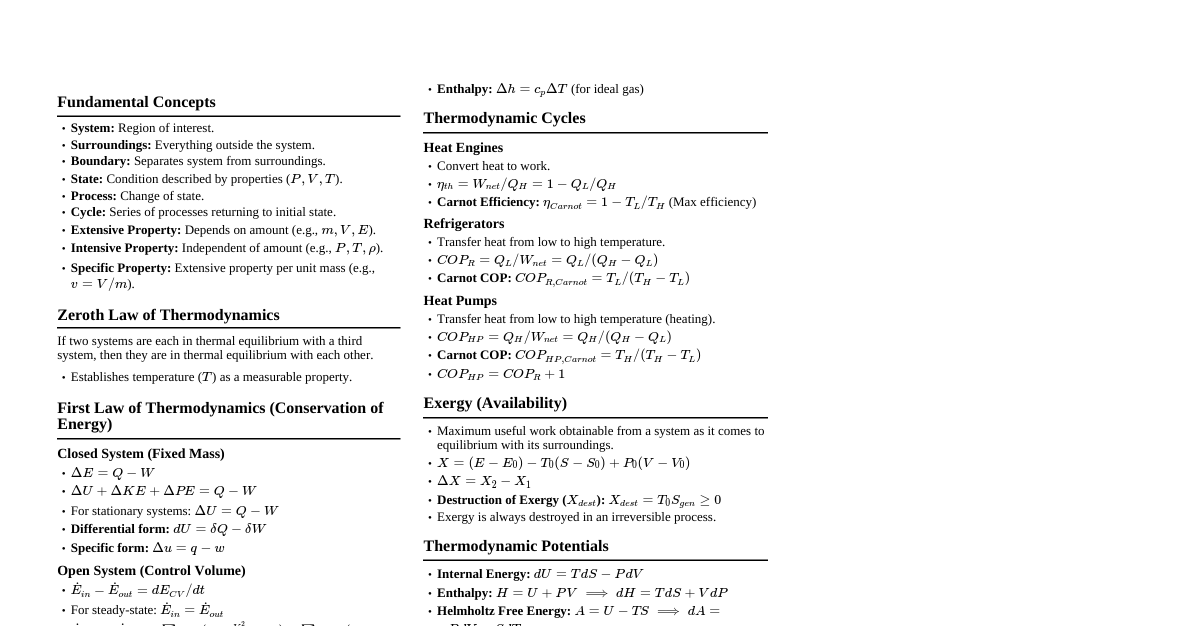
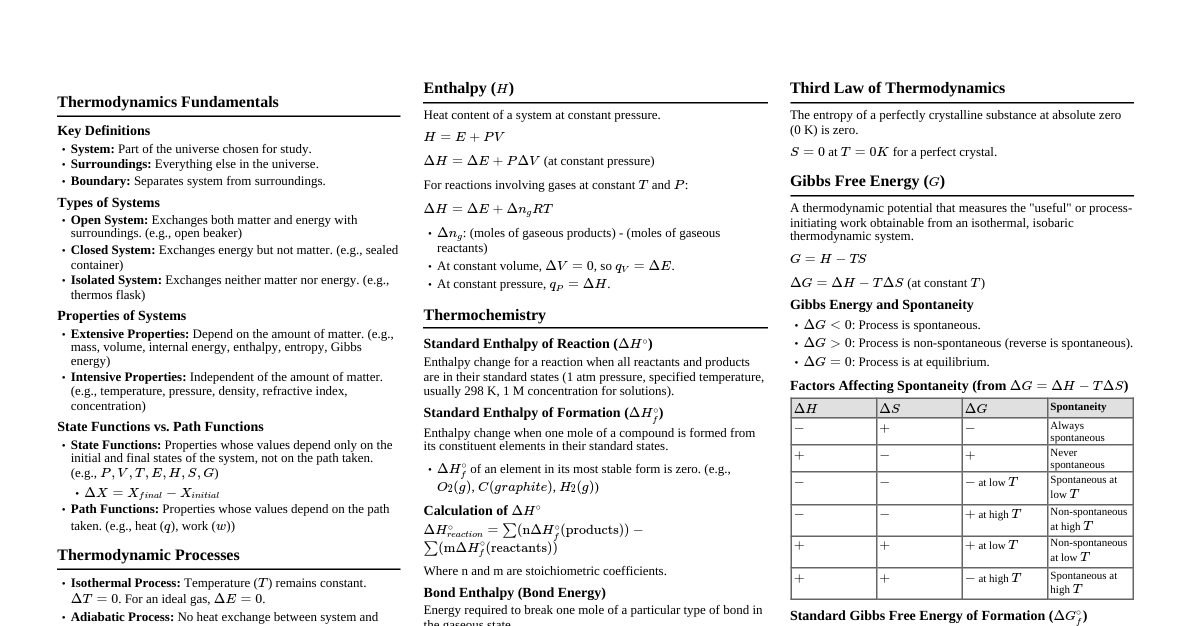
### Fundamental Concepts - **System:** A quantity of matter or a region in space chosen for study. - **Surroundings:** The mass or region outside the system. - **Boundary:** The real or imaginary surface that separates the system from its surroundings. - **State:** The condition of a system as described by its properties. - **Property:** Any characteristic of a system. - **Extensive Property:** Depends on the size or extent of the system (e.g., $V, U, H, S, G$, mass). - **Intensive Property:** Independent of the size of the system (e.g., $P, T, \rho$, specific volume). - **State Function:** A property whose value depends only on the state of the system, not on how that state was reached (e.g., $P, V, T, U, H, S, G$). Exact differential. - **Path Function:** A quantity whose value depends on the path taken during a process (e.g., work $W$, heat $Q$). Inexact differential. #### Types of Systems - **Open System:** Exchanges both mass and energy with surroundings. - **Closed System:** Exchanges energy but not mass with surroundings. - **Isolated System:** Exchanges neither mass nor energy with surroundings. ### Laws of Thermodynamics #### 1. Zeroth Law of Thermodynamics - If two systems are each in thermal equilibrium with a third system, then they are in thermal equilibrium with each other. This implies the existence of temperature. #### 2. First Law of Thermodynamics - **Conservation of Energy:** Energy can be converted from one form to another, but it cannot be created or destroyed. - **Mathematical Form:** $\Delta U = Q + W$ - $\Delta U$: Change in internal energy of the system. - $Q$: Heat added to the system (positive if absorbed by system). - $W$: Work done **on** the system (positive if work is done on system, i.e., compression). - **Alternate convention for W:** $W$: Work done **by** the system (positive if work is done by system, i.e., expansion). In this case, $\Delta U = Q - W$. (We will use the first convention: $W$ is work done on the system). #### 3. Second Law of Thermodynamics - **Entropy Increase:** The total entropy of an isolated system can only increase over time, or remain constant in ideal cases (reversible processes). It can never decrease. - **Clausius Statement:** Heat cannot spontaneously flow from a colder body to a hotter body. - **Kelvin-Planck Statement:** It is impossible to devise a cyclically operating heat engine that produces no other effect than the extraction of heat from a single thermal reservoir and the production of an equivalent amount of work. - **Mathematical Form:** $\Delta S_{universe} = \Delta S_{system} + \Delta S_{surroundings} \ge 0$ - For a reversible process: $\Delta S = \frac{Q_{rev}}{T}$ #### 4. Third Law of Thermodynamics - **Absolute Zero:** The entropy of a perfect crystal at absolute zero (0 K) is exactly zero. - This law provides a baseline for absolute entropy values. ### Thermodynamic Potentials These functions are useful for describing the state of a system under specific conditions. #### 1. Internal Energy ($U$) - **Definition:** The total energy contained within a thermodynamic system. - **Differential Form:** $dU = TdS - PdV$ (for a closed system, reversible process, only PV work) - **Natural Variables:** $S, V$ #### 2. Enthalpy ($H$) - **Definition:** $H = U + PV$ - **Significance:** Heat exchanged at constant pressure ($Q_P = \Delta H$). - **Differential Form:** $dH = TdS + VdP$ - **Natural Variables:** $S, P$ #### 3. Helmholtz Free Energy ($A$ or $F$) - **Definition:** $A = U - TS$ - **Significance:** Maximum work obtainable from a closed system at constant temperature and volume ($W_{max} = -\Delta A$). - **Differential Form:** $dA = -SdT - PdV$ - **Natural Variables:** $T, V$ #### 4. Gibbs Free Energy ($G$) - **Definition:** $G = H - TS$ - **Significance:** Maximum non-PV work obtainable from a closed system at constant temperature and pressure ($W_{non-PV, max} = -\Delta G$). Predicts spontaneity: - $\Delta G < 0$: Spontaneous - $\Delta G = 0$: Equilibrium - $\Delta G > 0$: Non-spontaneous (reverse is spontaneous) - **Differential Form:** $dG = -SdT + VdP$ - **Natural Variables:** $T, P$ ### Maxwell's Relations Derived from the exact differentials of the thermodynamic potentials, relating partial derivatives of state functions. - From $dU$: $\left(\frac{\partial T}{\partial V}\right)_S = -\left(\frac{\partial P}{\partial S}\right)_V$ - From $dH$: $\left(\frac{\partial T}{\partial P}\right)_S = \left(\frac{\partial V}{\partial S}\right)_P$ - From $dA$: $\left(\frac{\partial S}{\partial V}\right)_T = \left(\frac{\partial P}{\partial T}\right)_V$ - From $dG$: $\left(\frac{\partial S}{\partial P}\right)_T = -\left(\frac{\partial V}{\partial T}\right)_P$ ### Heat Capacity - **Definition:** The amount of heat required to raise the temperature of a substance by $1^\circ C$ or $1 K$. - **Constant Volume Heat Capacity ($C_V$):** $C_V = \left(\frac{\partial U}{\partial T}\right)_V = \frac{dQ_V}{dT}$ - **Constant Pressure Heat Capacity ($C_P$):** $C_P = \left(\frac{\partial H}{\partial T}\right)_P = \frac{dQ_P}{dT}$ - **Relationship for Ideal Gas:** $C_P - C_V = nR$ (for $n$ moles) or $C_P - C_V = R$ (per mole) - **Ratio of Heat Capacities ($\gamma$):** $\gamma = \frac{C_P}{C_V}$ ### Ideal Gas Processes #### 1. Isothermal Process ($T$=constant) - $\Delta U = 0$, $\Delta H = 0$ - $Q = -W$ - For reversible expansion/compression: $W = -nRT \ln\left(\frac{V_2}{V_1}\right) = -nRT \ln\left(\frac{P_1}{P_2}\right)$ #### 2. Adiabatic Process ($Q$=0) - $\Delta U = W$ - $PV^\gamma = \text{constant}$ - $TV^{\gamma-1} = \text{constant}$ - $P^{1-\gamma}T^\gamma = \text{constant}$ - Work done (reversible): $W = \frac{P_2V_2 - P_1V_1}{1-\gamma} = nC_V(T_2 - T_1)$ #### 3. Isobaric Process ($P$=constant) - $W = -P\Delta V$ (work done by system) or $W = -P_{ext}(V_2-V_1)$ (work done on system, if $P_{ext}$ is constant) - $Q = \Delta H$ #### 4. Isochoric Process ($V$=constant) - $W = 0$ - $Q = \Delta U$ ### Carnot Cycle - **Definition:** A theoretical reversible thermodynamic cycle consisting of two isothermal and two adiabatic processes. - **Efficiency ($\eta$):** The maximum possible efficiency for any heat engine operating between two temperatures. - $\eta = 1 - \frac{T_C}{T_H} = \frac{W_{net}}{Q_H}$ - $T_C$: Temperature of cold reservoir (K) - $T_H$: Temperature of hot reservoir (K) - $W_{net}$: Net work done by the engine - $Q_H$: Heat absorbed from the hot reservoir - **Coefficient of Performance (COP) for Refrigerator/Heat Pump:** - Refrigerator: $COP_{ref} = \frac{Q_C}{W_{in}} = \frac{T_C}{T_H - T_C}$ - Heat Pump: $COP_{hp} = \frac{Q_H}{W_{in}} = \frac{T_H}{T_H - T_C}$ ### Phase Transitions - **Clapeyron Equation:** Describes the slope of coexistence curves in P-T diagrams. - $\frac{dP}{dT} = \frac{\Delta H}{T\Delta V}$ - $\Delta H$: Molar enthalpy change of phase transition. - $\Delta V$: Molar volume change of phase transition. - **Clausius-Clapeyron Equation:** Approximation of Clapeyron for liquid-vapor or solid-vapor equilibrium (assuming ideal gas for vapor and $\Delta V \approx V_{gas}$). - $\ln\left(\frac{P_2}{P_1}\right) = -\frac{\Delta H_{vap}}{R}\left(\frac{1}{T_2} - \frac{1}{T_1}\right)$