Class 12 Physics Formulae
Cheatsheet Content
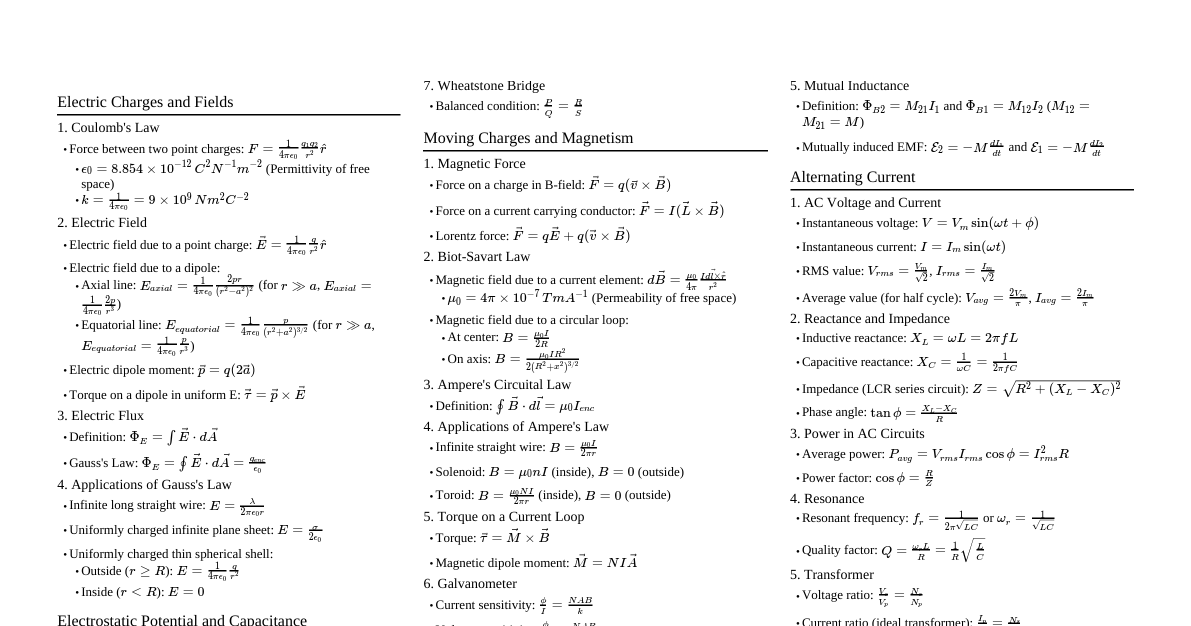
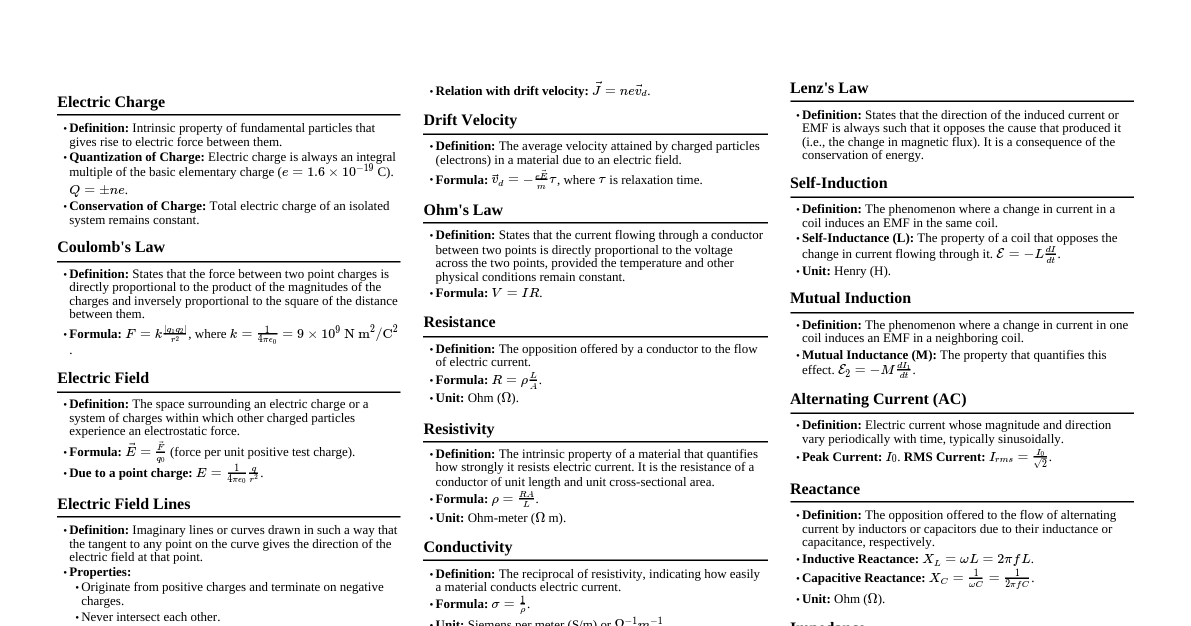
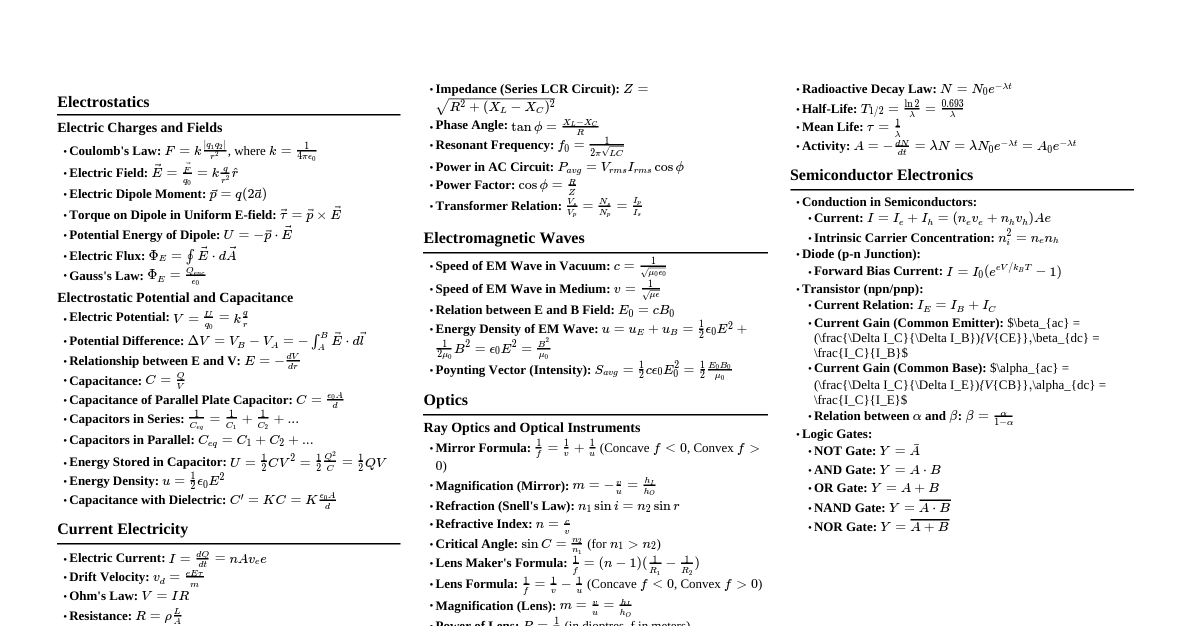
### Electrostatics | Concept/Formula | Formula | Application/Description | |---|---|---| | **Quantization of Charge** | $Q = ne$ | Total charge is an integer multiple of elementary charge ($e$). | | **Coulomb's Law** | $F = \frac{1}{4\pi\epsilon_0} \frac{q_1 q_2}{r^2} \hat{r}$ ($\epsilon_0 = 8.85 \times 10^{-12} C^2 N^{-1} m^{-2}$) | Force between two point charges; foundation of electrostatics. | | **Electric Field (Point Charge)** | $\vec{E}(\vec{r}) = \frac{1}{4\pi\epsilon_0} \frac{q}{r^2} \hat{r}$ | Force per unit positive test charge. | | **Electric Dipole Moment** | $\vec{p} = q \cdot 2\vec{l}$ | Measure of the separation of positive and negative charges in a system. | | **Torque on a Dipole** | $\vec{\tau} = \vec{p} \times \vec{E}$ | Rotational effect on an electric dipole in an external electric field. | | **Gauss's Law** | $\Phi = \oint \vec{E} \cdot d\vec{S} = \frac{Q_{enclosed}}{\epsilon_0}$ | Relates electric flux through a closed surface to the enclosed charge; useful for symmetric charge distributions. | | **Electric Potential Energy** | $U = \frac{KqQ}{r}$ | Energy required to bring charges to a configuration. | | **Electric Potential** | $V = \frac{Kq}{r}$ | Potential energy per unit charge. | | **Relation between E and V** | $dV = -\vec{E} \cdot d\vec{l}$ | Electric field is the negative gradient of the electric potential. | | **Capacitance Definition** | $C = q/V$ | Ability of a conductor to store electric charge. | | **Parallel Plate Capacitor** | $C = \frac{\epsilon_0 A}{d}$ | Capacitance of a common capacitor geometry. | | **Capacitors in Parallel** | $C_{eq} = C_1 + C_2$ | Increases total capacitance. | | **Capacitors in Series** | $\frac{1}{C_{eq}} = \frac{1}{C_1} + \frac{1}{C_2}$ | Decreases total capacitance. | | **Energy Stored in Capacitor** | $U = \frac{1}{2}CV^2 = \frac{Q^2}{2C}$ | Energy stored in the electric field of a capacitor. | | **Capacitor with Dielectric** | $C = \frac{\epsilon_0 KA}{d}$ | Dielectric increases capacitance by factor K. | ### Current Electricity | Concept/Formula | Formula | Application/Description | |---|---|---| | **Ohm's Law** | $V = IR$ | Relates voltage, current, and resistance in a circuit. | | **Current Density** | $J = I/A = \sigma E$ | Current per unit cross-sectional area. | | **Drift Velocity** | $\vec{v}_d = -\frac{e\vec{E}\tau_{av}}{m}$ | Average velocity of charge carriers in a conductor due to an electric field. | | **Resistance of a Wire** | $R = \rho L/A$ | Resistance depends on material resistivity ($\rho$), length ($L$), and cross-sectional area ($A$). | | **Temperature Dependence of R** | $R = R_0(1+\alpha\Delta T)$ | How resistance changes with temperature ($\alpha$ is temperature coefficient). | | **Kirchhoff's Junction Law** | $\sum I = 0$ | Conservation of charge: sum of currents entering a junction equals sum of currents leaving. | | **Kirchhoff's Loop Law** | $\sum \Delta V = 0$ | Conservation of energy: sum of voltage drops and rises around any closed loop is zero. | | **Electric Power** | $P = VI = I^2R = V^2/R$ | Rate at which electrical energy is converted to other forms. | | **Wheatstone Bridge (Balanced)** | $\frac{R_1}{R_2} = \frac{R_3}{R_4}$ | Used for precise measurement of unknown resistance. | | **Potentiometer (Comparing EMFs)** | $\frac{E_1}{E_2} = \frac{l_1}{l_2}$ | Measures and compares electromotive forces without drawing current. | | **Potentiometer (Internal Resistance)** | $r = R \left(\frac{l_1}{l_2} - 1\right)$ | Determines the internal resistance of a cell. | ### Magnetism | Concept/Formula | Formula | Application/Description | |---|---|---| | **Lorentz Force** | $\vec{F} = q(\vec{v} \times \vec{B}) + q\vec{E}$ | Total force on a charged particle in combined electric and magnetic fields. | | **Radius of Path (Charged Particle)** | $r = \frac{mv}{qB}$ | Radius of circular path for a charged particle moving perpendicular to a uniform magnetic field. | | **Force on Current Carrying Wire** | $\vec{F} = I(\vec{l} \times \vec{B})$ | Force experienced by a current element in a magnetic field. | | **Magnetic Dipole Moment** | $\vec{\mu} = I\vec{A}$ | Measure of the strength of a magnetic source (e.g., current loop). | | **Torque on a Magnetic Dipole** | $\vec{\tau} = \vec{\mu} \times \vec{B}$ | Rotational effect on a magnetic dipole in an external magnetic field. | | **Biot-Savart Law** | $d\vec{B} = \frac{\mu_0}{4\pi} \frac{I d\vec{l} \times \hat{r}}{r^2}$ | Calculates magnetic field due to a current element. | | **Magnetic Field (Infinite Straight Wire)** | $B = \frac{\mu_0 I}{2\pi d}$ | Magnetic field produced by a long, straight current-carrying wire. | | **Force Between Parallel Wires** | $\frac{dF}{dl} = \frac{\mu_0 I_1 I_2}{2\pi d}$ | Force per unit length between two parallel current-carrying wires. | | **Ampere's Circuital Law** | $\oint \vec{B} \cdot d\vec{l} = \mu_0 I_{in}$ | Relates the line integral of magnetic field around a closed loop to the current enclosed; useful for symmetric current distributions. | | **Field Inside a Solenoid** | $B = \mu_0 n I$ | Uniform magnetic field inside a long solenoid ($n$ is turns per unit length). | | **Moving Coil Galvanometer** | $nIAB = k\theta$ | Principle of operation: torque on a current loop in a magnetic field causes deflection. | ### Electromagnetic Induction | Concept/Formula | Formula | Application/Description | |---|---|---| | **Magnetic Flux** | $\Phi = \int \vec{B} \cdot d\vec{S}$ | Measure of the total magnetic field passing through a given area. | | **Faraday's Law of EMI** | $\epsilon = -\frac{d\Phi}{dt}$ | Induced electromotive force (EMF) is proportional to the rate of change of magnetic flux. | | **Motional EMF** | $\epsilon = Blv$ | EMF induced across a conductor moving in a uniform magnetic field. | | **Self-Inductance** | $\Phi = LI$, $\epsilon = -L\frac{dI}{dt}$ | Property of a coil to oppose changes in current flowing through it. | | **Mutual Inductance** | $\Phi = MI$, $\epsilon = -M\frac{dI}{dt}$ | Generation of EMF in one coil due to change in current in a nearby coil. | | **Energy Stored in an Inductor** | $U = \frac{1}{2}LI^2$ | Energy stored in the magnetic field of an inductor. | | **AC Generator (Induced EMF)** | $\epsilon = NAB\omega\sin\omega t$ | EMF induced in a coil rotating in a uniform magnetic field. | ### Alternating Current | Concept/Formula | Formula | Application/Description | |---|---|---| | **Alternating Current** | $i = i_0 \sin(\omega t + \phi)$ | Describes the sinusoidal variation of current with time. | | **RMS Current** | $I_{rms} = \frac{i_0}{\sqrt{2}}$ | Effective value of AC current, used for power calculations. | | **Capacitive Reactance** | $X_C = \frac{1}{\omega C}$ | Opposition offered by a capacitor to the flow of alternating current. | | **Inductive Reactance** | $X_L = \omega L$ | Opposition offered by an inductor to the flow of alternating current. | | **Impedance (LCR Circuit)** | $Z = \sqrt{R^2 + (X_L - X_C)^2}$ | Total opposition to current flow in an AC circuit containing R, L, and C. | | **Phase Angle (LCR Circuit)** | $\tan\phi = \frac{X_L - X_C}{R}$ | Phase difference between voltage and current in an LCR circuit. | | **Resonance Frequency (LCR)** | $\nu_{resonance} = \frac{1}{2\pi\sqrt{LC}}$ | Frequency at which $X_L = X_C$, leading to maximum current. | | **Speed of EM Waves in Vacuum** | $C = \frac{1}{\sqrt{\mu_0 \epsilon_0}}$ | Relates fundamental constants to the speed of light. | ### EM Waves | Concept/Formula | Formula | Application/Description | |---|---|---| | **Displacement Current** | $I_D = \epsilon_0 \frac{d\Phi_E}{dt}$ | Concept introduced by Maxwell to explain continuity of current in capacitor. | | **Maxwell's Equations** | (See full list in previous section) | Fundamental equations governing electric and magnetic fields and their interactions; predict existence of EM waves. | | **Speed of EM Wave** | $C = E_0/B_0$ | Ratio of peak electric and magnetic field strengths in an EM wave. | | **EM Spectrum** | | Range of all types of EM radiation, ordered by wavelength/frequency. | ### Ray Optics | Concept/Formula | Formula | Application/Description | |---|---|---| | **Snell's Law** | $\mu_1 \sin\theta_1 = \mu_2 \sin\theta_2$ | Governs the refraction of light at the boundary between two media. | | **Refractive Index** | $\mu = \frac{\text{speed of light in vacuum}}{\text{speed of light in medium}}$ | Measure of how much the speed of light is reduced in a medium. | | **Critical Angle** | $C = \sin^{-1}\left(\frac{1}{\mu}\right)$ | Angle of incidence above which total internal reflection occurs. | | **Refraction at Curved Surface** | $\frac{\mu_2}{V} - \frac{\mu_1}{U} = \frac{\mu_2 - \mu_1}{R}$ | Used to calculate image formation by single curved surfaces. | | **Thin Lens Formula** | $\frac{1}{V} - \frac{1}{U} = \frac{1}{f}$ | Relates object distance ($U$), image distance ($V$), and focal length ($f$) for thin lenses. | | **Lens Power** | $P = \frac{1}{f}$ | Measure of the converging or diverging ability of a lens (in diopters). | | **Lens Maker's Formula** | $P = (\mu - 1)\left(\frac{1}{R_1} - \frac{1}{R_2}\right)$ | Used to design lenses with specific focal lengths based on refractive index and radii of curvature. | | **Magnification (Lateral)** | $m = \frac{V}{U}$ | Ratio of image height to object height. | | **Deviation by Thin Prism** | $\delta = (\mu-1)A$ | Angle by which a light ray is deviated by a thin prism. | | **Angular Dispersion** | $\theta = (\mu_v - \mu_R)A$ | Difference in deviation for violet and red light by a prism. | ### Wave Optics | Concept/Formula | Formula | Application/Description | |---|---|---| | **Position of $n^{th}$ Bright Fringe (YDSE)** | $x_n = \frac{n\lambda D}{d}$ | Location of constructive interference maxima in Young's Double Slit Experiment. | | **Position of $n^{th}$ Dark Fringe (YDSE)** | $x_n = \frac{(2n-1)\lambda D}{2d}$ | Location of destructive interference minima in Young's Double Slit Experiment. | | **Fringe Width (YDSE)** | $\beta = \frac{\lambda D}{d}$ | Distance between two consecutive bright or dark fringes. | | **Resultant Wave Intensity** | $I = I_1 + I_2 + 2\sqrt{I_1 I_2} \cos\phi$ | Describes how intensity varies with phase difference ($\phi$) in interference. | | **Condition for Constructive Interference** | $\Delta = n\lambda$ | Path difference for bright fringes (maxima). | | **Condition for Destructive Interference** | $\Delta = (2n-1)\frac{\lambda}{2}$ | Path difference for dark fringes (minima). | | **Position of $n^{th}$ Dark Fringe (Single Slit Diffraction)** | $x_n = \frac{n\lambda D}{a}$ | Location of diffraction minima in single-slit diffraction pattern. | ### Optical Instruments | Concept/Formula | Formula | Application/Description | |---|---|---| | **Simple Microscope (Magnification, Image at D)** | $m = 1 + D/f$ | Magnification when the final image is formed at the near point. | | **Simple Microscope (Magnification, Normal Adjustment)** | $m = D/f$ | Magnification when the final image is formed at infinity. | | **Compound Microscope (Total Magnification, Image at D)** | $M = \frac{V_0}{U_0}(1 + \frac{D}{f_e})$ | Overall magnification for a compound microscope with final image at near point. | | **Compound Microscope (Total Magnification, Normal Adjustment)** | $M = \frac{L D}{f_o f_e}$ | Overall magnification for a compound microscope with final image at infinity. | | **Astronomical Telescope (Magnification, Normal Adjustment)** | $M = -f_o/f_e$ | Magnification for an astronomical telescope, producing an inverted image at infinity. | | **Astronomical Telescope (Length, Normal Adjustment)** | $L = f_o + f_e$ | Length of the telescope tube in normal adjustment. | | **Compound Microscope Diagram** | | Illustrates the optical path and components. | | **Astronomical Telescope Diagram** | | Illustrates the optical path and components. | ### Modern Physics | Concept/Formula | Formula | Application/Description | |---|---|---| | **Photon Energy** | $E = h\nu = hc/\lambda$ | Energy of a light quantum (photon), fundamental to photoelectric effect. | | **Photon Momentum** | $p = h/\lambda = E/c$ | Momentum carried by a photon. | | **Photoelectric Effect (Max KE)** | $K_{max} = h\nu - \phi$ | Einstein's photoelectric equation: max kinetic energy of emitted electrons. | | **De Broglie Wavelength** | $\lambda = h/p$ | Wavelength associated with a moving particle, demonstrating wave-particle duality. | | **Bohr's Energy in $n^{th}$ Orbit** | $E_n = -\frac{13.6 Z^2}{n^2} eV$ | Quantized energy levels of electrons in hydrogen-like atoms. | | **Bohr's Radius of $n^{th}$ Orbit** | $r_n = \frac{n^2 a_0}{Z}$ | Quantized radii of electron orbits in hydrogen-like atoms. | | **Quantization of Angular Momentum** | $L = \frac{nh}{2\pi}$ | Angular momentum of an electron in a stable orbit is quantized. | | **Wavelength of Emitted Radiation** | $\frac{1}{\lambda} = R Z^2 \left(\frac{1}{n_1^2} - \frac{1}{n_2^2}\right)$ | Rydberg formula for spectral lines emitted by hydrogen-like atoms. | | **X-ray Minimum Wavelength** | $\lambda_{min} = \frac{hc}{eV}$ | Shortest wavelength of X-rays produced, dependent on accelerating voltage. | | **Heisenberg Uncertainty Principle** | $\Delta p \Delta x \ge \hbar/(2\pi)$ | Impossible to simultaneously know position and momentum of a particle with perfect accuracy. | | **Nuclear Radius** | $R = R_0 A^{1/3}$ | Relationship between nuclear radius and mass number ($A$). | | **Radioactive Decay Rate** | $\frac{dN}{dt} = -\lambda N$ | Rate of disintegration of radioactive nuclei. | | **Mass Defect** | $\Delta m = [Z m_p + (A-Z) m_n - M_{nucleus}]$ | Difference between the mass of a nucleus and the sum of masses of its constituent nucleons. | | **Energy Released in Nuclear Reaction** | $\Delta E = \Delta m c^2$ | Energy released or absorbed in a nuclear reaction (from mass defect). | ### Semiconductors | Concept/Formula | Formula | Application/Description | |---|---|---| | **Transistor Current Gain ($\beta$)** | $\beta = \frac{I_C}{I_B}$ | Ratio of collector current to base current in a common emitter transistor. | | **AC Voltage Gain ($A_V$)** | $A_V = \beta_{ac} \times \frac{R_{out}}{R_{in}}$ | Amplification factor for AC voltage in a common emitter amplifier. | | **Half Wave Rectifier** | | Converts AC voltage to pulsating DC by allowing only one half-cycle to pass. | | **Full Wave Rectifier** | | Converts AC voltage to pulsating DC by rectifying both half-cycles. |