Class 11 Chemistry
Cheatsheet Content
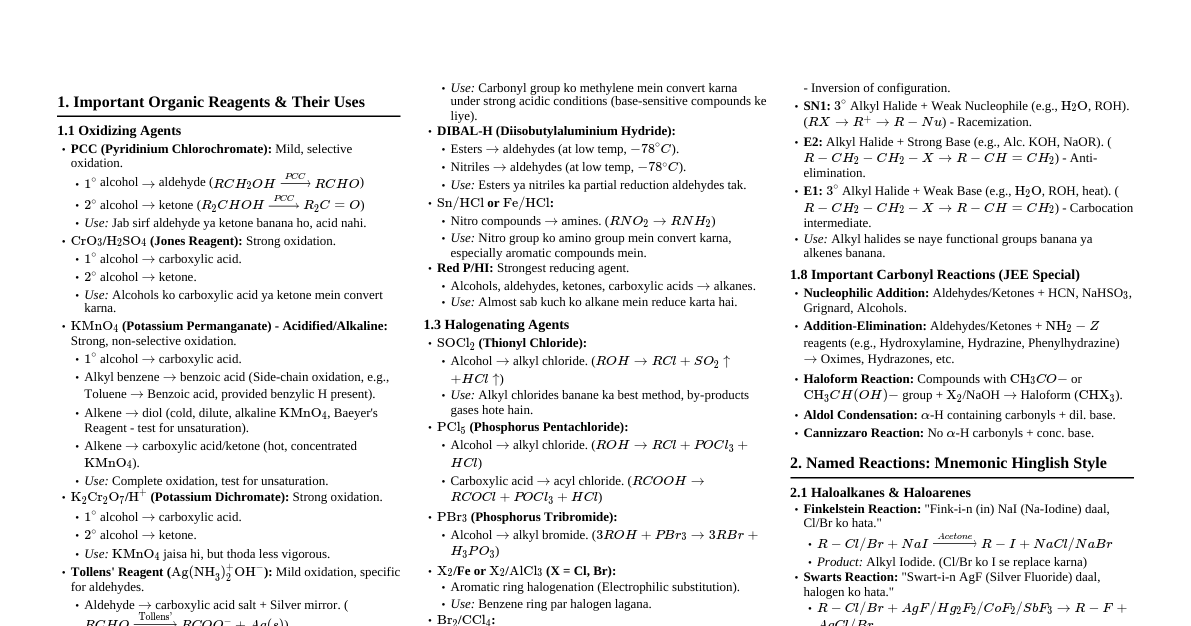
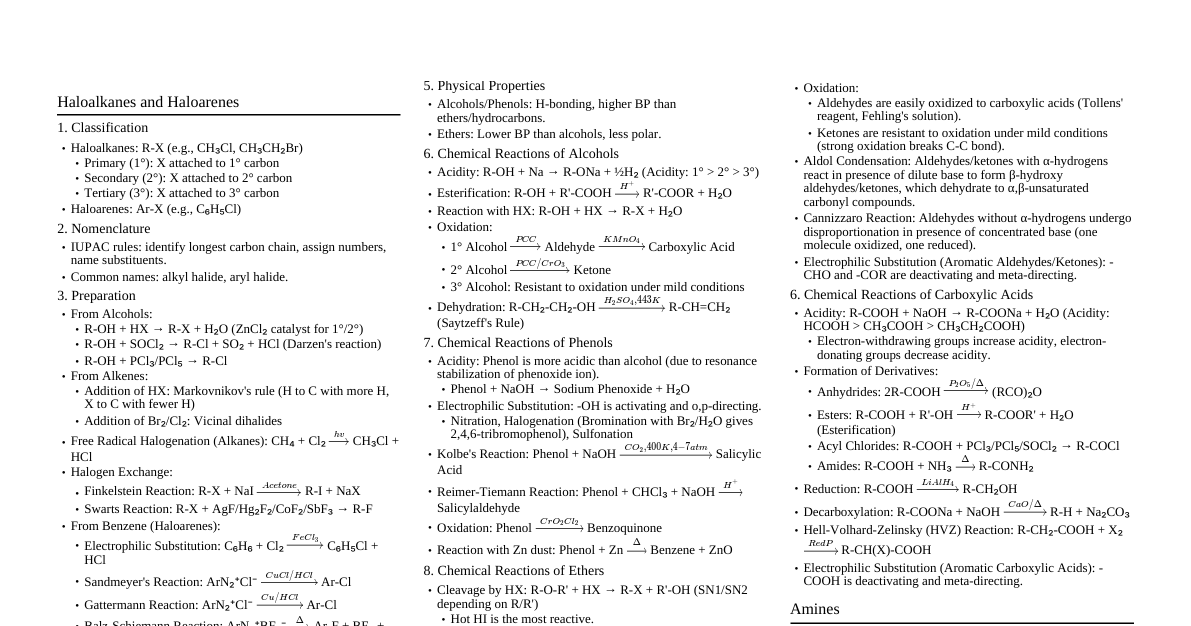
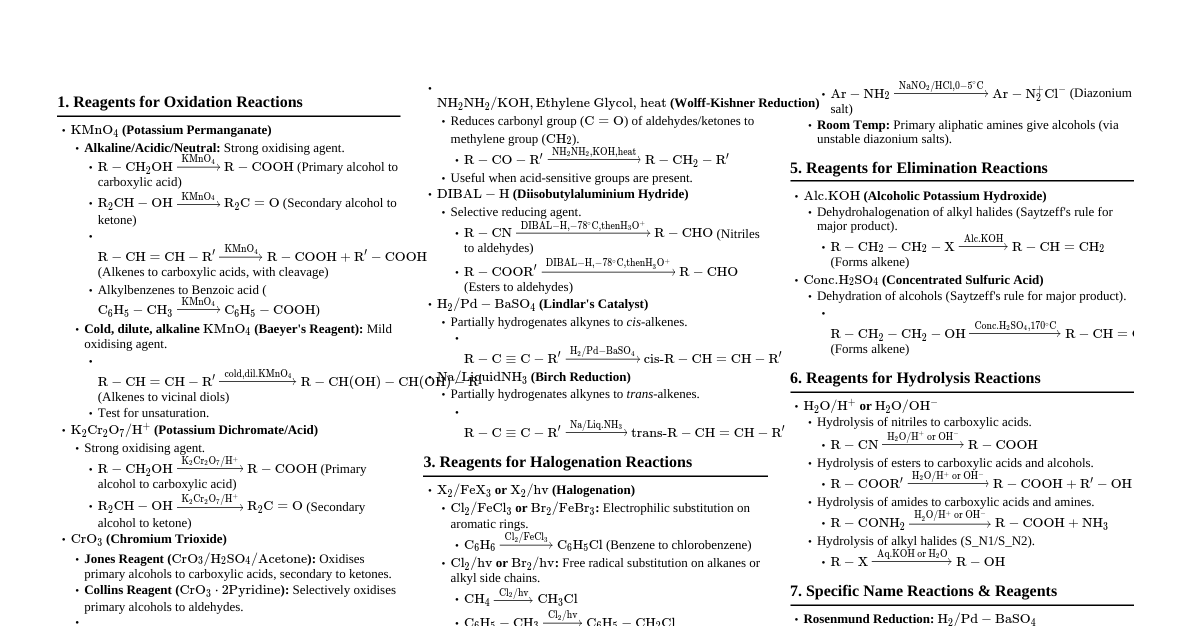
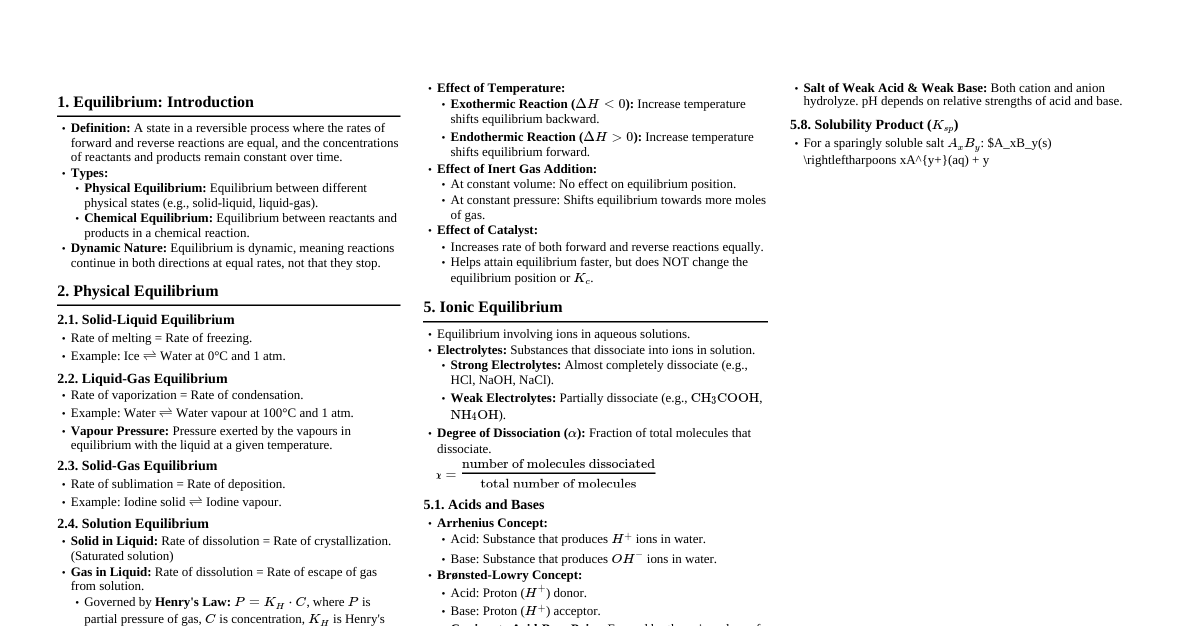
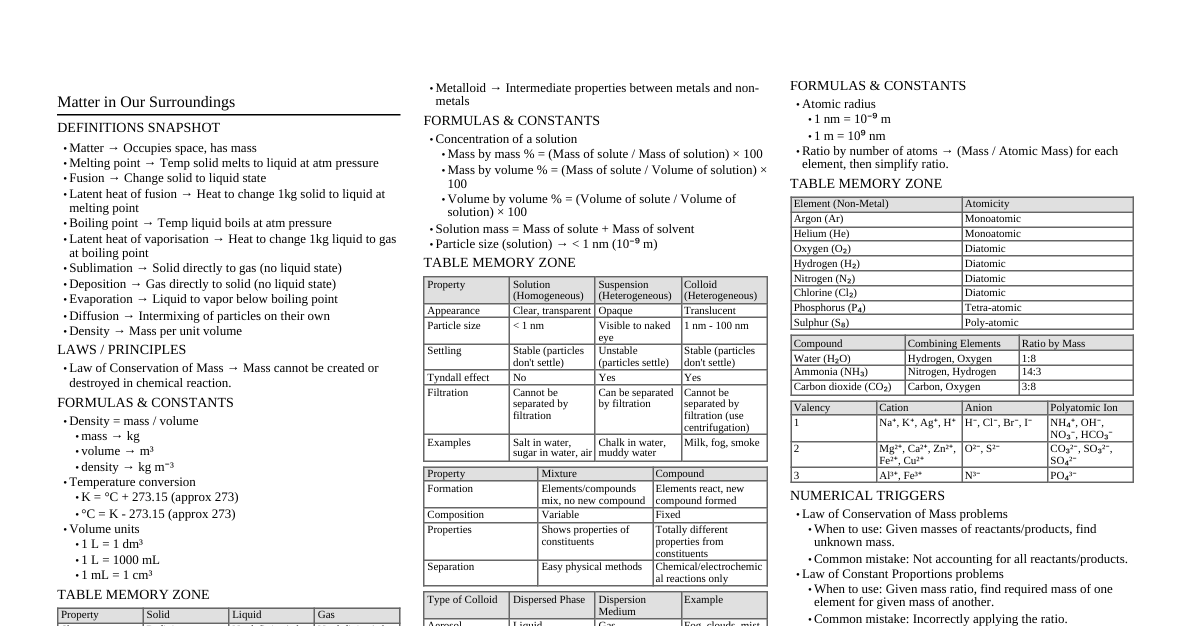
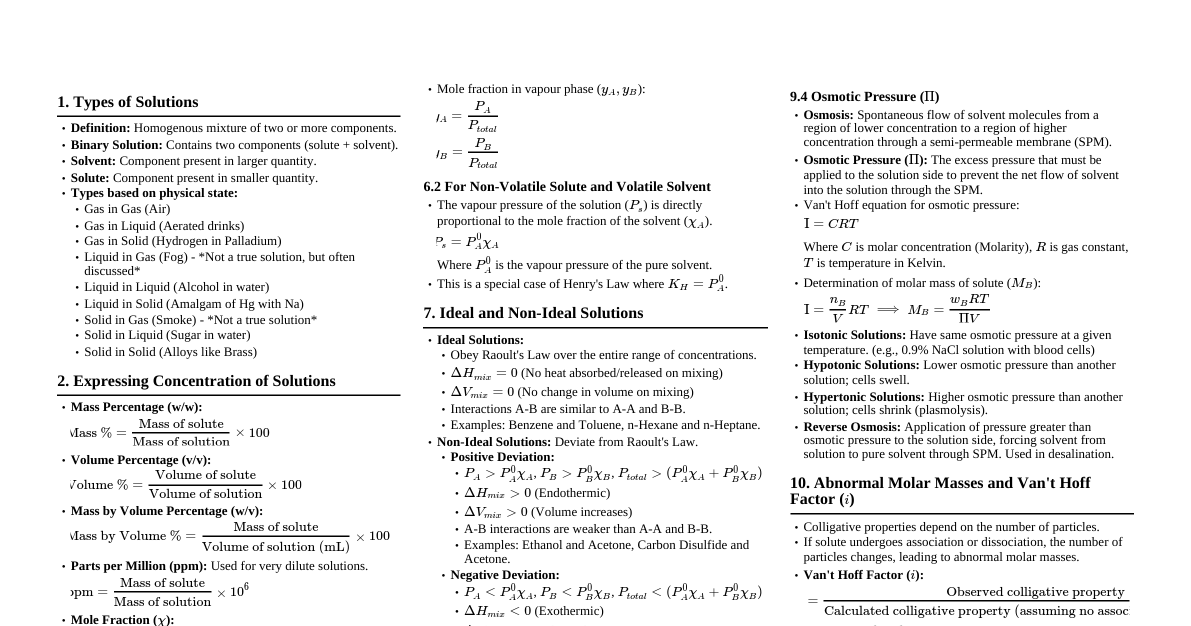
### Some Basic Concepts of Chemistry - **Matter:** Anything that has mass and occupies space. - **Classification:** Mixture (homogeneous/heterogeneous), Pure Substances (elements/compounds). - **Laws of Chemical Combination:** - **Law of Conservation of Mass:** Mass is neither created nor destroyed. - **Law of Definite Proportions:** A given compound always contains elements in the same proportion by mass. - **Law of Multiple Proportions:** If two elements combine to form more than one compound, the masses of one element that combine with a fixed mass of the other element are in ratios of small whole numbers. - **Gay Lussac's Law of Gaseous Volumes:** When gases combine, their volumes bear a simple whole number ratio if temperature and pressure are constant. - **Avogadro's Law:** Equal volumes of all gases at the same T & P contain equal number of molecules. - **Atomic Mass:** Average relative mass of an atom compared to 1/12th mass of C-12 atom. - **Molecular Mass:** Sum of atomic masses of all atoms in a molecule. - **Mole Concept:** 1 mole = $6.022 \times 10^{23}$ particles (Avogadro's number). - Molar mass = Atomic/Molecular mass in grams. - **Stoichiometry:** Calculations based on balanced chemical equations. - **Limiting Reagent:** Reactant consumed first, limiting product formation. - **Percentage Yield:** (Actual Yield / Theoretical Yield) $\times$ 100 - **Concentration Terms:** - **Mass %:** (Mass of solute / Mass of solution) $\times$ 100 - **Mole Fraction ($X_A$):** (Moles of A / Total moles) - **Molarity (M):** Moles of solute / Volume of solution (L) - **Molality (m):** Moles of solute / Mass of solvent (kg) ### Structure of Atom - **Dalton's Atomic Theory:** Atoms are indivisible, indestructible. (Later disproved) - **Discovery of Subatomic Particles:** - **Electron (J.J. Thomson):** Cathode ray experiment. Charge/mass ratio $e/m = 1.758820 \times 10^{11}$ C/kg. - **Proton (Goldstein/Rutherford):** Anode ray experiment. - **Neutron (Chadwick):** Bombardment of Beryllium with alpha particles. - **Thomson's Model (Plum Pudding Model):** Positive sphere with embedded electrons. - **Rutherford's Nuclear Model:** Alpha scattering experiment. Nucleus is dense, positively charged, electrons orbit. - **Bohr's Model of Hydrogen Atom:** - Electrons revolve in fixed orbits (stationary states). - Energy of electron in an orbit is quantized. - $E_n = -R_H(1/n^2)$, where $R_H = 2.18 \times 10^{-18}$ J. - Angular momentum $mvr = nh/2\pi$. - Limitations: Fails for multi-electron atoms, doesn't explain Zeeman/Stark effect. - **Quantum Mechanical Model:** - **Dual Nature of Matter (de Broglie):** $\lambda = h/mv$. - **Heisenberg's Uncertainty Principle:** $\Delta x \cdot \Delta p \ge h/4\pi$. - **Schrödinger Equation:** Describes wave nature of electron. - **Quantum Numbers:** - **Principal (n):** Shell, size, energy ($n=1, 2, 3...$) - **Azimuthal (l):** Subshell, shape ($l=0, 1, ..., n-1$; s, p, d, f) - **Magnetic ($m_l$):** Orientation ($-l, ..., 0, ..., +l$) - **Spin ($m_s$):** Spin of electron ($+1/2, -1/2$) - **Electronic Configuration Rules:** - **Aufbau Principle:** Fill lowest energy orbitals first. - **Pauli's Exclusion Principle:** No two electrons can have all four quantum numbers same. - **Hund's Rule of Maximum Multiplicity:** Pairing of electrons in degenerate orbitals does not occur until each orbital is singly occupied. - **Stability of Half-filled and Fully-filled Orbitals:** Due to symmetry and exchange energy. ### Classification of Elements & Periodicity - **Mendeleev's Periodic Law:** Properties of elements are periodic functions of their atomic masses. - **Modern Periodic Law (Moseley):** Properties of elements are periodic functions of their atomic numbers. - **Periodic Table:** 18 groups, 7 periods. - **s-block:** Groups 1 & 2 (Alkali & Alkaline Earth Metals). - **p-block:** Groups 13-18 (Non-metals, Metalloids, Noble Gases). - **d-block:** Groups 3-12 (Transition Elements). - **f-block:** Lanthanoids & Actinoids (Inner Transition Elements). - **Periodic Trends:** - **Atomic Radius:** Decreases across a period, increases down a group. - **Ionic Radius:** Cation parent atom. - **Ionization Enthalpy ($\Delta_i H$):** Energy required to remove an electron. Increases across a period, decreases down a group. - **Electron Gain Enthalpy ($\Delta_{eg} H$):** Energy released when an electron is added. Generally more negative (energy released) across a period, less negative down a group. Halogens have high negative values. Noble gases have positive values. - **Electronegativity:** Tendency of an atom to attract shared electron pair. Increases across a period, decreases down a group. (Pauling scale, Mulliken scale). F is most electronegative. - **Metallic Character:** Decreases across a period, increases down a group. - **Non-metallic Character:** Increases across a period, decreases down a group. - **Valency:** No. of electrons in outermost shell or 8 - no. of valence electrons. ### Chemical Bonding and Molecular Structure - **Octet Rule:** Atoms combine to achieve 8 electrons in valence shell. (Exceptions: H, He, Li, Be, B, P, S). - **Lewis Symbols:** Dots represent valence electrons. - **Ionic Bond:** Transfer of electrons, forms ions. - Factors: Low IE for metal, high EGE for non-metal, high Lattice Enthalpy. - **Covalent Bond:** Sharing of electrons. - **Bond Parameters:** Bond length, bond angle, bond enthalpy, bond order. - **Polar Covalent Bond:** Unequal sharing due to electronegativity difference. - **Dipole Moment ($\mu$):** $\mu = Q \times r$ (Charge $\times$ distance). Vector quantity. Non-polar molecules have $\mu = 0$. - **VSEPR Theory (Valence Shell Electron Pair Repulsion):** Predicts molecular geometry based on repulsion between electron pairs. - Lone pair-lone pair > lone pair-bond pair > bond pair-bond pair repulsion. - **Shapes:** Linear ($AX_2$), Trigonal Planar ($AX_3$), Tetrahedral ($AX_4$), Trigonal Bipyramidal ($AX_5$), Octahedral ($AX_6$), Bent ($AX_2E_1$), Pyramidal ($AX_3E_1$). - **Valence Bond Theory (VBT):** Overlap of atomic orbitals to form bonds. - **Hybridization:** Mixing of atomic orbitals to form new hybrid orbitals. - $sp$ (linear), $sp^2$ (trigonal planar), $sp^3$ (tetrahedral), $sp^3d$ (trigonal bipyramidal), $sp^3d^2$ (octahedral). - **Sigma ($\sigma$) bond:** Head-on overlap. - **Pi ($\pi$) bond:** Sideways overlap. - **Molecular Orbital Theory (MOT):** Atomic orbitals combine to form molecular orbitals (bonding & anti-bonding). - **Bond Order:** $1/2 (\text{No. of electrons in bonding MO - No. of electrons in anti-bonding MO})$. - Predicts magnetic properties (paramagnetic if unpaired electrons, diamagnetic if all paired). - **Hydrogen Bonding:** Special dipole-dipole interaction between H and highly electronegative atom (F, O, N). - **Intramolecular:** Within same molecule. - **Intermolecular:** Between different molecules. ### States of Matter - **Intermolecular Forces:** - **Dispersion Forces (London Forces):** Weakest, non-polar molecules. - **Dipole-Dipole Forces:** Polar molecules. - **Dipole-Induced Dipole Forces:** Polar and non-polar molecules. - **Hydrogen Bonding:** Strongest intermolecular force. - **Gaseous State:** - **Gas Laws:** - **Boyle's Law:** $P \propto 1/V$ (at constant T, n). $P_1V_1 = P_2V_2$. - **Charles's Law:** $V \propto T$ (at constant P, n). $V_1/T_1 = V_2/T_2$. - **Gay-Lussac's Law:** $P \propto T$ (at constant V, n). $P_1/T_1 = P_2/T_2$. - **Avogadro's Law:** $V \propto n$ (at constant T, P). $V_1/n_1 = V_2/n_2$. - **Ideal Gas Equation:** $PV = nRT$. $R = 0.0821 \text{ L atm mol}^{-1} \text{ K}^{-1}$ or $8.314 \text{ J mol}^{-1} \text{ K}^{-1}$. - **Dalton's Law of Partial Pressures:** $P_{total} = P_1 + P_2 + ...$ - **Graham's Law of Diffusion/Effusion:** $r_1/r_2 = \sqrt{M_2/M_1}$. - **Kinetic Theory of Gases:** - Gases consist of tiny particles in constant random motion. - Negligible volume of particles compared to container volume. - No intermolecular forces. - Collisions are elastic. - Average kinetic energy $\propto$ absolute temperature. $KE = 3/2 nRT$. - **Real Gases (Deviations from Ideal Gas):** - **Van der Waals Equation:** $(P + an^2/V^2)(V - nb) = nRT$. - 'a' accounts for intermolecular forces, 'b' for volume of gas molecules. - **Liquid State:** - **Vapour Pressure:** Pressure exerted by vapour in equilibrium with liquid. Increases with T. - **Boiling Point:** Temperature at which vapour pressure = external pressure. - **Surface Tension:** Force acting per unit length perpendicular to line drawn on surface. Minimizes surface area. - **Viscosity:** Resistance to flow. ### Thermodynamics - **System:** Part of universe under study. (Open, Closed, Isolated). - **Surroundings:** Rest of the universe. - **State Functions:** Properties depending only on initial and final states (P, V, T, U, H, S, G). - **Path Functions:** Properties depending on path taken (q, w). - **Internal Energy (U):** Total energy of a system. - **First Law of Thermodynamics:** $\Delta U = q + w$. (Conservation of energy) - $q$: heat (positive if absorbed, negative if released). - $w$: work (positive if work done on system, negative if work done by system). - Work done by gas: $w = -P\Delta V$. - **Enthalpy (H):** $H = U + PV$. - $\Delta H = q_p$ (heat at constant pressure). - For reactions: $\Delta H = \sum H_{products} - \sum H_{reactants}$. - **Standard Enthalpies:** $\Delta H_f^\circ$ (formation), $\Delta H_c^\circ$ (combustion), $\Delta H_{vap}^\circ$ (vaporization), $\Delta H_{fus}^\circ$ (fusion), $\Delta H_{sol}^\circ$ (solution). - **Hess's Law of Constant Heat Summation:** Total enthalpy change is same regardless of path. - **Entropy (S):** Measure of randomness or disorder. - **Second Law of Thermodynamics:** For a spontaneous process, $\Delta S_{total} > 0$. - $\Delta S_{sys} = q_{rev}/T$. - **Gibbs Free Energy (G):** $G = H - TS$. - **Gibbs-Helmholtz Equation:** $\Delta G = \Delta H - T\Delta S$. - **Spontaneity:** - $\Delta G 0$: Non-spontaneous - $\Delta G = 0$: Equilibrium - **Relationship with Equilibrium Constant:** $\Delta G^\circ = -RT \ln K$. ### Equilibrium - **Dynamic Equilibrium:** Rate of forward reaction = Rate of backward reaction. - **Law of Mass Action:** For $aA + bB \rightleftharpoons cC + dD$, Rate $= k[A]^x[B]^y$. - **Equilibrium Constant (K):** - $K_c = [C]^c[D]^d / [A]^a[B]^b$ (in terms of concentration). - $K_p = (P_C)^c(P_D)^d / (P_A)^a(P_B)^b$ (in terms of partial pressures). - **Relationship:** $K_p = K_c(RT)^{\Delta n_g}$. - If $K > 10^3$, products favored. If $K K$, reaction proceeds backward. - If $Q = K$, reaction is at equilibrium. - **Le Chatelier's Principle:** If a system at equilibrium is subjected to a change, it will shift in a direction that counteracts the change. - **Effect of Concentration:** Add reactant $\rightarrow$ shift right. Remove product $\rightarrow$ shift right. - **Effect of Pressure/Volume:** Increase P (decrease V) $\rightarrow$ shift to side with fewer gas moles. - **Effect of Temperature:** Increase T $\rightarrow$ shift in endothermic direction. - **Effect of Catalyst:** No effect on equilibrium position, only speeds up attainment. - **Acids and Bases:** - **Arrhenius Concept:** Acid = $H^+$ donor, Base = $OH^-$ donor. - **Brønsted-Lowry Concept:** Acid = proton donor, Base = proton acceptor. - Conjugate acid-base pairs. - **Lewis Concept:** Acid = electron pair acceptor, Base = electron pair donor. - **Ionization of Acids and Bases:** - **Strong Acids/Bases:** Complete ionization. - **Weak Acids/Bases:** Partial ionization. - $K_a = [H^+][A^-]/[HA]$, $K_b = [B^+][OH^-]/[BOH]$. - $pK_a = -\log K_a$, $pK_b = -\log K_b$. - $K_a \cdot K_b = K_w$ (for conjugate acid-base pair). - **Ionic Product of Water ($K_w$):** $[H^+][OH^-] = 10^{-14}$ at 298K. - **pH Scale:** $pH = -\log[H^+]$. $pH + pOH = 14$. - **Buffer Solutions:** Resist change in pH upon addition of small amounts of acid/base. - **Acidic Buffer:** Weak acid + its salt (e.g., $CH_3COOH/CH_3COONa$). - **Basic Buffer:** Weak base + its salt (e.g., $NH_4OH/NH_4Cl$). - **Henderson-Hasselbalch Equation:** $pH = pK_a + \log([Salt]/[Acid])$. - **Solubility Product ($K_{sp}$):** For sparingly soluble salt $A_xB_y \rightleftharpoons xA^{y+} + yB^{x-}$, $K_{sp} = [A^{y+}]^x[B^{x-}]^y$. - If Ionic Product ($Q_{sp}$) > $K_{sp}$, precipitation occurs. - If $Q_{sp} ### Redox Reactions - **Oxidation:** Loss of electrons, increase in oxidation number. - **Reduction:** Gain of electrons, decrease in oxidation number. - **Oxidizing Agent:** Causes oxidation, itself gets reduced. - **Reducing Agent:** Causes reduction, itself gets oxidized. - **Oxidation Number Rules:** - Elements in free state: 0. - Monatomic ions: equal to charge. - Oxygen: -2 (except peroxides -1, superoxides -1/2, $OF_2$ +2). - Hydrogen: +1 (except metal hydrides -1). - Sum of oxidation numbers in a neutral compound = 0. - Sum in a polyatomic ion = charge on ion. - **Types of Redox Reactions:** - **Combination:** $A + B \rightarrow C$. - **Decomposition:** $A \rightarrow B + C$. - **Displacement:** $X + YZ \rightarrow XZ + Y$. (Metal/Non-metal displacement). - **Disproportionation:** Same element is simultaneously oxidized and reduced. - **Balancing Redox Reactions:** - **Oxidation Number Method:** 1. Assign oxidation numbers. 2. Identify oxidized and reduced species. 3. Balance increase/decrease in oxidation numbers. 4. Balance atoms (O with $H_2O$, H with $H^+$ or $OH^-$). - **Half-Reaction Method (Ion-Electron Method):** 1. Write separate oxidation and reduction half-reactions. 2. Balance atoms (O with $H_2O$, H with $H^+$ in acidic medium; H with $H_2O$ and $OH^-$ in basic medium). 3. Balance charge by adding electrons. 4. Make electron count equal in both half-reactions. 5. Add half-reactions. ### Hydrogen - **Position in Periodic Table:** Resembles both alkali metals (Group 1) and halogens (Group 17). - **Isotopes:** Protium ($^1H$), Deuterium ($^2H$ or D), Tritium ($^3H$ or T). - **Preparation of Dihydrogen ($H_2$):** - **Laboratory:** $\text{Zn} + \text{dil. } H_2SO_4 \rightarrow \text{ZnSO}_4 + H_2$. - **Industrial:** Electrolysis of acidified water, from hydrocarbons (steam reforming). - **Properties:** - Lightest gas, non-polar, low melting/boiling point. - **Redox:** Can act as both reducing agent (with non-metals) and oxidizing agent (with active metals). - **Hydrides:** Binary compounds of hydrogen with other elements. - **Ionic/Saline:** Formed with s-block elements (e.g., $NaH, CaH_2$). - **Covalent/Molecular:** Formed with p-block elements (e.g., $CH_4, NH_3, H_2O, HF$). - **Metallic/Interstitial:** Formed with d-block & f-block elements. Non-stoichiometric. - **Water ($H_2O$):** - **Structure:** Bent, polar molecule. - **Hard Water:** Contains dissolved $Ca^{2+}, Mg^{2+}$ ions. - **Temporary Hardness:** Due to bicarbonates. Removed by boiling, Clark's method ($Ca(OH)_2$). - **Permanent Hardness:** Due to chlorides/sulphates. Removed by washing soda, ion-exchange, synthetic resins. - **Hydrogen Peroxide ($H_2O_2$):** - **Preparation:** From $BaO_2 \cdot 8H_2O$ or electrolysis of $H_2SO_4$. - **Structure:** Non-planar, open book structure. - **Properties:** Oxidizing and reducing agent, bleaching agent. - **Heavy Water ($D_2O$):** Used as moderator in nuclear reactors. ### The s-Block Elements - **Group 1: Alkali Metals (Li, Na, K, Rb, Cs, Fr)** - **Electronic Configuration:** $[Noble Gas] ns^1$. - **Properties:** Soft, low melting point, highly reactive, strong reducing agents, form ionic compounds. - **Flame Colouration:** Li (crimson red), Na (golden yellow), K (lilac). - **Reactivity:** Increases down the group. - **Compounds:** - **Oxides:** Form normal oxides ($M_2O$), peroxides ($M_2O_2$), superoxides ($MO_2$). - **Hydroxides:** Strong bases, e.g., $NaOH, KOH$. - **Carbonates/Bicarbonates:** Stable, except $Li_2CO_3$. - **Anomalous Behaviour of Li:** Small size, high polarizing power. Forms covalent compounds, reacts slowly with water, forms $Li_3N$. Diagonal relationship with Mg. - **Group 2: Alkaline Earth Metals (Be, Mg, Ca, Sr, Ba, Ra)** - **Electronic Configuration:** $[Noble Gas] ns^2$. - **Properties:** Harder than alkali metals, higher melting point, less reactive than Group 1, strong reducing agents. - **Flame Colouration:** Ca (brick red), Sr (crimson), Ba (apple green). Be and Mg do not show flame coloration. - **Reactivity:** Increases down the group. - **Compounds:** - **Oxides:** MO, basic (except BeO which is amphoteric). - **Hydroxides:** $M(OH)_2$, less soluble and less basic than Group 1. - **Sulphates:** Solubility decreases down the group. - **Carbonates:** Thermal stability increases down the group. - **Anomalous Behaviour of Be:** Small size, high polarizing power. Forms covalent compounds, amphoteric oxide/hydroxide. Diagonal relationship with Al. ### The p-Block Elements - **General Characteristics:** Valence shell configuration $ns^2 np^{1-6}$. Includes non-metals, metalloids, and some metals. - **Group 13: Boron Family (B, Al, Ga, In, Tl)** - **Electronic Configuration:** $ns^2 np^1$. - **Oxidation State:** +3 (most common). +1 becomes more stable down the group (inert pair effect). - **Boron:** Non-metal, forms covalent compounds. - **Borax ($Na_2B_4O_7 \cdot 10H_2O$):** Used in borax bead test. - **Boric Acid ($H_3BO_3$):** Weak monobasic acid. - **Diborane ($B_2H_6$):** Electron deficient, forms banana bonds. - **Aluminium:** Metal, forms ionic and covalent compounds. - **Amphoteric:** $Al_2O_3$ and $Al(OH)_3$. - **Group 14: Carbon Family (C, Si, Ge, Sn, Pb)** - **Electronic Configuration:** $ns^2 np^2$. - **Oxidation States:** +4, +2. +2 stability increases down the group (inert pair effect). - **Carbon:** Non-metal. - **Allotropes:** Diamond (hardest), Graphite (lubricant, conductor), Fullerenes ($C_{60}$). - **Catenation:** Self-linking property, strongest in Carbon. - **Oxides:** CO (neutral, poisonous), $CO_2$ (acidic). - **Silicon:** Metalloid. - **Silica ($SiO_2$):** Covalent network solid. - **Silicones:** Polymers with -Si-O-Si- backbone. - **Tin & Lead:** Metals. ### Organic Chemistry: Some Basic Principles and Techniques - **Classification of Organic Compounds:** - **Acyclic/Open chain:** Alkanes, alkenes, alkynes. - **Alicyclic/Cyclic:** Cycloalkanes, cycloalkenes. - **Aromatic:** Benzene and its derivatives. - **Nomenclature (IUPAC):** - **Word Root:** No. of carbon atoms. - **Suffix:** Primary (type of C-C bond), Secondary (functional group). - **Prefix:** Primary (cyclic/acyclic), Secondary (substituents). - **Isomerism:** Same molecular formula, different structures. - **Structural Isomerism:** - **Chain:** Different carbon skeleton. - **Position:** Different position of functional group/substituent. - **Functional Group:** Different functional groups. - **Metamerism:** Different alkyl groups attached to functional group. - **Tautomerism:** Rapid equilibrium between two forms (e.g., keto-enol). - **Stereoisomerism:** - **Geometrical (cis-trans):** Restricted rotation around double bond. - **Optical:** Chiral center, non-superimposable mirror images (enantiomers). - **Homologous Series:** Series of compounds with same functional group, differ by $CH_2$ unit. - **Reaction Intermediates:** - **Carbocation:** Positively charged carbon, $sp^2$ hybridized, trigonal planar. Stability: $3^\circ > 2^\circ > 1^\circ > CH_3^+$. - **Carbanion:** Negatively charged carbon, $sp^3$ hybridized, pyramidal. Stability: $CH_3^- > 1^\circ > 2^\circ > 3^\circ$. - **Free Radicals:** Odd electron on carbon, $sp^2$ hybridized, planar. Stability: $3^\circ > 2^\circ > 1^\circ > CH_3^\cdot$. - **Electron Displacement Effects:** - **Inductive Effect (I):** Permanent displacement of $\sigma$-electrons along a chain. - **$+I$ effect:** Electron donating (e.g., alkyl groups). - **$-I$ effect:** Electron withdrawing (e.g., $-NO_2, -COOH, -X$). - **Resonance Effect (M/R):** Delocalization of $\pi$-electrons. - **$+M$ effect:** Electron donating groups (e.g., $-OH, -NH_2$). - **$-M$ effect:** Electron withdrawing groups (e.g., $-NO_2, -CHO$). - **Hyperconjugation:** Delocalization of $\sigma$-electrons of C-H bond with adjacent $\pi$-system or empty orbital. (No bond resonance). Increases stability of carbocations, free radicals, and alkenes. - **Types of Reactions:** - **Substitution:** One atom/group replaced by another. - **Addition:** Across double/triple bond. - **Elimination:** Removal of atoms/groups to form multiple bond. - **Rearrangement:** Atoms/groups migrate within same molecule. - **Purification Methods:** Sublimation, Crystallization, Distillation, Differential Extraction, Chromatography. - **Qualitative Analysis:** - **Lassaigne's Test:** For N, S, Halogens. Convert to ionic form. - **Test for Carbon & Hydrogen:** Oxidize with CuO. $CO_2$ to lime water, $H_2O$ to anhydrous $CuSO_4$. - **Test for Nitrogen:** Prussian blue color with $FeSO_4$ and $FeCl_3$. - **Test for Sulphur:** Black ppt with lead acetate; violet color with sodium nitroprusside. - **Test for Halogens:** Beilstein test (green flame); Silver nitrate test (precipitate). - **Test for Phosphorus:** Yellow ppt with ammonium molybdate. - **Quantitative Analysis:** - **Liebig's Method:** For C & H. - **Dumas Method:** For N. - **Kjeldahl's Method:** For N (except for nitro, azo, and N in ring). - **Carius Method:** For halogens, S, P. ### Hydrocarbons - **Alkanes (C-C single bond):** $C_nH_{2n+2}$ - **Preparation:** Wurtz reaction, Decarboxylation, Hydrogenation of alkenes/alkynes. - **Reactions:** - **Halogenation (Free Radical):** $CH_4 + Cl_2 \xrightarrow{hv} CH_3Cl + HCl$. - **Combustion:** $CH_4 + 2O_2 \rightarrow CO_2 + 2H_2O$. - **Nitration, Sulphonation:** With higher alkanes. - **Alkenes (C=C double bond):** $C_nH_{2n}$ - **Preparation:** Dehydration of alcohols, Dehydrohalogenation of alkyl halides, from alkynes. - **Reactions (Electrophilic Addition):** - **Hydrogenation:** $\xrightarrow{H_2, Ni/Pt/Pd}$ Alkane. - **Halogenation:** $\xrightarrow{Br_2/CCl_4}$ Vicinal dibromide (test for unsaturation). - **Hydrohalogenation:** $\xrightarrow{HCl}$ Alkyl halide (Markovnikov's rule). - **Markovnikov's Rule:** Negative part of addendum adds to carbon with fewer hydrogens. - **Anti-Markovnikov's Rule (Peroxide Effect):** In presence of peroxides, HBr adds opposite to Markovnikov's rule (free radical mechanism). - **Hydration:** $\xrightarrow{H_2O, H^+}$ Alcohol. - **Ozonolysis:** $\xrightarrow{O_3, Zn/H_2O}$ Aldehydes/Ketones. - **Baeyer's Test:** $\xrightarrow{Cold, dil. KMnO_4}$ Vicinal diol (test for unsaturation, pink color disappears). - **Alkynes (C$\equiv$C triple bond):** $C_nH_{2n-2}$ - **Preparation:** From vicinal dihalides, calcium carbide. - **Acidity of Terminal Alkynes:** H attached to $sp$ carbon is acidic. Reacts with Na, $NaNH_2$. - **Reactions (Electrophilic Addition):** - **Hydrogenation:** $\xrightarrow{H_2, Ni/Pt/Pd}$ Alkane. $\xrightarrow{H_2, Lindlar's catalyst}$ Cis-alkene. $\xrightarrow{Na/Li, liq. NH_3}$ Trans-alkene. - **Halogenation, Hydrohalogenation, Hydration:** Similar to alkenes, but two molecules add. - **Polymerization:** Linear (Acetylene to polyacetylene), Cyclic (Acetylene to Benzene). - **Aromatic Hydrocarbons (Benzene):** - **Structure:** Planar, cyclic, conjugated, $4n+2$ $\pi$-electrons (Hückel's Rule). - **Resonance:** All C-C bonds are equivalent. - **Electrophilic Substitution Reactions:** - **Nitration:** $\xrightarrow{Conc. HNO_3, Conc. H_2SO_4}$ Nitrobenzene. - **Halogenation:** $\xrightarrow{Cl_2, FeCl_3}$ Chlorobenzene. - **Sulphonation:** $\xrightarrow{Conc. H_2SO_4}$ Benzenesulphonic acid. - **Friedel-Crafts Alkylation:** $\xrightarrow{R-X, Anhyd. AlCl_3}$ Alkylbenzene. - **Friedel-Crafts Acylation:** $\xrightarrow{RCOCl, Anhyd. AlCl_3}$ Acylbenzene. - **Directing Groups:** - **Ortho-para directing & activating:** $-OH, -NH_2, -R, -OCH_3$. - **Meta directing & deactivating:** $-NO_2, -COOH, -CHO, -CN$. - **Halogens:** Ortho-para directing but deactivating. ### Environmental Chemistry - **Environmental Pollution:** Undesirable change in physical, chemical, or biological characteristics of environment. - **Tropospheric Pollution:** - **Gaseous Pollutants:** Oxides of Sulphur ($SO_2$), Nitrogen ($NO_x$), Carbon ($CO, CO_2$), Hydrocarbons. - **Acid Rain:** $SO_2, NO_x$ react with $H_2O$ to form $H_2SO_4, HNO_3$. - **Smog:** - **Classical Smog (London Smog):** Coal smoke, fog, $SO_2$. Reducing in nature. - **Photochemical Smog (Los Angeles Smog):** Sunlight, $NO_x$, hydrocarbons. Oxidizing in nature. Components: Ozone, PAN, Acrolein, Formaldehyde. - **Greenhouse Effect & Global Warming:** $CO_2, CH_4, N_2O, CFCs$ trap heat. - **Stratospheric Pollution:** - **Ozone Layer Depletion:** CFCs break down ozone ($O_3 \rightarrow O_2$). Protects from UV radiation. - **Water Pollution:** - **Causes:** Pathogens, organic wastes (increase BOD), chemical pollutants. - **BOD (Biological Oxygen Demand):** Amount of oxygen consumed by bacteria in decomposing organic matter. High BOD = more polluted water. - **Soil Pollution:** Pesticides, insecticides, industrial wastes. - **Green Chemistry:** Use of chemical products and processes that reduce or eliminate hazardous substances. - Principles: Prevention, Atom Economy, Less Hazardous Chemical Syntheses, Design Safer Chemicals, Safer Solvents and Auxiliaries, Design for Energy Efficiency, Use of Renewable Feedstocks, Reduce Derivatives, Catalysis, Design for Degradation, Real-time analysis for Pollution Prevention, Inherently Safer Chemistry for Accident Prevention.