Elimination Reactions
Cheatsheet Content
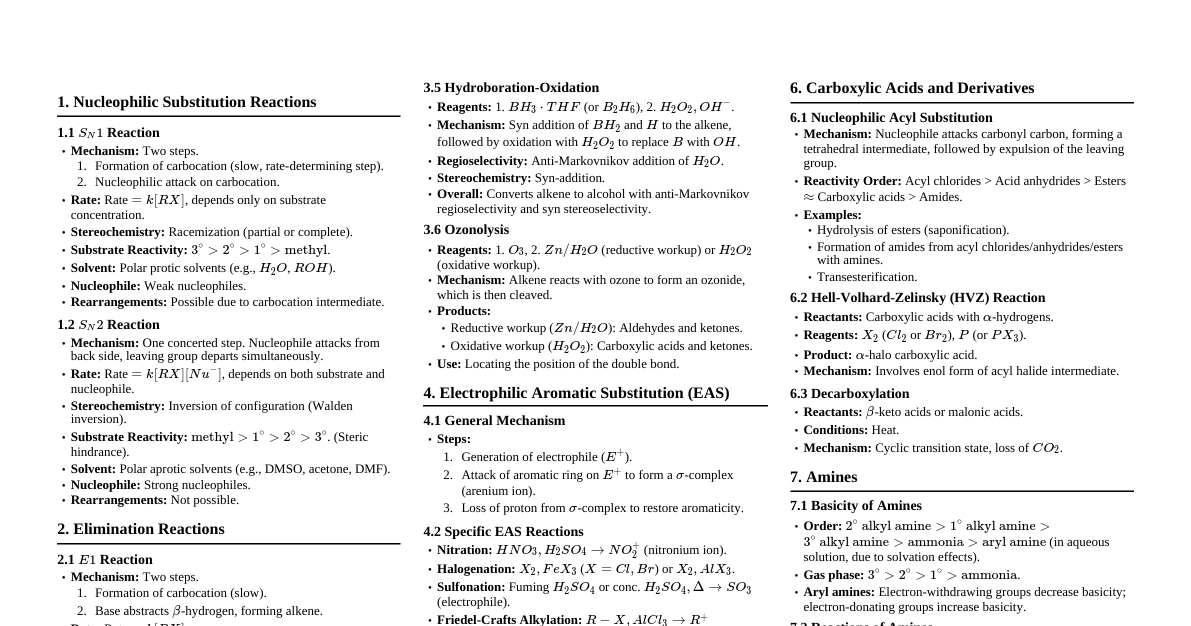
### E1 Reactions - **Mechanism:** Unimolecular Elimination. Two steps: 1. Formation of a carbocation (rate-determining step). 2. Deprotonation by a weak base to form an alkene. - **Rate Law:** Rate = k[substrate] (first-order) - **Substrate Reactivity:** Tertiary > Secondary (Primary almost never) - **Stereochemistry:** Not stereospecific. Can form E and Z isomers. - **Regioselectivity:** Favors Zaitsev product (more substituted alkene) due to carbocation stability. - **Leaving Group:** Good leaving groups (halides, tosylates) are essential. - **Solvent:** Polar protic solvents favor E1 (stabilize carbocation). - **Base:** Weak bases (e.g., H₂O, EtOH, MeOH) are typically used. - **Competition:** Often competes with S N 1 reactions. High temperatures favor E1. #### Advanced Concepts: - **Carbocation Rearrangements:** Hydride or alkyl shifts can occur to form more stable carbocations, leading to unexpected products. - **Orbital Overlap:** While not stereospecific, the deprotonation step involves overlap of the adjacent C-H bond with the empty p-orbital of the carbocation. ### E2 Reactions - **Mechanism:** Bimolecular Elimination. Concerted, one-step process. - **Rate Law:** Rate = k[substrate][base] (second-order) - **Substrate Reactivity:** Tertiary > Secondary > Primary (Primary is possible with strong, hindered bases). - **Stereochemistry:** **Anti-periplanar geometry required** for the H and leaving group. This makes E2 stereospecific. - Example: Cyclohexane rings require the H and LG to be axial and anti. - **Regioselectivity:** - **Zaitsev's Rule:** Favors the more substituted alkene (strong, unhindered bases). - **Hofmann's Rule:** Favors the less substituted alkene (bulky, hindered bases like t-BuOK). - **Leaving Group:** Good leaving groups are essential. - **Solvent:** Polar aprotic solvents can enhance reaction rate, but solvent choice is less critical than for E1. - **Base:** Strong bases are required (e.g., RO⁻, OH⁻, DBN, DBU). Bulky bases influence regioselectivity. - **Competition:** Often competes with S N 2 reactions. High temperatures favor E2. #### Advanced Concepts: - **Isotope Effects:** Significant kinetic isotope effect (k H /k D > 1) if C-H bond cleavage is in the rate-determining step, confirming concerted nature. - **Transition State:** Features partial bond breaking (C-H, C-LG) and partial bond formation (C=C, H-Base). ### E1cb Reactions - **Mechanism:** Unimolecular Elimination, Conjugate Base. Two steps: 1. Deprotonation of an acidic proton by a strong base, forming a carbanion (conjugate base). 2. Loss of leaving group from the carbanion to form an alkene. - **Rate Law:** Rate = k[substrate][base] or k[conjugate base] (can vary depending on rate-determining step). - **Substrate Requirements:** Requires an acidic proton β to the leaving group (e.g., adjacent to a carbonyl, nitro group, or other electron-withdrawing group). - **Stereochemistry:** Not typically stereospecific, can form E and Z isomers. - **Regioselectivity:** Often leads to the less substituted alkene if the carbanion is stabilized by an adjacent electron-withdrawing group. - **Leaving Group:** Can proceed with poorer leaving groups than E1/E2. - **Solvent:** Typically polar protic or aprotic, depending on the specific reaction. - **Base:** Strong bases are required to deprotonate the acidic proton. #### Advanced Concepts: - **Irreversible vs. Reversible Deprotonation:** - **E1cb (irreversible):** Deprotonation is rate-determining. - **E1cb (reversible):** Leaving group departure is rate-determining, and deprotonation is in rapid equilibrium. - **Applications:** Important in reactions involving enolates, aldol condensations, and other reactions where carbanion intermediates are formed. ### Problem Set: Advanced Elimination Reactions **Problem 1:** Consider the reaction of (1S,2S)-1-bromo-1,2-diphenylpropane with potassium tert-butoxide (t-BuOK) in tert-butanol. a) Predict the major elimination product(s) and draw their structures. b) Explain the regioselectivity and stereoselectivity observed. c) What would be the major product if a strong, unhindered base like NaOEt were used instead? **Problem 2:** Propose a mechanism and predict the major product for the following reaction: 1-Phenyl-2-nitroethane heated with potassium hydroxide (KOH). Explain why this reaction likely proceeds via an E1cb mechanism. **Problem 3:** When (2S,3R)-3-bromo-2-phenylbutane reacts with sodium methoxide (NaOMe) in methanol, two elimination products are formed. a) Draw the Newman projections showing the anti-periplanar conformations leading to each product. b) Identify the major and minor products and explain your reasoning based on stereoelectronic requirements. c) How would the product ratio change if the substrate was (2S,3S)-3-bromo-2-phenylbutane? **Problem 4:** A compound with the molecular formula C₆H₁₂Br₂ undergoes elimination when treated with excess strong base, yielding a single alkene product, C₆H₁₀. Spectroscopic analysis of the alkene shows only two types of protons, both vinylic and in a 1:1 ratio, and two types of carbons. Propose a structure for the starting dibromide and mechanism for its conversion to the alkene. **Problem 5 (Synthesis Challenge):** Design a synthetic route to prepare (E)-3-methylpent-2-ene from 2-bromo-3-methylpentane, ensuring high stereoselectivity. Justify your choice of reagents and conditions.