ICSE Class 10 Physics
Cheatsheet Content
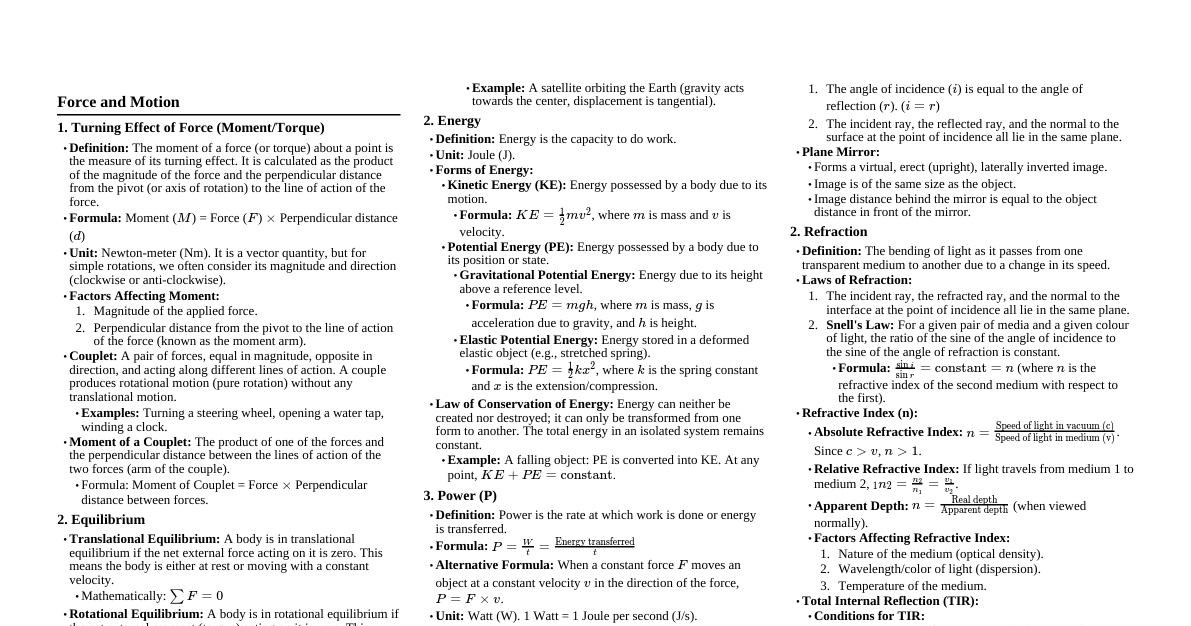
### Force - **Moment of Force (Torque):** $\tau = F \times d$ (Force $\times$ Perpendicular distance from pivot) - **Principle of Moments:** For equilibrium, Sum of anticlockwise moments = Sum of clockwise moments - **Couple:** Two equal and opposite parallel forces, $\tau = F \times \text{perpendicular distance between forces}$ - **Center of Gravity (CG):** The point where the entire weight of the body appears to act. - **Conditions for Equilibrium:** 1. Net force is zero. 2. Net torque is zero. - **Types of Equilibrium:** Stable, Unstable, Neutral. ### Work, Energy, Power - **Work Done:** $W = F \times d \times \cos\theta$ (Force $\times$ Displacement $\times \cos\theta$) - **Kinetic Energy (KE):** $KE = \frac{1}{2}mv^2$ - **Potential Energy (PE):** $PE = mgh$ (Gravitational PE) - **Power:** $P = \frac{W}{t} = F \times v$ (Work done per unit time) - **Units:** Work (Joule), Energy (Joule), Power (Watt) - **Law of Conservation of Energy:** Energy can neither be created nor destroyed, only transformed from one form to another. - **Mechanical Advantage (MA):** $MA = \frac{\text{Load}}{\text{Effort}}$ - **Velocity Ratio (VR):** $VR = \frac{\text{Displacement of Effort}}{\text{Displacement of Load}}$ - **Efficiency ($\eta$):** $\eta = \frac{\text{Work Output}}{\text{Work Input}} \times 100\% = \frac{MA}{VR} \times 100\%$ ### Machines - **Lever:** - Class I: Fulcrum between effort and load (e.g., seesaw, crowbar) - Class II: Load between fulcrum and effort (e.g., nutcracker, wheelbarrow) - Class III: Effort between fulcrum and load (e.g., sugar tongs, fishing rod) - **Pulley System:** - **Single Fixed Pulley:** $MA = 1$, $VR = 1$ (changes direction of force) - **Single Movable Pulley:** $MA = 2$, $VR = 2$ (reduces effort) - **Block & Tackle System:** $VR = \text{number of strands supporting the movable block}$ ### Refraction of Light - **Snell's Law:** $\frac{\sin i}{\sin r} = n$ (Refractive Index) - **Refractive Index ($n$):** $n = \frac{\text{Speed of light in vacuum/air}}{\text{Speed of light in medium}} = \frac{c}{v}$ - **Also:** $n = \frac{\text{Real Depth}}{\text{Apparent Depth}}$ - **Critical Angle ($C$):** $\sin C = \frac{1}{n}$ (for light going from denser to rarer medium) - **Total Internal Reflection (TIR):** Occurs when $i > C$ and light travels from denser to rarer medium. - **Lenses:** - **Lens Formula:** $\frac{1}{v} - \frac{1}{u} = \frac{1}{f}$ (for thin lenses) - **Magnification ($M$):** $M = \frac{\text{Height of Image}}{\text{Height of Object}} = \frac{v}{u}$ - **Power of a Lens ($P$):** $P = \frac{1}{f}$ (in dioptres, if $f$ in meters) - **Sign Convention:** Cartesian sign convention (light travels from left to right) - Distances measured from optical center. - Distances in direction of light are positive, opposite are negative. - Heights above principal axis positive, below negative. ### Spectrum of Light - **Dispersion:** Splitting of white light into its constituent colors (VIBGYOR) due to different refractive indices for different wavelengths. - **Electromagnetic Spectrum:** Radio, Microwave, Infrared, Visible, Ultraviolet, X-rays, Gamma rays (increasing frequency, decreasing wavelength). - **Properties of EM Waves:** Transverse, travel at speed of light in vacuum, do not require a medium. ### Sound - **Speed of Sound ($v$):** $v = f \lambda$ (Frequency $\times$ Wavelength) - **Loudness:** Dependent on amplitude (measured in decibels, dB). - **Pitch:** Dependent on frequency. - **Quality (Timbre):** Dependent on waveform (presence of overtones). - **Echo:** Reflection of sound. - **Condition:** Minimum distance from reflecting surface for distinct echo $\approx 17 \text{ m}$ (for speed of sound $340 \text{ m/s}$). - **Resonance:** Forced vibration at natural frequency, leading to large amplitude vibrations. - **Vibrations:** - **Free Vibrations:** Oscillating with natural frequency. - **Damped Vibrations:** Amplitude decreases over time due to energy loss. - **Forced Vibrations:** Body made to vibrate by an external periodic force. ### Electricity - **Ohm's Law:** $V = IR$ (Voltage = Current $\times$ Resistance) - **Resistance (R):** $R = \rho \frac{L}{A}$ (Resistivity $\times \frac{\text{Length}}{\text{Area}}$) - **Resistors in Series:** $R_{eq} = R_1 + R_2 + R_3 + ...$ - **Resistors in Parallel:** $\frac{1}{R_{eq}} = \frac{1}{R_1} + \frac{1}{R_2} + \frac{1}{R_3} + ...$ - **Electrical Power ($P$):** $P = VI = I^2R = \frac{V^2}{R}$ - **Electrical Energy ($E$):** $E = P \times t = VIt = I^2Rt = \frac{V^2}{R}t$ - **Coulomb's Law:** $F = k \frac{q_1 q_2}{r^2}$ (Force between two charges) - **Current ($I$):** $I = \frac{Q}{t}$ (Charge per unit time) - **Voltage/Potential Difference ($V$):** $V = \frac{W}{Q}$ (Work done per unit charge) - **Household Wiring:** Live (Red/Brown), Neutral (Black/Blue), Earth (Green/Yellow) ### Magnetism - **Magnetic Field Lines:** Originate from North pole, end at South pole, never intersect. - **Electromagnetism:** Moving charges produce magnetic fields. - **Right-Hand Thumb Rule:** For current-carrying straight conductor. - **Fleming's Left-Hand Rule:** For force on a current-carrying conductor in a magnetic field (Motor Rule). - Thumb: Direction of Force - Forefinger: Direction of Field - Middle Finger: Direction of Current - **Fleming's Right-Hand Rule:** For induced current (Generator Rule). - Thumb: Direction of Motion - Forefinger: Direction of Field - Middle Finger: Direction of Induced Current - **Faraday's Law of Electromagnetic Induction:** Induced EMF is proportional to rate of change of magnetic flux. - **Lenz's Law:** Induced current opposes the cause producing it. - **AC Generator:** Converts mechanical energy to electrical energy (AC). - **DC Motor:** Converts electrical energy to mechanical energy. - **Transformer:** Changes AC voltage and current. - **Turns Ratio:** $\frac{N_s}{N_p} = \frac{V_s}{V_p} = \frac{I_p}{I_s}$ - **Efficiency:** $\eta = \frac{\text{Output Power}}{\text{Input Power}} \times 100\%$ ### Heat - **Specific Heat Capacity ($c$):** $Q = mc\Delta T$ (Heat energy = mass $\times$ specific heat capacity $\times$ change in temperature) - **Latent Heat ($L$):** $Q = mL$ (Heat energy for phase change = mass $\times$ latent heat) - **Specific Latent Heat of Fusion:** For melting/freezing. - **Specific Latent Heat of Vaporization:** For boiling/condensation. - **Principle of Calorimetry:** Heat lost by hot body = Heat gained by cold body. - **Greenhouse Effect:** Trapping of Earth's heat by atmospheric gases (e.g., CO$_2$, CH$_4$). ### Radioactivity - **Radioactivity:** Spontaneous disintegration of unstable atomic nuclei. - **Types of Radiations:** - **Alpha ($\alpha$):** Helium nucleus ($_2^4\text{He}$), positively charged, low penetrating power, high ionizing power. - **Beta ($\beta$):** Electron ($_{-1}^0\text{e}$), negatively charged, moderate penetrating power, moderate ionizing power. - **Gamma ($\gamma$):** Electromagnetic wave, no charge, high penetrating power, low ionizing power. - **Half-Life ($T_{1/2}$):** Time taken for half of the radioactive nuclei to decay. - **Nuclear Fission:** Splitting of a heavy nucleus into lighter nuclei. - **Nuclear Fusion:** Combining of lighter nuclei to form a heavier nucleus. - **Uses of Radioactivity:** Medical (diagnosis, treatment), industrial (tracers, gauges), power generation. - **Safety Precautions:** Shielding, safe disposal, limited exposure time, distance.