ICSE Class X Physics
Cheatsheet Content
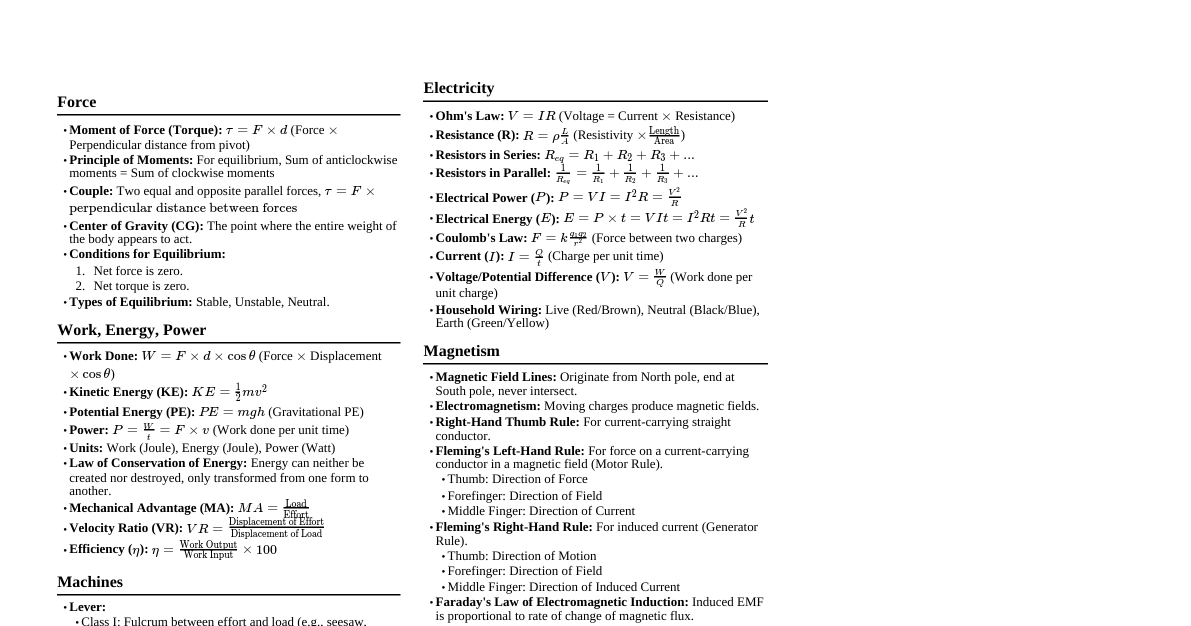
### Force and Motion #### 1. Turning Effect of Force (Moment/Torque) - **Definition:** The moment of a force (or torque) about a point is the measure of its turning effect. It is calculated as the product of the magnitude of the force and the perpendicular distance from the pivot (or axis of rotation) to the line of action of the force. - **Formula:** Moment ($M$) = Force ($F$) $\times$ Perpendicular distance ($d$) - **Unit:** Newton-meter (Nm). It is a vector quantity, but for simple rotations, we often consider its magnitude and direction (clockwise or anti-clockwise). - **Factors Affecting Moment:** 1. Magnitude of the applied force. 2. Perpendicular distance from the pivot to the line of action of the force (known as the moment arm). - **Couplet:** A pair of forces, equal in magnitude, opposite in direction, and acting along different lines of action. A couple produces rotational motion (pure rotation) without any translational motion. - **Examples:** Turning a steering wheel, opening a water tap, winding a clock. - **Moment of a Couplet:** The product of one of the forces and the perpendicular distance between the lines of action of the two forces (arm of the couple). - Formula: Moment of Couplet = Force $\times$ Perpendicular distance between forces. #### 2. Equilibrium - **Translational Equilibrium:** A body is in translational equilibrium if the net external force acting on it is zero. This means the body is either at rest or moving with a constant velocity. - Mathematically: $\sum F = 0$ - **Rotational Equilibrium:** A body is in rotational equilibrium if the net external moment (torque) acting on it is zero. This means there is no angular acceleration; the body is either not rotating or rotating at a constant angular velocity. - Mathematically: $\sum M = 0$ - **Principle of Moments:** For a body to be in rotational equilibrium, the sum of all clockwise moments about any pivot point must be equal to the sum of all anti-clockwise moments about the same pivot point. - This principle is fundamental in understanding levers, balances, and other rotating systems. #### 3. Centre of Gravity (CG) - **Definition:** The centre of gravity (CG) of a body is the point through which the entire weight of the body appears to act, regardless of the body's orientation. - **Stability:** The position of the CG significantly affects an object's stability. - **Stable Equilibrium:** CG is lowered when tilted (e.g., a cone resting on its base). - **Unstable Equilibrium:** CG is raised when tilted (e.g., a cone balanced on its tip). - **Neutral Equilibrium:** CG remains at the same height when tilted (e.g., a sphere on a flat surface). - **Examples of CG locations for uniform objects:** - **Uniform Rod:** At its midpoint. - **Uniform Circular Disc/Ring:** At its geometric center. - **Uniform Square/Rectangle:** At the intersection of its diagonals. - **Uniform Triangular Lamina:** At its centroid (intersection of medians). #### 4. Uniform Circular Motion - **Definition:** The motion of an object describing a circular path with constant speed. Although the speed is constant, the velocity is continuously changing because the direction of motion is constantly changing. - **Centripetal Force ($F_c$):** The force required to keep an object moving in a circular path. This force is always directed towards the center of the circular path and is perpendicular to the velocity of the object. - **Formula:** $F_c = \frac{mv^2}{r}$, where $m$ is mass, $v$ is speed, and $r$ is the radius of the circular path. - **Nature:** It is not a new type of force but rather a role played by existing forces (e.g., tension in a string, gravitational force, friction, normal force). - **Centrifugal Force:** A fictitious or pseudo force experienced by an object moving in a circular path when viewed from a non-inertial (rotating) frame of reference. It acts outwards, away from the center of the circle, and is equal in magnitude to the centripetal force. - It is an apparent force, not a real interaction. - **Examples:** Stone whirled in a circle by a string, planets orbiting the sun, a car taking a turn. ### Work, Energy, Power and Machines #### 1. Work Done (W) - **Definition:** Work is done when a force causes a displacement of an object in the direction of the force. - **Formula:** $W = F \times d \times \cos\theta$, where $F$ is the force, $d$ is the displacement, and $\theta$ is the angle between the force and displacement vectors. - **Unit:** Joule (J). 1 Joule = 1 Newton-meter (Nm). - **Conditions for Zero Work:** 1. If there is no force ($F=0$). 2. If there is no displacement ($d=0$). 3. If the force is perpendicular to the displacement ($\theta = 90^\circ$, so $\cos 90^\circ = 0$). - **Example:** A satellite orbiting the Earth (gravity acts towards the center, displacement is tangential). #### 2. Energy - **Definition:** Energy is the capacity to do work. - **Unit:** Joule (J). - **Forms of Energy:** - **Kinetic Energy (KE):** Energy possessed by a body due to its motion. - **Formula:** $KE = \frac{1}{2}mv^2$, where $m$ is mass and $v$ is velocity. - **Potential Energy (PE):** Energy possessed by a body due to its position or state. - **Gravitational Potential Energy:** Energy due to its height above a reference level. - **Formula:** $PE = mgh$, where $m$ is mass, $g$ is acceleration due to gravity, and $h$ is height. - **Elastic Potential Energy:** Energy stored in a deformed elastic object (e.g., stretched spring). - **Formula:** $PE = \frac{1}{2}kx^2$, where $k$ is the spring constant and $x$ is the extension/compression. - **Law of Conservation of Energy:** Energy can neither be created nor destroyed; it can only be transformed from one form to another. The total energy in an isolated system remains constant. - **Example:** A falling object: PE is converted into KE. At any point, $KE + PE = \text{constant}$. #### 3. Power (P) - **Definition:** Power is the rate at which work is done or energy is transferred. - **Formula:** $P = \frac{W}{t} = \frac{\text{Energy transferred}}{t}$ - **Alternative Formula:** When a constant force $F$ moves an object at a constant velocity $v$ in the direction of the force, $P = F \times v$. - **Unit:** Watt (W). 1 Watt = 1 Joule per second (J/s). - **Other Units:** Horsepower (hp), 1 hp $\approx$ 746 W. - **Commercial Unit of Electrical Energy:** kilowatt-hour (kWh). - $\text{1 kWh} = \text{1 kW} \times \text{1 hour} = \text{1000 W} \times \text{3600 s} = \text{3.6} \times 10^6 \text{ J}$. #### 4. Machines - **Definition:** A machine is a device that helps us to do work more easily or conveniently. They can: 1. Change the point of application of force. 2. Change the direction of force. 3. Multiply force (force multiplier). 4. Multiply speed (speed multiplier). - **Key Terms:** - **Load:** The resistance or weight to be overcome. - **Effort:** The force applied to the machine. - **Mechanical Advantage (MA):** The ratio of load to effort. - **Formula:** $MA = \frac{\text{Load}}{\text{Effort}}$ - If MA > 1, the machine is a force multiplier. - If MA 1, 1 (force multiplier). - **Class III Lever:** Effort is between the fulcrum and the load. - **Examples:** Fishing rods, forceps, human forearm, broom. - MA is always ### Light #### 1. Reflection - **Definition:** The bouncing back of light when it strikes a surface. - **Laws of Reflection:** 1. The angle of incidence ($i$) is equal to the angle of reflection ($r$). ($i=r$) 2. The incident ray, the reflected ray, and the normal to the surface at the point of incidence all lie in the same plane. - **Plane Mirror:** - Forms a virtual, erect (upright), laterally inverted image. - Image is of the same size as the object. - Image distance behind the mirror is equal to the object distance in front of the mirror. #### 2. Refraction - **Definition:** The bending of light as it passes from one transparent medium to another due to a change in its speed. - **Laws of Refraction:** 1. The incident ray, the refracted ray, and the normal to the interface at the point of incidence all lie in the same plane. 2. **Snell's Law:** For a given pair of media and a given colour of light, the ratio of the sine of the angle of incidence to the sine of the angle of refraction is constant. - **Formula:** $\frac{\sin i}{\sin r} = \text{constant} = n$ (where $n$ is the refractive index of the second medium with respect to the first). - **Refractive Index (n):** - **Absolute Refractive Index:** $n = \frac{\text{Speed of light in vacuum (c)}}{\text{Speed of light in medium (v)}}$. Since $c > v$, $n > 1$. - **Relative Refractive Index:** If light travels from medium 1 to medium 2, $_1n_2 = \frac{n_2}{n_1} = \frac{v_1}{v_2}$. - **Apparent Depth:** $n = \frac{\text{Real depth}}{\text{Apparent depth}}$ (when viewed normally). - **Factors Affecting Refractive Index:** 1. Nature of the medium (optical density). 2. Wavelength/color of light (dispersion). 3. Temperature of the medium. - **Total Internal Reflection (TIR):** - **Conditions for TIR:** 1. Light must travel from an optically denser medium to an optically rarer medium. 2. The angle of incidence in the denser medium must be greater than the critical angle ($C$). - **Critical Angle (C):** The angle of incidence in the denser medium for which the angle of refraction in the rarer medium is $90^\circ$. - **Relationship with Refractive Index:** $\sin C = \frac{1}{n}$ (for light going from a denser medium to air/vacuum). - **Applications:** Optical fibers, sparkling of diamonds, mirage, prisms in binoculars. #### 3. Lenses - **Definition:** A lens is a transparent optical device that focuses or disperses light rays by means of refraction. - **Types of Lenses:** - **Convex Lens (Converging Lens):** Thicker at the center and thinner at the edges. It converges parallel rays of light to a point (focus). - Forms both real and virtual images depending on object position. - Used in magnifying glasses, cameras, projectors, correction of hypermetropia. - **Concave Lens (Diverging Lens):** Thinner at the center and thicker at the edges. It diverges parallel rays of light. - Always forms virtual, erect, and diminished images. - Used in peepholes, flashlights, correction of myopia. - **Key Terms:** Optical center, principal axis, principal focus (F), focal length (f), center of curvature (2F/C). - **Lens Formula:** $\frac{1}{v} - \frac{1}{u} = \frac{1}{f}$ - $u$: object distance from optical center. - $v$: image distance from optical center. - $f$: focal length of the lens. - **Magnification (m):** - **Formula:** $m = \frac{\text{Height of image (h')}}{\text{Height of object (h)}} = \frac{v}{u}$ - If $m > 1$, image is magnified. If $m ### Sound #### 1. Waves - **Definition:** A wave is a disturbance that propagates through a medium (or space) by transferring energy without transferring matter. - **Types of Waves:** - **Transverse Waves:** The particles of the medium oscillate perpendicular to the direction of wave propagation. - **Examples:** Light waves, waves on a string. - Characterized by crests and troughs. - **Longitudinal Waves:** The particles of the medium oscillate parallel to the direction of wave propagation. - **Examples:** Sound waves, waves in a spring. - Characterized by compressions (regions of high density/pressure) and rarefactions (regions of low density/pressure). - **Wave Characteristics:** - **Wavelength ($\lambda$):** The distance between two consecutive crests/troughs (transverse) or compressions/rarefactions (longitudinal). Unit: meter (m). - **Amplitude (A):** The maximum displacement of a particle from its mean position. Related to the intensity/loudness of a wave. - **Frequency (f):** The number of oscillations or waves passing a point per second. Unit: Hertz (Hz). - **Time Period (T):** The time taken for one complete oscillation. $T = \frac{1}{f}$. Unit: second (s). - **Wave Speed (v):** The distance covered by a wave per unit time. - **Wave Equation:** $v = f\lambda$. #### 2. Characteristics of Sound - **Loudness:** The characteristic of sound that distinguishes a loud sound from a faint sound. It depends on the amplitude of the sound wave. Larger amplitude means louder sound. - **Unit of Loudness (Intensity):** Decibel (dB). - **Pitch:** The characteristic of sound that distinguishes a shrill (high-pitched) sound from a flat (low-pitched) sound. It depends on the frequency of the sound wave. Higher frequency means higher pitch. - **Quality (Timbre):** The characteristic of sound that enables us to distinguish between two sounds of the same loudness and pitch produced by different sources. It depends on the waveform of the sound, specifically the number and intensity of overtones (harmonics) present. #### 3. Echo and Reverberation - **Echo:** The distinct repetition of sound heard after reflection from a distant obstacle (e.g., a wall, mountain). - For a distinct echo, the reflected sound must reach the ear at least 0.1 seconds after the original sound. - **Minimum Distance:** Given the speed of sound in air is approximately 340 m/s, for a distinct echo, the total distance covered by sound (to the obstacle and back) must be at least $340 \text{ m/s} \times 0.1 \text{ s} = 34 \text{ m}$. Therefore, the minimum distance to the obstacle is $\frac{34}{2} = 17 \text{ m}$ (at 20°C). - **Reverberation:** The persistence of sound in an enclosed space due to multiple successive reflections from walls, ceiling, and other surfaces, even after the sound source has stopped. - Excessive reverberation can make speech unclear. It is controlled by using sound-absorbing materials. #### 4. Resonance - **Definition:** A phenomenon that occurs when the frequency of an applied periodic force (driving frequency) matches the natural frequency of an object, leading to a large amplitude of vibration. - **Conditions:** The driving frequency must be equal or very close to the natural frequency of the oscillating system. - **Examples:** - A child on a swing pushed at the right time. - Breaking a glass with sound (if the sound frequency matches the natural frequency of the glass). - Tuning a radio to a particular station. - Tacoma Narrows Bridge collapse (though this was more complex fluid-structure interaction, it's often used as an example of resonance). #### 5. Sonameter - **Purpose:** An apparatus used to study the laws of vibrating strings. - **Laws of Vibrating Strings (for a stretched string):** 1. **Law of Length:** The frequency ($f$) of vibration is inversely proportional to the length ($L$) of the vibrating segment, provided the tension and mass per unit length are constant. ($f \propto \frac{1}{L}$) 2. **Law of Tension:** The frequency ($f$) of vibration is directly proportional to the square root of the tension ($T$) in the string, provided the length and mass per unit length are constant. ($f \propto \sqrt{T}$) 3. **Law of Mass per Unit Length:** The frequency ($f$) of vibration is inversely proportional to the square root of the mass per unit length ($m$) of the string, provided the length and tension are constant. ($f \propto \frac{1}{\sqrt{m}}$) - **Combined Formula:** $f = \frac{1}{2L} \sqrt{\frac{T}{m}}$ #### 6. Ultrasonics - **Definition:** Sound waves with frequencies above the upper limit of human hearing (typically > 20 kHz). - **Properties:** High frequency, short wavelength, can travel long distances, can be focused into narrow beams. - **Applications:** - **Medical:** Ultrasound imaging (sonography) for diagnosis, breaking kidney stones, therapeutic uses. - **Industrial:** Cleaning delicate instruments, detecting flaws in metals, welding plastics. - **Navigation/Detection:** SONAR (Sound Navigation and Ranging) for measuring ocean depth, detecting submarines. - **Biology:** Bats and dolphins use ultrasonics for echolocation. ### Current Electricity #### 1. Electric Current and Circuits - **Electric Current (I):** The rate of flow of electric charge. - **Formula:** $I = \frac{Q}{t}$ (Charge $Q$ flowing in time $t$). - **Unit:** Ampere (A). 1 A = 1 C/s (Coulomb per second). - **Electric Potential (V):** The work done per unit charge in moving a charge from infinity to a point in an electric field. - **Potential Difference (V):** The work done per unit charge in moving a charge from one point to another in an electric field. This is what drives current. - **Formula:** $V = \frac{W}{Q}$. - **Unit:** Volt (V). 1 V = 1 J/C (Joule per Coulomb). - **Electric Circuit:** A closed path through which electric current can flow. - **Components:** Cell/Battery (source of EMF), Wires (conductors), Resistor (load), Switch, Ammeter (measures current in series), Voltmeter (measures voltage in parallel). #### 2. Ohm's Law - **Statement:** At constant temperature, the current flowing through a conductor is directly proportional to the potential difference across its ends. - **Formula:** $V = IR$, where $V$ is potential difference, $I$ is current, and $R$ is resistance. - **Resistance (R):** The opposition offered by a conductor to the flow of electric current. - **Unit:** Ohm ($\Omega$). #### 3. Factors Affecting Resistance and Combination of Resistors - **Factors Affecting Resistance:** 1. **Length (L):** Resistance is directly proportional to the length of the conductor ($R \propto L$). 2. **Area of Cross-section (A):** Resistance is inversely proportional to the area of cross-section of the conductor ($R \propto \frac{1}{A}$). 3. **Nature of Material:** Different materials have different inherent resistances (resistivity). 4. **Temperature:** Resistance of most conductors increases with temperature. - **Resistivity ($\rho$):** The resistance offered by a conductor of unit length and unit area of cross-section. It is an intrinsic property of the material. - **Formula:** $R = \rho \frac{L}{A}$. - **Unit:** Ohm-meter ($\Omega$m). - **Combination of Resistors:** - **Series Combination:** Resistors are connected end-to-end. - **Equivalent Resistance ($R_{eq}$):** $R_{eq} = R_1 + R_2 + R_3 + ...$ - **Characteristics:** - The same current flows through each resistor. - The total potential difference is the sum of individual potential differences across each resistor ($V = V_1 + V_2 + ...$). - The equivalent resistance is greater than the largest individual resistance. - **Parallel Combination:** Resistors are connected across the same two points. - **Equivalent Resistance ($R_{eq}$):** $\frac{1}{R_{eq}} = \frac{1}{R_1} + \frac{1}{R_2} + \frac{1}{R_3} + ...$ - **Characteristics:** - The potential difference across each resistor is the same. - The total current is the sum of individual currents through each resistor ($I = I_1 + I_2 + ...$). - The equivalent resistance is smaller than the smallest individual resistance. #### 4. Electrical Energy and Power - **Electrical Energy (E):** The total work done by the current in an electrical circuit. - **Formulas:** - $E = VIt$ - $E = I^2Rt$ (Joule's Law of Heating) - $E = \frac{V^2}{R}t$ - **Unit:** Joule (J). - **Commercial Unit:** kilowatt-hour (kWh). - **Electrical Power (P):** The rate at which electrical energy is consumed or dissipated. - **Formulas:** - $P = VI$ - $P = I^2R$ - $P = \frac{V^2}{R}$ - **Unit:** Watt (W). #### 5. Household Circuits - **Main Components:** - **Live Wire (Phase Wire):** Usually red or brown insulation. It is at a high potential (e.g., 220-240V AC) relative to the earth. Current enters the appliance through this wire. - **Neutral Wire:** Usually black or blue insulation. It is at zero potential (earth potential). Current returns from the appliance through this wire. - **Earth Wire:** Usually green or yellow insulation. It is a safety wire connected to the metal casing of appliances. It provides a low-resistance path for current to flow to the earth in case of an insulation fault, preventing electric shock. - **Fuses:** A safety device that protects electrical circuits and appliances from excessive current. It consists of a thin wire made of a material with a low melting point. When the current exceeds a safe limit, the fuse wire melts, breaking the circuit. - **Switches:** Devices used to make or break an electrical circuit. **Crucially, switches are always connected to the live wire** to ensure that the appliance is completely disconnected from the high potential when the switch is off. - **Earthing:** The process of connecting the metallic body of an electrical appliance to the earth (ground) through a low-resistance wire. This prevents electric shock by ensuring that if the live wire accidentally touches the metal casing, the current flows to the earth instead of through the user. - **Short Circuit:** Occurs when the live wire and neutral wire come into direct contact, creating a path of very low resistance. This causes a very large current to flow, leading to excessive heating and potential fire hazards. - **Overloading:** Occurs when too many appliances are connected to a single socket or circuit, drawing more current than the circuit is designed to handle. This also leads to overheating and potential damage. ### Electromagnetism #### 1. Magnetic Fields - **Definition:** The region around a magnet or a current-carrying conductor where its magnetic influence can be detected. - **Magnetic Field Lines (Lines of Force):** Imaginary lines used to represent a magnetic field. - **Properties:** 1. They originate from the North pole and enter the South pole outside the magnet, forming continuous closed loops. 2. They never intersect each other. 3. The tangent at any point on a field line gives the direction of the magnetic field at that point. 4. The density of field lines indicates the strength of the magnetic field (closer lines = stronger field). 5. They do not pass through the interior of a magnet. (Incorrect for permanent magnets, they do pass through). Let's revise: They pass through the magnet from S to N pole. #### 2. Electromagnetism - **Oersted's Experiment:** Demonstrated that an electric current produces a magnetic field around it. A compass needle deflected when placed near a current-carrying wire. - **Magnetic Field due to a Straight Current-Carrying Conductor:** - **Right-Hand Thumb Rule (Maxwell's Corkscrew Rule):** If you hold the current-carrying conductor in your right hand with your thumb pointing in the direction of the current, then the direction in which your fingers curl around the conductor gives the direction of the magnetic field lines. - The field lines are concentric circles around the wire. - **Magnetic Field due to a Solenoid:** A solenoid is a coil of many turns of insulated wire wound in the shape of a cylinder. - When current passes through a solenoid, it behaves like a bar magnet. - The magnetic field inside a solenoid is strong and uniform. - The polarity (North and South poles) can be determined by the direction of current using the right-hand rule for coils or the clock rule. - **Factors affecting strength of electromagnet:** Number of turns, current, nature of core material. #### 3. Motor Effect (Force on a Current-Carrying Conductor in a Magnetic Field) - **Principle:** When a current-carrying conductor is placed in an external magnetic field, it experiences a force. - **Direction of Force:** Given by **Fleming's Left-Hand Rule:** - **Thumb:** Direction of Force (or Motion) - **Forefinger:** Direction of Magnetic Field (North to South) - **Middle Finger:** Direction of Current (Positive to Negative) - **Magnitude of Force (F):** $F = BIL\sin\theta$, where $B$ is magnetic field strength, $I$ is current, $L$ is length of conductor in the field, and $\theta$ is the angle between the current direction and magnetic field direction. - **Applications:** Electric motors (DC motors), galvanometers. - **DC Motor:** Converts electrical energy into mechanical energy. It works on the principle of the motor effect. #### 4. Electromagnetic Induction (EMI) - **Definition:** The phenomenon of producing an induced electromotive force (EMF) and hence an induced current in a conductor when the magnetic flux linked with the conductor changes. - **Faraday's Laws of Electromagnetic Induction:** 1. Whenever the magnetic flux linked with a circuit changes, an EMF is induced in the circuit. 2. The magnitude of the induced EMF is directly proportional to the rate of change of magnetic flux linked with the circuit. - **Lenz's Law:** States that the direction of the induced current is such that it opposes the cause that produces it. This law is a consequence of the conservation of energy. - **Direction of Induced Current:** Given by **Fleming's Right-Hand Rule (Generator Rule):** - **Thumb:** Direction of Motion of the conductor - **Forefinger:** Direction of Magnetic Field - **Middle Finger:** Direction of Induced Current - **Applications:** Electric generators (AC generators), transformers. - **AC Generator:** Converts mechanical energy into electrical energy. It works on the principle of EMI, producing alternating current. #### 5. Transformers - **Definition:** An electrical device used to change (step up or step down) alternating voltages. It works on the principle of mutual induction. - **Components:** Two coils (primary and secondary) wound on a laminated soft iron core. - **Types of Transformers:** - **Step-up Transformer:** Increases the AC voltage and decreases the current. The number of turns in the secondary coil ($N_s$) is greater than in the primary coil ($N_p$). - **Step-down Transformer:** Decreases the AC voltage and increases the current. The number of turns in the secondary coil ($N_s$) is less than in the primary coil ($N_p$). - **Transformer Equation (for an ideal transformer):** - $\frac{V_s}{V_p} = \frac{N_s}{N_p} = \frac{I_p}{I_s}$ - Where $V_p, I_p, N_p$ are voltage, current, and turns in the primary coil, and $V_s, I_s, N_s$ are for the secondary coil. - **Energy Losses in Transformers:** Hysteresis loss, eddy current loss, copper loss (resistance of windings), flux leakage. These ensure efficiency is less than 100%. - **Usefulness of AC:** AC can be easily stepped up or stepped down using transformers, making it suitable for long-distance power transmission at high voltages (to minimize power loss). ### Heat and Radioactivity #### 1. Heat - **Definition:** Heat is a form of energy that flows from a region of higher temperature to a region of lower temperature. - **Unit:** Joule (J). Other common unit is calorie (1 cal = 4.18 J). - **Temperature:** A measure of the average kinetic energy of the particles within a substance. - **Specific Heat Capacity (c):** The amount of heat energy required to raise the temperature of 1 kg of a substance by 1°C or 1 K. - **Formula:** $Q = mc\Delta T$, where $Q$ is heat energy, $m$ is mass, $c$ is specific heat capacity, and $\Delta T$ is the change in temperature. - **Unit:** Joule per kilogram per Kelvin (J kg$^{-1}$ K$^{-1}$) or Joule per kilogram per degree Celsius (J kg$^{-1}$ °C$^{-1}$). - Water has a high specific heat capacity (4200 J kg$^{-1}$ °C$^{-1}$), which makes it a good coolant. - **Latent Heat (L):** The amount of heat energy absorbed or released by a substance during a phase change (e.g., melting, freezing, boiling, condensation) without a change in temperature. - **Formula:** $Q = mL$, where $Q$ is heat energy, $m$ is mass, and $L$ is the specific latent heat. - **Unit:** Joule per kilogram (J kg$^{-1}$). - **Specific Latent Heat of Fusion ($L_f$):** Heat required to change 1 kg of solid to liquid at its melting point. - **Specific Latent Heat of Vaporisation ($L_v$):** Heat required to change 1 kg of liquid to gas at its boiling point. - **Reason for Latent Heat:** Energy is used to overcome intermolecular forces during phase change, not to increase kinetic energy (temperature). #### 2. Radioactivity - **Definition:** The spontaneous emission of radiation (alpha, beta, or gamma rays) from the nuclei of unstable atoms. - **Radioactive Decay:** The process by which an unstable atomic nucleus loses energy by emitting radiation. - **Types of Radiations:** 1. **Alpha ($\alpha$) Particles:** - **Nature:** Consist of two protons and two neutrons (identical to a Helium nucleus, $^4_2He$). - **Charge:** Positively charged (2e). - **Ionizing Power:** Very high (due to large mass and charge). - **Penetrating Power:** Very low (can be stopped by a sheet of paper or a few cm of air). - **Effect of Electric/Magnetic Field:** Deflected. 2. **Beta ($\beta$) Particles:** - **Nature:** Fast-moving electrons ($^0_{-1}e$) emitted from the nucleus (when a neutron converts into a proton and an electron). - **Charge:** Negatively charged (-e). - **Ionizing Power:** Medium (less than alpha, more than gamma). - **Penetrating Power:** Medium (can pass through a few mm of aluminum). - **Effect of Electric/Magnetic Field:** Deflected (opposite to alpha). 3. **Gamma ($\gamma$) Rays:** - **Nature:** High-energy electromagnetic waves (photons) emitted from the nucleus. - **Charge:** No charge. - **Ionizing Power:** Very low. - **Penetrating Power:** Very high (can penetrate several cm of lead or several meters of concrete). - **Effect of Electric/Magnetic Field:** Not deflected. - **Uses of Radioactivity:** Medical diagnosis (tracers), cancer treatment (radiotherapy), carbon dating, industrial applications (e.g., thickness gauges). #### 3. Nuclear Energy - **Nuclear Fission:** - **Definition:** The process in which a heavy atomic nucleus (e.g., Uranium-235, Plutonium-239) is split into two or more smaller nuclei, along with the emission of neutrons and a tremendous amount of energy. - **Initiation:** Typically initiated by bombarding the heavy nucleus with a slow neutron. - **Chain Reaction:** The emitted neutrons can cause further fission in other nuclei, leading to a self-sustaining chain reaction. - **Applications:** Nuclear power reactors (controlled chain reaction for electricity generation), atomic bombs (uncontrolled chain reaction). - **Nuclear Fusion:** - **Definition:** The process in which two or more light atomic nuclei combine to form a heavier nucleus, releasing an enormous amount of energy. - **Conditions:** Requires extremely high temperatures (millions of degrees Celsius) and pressures (e.g., found in the core of stars). - **Applications:** Occurs naturally in the Sun and other stars. Research is ongoing for controlled fusion on Earth as a potential clean energy source. #### 4. Safety Precautions in Handling Radioactive Materials - **Shielding:** Using materials like lead, concrete, or steel to absorb radiation and protect personnel. - **Distance:** Maintaining a safe distance from radioactive sources, as radiation intensity decreases with the square of the distance. - **Time:** Minimizing the time of exposure to radioactive sources. - **Remote Handling:** Using robotic arms or other remote tools to handle highly radioactive materials. - **Proper Storage and Disposal:** Storing radioactive materials in secure, shielded containers and disposing of radioactive waste according to strict regulations to prevent environmental contamination. - **Monitoring:** Wearing dosimeters to monitor radiation exposure levels.