Class 11 PCB Physics
Shared 3/20/2026•177 views
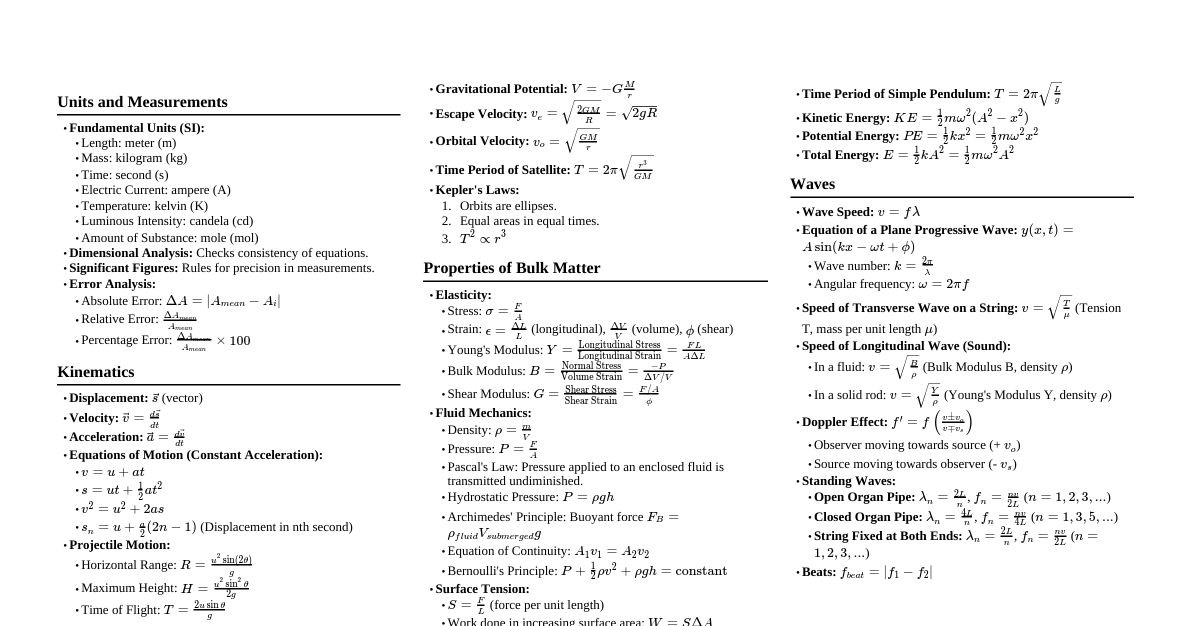
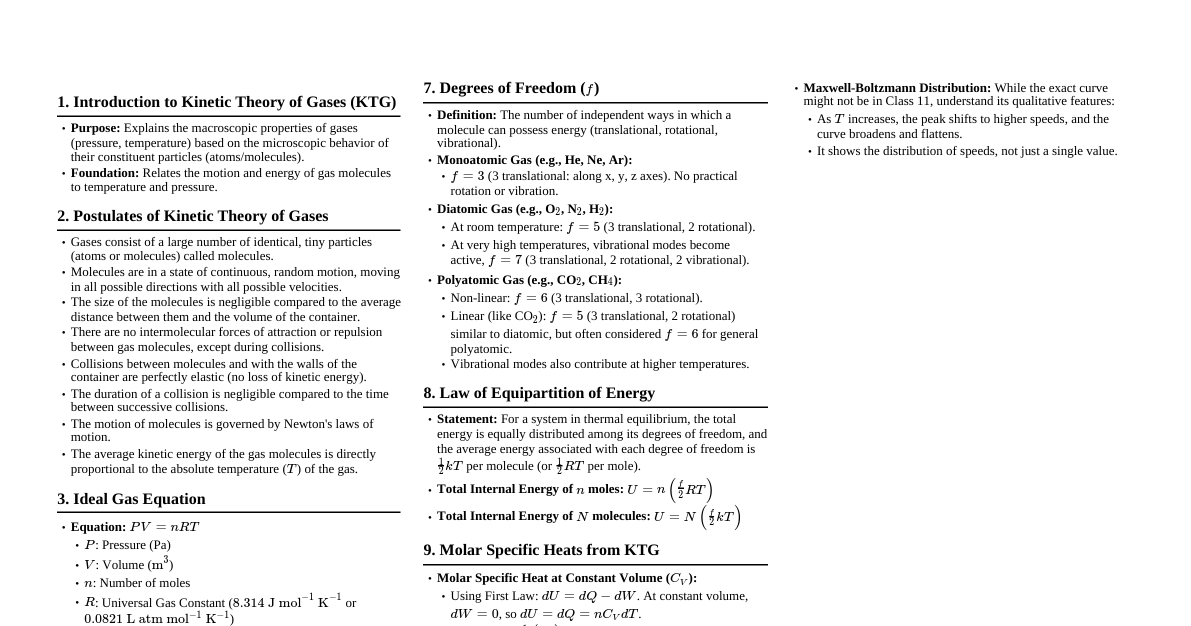
### Units and Measurements - **Fundamental Units (SI):** - Length: meter (m) - Mass: kilogram (kg) - Time: second (s) - Electric Current: ampere (A) - Temperature: kelvin (K) - Amount of Substance: mole (mol) - Luminous Intensity: candela (cd) - **Derived Units:** Units obtained from fundamental units (e.g., Velocity: m/s, Force: kg m/s² = Newton (N)). - **Dimensional Analysis:** Used to check consistency of equations and derive relations between physical quantities. - Principle of Homogeneity: Dimensions of all terms in an equation must be the same. - **Significant Figures:** - Non-zero digits are always significant. - Zeros between two non-zero digits are significant. - Leading zeros (0.00x) are not significant. - Trailing zeros (x.00) are significant if there is a decimal point. - Trailing zeros (x00) are not significant if no decimal point. - **Errors in Measurement:** - **Absolute Error:** $| \Delta A | = | A_{mean} - A_i |$ - **Mean Absolute Error:** $\overline{\Delta A} = \frac{\sum |\Delta A_i|}{N}$ - **Relative Error:** $\frac{\overline{\Delta A}}{A_{mean}}$ - **Percentage Error:** $\frac{\overline{\Delta A}}{A_{mean}} \times 100\%$ #### Important Questions: 1. Check the dimensional consistency of the equation $E = mc^2$. 2. Find the number of significant figures in 0.007 m², 2.64 x 10²⁴ kg, 0.2370 g/cm³, 6.032 N, 0.0006032 m². 3. If the length and breadth of a rectangle are (10.0 ± 0.1) cm and (5.0 ± 0.1) cm respectively, calculate the area with error limits. ### Kinematics - **Distance:** Total path length covered (scalar). - **Displacement:** Change in position (vector). - **Speed:** $\text{Distance} / \text{Time}$ (scalar). - **Velocity:** $\text{Displacement} / \text{Time}$ (vector). - **Acceleration:** Change in velocity / Time (vector). $a = \frac{dv}{dt}$. #### Equations of Motion (for constant acceleration): 1. $v = u + at$ 2. $s = ut + \frac{1}{2}at^2$ 3. $v^2 = u^2 + 2as$ 4. $s_n = u + \frac{a}{2}(2n - 1)$ (Displacement in n-th second) - **Relative Velocity:** - $\vec{v}_{AB} = \vec{v}_A - \vec{v}_B$ (velocity of A with respect to B) - **Projectile Motion:** - **Time of Flight:** $T = \frac{2u \sin\theta}{g}$ - **Maximum Height:** $H = \frac{u^2 \sin^2\theta}{2g}$ - **Horizontal Range:** $R = \frac{u^2 \sin(2\theta)}{g}$ - For $R_{max}$, $\theta = 45^\circ$. $R_{max} = \frac{u^2}{g}$. - Equation of trajectory: $y = x \tan\theta - \frac{gx^2}{2u^2 \cos^2\theta}$ #### Important Questions: 1. A car accelerates uniformly from rest to 72 km/h in 10 s. Calculate the acceleration and the distance covered. 2. A ball is thrown vertically upwards with a velocity of 20 m/s from the top of a 25 m high building. a) How high will the ball rise? b) How long will it take before the ball hits the ground? 3. A projectile is fired at an angle of $30^\circ$ to the horizontal with an initial velocity of 100 m/s. Find the time of flight, maximum height, and horizontal range. ### Laws of Motion - **Newton's First Law (Law of Inertia):** An object at rest stays at rest, and an object in motion stays in motion with the same speed and in the same direction unless acted upon by an unbalanced force. - **Newton's Second Law:** $\vec{F} = m\vec{a}$ (Rate of change of momentum is directly proportional to the applied force). - **Momentum:** $\vec{p} = m\vec{v}$ - **Impulse:** $\vec{I} = \vec{F}_{avg} \Delta t = \Delta \vec{p}$ (Change in momentum) - **Newton's Third Law:** To every action, there is an equal and opposite reaction. - **Conservation of Momentum:** In an isolated system, the total momentum remains constant. $m_1 u_1 + m_2 u_2 = m_1 v_1 + m_2 v_2$. - **Friction:** - **Static Friction:** $f_s \le \mu_s N$ - **Kinetic Friction:** $f_k = \mu_k N$ - $\mu_s > \mu_k$ - **Circular Motion:** - **Centripetal Acceleration:** $a_c = \frac{v^2}{r} = \omega^2 r$ (directed towards the center) - **Centripetal Force:** $F_c = \frac{mv^2}{r} = m\omega^2 r$ #### Important Questions: 1. A force of 10 N acts on a body of mass 2 kg for 5 seconds. Calculate the change in momentum and the acceleration produced. 2. A bullet of mass 20 g is fired from a rifle of mass 2 kg with a velocity of 150 m/s. Calculate the recoil velocity of the rifle. 3. A car is moving on a circular track of radius 50 m with a speed of 10 m/s. What is the centripetal force acting on the car if its mass is 1000 kg? 4. Derive the condition for banking of roads to avoid skidding. ### Work, Energy, and Power - **Work Done:** $W = \vec{F} \cdot \vec{d} = Fd \cos\theta$ (scalar quantity) - Work done by constant force: $W = F \Delta x$ - Work done by variable force: $W = \int \vec{F} \cdot d\vec{r}$ - **Kinetic Energy:** $K = \frac{1}{2}mv^2$ - **Potential Energy:** - **Gravitational PE:** $U_g = mgh$ - **Elastic PE (Spring):** $U_s = \frac{1}{2}kx^2$ (where k is spring constant, x is extension/compression) - **Work-Energy Theorem:** $W_{net} = \Delta K = K_f - K_i$ (Net work done on a body equals the change in its kinetic energy). - **Conservation of Mechanical Energy:** For conservative forces, $E = K + U = \text{constant}$. - **Power:** Rate of doing work. - $P = \frac{W}{t} = \vec{F} \cdot \vec{v}$ (instantaneous power) - Units: Watt (W) = J/s - **Collisions:** - **Elastic Collision:** Both momentum and kinetic energy are conserved. - **Inelastic Collision:** Momentum is conserved, but kinetic energy is not (some energy is lost as heat, sound, etc.). - **Coefficient of Restitution (e):** $e = \frac{v_{2f} - v_{1f}}{u_{1i} - u_{2i}}$ - For elastic collision, $e=1$. - For perfectly inelastic collision, $e=0$. #### Important Questions: 1. A body of mass 5 kg is displaced by 2 m under the action of a force $\vec{F} = (3\hat{i} + 4\hat{j} - 5\hat{k})$ N. Calculate the work done. 2. A 10 kg mass falls from a height of 10 m. What is its kinetic energy just before hitting the ground? (Use conservation of energy). 3. A spring with spring constant 200 N/m is compressed by 10 cm. Calculate the potential energy stored in the spring. 4. Prove the work-energy theorem. 5. Distinguish between elastic and inelastic collisions. ### System of Particles and Rotational Motion - **Centre of Mass (CM):** - For two particles: $x_{CM} = \frac{m_1 x_1 + m_2 x_2}{m_1 + m_2}$ - For n particles: $\vec{r}_{CM} = \frac{\sum m_i \vec{r}_i}{\sum m_i}$ - For continuous body: $\vec{r}_{CM} = \frac{\int \vec{r} dm}{\int dm}$ - **Moment of Inertia (I):** Measure of rotational inertia. - $I = \sum m_i r_i^2$ (for discrete particles) - $I = \int r^2 dm$ (for continuous bodies) - **Parallel Axis Theorem:** $I = I_{CM} + Md^2$ - **Perpendicular Axis Theorem:** $I_z = I_x + I_y$ (for planar bodies) - **Rotational Kinematics (constant angular acceleration):** - $\omega = \omega_0 + \alpha t$ - $\theta = \omega_0 t + \frac{1}{2}\alpha t^2$ - $\omega^2 = \omega_0^2 + 2\alpha \theta$ - Relation between linear and angular: $v = r\omega$, $a_t = r\alpha$, $a_c = r\omega^2$ - **Torque ($\vec{\tau}$):** Rotational analogue of force. - $\vec{\tau} = \vec{r} \times \vec{F}$ - $\tau = I\alpha$ - **Angular Momentum ($\vec{L}$):** Rotational analogue of linear momentum. - $\vec{L} = \vec{r} \times \vec{p} = \vec{r} \times (m\vec{v})$ - For a rigid body: $L = I\omega$ - **Conservation of Angular Momentum:** If net external torque is zero, $\vec{L} = \text{constant}$. $I_1 \omega_1 = I_2 \omega_2$. - **Rotational Kinetic Energy:** $K_{rot} = \frac{1}{2}I\omega^2$ - **Total Kinetic Energy (Rolling):** $K_{total} = K_{trans} + K_{rot} = \frac{1}{2}mv^2 + \frac{1}{2}I\omega^2$ #### Important Questions: 1. Locate the center of mass of a system of three particles of masses 1 kg, 2 kg, and 3 kg placed at (1,1,1), (2,2,2), and (3,3,3) respectively. 2. Derive the expression for the moment of inertia of a thin circular ring about an axis passing through its center and perpendicular to its plane. 3. A solid cylinder rolls down an inclined plane without slipping. What fraction of its total energy is rotational? 4. Explain the principle of conservation of angular momentum with an example (e.g., a spinning ice skater). 5. State and prove the parallel and perpendicular axis theorems. ### Gravitation - **Newton's Law of Universal Gravitation:** $F = G \frac{m_1 m_2}{r^2}$ - $G = 6.67 \times 10^{-11} \text{ Nm}^2/\text{kg}^2$ (Universal Gravitational Constant) - **Acceleration due to gravity (g):** - At Earth's surface: $g = \frac{GM}{R^2}$ - Variation with altitude: $g_h = g(1 - \frac{2h}{R})$ (for $h \ll R$) - Variation with depth: $g_d = g(1 - \frac{d}{R})$ - Variation with latitude: $g' = g - R\omega^2 \cos^2\phi$ - **Gravitational Potential Energy:** $U = -\frac{GMm}{r}$ - **Gravitational Potential:** $V = -\frac{GM}{r}$ - **Escape Velocity ($v_e$):** Minimum velocity required to escape Earth's gravitational field. - $v_e = \sqrt{\frac{2GM}{R}} = \sqrt{2gR}$ - For Earth, $v_e \approx 11.2 \text{ km/s}$ - **Orbital Velocity ($v_o$):** Velocity required for an object to orbit Earth in a stable circular path. - $v_o = \sqrt{\frac{GM}{r}}$ (where r is orbital radius from center of Earth) - For close orbits ($r \approx R$): $v_o = \sqrt{gR}$ - Time period of satellite: $T = \frac{2\pi r}{v_o} = 2\pi \sqrt{\frac{r^3}{GM}}$ - **Kepler's Laws of Planetary Motion:** 1. **Law of Orbits:** All planets move in elliptical orbits with the Sun at one of the foci. 2. **Law of Areas:** The line joining any planet to the Sun sweeps out equal areas in equal intervals of time. (Implies conservation of angular momentum). 3. **Law of Periods:** The square of the orbital period ($T$) of a planet is directly proportional to the cube of the semi-major axis ($a$) of its orbit. $T^2 \propto a^3$. #### Important Questions: 1. Derive the expression for the variation of g with altitude. 2. Calculate the escape velocity for an object from the Earth's surface, given $G = 6.67 \times 10^{-11} \text{ Nm}^2/\text{kg}^2$, $M_E = 6 \times 10^{24} \text{ kg}$, $R_E = 6.4 \times 10^6 \text{ m}$. 3. State Kepler's laws of planetary motion. 4. What is a geostationary satellite? What are its uses? 5. Show that for a satellite orbiting close to Earth's surface, its orbital velocity is $\sqrt{gR}$. ### Mechanical Properties of Solids - **Stress ($\sigma$):** Restoring force per unit area. $\sigma = \frac{F}{A}$ (Unit: Pa or N/m²) - **Tensile/Compressive Stress:** Force perpendicular to area. - **Shearing Stress:** Force parallel to area. - **Strain ($\epsilon$):** Fractional change in dimension. (Dimensionless) - **Longitudinal Strain:** $\Delta L / L$ - **Volumetric Strain:** $\Delta V / V$ - **Shearing Strain:** $\phi = \Delta x / L$ (angle of shear) - **Hooke's Law:** Within elastic limit, stress is proportional to strain. $\sigma \propto \epsilon \implies \sigma = E \epsilon$. - **Modulus of Elasticity (E):** Ratio of stress to strain. - **Young's Modulus (Y):** $Y = \frac{\text{Tensile Stress}}{\text{Longitudinal Strain}} = \frac{F/A}{\Delta L/L}$ - **Bulk Modulus (B):** $B = \frac{\text{Normal Stress}}{\text{Volumetric Strain}} = \frac{-P}{\Delta V/V}$ - **Shear Modulus (G) or Modulus of Rigidity:** $G = \frac{\text{Shearing Stress}}{\text{Shearing Strain}} = \frac{F/A}{\phi}$ - **Poisson's Ratio ($\nu$):** Ratio of lateral strain to longitudinal strain. - $\nu = \frac{-\Delta d/d}{\Delta L/L}$ (negative sign indicates contraction) - Typical values: 0 to 0.5 - **Elastic Potential Energy (per unit volume):** $U_v = \frac{1}{2} \text{Stress} \times \text{Strain} = \frac{1}{2} Y \epsilon^2 = \frac{1}{2} \frac{\sigma^2}{Y}$ #### Important Questions: 1. Define stress and strain. Differentiate between tensile stress and shearing stress. 2. State Hooke's law. Draw and explain the stress-strain curve for a metallic wire. 3. A wire of length 2 m and cross-sectional area 0.5 cm² is stretched by 0.1 mm when a load of 10 kg is suspended from it. Calculate the Young's modulus of the wire. 4. Explain why steel is preferred over copper in structural designs. ### Mechanical Properties of Fluids - **Pressure (P):** Force per unit area. $P = \frac{F}{A}$ (Unit: Pa or N/m²) - **Pressure in a fluid column:** $P = \rho gh$ (where $\rho$ is density, h is depth) - **Pascal's Law:** Pressure applied to an enclosed fluid is transmitted undiminished to every portion of the fluid and the walls of the containing vessel. (Basis of hydraulic lift). - **Archimedes' Principle:** When a body is immersed fully or partially in a fluid, it experiences an upward buoyant force equal to the weight of the fluid displaced by it. - Buoyant Force ($F_B$) = $\rho_{fluid} V_{immersed} g$ - **Streamline Flow (Laminar Flow):** Fluid particles follow smooth paths, and paths do not cross. - **Turbulent Flow:** Irregular, chaotic flow. - **Equation of Continuity:** For an incompressible, non-viscous fluid in streamline flow, $A_1 v_1 = A_2 v_2 = \text{constant}$. (Conservation of mass). - **Bernoulli's Principle:** For an ideal fluid in streamline flow, the sum of pressure energy, kinetic energy, and potential energy per unit volume is constant. - $P + \frac{1}{2}\rho v^2 + \rho gh = \text{constant}$ - **Viscosity:** Internal friction in fluids. - **Newton's Law of Viscosity:** $F = -\eta A \frac{dv}{dz}$ (where $\eta$ is coefficient of viscosity) - **Stokes' Law:** Viscous force on a spherical body moving in a fluid: $F_v = 6\pi \eta r v$ - **Terminal Velocity ($v_t$):** Constant velocity attained by a body falling through a viscous fluid. $v_t = \frac{2 r^2 (\rho - \sigma) g}{9 \eta}$ (where $\rho$ is density of body, $\sigma$ is density of fluid) - **Surface Tension (S):** Force per unit length acting on the surface of a liquid. - $S = \frac{F}{L}$ (Unit: N/m) - **Surface Energy:** Work done per unit area to increase the surface area of a liquid. $W = S \Delta A$. - **Excess Pressure inside a liquid drop:** $\Delta P = \frac{2S}{R}$ - **Excess Pressure inside a soap bubble:** $\Delta P = \frac{4S}{R}$ - **Capillary Rise:** $h = \frac{2S \cos\theta}{\rho gr}$ (where $\theta$ is angle of contact) - **Reynolds Number ($R_e$):** Dimensionless number predicting flow patterns. - $R_e = \frac{\rho v D}{\eta}$ - $R_e 3000$: Turbulent flow #### Important Questions: 1. State and prove Pascal's law. Explain its application in a hydraulic lift. 2. Derive Bernoulli's equation for the streamline flow of an incompressible non-viscous fluid. 3. Explain the phenomenon of surface tension. What is its origin? 4. Calculate the terminal velocity of a rain drop of radius 0.2 mm falling through air. (Given: $\rho_{water} = 1000 \text{ kg/m}^3$, $\rho_{air} \approx 1.2 \text{ kg/m}^3$, $\eta_{air} = 1.8 \times 10^{-5} \text{ Pa s}$) 5. What is the excess pressure inside a soap bubble of radius 1 cm if the surface tension of the soap solution is $2.5 \times 10^{-2} \text{ N/m}$? ### Thermal Properties of Matter - **Temperature Scales:** - Celsius (°C), Fahrenheit (°F), Kelvin (K) - $T_K = T_C + 273.15$ - $\frac{C}{5} = \frac{F-32}{9}$ - **Thermal Expansion:** - **Linear Expansion:** $\Delta L = L_0 \alpha \Delta T$ (where $\alpha$ is coefficient of linear expansion) - **Area Expansion:** $\Delta A = A_0 \beta \Delta T$ (where $\beta = 2\alpha$) - **Volume Expansion:** $\Delta V = V_0 \gamma \Delta T$ (where $\gamma = 3\alpha$) - **Anomalous Expansion of Water:** Water contracts on heating from $0^\circ \text{C}$ to $4^\circ \text{C}$, then expands. Density is maximum at $4^\circ \text{C}$. - **Heat Capacity and Specific Heat:** - **Heat Capacity (C):** Amount of heat required to raise the temperature of a substance by $1^\circ \text{C}$ or 1 K. $C = \frac{\Delta Q}{\Delta T}$. - **Specific Heat Capacity (c):** Amount of heat required to raise the temperature of unit mass of a substance by $1^\circ \text{C}$ or 1 K. $Q = mc\Delta T$. (Unit: J/kg K) - **Molar Specific Heat Capacity:** Amount of heat required to raise the temperature of one mole of a substance by $1^\circ \text{C}$ or 1 K. $Q = nC\Delta T$. - **Latent Heat (L):** Heat required to change the state of a substance without changing its temperature. - $Q = mL$ - **Latent Heat of Fusion ($L_f$):** For melting/freezing. - **Latent Heat of Vaporization ($L_v$):** For boiling/condensation. - **Heat Transfer:** - **Conduction:** Heat transfer through direct contact (solids). - Rate of heat flow: $\frac{dQ}{dt} = -KA \frac{dT}{dx}$ (Fourier's Law, K is thermal conductivity) - **Convection:** Heat transfer through movement of fluids (liquids and gases). - **Radiation:** Heat transfer through electromagnetic waves (no medium required). - **Stefan-Boltzmann Law:** Power radiated by a black body: $P = \sigma A T^4$ (where $\sigma = 5.67 \times 10^{-8} \text{ W/m}^2 \text{K}^4$ is Stefan's constant) - For a body with emissivity e: $P = e \sigma A T^4$ - **Wien's Displacement Law:** $\lambda_m T = b$ (where b is Wien's constant, $\lambda_m$ is wavelength of maximum emission) - **Newton's Law of Cooling:** Rate of cooling is proportional to the temperature difference between the body and surroundings. $\frac{dT}{dt} \propto (T - T_s)$. #### Important Questions: 1. Explain the concept of specific heat capacity and latent heat. How are they different? 2. A 10 kg block of ice at $0^\circ \text{C}$ is converted into water at $0^\circ \text{C}$. Calculate the heat required. (Given $L_f = 3.36 \times 10^5 \text{ J/kg}$). 3. Discuss the three modes of heat transfer with examples. 4. Derive the relationship between $\alpha, \beta, \gamma$. 5. Why do we prefer to use a pressure cooker for cooking food at high altitudes? ### Thermodynamics - **Thermodynamic System:** A collection of matter within a clearly defined boundary. - **Open System:** Exchanges both matter and energy with surroundings. - **Closed System:** Exchanges energy but not matter with surroundings. - **Isolated System:** Exchanges neither matter nor energy with surroundings. - **Thermodynamic Variables:** Pressure (P), Volume (V), Temperature (T), Internal Energy (U), Entropy (S). - **Thermodynamic Processes:** - **Isothermal Process:** Temperature remains constant ($\Delta T = 0$). For an ideal gas, $PV = \text{constant}$. - **Adiabatic Process:** No heat exchange with surroundings ($\Delta Q = 0$). For an ideal gas, $PV^\gamma = \text{constant}$. - **Isobaric Process:** Pressure remains constant ($\Delta P = 0$). - **Isochoric Process:** Volume remains constant ($\Delta V = 0$). - **First Law of Thermodynamics:** Conservation of Energy. - $\Delta Q = \Delta U + \Delta W$ (Heat supplied to a system = Change in internal energy + Work done by the system) - **Work Done by a Gas:** $W = \int P dV$ - For Isochoric process: $W=0 \implies \Delta Q = \Delta U$. - For Isothermal process: $\Delta U=0 \implies \Delta Q = \Delta W$. - For Adiabatic process: $\Delta Q=0 \implies \Delta U = -\Delta W$. - **Internal Energy (U):** Sum of kinetic and potential energies of molecules. For an ideal gas, $U$ depends only on temperature. - For ideal gas: $\Delta U = n C_v \Delta T$ (where $C_v$ is molar specific heat at constant volume). - **Specific Heat Capacities of Gases:** - $C_p$: Molar specific heat at constant pressure. - $C_v$: Molar specific heat at constant volume. - **Mayer's Relation:** $C_p - C_v = R$ (where R is universal gas constant) - **Ratio of specific heats:** $\gamma = \frac{C_p}{C_v}$ - **Second Law of Thermodynamics:** - **Kelvin-Planck Statement:** It is impossible to construct a device which operates in a cycle and produces no effect other than the extraction of heat from a reservoir and its conversion into an equivalent amount of work. - **Clausius Statement:** It is impossible for a self-acting machine, unaided by an external agency, to transfer heat from a body at a lower temperature to another body at a higher temperature. - **Heat Engine:** Device that converts heat energy into mechanical work. - **Efficiency ($\eta$):** $\eta = \frac{W}{Q_1} = 1 - \frac{Q_2}{Q_1}$ (where $Q_1$ is heat absorbed from hot reservoir, $Q_2$ is heat rejected to cold reservoir) - **Carnot Engine Efficiency:** $\eta_{Carnot} = 1 - \frac{T_2}{T_1}$ (where $T_1$ and $T_2$ are absolute temperatures of hot and cold reservoirs, $T_1 > T_2$) - **Refrigerator/Heat Pump:** Device that transfers heat from a cold body to a hot body. - **Coefficient of Performance (COP):** $K_{ref} = \frac{Q_2}{W} = \frac{Q_2}{Q_1 - Q_2}$ - $K_{HP} = \frac{Q_1}{W} = \frac{Q_1}{Q_1 - Q_2}$ #### Important Questions: 1. State and explain the First Law of Thermodynamics. What are its limitations? 2. Derive the work done during an isothermal process for an ideal gas. 3. Explain the concept of internal energy. How does it depend on temperature for an ideal gas? 4. State the Second Law of Thermodynamics (both statements). 5. What is a Carnot engine? Calculate its efficiency and explain why no engine can have efficiency greater than a Carnot engine. 6. Derive Mayer's relation. ### Kinetic Theory of Gases - **Assumptions of Kinetic Theory of Gases:** 1. Gas consists of a large number of identical, tiny, rigid, elastic particles (molecules). 2. Molecules are in continuous, random motion. 3. Volume of molecules is negligible compared to volume of gas. 4. No intermolecular forces except during collisions. 5. Collisions are perfectly elastic and instantaneous. 6. Time between collisions is much greater than collision time. 7. Gravity's effect on molecules is negligible. - **Pressure Exerted by an Ideal Gas:** $P = \frac{1}{3} \frac{Nmv^2_{rms}}{V} = \frac{1}{3} \rho v^2_{rms}$ - **Root Mean Square Speed ($v_{rms}$):** $v_{rms} = \sqrt{\frac{3kT}{m}} = \sqrt{\frac{3RT}{M_m}}$ (where $k$ is Boltzmann constant, $M_m$ is molar mass) - **Average Kinetic Energy of a Gas Molecule:** - $E_{avg} = \frac{1}{2} m v^2_{rms} = \frac{3}{2} kT$ (per molecule) - For 1 mole: $E_{avg} = \frac{3}{2} RT$ (where R is universal gas constant) - This shows that temperature is a measure of the average kinetic energy of gas molecules. - **Degrees of Freedom (f):** Number of independent ways in which a molecule can possess energy. - Monatomic (He, Ne): f = 3 (translational) - Diatomic (O₂, N₂): f = 5 (3 translational + 2 rotational) (at room temp) - Polyatomic: f = 6 or more (3 translational + 3 rotational + vibrational modes at high temps) - **Law of Equipartition of Energy:** For any thermodynamic system in thermal equilibrium, the total energy is distributed equally among all possible degrees of freedom, and the energy associated with each degree of freedom is $\frac{1}{2} kT$. - **Specific Heat Capacities from Equipartition:** - $U = \frac{f}{2} nRT$ (Internal energy for n moles) - $C_v = \frac{f}{2} R$ - $C_p = C_v + R = (\frac{f}{2} + 1) R$ - $\gamma = \frac{C_p}{C_v} = 1 + \frac{2}{f}$ - Monatomic (f=3): $\gamma = 1 + \frac{2}{3} = 5/3 \approx 1.67$ - Diatomic (f=5): $\gamma = 1 + \frac{2}{5} = 7/5 = 1.4$ #### Important Questions: 1. State the postulates of the Kinetic Theory of Gases. 2. Derive the expression for the pressure exerted by an ideal gas. 3. Based on kinetic theory, show that the average kinetic energy of a gas molecule is directly proportional to its absolute temperature. 4. Explain the concept of degrees of freedom and the law of equipartition of energy. 5. Calculate the ratio of specific heats ($\gamma$) for a diatomic gas like oxygen at room temperature. ### Oscillations - **Periodic Motion:** Motion that repeats itself after a fixed interval of time. - **Oscillatory Motion:** A type of periodic motion where a body moves back and forth about a mean position. - **Simple Harmonic Motion (SHM):** A special type of oscillatory motion where the restoring force is directly proportional to the displacement from the mean position and acts opposite to the displacement. - $\vec{F} = -k\vec{x}$ (where k is spring constant) - **Differential Equation of SHM:** $\frac{d^2x}{dt^2} + \omega^2 x = 0$ - **Solution:** $x(t) = A \cos(\omega t + \phi)$ or $x(t) = A \sin(\omega t + \phi)$ - A: Amplitude (maximum displacement) - $\omega$: Angular frequency ($\omega = \sqrt{k/m}$ for spring-mass system) - $\phi$: Initial phase angle - **Velocity in SHM:** $v(t) = -A\omega \sin(\omega t + \phi) = \pm \omega \sqrt{A^2 - x^2}$ - **Acceleration in SHM:** $a(t) = -A\omega^2 \cos(\omega t + \phi) = -\omega^2 x$ - **Time Period (T):** Time taken for one complete oscillation. $T = \frac{2\pi}{\omega}$. - For spring-mass system: $T = 2\pi \sqrt{\frac{m}{k}}$ - For simple pendulum: $T = 2\pi \sqrt{\frac{L}{g}}$ (for small angles) - **Frequency (f):** Number of oscillations per unit time. $f = \frac{1}{T} = \frac{\omega}{2\pi}$. - **Energy in SHM:** - **Kinetic Energy:** $K = \frac{1}{2}mv^2 = \frac{1}{2}m\omega^2 (A^2 - x^2)$ - **Potential Energy:** $U = \frac{1}{2}kx^2 = \frac{1}{2}m\omega^2 x^2$ - **Total Mechanical Energy:** $E = K + U = \frac{1}{2}m\omega^2 A^2 = \frac{1}{2}kA^2$ (constant) - **Damped Oscillations:** Oscillations whose amplitude decreases over time due to dissipative forces (e.g., friction). - **Forced Oscillations:** Oscillations maintained by an external periodic force. - **Resonance:** When the frequency of the external force matches the natural frequency of the oscillating system, leading to a large amplitude of oscillation. #### Important Questions: 1. Define Simple Harmonic Motion (SHM). Write its differential equation and general solution. 2. Derive the expression for the time period of a simple pendulum. 3. Show that the total mechanical energy of a body executing SHM remains constant. 4. A mass of 0.5 kg attached to a spring of spring constant 50 N/m oscillates with an amplitude of 10 cm. Calculate its time period, maximum velocity, and total energy. 5. Explain the phenomena of damping and resonance with suitable examples. ### Waves - **Wave:** A disturbance that propagates through a medium (or space) without actual transfer of matter, but with transfer of energy. - **Transverse Wave:** Particles of the medium oscillate perpendicular to the direction of wave propagation (e.g., light waves, waves on a string). - **Longitudinal Wave:** Particles of the medium oscillate parallel to the direction of wave propagation (e.g., sound waves). - **Wave Terminology:** - **Amplitude (A):** Maximum displacement of particles from their mean position. - **Wavelength ($\lambda$):** Distance between two consecutive crests/troughs or compressions/rarefactions. - **Frequency (f):** Number of waves passing a point per second. - **Time Period (T):** Time taken for one complete wave to pass a point. $T = 1/f$. - **Wave Speed (v):** $v = f\lambda = \lambda/T$. - **Equation of a Plane Progressive Wave:** $y(x,t) = A \sin(kx - \omega t + \phi)$ - $k = \frac{2\pi}{\lambda}$ (angular wave number) - $\omega = 2\pi f$ (angular frequency) - **Speed of Transverse Wave on a Stretched String:** $v = \sqrt{\frac{T}{\mu}}$ (where T is tension, $\mu$ is mass per unit length) - **Speed of Longitudinal Wave (Sound) in a Medium:** - In fluids: $v = \sqrt{\frac{B}{\rho}}$ (B is Bulk Modulus, $\rho$ is density) - In solids: $v = \sqrt{\frac{Y}{\rho}}$ (Y is Young's Modulus) - **Newton-Laplace Formula for Speed of Sound in Air:** $v = \sqrt{\frac{\gamma P}{\rho}}$ (where $\gamma = C_p/C_v$) - **Principle of Superposition:** When two or more waves overlap, the resultant displacement at any point is the vector sum of the displacements due to individual waves. - **Interference:** Superposition of waves resulting in a pattern of constructive and destructive interference. - **Standing Waves:** Formed when two identical progressive waves traveling in opposite directions superpose. - Nodes: Points of zero displacement. - Antinodes: Points of maximum displacement. - **Standing Waves in Open Organ Pipe:** Both ends open (antinodes). - $L = n \frac{\lambda}{2} \implies f_n = n \frac{v}{2L}$ (n = 1, 2, 3, ...) - All harmonics are present. - **Standing Waves in Closed Organ Pipe:** One end closed (node), one end open (antinode). - $L = (2n-1) \frac{\lambda}{4} \implies f_n = (2n-1) \frac{v}{4L}$ (n = 1, 2, 3, ...) - Only odd harmonics are present. - **Beats:** Phenomenon of periodic variation in the intensity of sound when two sound waves of slightly different frequencies superpose. - **Beat Frequency:** $f_{beat} = |f_1 - f_2|$ - **Doppler Effect:** Apparent change in frequency of a wave due to relative motion between source and observer. - $f' = f \left( \frac{v \pm v_o}{v \mp v_s} \right)$ - $v$: speed of sound - $v_o$: speed of observer (towards source +, away -) - $v_s$: speed of source (towards observer -, away +) #### Important Questions: 1. Distinguish between transverse and longitudinal waves with examples. 2. Derive the equation of a plane progressive wave. 3. Explain the principle of superposition of waves. How does it lead to the formation of standing waves? 4. Calculate the speed of sound in air at $27^\circ \text{C}$. (Given $\gamma = 1.4$, $R = 8.314 \text{ J/mol K}$, Molar mass of air $\approx 29 \times 10^{-3} \text{ kg/mol}$). 5. What are beats? How are they formed? 6. Explain the Doppler effect in sound. Give two applications. 7. A string of length 1 m and mass 5 g is under a tension of 20 N. Calculate the speed of transverse waves on the string. 8. Draw the first three modes of vibration for an open organ pipe and a closed organ pipe.