Organic Chemistry Cheatsheet
Shared 3/26/2026•80 views
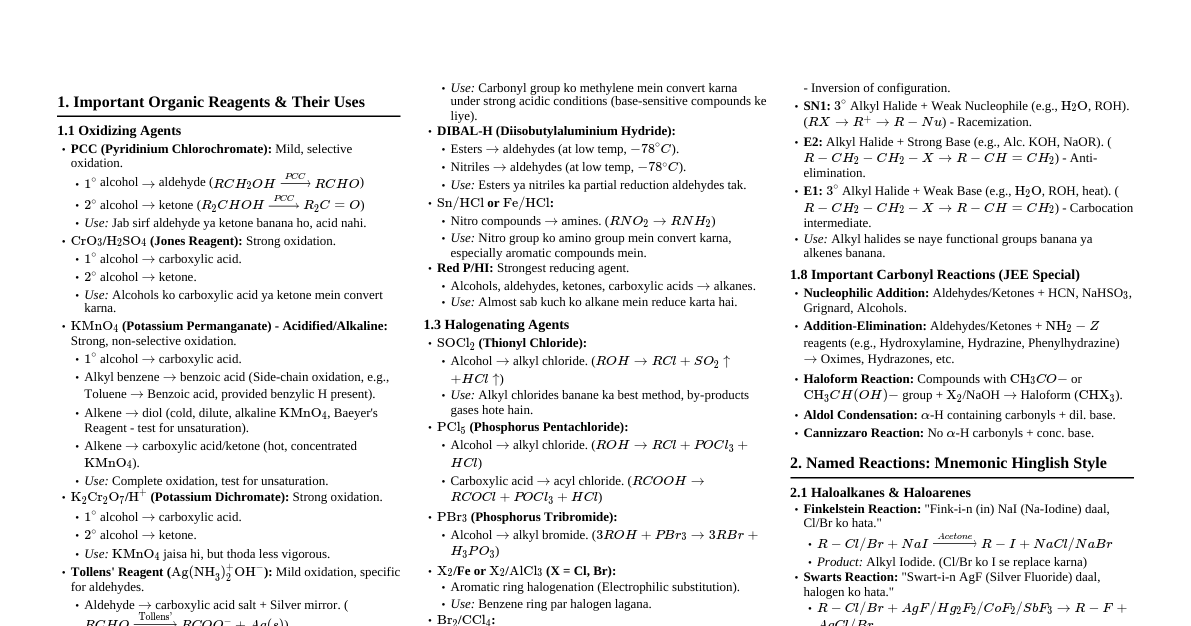
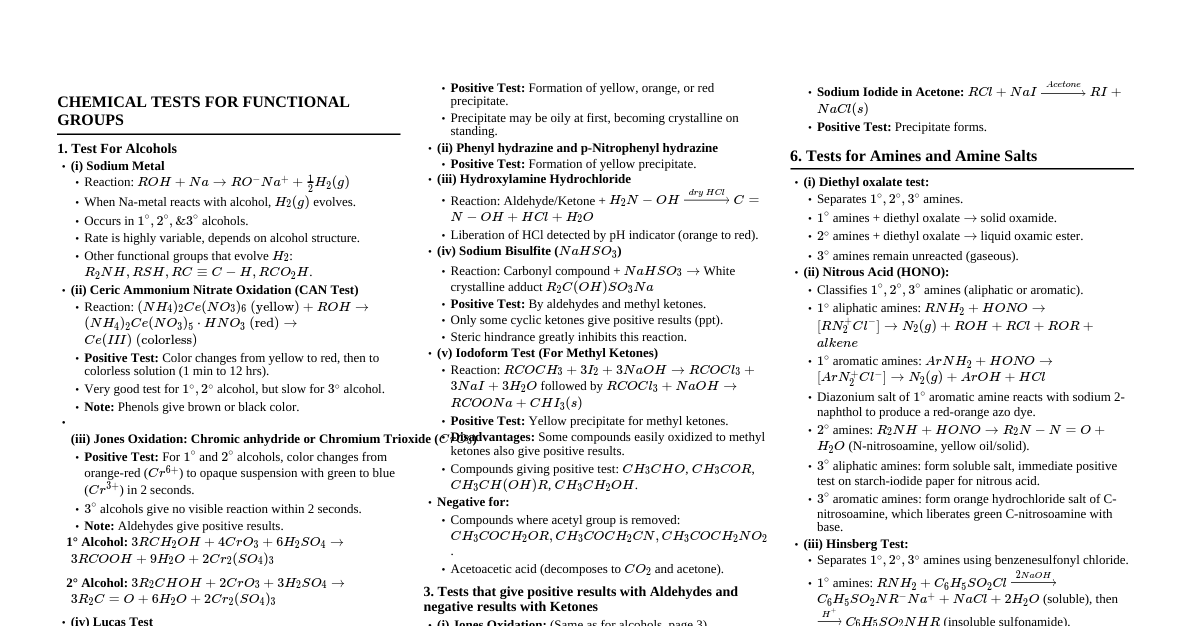
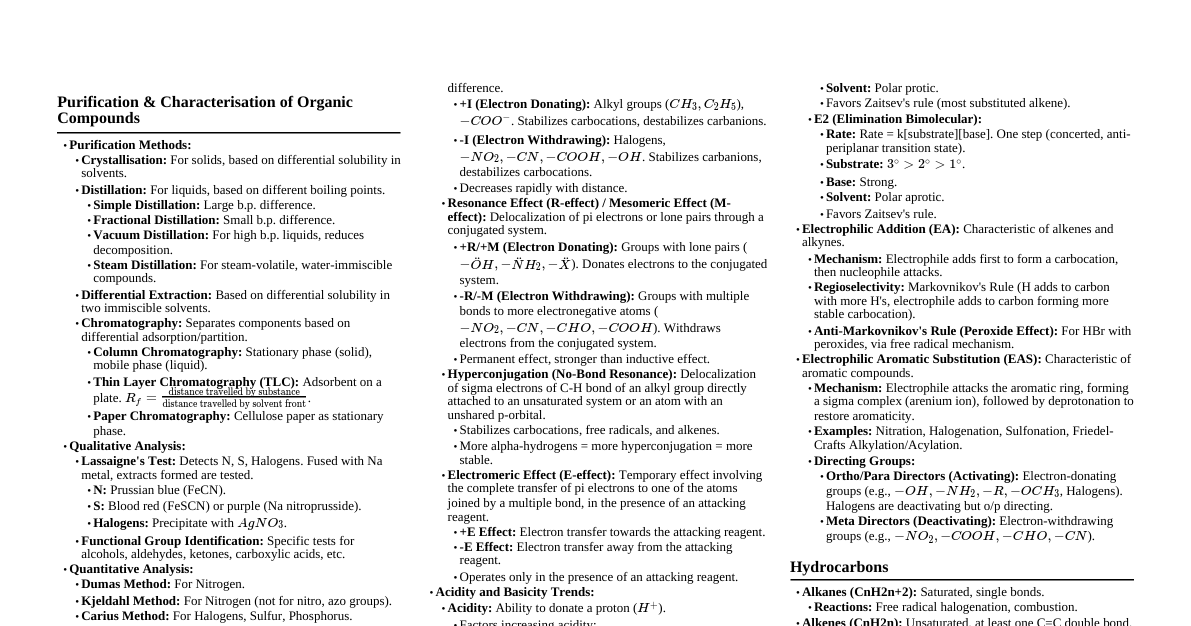
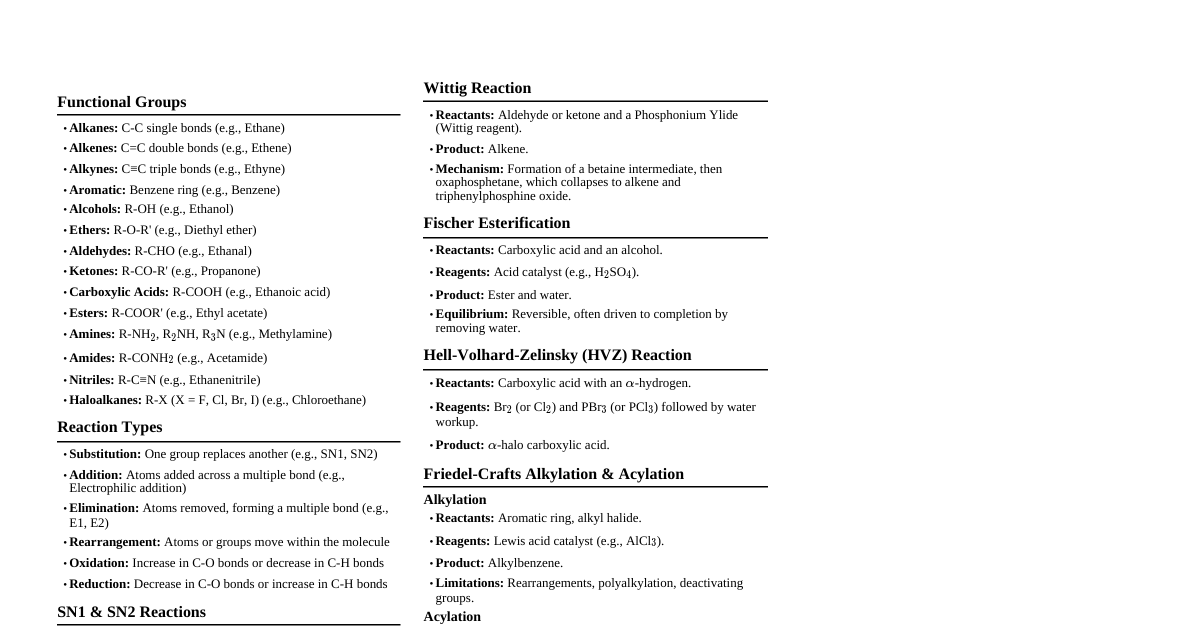
### General Organic Chemistry (GOC) #### Electronic Displacement Effects - Inductive Effect (I-effect): $\sigma$-electron displacement. - +I: electron-donating (alkyl groups). - -I: electron-withdrawing (-NO2, -COOH). - Resonance Effect (M-effect): $\pi$-electron/lone pair delocalization. - +M: electron-donating (-OH, -NH2). - -M: electron-withdrawing (-NO2, -CHO). - Hyperconjugation: $\sigma$-C-H electrons delocalize with adjacent p-orbital/$\pi$ bond. #### Acidity & Basicity - Acidity: $H^+$ donation. - Factors increasing acidity: EWG (-I, -M), resonance stabilization of conjugate base. - Basicity: $H^+$ acceptance / electron pair donation. - Factors increasing basicity: EDG (+I, +M), electron pair availability. #### Stability Orders - **Carbocation Stability:** $3^\circ > 2^\circ > 1^\circ > CH_3^+$ (stabilized by +I, hyperconjugation, resonance). - **Carbanion Stability:** $CH_3^- > 1^\circ > 2^\circ > 3^\circ$ (stabilized by -I, resonance). - **Free Radical Stability:** $3^\circ > 2^\circ > 1^\circ > CH_3 \cdot$ (stabilized by hyperconjugation, resonance). - **Acidity Order:** Carboxylic acid > Phenol > Alcohol > Alkyne > Alkane. - **Basicity Order (Gas Phase):** $3^\circ > 2^\circ > 1^\circ > NH_3$. - **Basicity Order (Aqueous Phase):** $2^\circ > 1^\circ > 3^\circ > NH_3$ (for methylamines). $2^\circ > 3^\circ > 1^\circ > NH_3$ (for ethylamines). - **Basicity Order (Aromatic vs. Aliphatic):** Aliphatic amines > $NH_3$ > Aniline. #### Types of Reagents - Electrophiles ($E^+$): Electron-deficient (Lewis acids), e.g., $H^+$, $NO_2^+$, $BF_3$. - Nucleophiles ($Nu^-$): Electron-rich (Lewis bases), e.g., $OH^-$, $CN^-$, $NH_3$, $H_2O$. #### Reaction Mechanisms - **$S_N1$:** 2 steps: Carbocation formation (RDS), then Nu attack. Racemization. Favored by $3^\circ$, weak Nu, polar protic. - **$S_N2$:** 1 step: Concerted. Backside attack. Inversion (Walden). Favored by $1^\circ$, strong Nu, polar aprotic. - **$E1$:** 2 steps: Carbocation formation, then $H^+$ abstraction. Zaitsev. Favored by $3^\circ$, weak base, polar protic. - **$E2$:** 1 step: Concerted. Anti-periplanar. Zaitsev. Favored by strong base. ### Isomerism - Same molecular formula, different structure/spatial arrangement. #### Structural Isomerism - Chain: Different carbon skeleton. - Position: Different functional group position. - Functional: Different functional groups. - Metamers: Different alkyl groups around polyvalent atom. - Tautomers: Dynamic equilibrium, proton transfer (keto-enol). #### Stereoisomerism - Geometrical (cis-trans): Restricted rotation (double bond, cyclic). - Optical: Non-superimposable mirror images (enantiomers). - Chiral center: Carbon with four different groups. - Enantiomers: Non-superimposable mirror images. - Diastereomers: Non-mirror image stereoisomers. - Meso compound: Chiral centers, but achiral (internal symmetry). - Racemic mixture: Equimolar enantiomers, optically inactive. ### Hydrocarbons #### Alkanes ($C_nH_{2n+2}$) - $sp^3$ carbons. - Reactions: Combustion, Free Radical Halogenation ($Cl_2/hv$). #### Alkenes ($C_nH_{2n}$) - $sp^2$ carbons. - Reactions (Electrophilic Addition): - Hydrogenation: $H_2/Ni, Pd, Pt \rightarrow$ alkane. - Halogenation: $Br_2 \rightarrow$ vicinal dibromide (anti-addition). - Hydrohalogenation: $HX \rightarrow$ alkyl halide (Markovnikov). Anti-Markovnikov with $HBr$/peroxide. - Hydration: $H_2O/H_2SO_4 \rightarrow$ alcohol (Markovnikov). - Oxidation: Cold, dilute $KMnO_4$ (Baeyer's) $\rightarrow$ vicinal diol (syn-addition). Hot $KMnO_4$/$O_3$ (Ozonolysis) $\rightarrow$ aldehydes/ketones. #### Alkynes ($C_nH_{2n-2}$) - $sp$ carbons. - Reactions (Electrophilic Addition): - Hydrogenation: $2H_2/Ni, Pd, Pt \rightarrow$ alkane. $H_2$/Lindlar's $\rightarrow$ cis-alkene. $Na/Li$ in liq. $NH_3 \rightarrow$ trans-alkene. - Halogenation: $2X_2 \rightarrow$ tetrahalide. - Hydrohalogenation: $2HX \rightarrow$ geminal dihalide (Markovnikov). - Hydration: $H_2O/HgSO_4/H_2SO_4 \rightarrow$ ketone (via enol). Ethyne $\rightarrow$ acetaldehyde. - Acidity: Terminal alkynes (acidic H on $sp$ carbon). #### Aromatic Hydrocarbons (Benzene) - Aromaticity (Hückel's Rule): Cyclic, planar, conjugated, $(4n+2)\pi$ electrons. - Reactions (Electrophilic Aromatic Substitution - EAS): - Nitration: $HNO_3/H_2SO_4 \rightarrow$ nitrobenzene. - Halogenation: $X_2/FeX_3 \rightarrow$ halobenzene. - Sulfonation: Conc. $H_2SO_4 \rightarrow$ benzenesulfonic acid. - Friedel-Crafts Alkylation: $RX/AlCl_3 \rightarrow$ alkylbenzene (rearrangement, polysubstitution possible). - Friedel-Crafts Acylation: $RCOCl/AlCl_3 \rightarrow$ acylbenzene (no rearrangement, no polysubstitution). - Directing Groups: - Ortho/Para: Activators (+M, +I), e.g., -OH, -NH2, -CH3, -Cl, -Br. - Meta: Deactivators (-M, -I), e.g., -NO2, -COOH, -CHO, -CN. ### Haloalkanes and Haloarenes #### Preparation - Alcohols: $ROH + HX/ZnCl_2$, $ROH + PCl_5$. - Alkenes: $C=C + HX$, $C=C + X_2$. - Alkanes: $R-H + X_2/hv$. - Finkelstein: $R-Cl/Br + NaI \xrightarrow{Acetone} R-I$. - Swarts: $R-Br/Cl + AgF \rightarrow R-F$. #### Reactions - Wurtz: $2RX + 2Na \xrightarrow{Dry Ether} R-R$. - Wurtz-Fittig: $RX + Ar-X + 2Na \xrightarrow{Dry Ether} Ar-R$. - Fittig: $2Ar-X + 2Na \xrightarrow{Dry Ether} Ar-Ar$. - Dehydrohalogenation ($E2$): $R-CH_2-CH_2-X + KOH (alc.) \rightarrow$ Alkene (Zaitsev). - Haloarenes: Unreactive to $S_N$ (resonance, $sp^2$ C-X, unstable phenyl carbocation). EWG activate $o/p$. ### Alcohols, Phenols and Ethers #### Alcohols ($R-OH$) - Preparation: Alkene hydration, Carbonyl reduction ($NaBH_4, LiAlH_4$), Grignard ($RMgX$). - Properties: H-bonding, high BP. - Reactions: - Acidic: React with Na $\rightarrow$ alkoxide. - Esterification: $R-OH + R'-COOH \rightarrow R'-COOR$. - Dehydration: $\xrightarrow{H_2SO_4, heat}$ Alkene. - Oxidation: $1^\circ \xrightarrow{PCC}$ aldehyde; $1^\circ \xrightarrow{K_2Cr_2O_7}$ carboxylic acid; $2^\circ \xrightarrow{CrO_3}$ ketone; $3^\circ$ no mild oxidation. #### Phenols ($Ar-OH$) - Preparation: Cumene process, Diazonium salts. - Acidic: More acidic than alcohols (phenoxide resonance). - Reactions (EAS): -OH is $o/p$ directing, activating. - Nitration: Dilute $HNO_3 \rightarrow o/p$-nitrophenol. - Bromination: $Br_2(aq) \rightarrow$ 2,4,6-tribromophenol. #### Ethers ($R-O-R'$) - Preparation: Williamson Synthesis ($R-X + R'-ONa$), Dehydration of alcohols ($2ROH \xrightarrow{H_2SO_4, 140^\circ C}$). - Reactions: Cleavage by $HX$ (forms $RX + ROH$). ### Aldehydes, Ketones and Carboxylic Acids #### Aldehydes ($R-CHO$) & Ketones ($R-CO-R'$) - Preparation: Alcohol oxidation, Alkene ozonolysis, Rosenmund ($RCOCl \xrightarrow{H_2/Pd-BaSO_4} RCHO$), Nitrile reduction ($R-CN \xrightarrow{DIBAL-H} RCHO$). - Nucleophilic Addition: HCN $\rightarrow$ cyanohydrin; Grignard $\rightarrow$ alcohols; Alcohols $\rightarrow$ acetals/ketals. - Reactions: - Aldol Condensation: $\alpha$-H, dil. base/acid $\rightarrow \beta$-hydroxy carbonyl. - Cannizzaro: No $\alpha$-H, strong base $\rightarrow$ disproportionation (alcohol + acid salt). - Haloform: Methyl ketones/alcohols ($CH_3COR$/$CH_3CH(OH)R$) with $X_2/NaOH \rightarrow CHX_3$. - Clemmensen Reduction: $\xrightarrow{Zn-Hg/HCl}$ Alkane. - Wolf-Kishner Reduction: $\xrightarrow{NH_2NH_2/KOH, glycol}$ Alkane. #### Carboxylic Acids ($R-COOH$) - Preparation: $1^\circ$ alcohol/aldehyde oxidation, Nitrile hydrolysis, Grignard ($RMgX + CO_2$). - Properties: Acidic (carboxylate resonance). - Reactions: - Esterification: $R-COOH + R'-OH \rightarrow R'-COOR$. - Reduction: $\xrightarrow{LiAlH_4} R-CH_2OH$. - HVZ Reaction: $\alpha$-halogenation ($R-CH_2-COOH + X_2/Red P \rightarrow R-CH(X)-COOH$). - Derivatives: Acid Halides (most reactive) > Anhydrides > Esters > Amides (least reactive). ### Organic Compounds Containing Nitrogen #### Amines ($R-NH_2$) - Preparation: Nitro reduction, Hofmann Ammonolysis ($RX + NH_3$), Gabriel Phthalimide (for $1^\circ$), Hofmann Bromamide Degradation ($RCONH_2 \rightarrow RNH_2$, loss of C). - Basicity: Alkylamines > $NH_3$ > Aniline. - Reactions: - Acylation: $R-NH_2 + R'-COCl \rightarrow R-NHCOR'$. - Carbylamine: $1^\circ$ amine + $CHCl_3/KOH \rightarrow$ isocyanide (foul smell). - Diazotization: $Ar-NH_2 + NaNO_2/HCl \xrightarrow{0-5^\circ C} Ar-N_2^+Cl^-$. - Sandmeyer: $Ar-N_2^+Cl^- \xrightarrow{CuX/HX} Ar-X$. - Coupling: With phenols/anilines $\rightarrow$ azo dyes. #### Cyanides ($R-CN$) & Isocyanides ($R-NC$) - Prep: $R-X + KCN \rightarrow R-CN$. $R-X + AgCN \rightarrow R-NC$. - Reactions: $R-CN$ hydrolysis $\rightarrow$ acid; reduction $\rightarrow 1^\circ$ amine. ### Biomolecules #### Carbohydrates - Monosaccharides: Glucose, Fructose. - Disaccharides: Sucrose, Lactose, Maltose. - Polysaccharides: Starch, Cellulose, Glycogen. - Reducing sugars: Tollens'/Fehling's positive (all mono-, maltose, lactose). Sucrose is non-reducing. #### Proteins - Polymers of $\alpha$-amino acids (peptide bonds). - Structure: Primary (sequence), Secondary ($\alpha$-helix, $\beta$-sheet), Tertiary (3D folding), Quaternary (multiple chains). - Denaturation: Loss of 3D structure/activity (heat, pH). #### Nucleic Acids - Polymers of nucleotides (sugar, base, phosphate). - DNA: Deoxyribose, A, G, C, T. Double helix. Genetic info. - RNA: Ribose, A, G, C, U. Single strand. Protein synthesis. ### Polymers #### Addition Polymers - Monomers add without byproduct. - Examples: Polyethylene, PVC, Teflon, Polypropylene, Polyacrylonitrile. #### Condensation Polymers - Monomers combine with elimination of small molecules. - Examples: Polyester, Nylon 6,6, Nylon 6, Bakelite. ### Chemistry in Everyday Life #### Drugs - Analgesics: Pain relief (Aspirin, Paracetamol). - Antipyretics: Fever reduction (Aspirin, Paracetamol). - Antiseptics: Living tissue (Dettol). - Disinfectants: Inanimate objects (Phenol). - Antibiotics: Kill bacteria (Penicillin). #### Soaps & Detergents - Soaps: Fatty acid salts, form scum with hard water. - Detergents: Synthetic, no scum with hard water. ### Practical Organic Chemistry #### Functional Group Tests - Unsaturation: Baeyer's (decolorizes $KMnO_4$), Bromine water (decolorizes $Br_2$). - Alcohols: Lucas test ($3^\circ > 2^\circ > 1^\circ$ turbidity), Ceric ammonium nitrate (red). - Phenols: Ferric chloride (violet/blue/green). - Aldehydes/Ketones: 2,4-DNP (yellow/orange/red ppt). - Aldehydes: Tollens' (silver mirror), Fehling's (red ppt). - Methyl Ketones/Alcohols: Iodoform ($CH_3COR$/$CH_3CH(OH)R$) with $I_2/NaOH$ (yellow $CHI_3$ ppt). - Carboxylic Acids: Litmus (blue to red), $NaHCO_3$ (effervescence). - $1^\circ$ Amines: Carbylamine (foul smell). #### Purification Methods - Crystallization: Solids, differential solubility. - Distillation: Liquids, different boiling points. - Simple: Large BP diff. - Fractional: Close BP. - Vacuum: Decomposable liquids. - Steam: Steam volatile, water immiscible. - Chromatography: Separation based on stationary/mobile phase partitioning. - TLC, Column, Paper, GC, HPLC. ### Named Reactions - **Wurtz Reaction:** $RX \rightarrow R-R$ (symmetrical alkane) $\rightarrow Na/Dry Ether$. - **Wurtz-Fittig Reaction:** $RX + Ar-X \rightarrow Ar-R$ (alkylarene) $\rightarrow Na/Dry Ether$. - **Fittig Reaction:** $Ar-X \rightarrow Ar-Ar$ (biaryl) $\rightarrow Na/Dry Ether$. - **Finkelstein Reaction:** $R-Cl/Br \rightarrow R-I$ (alkyl iodide) $\rightarrow NaI/Acetone$. - **Swarts Reaction:** $R-Br/Cl \rightarrow R-F$ (alkyl fluoride) $\rightarrow AgF$. - **Rosenmund Reduction:** $RCOCl \rightarrow RCHO$ (aldehyde) $\rightarrow H_2/Pd-BaSO_4$. - **Clemmensen Reduction:** $RCHO/R_2CO \rightarrow RCH_3/R_2CH_2$ (alkane) $\rightarrow Zn-Hg/HCl$. - **Wolf-Kishner Reduction:** $RCHO/R_2CO \rightarrow RCH_3/R_2CH_2$ (alkane) $\rightarrow NH_2NH_2/KOH, glycol$. - **Aldol Condensation:** Carbonyl with $\alpha$-H $\rightarrow \beta$-hydroxy carbonyl $\rightarrow$ dil. base/acid. - **Cannizzaro Reaction:** Carbonyl w/o $\alpha$-H $\rightarrow$ alcohol + acid salt $\rightarrow$ conc. base. - **Haloform Reaction:** Methyl ketone/alcohol $\rightarrow CHX_3$ (haloform) $\rightarrow X_2/NaOH$. - **HVZ Reaction (Hell-Volhard-Zelinsky):** Carboxylic acid with $\alpha$-H $\rightarrow \alpha$-halo acid $\rightarrow X_2/Red P$. - **Gabriel Phthalimide Synthesis:** $RX \rightarrow RNH_2$ ($1^\circ$ amine) $\rightarrow$ Phthalimide, KOH, RX, $H_2O/H^+$. - **Hofmann Bromamide Degradation:** $RCONH_2 \rightarrow RNH_2$ (amine, 1 C less) $\rightarrow Br_2/KOH$. - **Carbylamine Reaction:** $1^\circ$ Amine $\rightarrow RNC$ (isocyanide) $\rightarrow CHCl_3/KOH$. - **Diazotization:** $ArNH_2 \rightarrow ArN_2^+Cl^-$ (diazonium salt) $\rightarrow NaNO_2/HCl, 0-5^\circ C$. - **Sandmeyer Reaction:** $ArN_2^+Cl^- \rightarrow Ar-X/Ar-CN$ $\rightarrow CuX/HX$ or $CuCN/KCN$. - **Gattermann Reaction:** $ArN_2^+Cl^- \rightarrow Ar-X/Ar-CN$ $\rightarrow Cu powder/HX$ or $CuCN$. - **Kolbe's Reaction:** Phenol $\rightarrow$ Salicylic acid $\rightarrow NaOH, CO_2, 140^\circ C$. - **Reimer-Tiemann Reaction:** Phenol $\rightarrow$ Salicylaldehyde $\rightarrow CHCl_3/NaOH$. ### Reagent Table | Reagent | Function | |---|---| | $H_2/Ni, Pd, Pt$ | Catalytic hydrogenation (alkene/alkyne $\rightarrow$ alkane) | | Cold, dil. $KMnO_4$ (Baeyer's) | Test for unsaturation, syn-dihydroxylation of alkenes | | Hot $KMnO_4$/$O_3$ | Oxidative cleavage of alkenes/alkynes | | $HBr$/peroxide | Anti-Markovnikov addition to alkenes | | Lindlar's Catalyst | Alkyne $\rightarrow$ cis-alkene | | $Na$ in liq. $NH_3$ (Birch) | Alkyne $\rightarrow$ trans-alkene | | $HgSO_4/H_2SO_4$ | Hydration of alkynes (Markovnikov) | | $HNO_3/H_2SO_4$ | Nitration (EAS) | | $X_2/FeX_3$ | Halogenation (EAS) | | $RCOCl/AlCl_3$ | Friedel-Crafts acylation (EAS) | | $NaI/Acetone$ | Finkelstein reaction (Halogen exchange for I) | | $AgF$ | Swarts reaction (Halogen exchange for F) | | $Zn-Hg/HCl$ | Clemmensen reduction (carbonyl $\rightarrow$ alkane) | | $NH_2NH_2/KOH, glycol$ | Wolf-Kishner reduction (carbonyl $\rightarrow$ alkane) | | $PCC$ (Pyridinium Chlorochromate) | $1^\circ$ alcohol $\rightarrow$ aldehyde | | $K_2Cr_2O_7/H_2SO_4$ | $1^\circ$ alcohol $\rightarrow$ carboxylic acid; $2^\circ$ alcohol $\rightarrow$ ketone | | $LiAlH_4$ | Strong reducing agent (carbonyls, acids, esters $\rightarrow$ alcohols) | | $NaBH_4$ | Mild reducing agent (aldehydes, ketones $\rightarrow$ alcohols) | | $DIBAL-H$ | Nitrile $\rightarrow$ aldehyde, Ester $\rightarrow$ aldehyde | | $RMgX$ (Grignard) | Forms C-C bonds, reacts with carbonyls to form alcohols | | $NaNO_2/HCl, 0-5^\circ C$ | Diazotization of $1^\circ$ aromatic amines | | $CuX/HX$ or $CuCN/KCN$ | Sandmeyer reaction | | $CHCl_3/KOH$ | Carbylamine reaction (test for $1^\circ$ amines) | | $2,4-DNP$ | Test for aldehydes/ketones | | Tollens' Reagent | Test for aldehydes (silver mirror) | | Fehling's Solution | Test for aldehydes (red ppt) | | $I_2/NaOH$ | Iodoform test (for methyl ketones/alcohols) | | Lucas Reagent ($HCl/ZnCl_2$) | Test for alcohols ($1^\circ, 2^\circ, 3^\circ$) | ### Conversion Map (Examples) - Alkane $\rightarrow$ Alkyl Halide $\rightarrow$ Alcohol $\rightarrow$ Aldehyde $\rightarrow$ Carboxylic Acid - Alkene $\rightarrow$ Alcohol $\rightarrow$ Alkyl Halide $\rightarrow$ Amine - Alkyne $\rightarrow$ Alkene (cis/trans) $\rightarrow$ Alkane - Benzene $\rightarrow$ Nitrobenzene $\rightarrow$ Aniline $\rightarrow$ Diazonium Salt $\rightarrow$ Phenol - Aldehyde $\rightarrow$ Alcohol $\rightarrow$ Alkene - Carboxylic Acid $\rightarrow$ Ester $\rightarrow$ Alcohol ### Exceptions & Traps - **Markovnikov's Rule:** Anti-Markovnikov only with $HBr$ in presence of peroxides. - **Friedel-Crafts Alkylation:** Carbocation rearrangement possible; polysubstitution common. - **Haloarenes:** Unreactive to $S_N$ due to resonance stability, $sp^2$ carbon. - **Williamson Synthesis:** Best with $1^\circ$ alkyl halides to avoid $E2$. - **Hofmann Ammonolysis:** Gives mixture of amines. - **Gabriel Phthalimide Synthesis:** Only for $1^\circ$ amines. - **Hofmann Bromamide:** Amide to amine with one less carbon. - **Diazotization:** Aromatic $1^\circ$ amines only, $0-5^\circ C$. - **Basicity of Amines:** Gas phase vs. aqueous phase order differs due to solvation. - **Reducing Sugars:** Sucrose is non-reducing.