Calculus Quiz Prep (Ch 5, 6, 11)
Cheatsheet Content
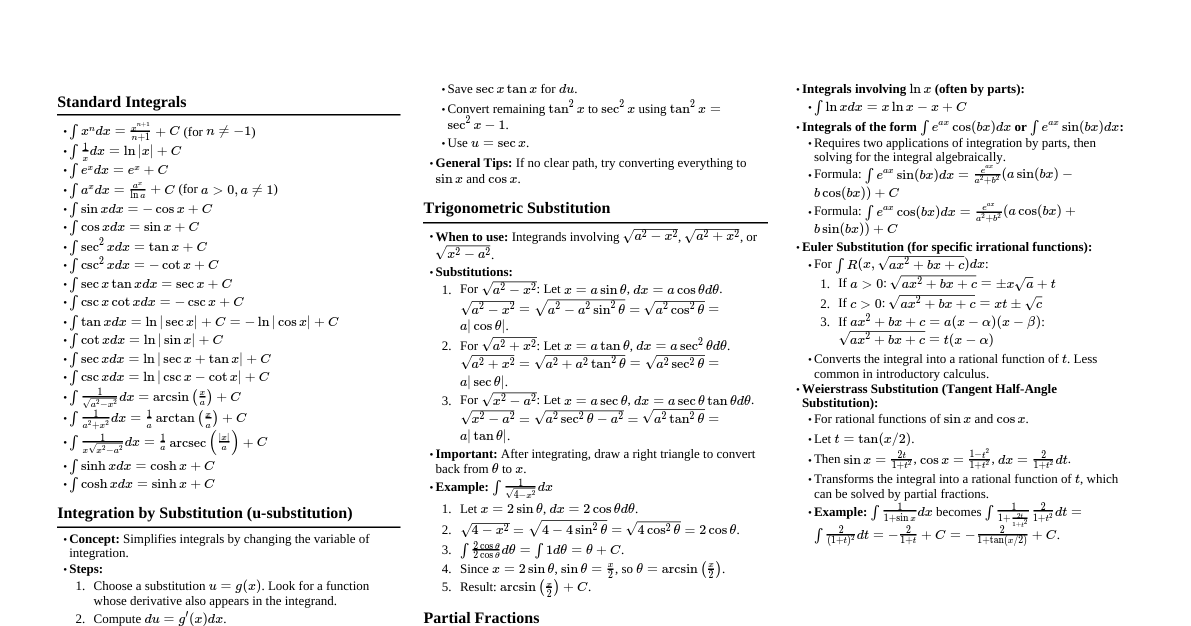
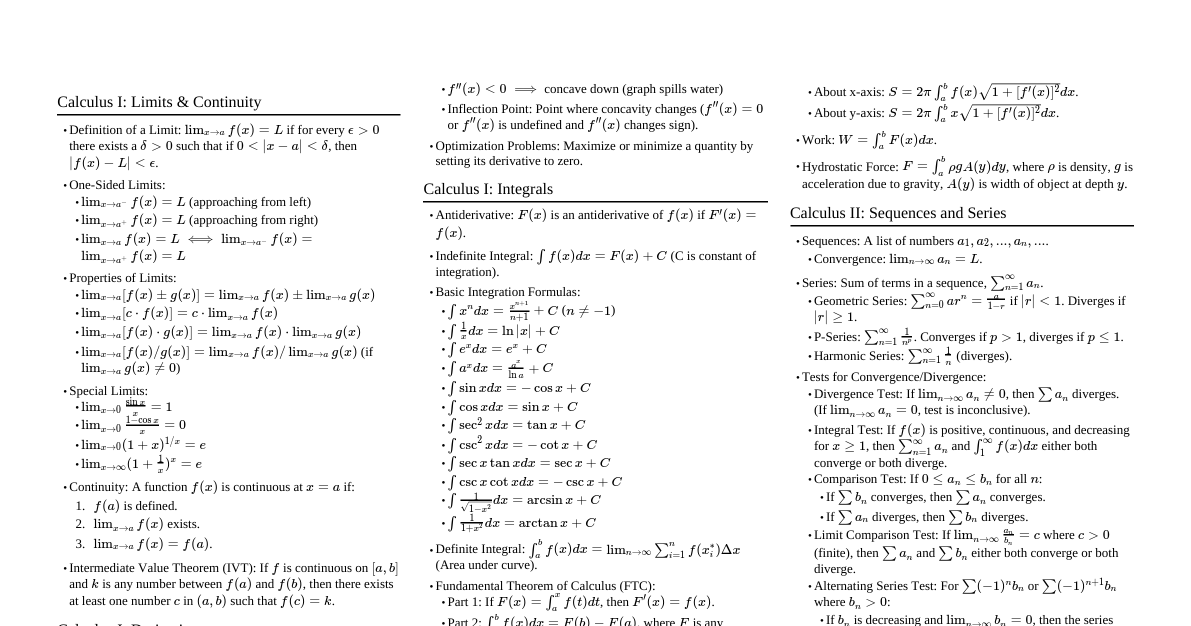
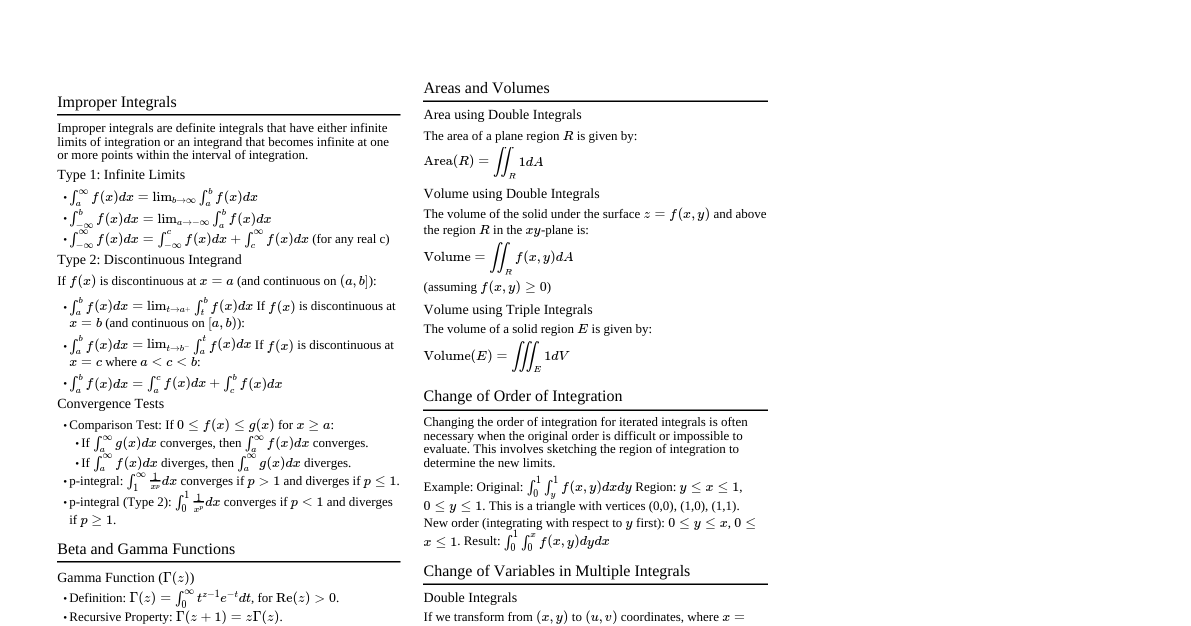
Chapter 5: Integrals 5.1 Area and Estimating with Finite Sums Riemann Sums: Approximate area under $f(x)$ from $a$ to $b$. Left-hand: $\sum f(x_k) \Delta x$ Right-hand: $\sum f(x_{k+1}) \Delta x$ Midpoint: $\sum f(\bar{x}_k) \Delta x$ $\Delta x = (b-a)/n$ 5.2 Definite Integral Definition: $\int_a^b f(x) dx = \lim_{n \to \infty} \sum_{k=1}^n f(c_k) \Delta x$ Properties: $\int_a^b k f(x) dx = k \int_a^b f(x) dx$ $\int_a^b (f(x) \pm g(x)) dx = \int_a^b f(x) dx \pm \int_a^b g(x) dx$ $\int_a^b f(x) dx = \int_a^c f(x) dx + \int_c^b f(x) dx$ $\int_a^b f(x) dx = -\int_b^a f(x) dx$ Average Value: $f_{avg} = \frac{1}{b-a} \int_a^b f(x) dx$ 5.3 Fundamental Theorem of Calculus (FTC) Part 1: If $F(x) = \int_a^x f(t) dt$, then $F'(x) = f(x)$. Chain Rule: $\frac{d}{dx} \int_{g(x)}^{h(x)} f(t) dt = f(h(x))h'(x) - f(g(x))g'(x)$ Part 2: $\int_a^b f(x) dx = F(b) - F(a)$, where $F'(x) = f(x)$. 5.4 Indefinite Integrals and Substitution Antiderivative: $F(x)$ such that $F'(x) = f(x)$. Notation: $\int f(x) dx = F(x) + C$. Substitution Rule: $\int f(g(x))g'(x) dx = \int f(u) du$, where $u = g(x)$, $du = g'(x) dx$. For definite integrals, change limits of integration: $\int_a^b f(g(x))g'(x) dx = \int_{g(a)}^{g(b)} f(u) du$. 5.5 Substitution and Area Between Curves Area Between Curves: $\int_a^b (f(x) - g(x)) dx$, where $f(x) \ge g(x)$ on $[a,b]$. If integrating with respect to $y$: $\int_c^d (f(y) - g(y)) dy$, where $f(y) \ge g(y)$. Chapter 6: Applications of Definite Integrals 6.1 Volumes Using Cross-Sections General Method: $V = \int_a^b A(x) dx$ (or $A(y) dy$). Disk Method: $V = \int_a^b \pi [R(x)]^2 dx$ (rotation around x-axis). Washer Method: $V = \int_a^b \pi ([R(x)]^2 - [r(x)]^2) dx$. 6.2 Volumes Using Cylindrical Shells Shell Method: $V = \int_a^b 2\pi (\text{radius})(\text{height}) dx$. Rotation about y-axis: $V = \int_a^b 2\pi x f(x) dx$. Rotation about x-axis: $V = \int_c^d 2\pi y f(y) dy$. 6.3 Arc Length Arc Length: $L = \int_a^b \sqrt{1 + [f'(x)]^2} dx = \int_a^b \sqrt{1 + \left(\frac{dy}{dx}\right)^2} dx$. If $x$ is a function of $y$: $L = \int_c^d \sqrt{1 + [g'(y)]^2} dy = \int_c^d \sqrt{1 + \left(\frac{dx}{dy}\right)^2} dy$. 6.4 Areas of Surfaces of Revolution Surface Area: $S = \int_a^b 2\pi (\text{radius}) ds$. About x-axis: $S = \int_a^b 2\pi f(x) \sqrt{1 + [f'(x)]^2} dx$. About y-axis: $S = \int_a^b 2\pi x \sqrt{1 + [f'(x)]^2} dx$. 6.5 Work Work done by variable force: $W = \int_a^b F(x) dx$. Hooke's Law (Springs): $F(x) = kx$. Work to stretch/compress: $W = \int_a^b kx dx$. Pumping Liquids: $W = \int_a^b \rho g A(y) D(y) dy$, where $\rho$ is density, $g$ is gravity, $A(y)$ is cross-sectional area, $D(y)$ is distance lifted. Chapter 11: Infinite Sequences and Series 11.1 Sequences Definition: An ordered list of numbers $\{a_n\}_{n=1}^\infty$. Convergence: A sequence $\{a_n\}$ converges to $L$ if $\lim_{n \to \infty} a_n = L$. Otherwise, it diverges. Properties: Sum, difference, product, quotient, constant multiple rules apply to limits. Monotonic Sequence: Either non-decreasing ($a_n \le a_{n+1}$) or non-increasing ($a_n \ge a_{n+1}$). Bounded Sequence: Bounded above ($a_n \le M$) and bounded below ($a_n \ge m$). Monotonic Sequence Theorem: If a sequence is both monotonic and bounded, it converges. 11.2 Infinite Series Definition: Sum of an infinite sequence $S = \sum_{n=1}^\infty a_n$. Partial Sums: $S_N = \sum_{n=1}^N a_n$. Convergence: The series converges if the sequence of partial sums $\{S_N\}$ converges to a finite limit $S$. Otherwise, it diverges. Geometric Series: $\sum_{n=0}^\infty ar^n = \frac{a}{1-r}$ if $|r| $p$-series: $\sum_{n=1}^\infty \frac{1}{n^p}$. Converges if $p > 1$, diverges if $p \le 1$. Test for Divergence (nth Term Test): If $\lim_{n \to \infty} a_n \ne 0$, then $\sum a_n$ diverges. (If $\lim_{n \to \infty} a_n = 0$, the test is inconclusive). 11.3 The Integral Test If $f(x)$ is positive, continuous, and decreasing for $x \ge 1$, then $\sum_{n=1}^\infty a_n$ and $\int_1^\infty f(x) dx$ either both converge or both diverge. (where $a_n = f(n)$). 11.4 Comparison Tests Direct Comparison Test: Assume $0 \le a_n \le b_n$ for all $n$. If $\sum b_n$ converges, then $\sum a_n$ converges. If $\sum a_n$ diverges, then $\sum b_n$ diverges. Limit Comparison Test: Assume $a_n > 0$ and $b_n > 0$. If $\lim_{n \to \infty} \frac{a_n}{b_n} = L$ where $0 11.5 Absolute Convergence; The Ratio and Root Tests Absolute Convergence: A series $\sum a_n$ converges absolutely if $\sum |a_n|$ converges. If a series converges absolutely, then it converges. Conditional Convergence: A series converges but does not converge absolutely. Ratio Test: Let $L = \lim_{n \to \infty} \left| \frac{a_{n+1}}{a_n} \right|$. If $L If $L > 1$ or $L = \infty$, the series diverges. If $L = 1$, the test is inconclusive. Root Test: Let $L = \lim_{n \to \infty} \sqrt[n]{|a_n|}$. If $L If $L > 1$ or $L = \infty$, the series diverges. If $L = 1$, the test is inconclusive. 11.6 Alternating Series, Absolute and Conditional Convergence Alternating Series: Series of the form $\sum (-1)^{n-1} b_n$ or $\sum (-1)^n b_n$, where $b_n > 0$. Alternating Series Test (Leibniz): If an alternating series satisfies: $b_n$ is decreasing ($b_{n+1} \le b_n$) $\lim_{n \to \infty} b_n = 0$ Then the series converges. Estimation: For a convergent alternating series, $|R_N| = |S - S_N| \le b_{N+1}$. 11.7 Power Series Definition: A series of the form $\sum_{n=0}^\infty c_n (x-a)^n$. Convergence: A power series converges for $x$ in an interval centered at $a$. Radius of Convergence ($R$): The series converges for $|x-a| Found using Ratio or Root Test. If $L = \lim \left| \frac{c_{n+1}}{c_n} \right| |x-a| If $L=0$, then $R=\infty$. If $L=\infty$, then $R=0$. Interval of Convergence: Check endpoints $x=a-R$ and $x=a+R$ separately. 11.8 Taylor and Maclaurin Series Taylor Series for $f(x)$ about $x=a$: $\sum_{n=0}^\infty \frac{f^{(n)}(a)}{n!}(x-a)^n$. Maclaurin Series (Taylor series about $x=0$): $\sum_{n=0}^\infty \frac{f^{(n)}(0)}{n!}x^n$. Common Maclaurin Series: $e^x = \sum_{n=0}^\infty \frac{x^n}{n!} = 1+x+\frac{x^2}{2!}+...$ for all $x$. $\sin x = \sum_{n=0}^\infty (-1)^n \frac{x^{2n+1}}{(2n+1)!} = x-\frac{x^3}{3!}+\frac{x^5}{5!}-...$ for all $x$. $\cos x = \sum_{n=0}^\infty (-1)^n \frac{x^{2n}}{(2n)!} = 1-\frac{x^2}{2!}+\frac{x^4}{4!}-...$ for all $x$. $\frac{1}{1-x} = \sum_{n=0}^\infty x^n = 1+x+x^2+...$ for $|x| $\ln(1+x) = \sum_{n=1}^\infty (-1)^{n-1} \frac{x^n}{n} = x-\frac{x^2}{2}+\frac{x^3}{3}-...$ for $-1 $\arctan x = \sum_{n=0}^\infty (-1)^n \frac{x^{2n+1}}{2n+1} = x-\frac{x^3}{3}+\frac{x^5}{5}-...$ for $|x| \le 1$. Taylor Polynomial of order $n$: $P_N(x) = \sum_{n=0}^N \frac{f^{(n)}(a)}{n!}(x-a)^n$. Taylor's Theorem with Remainder: $f(x) = P_N(x) + R_N(x)$, where $R_N(x) = \frac{f^{(N+1)}(c)}{(N+1)!}(x-a)^{N+1}$ for some $c$ between $x$ and $a$.