Light: Reflection & Refraction
Cheatsheet Content
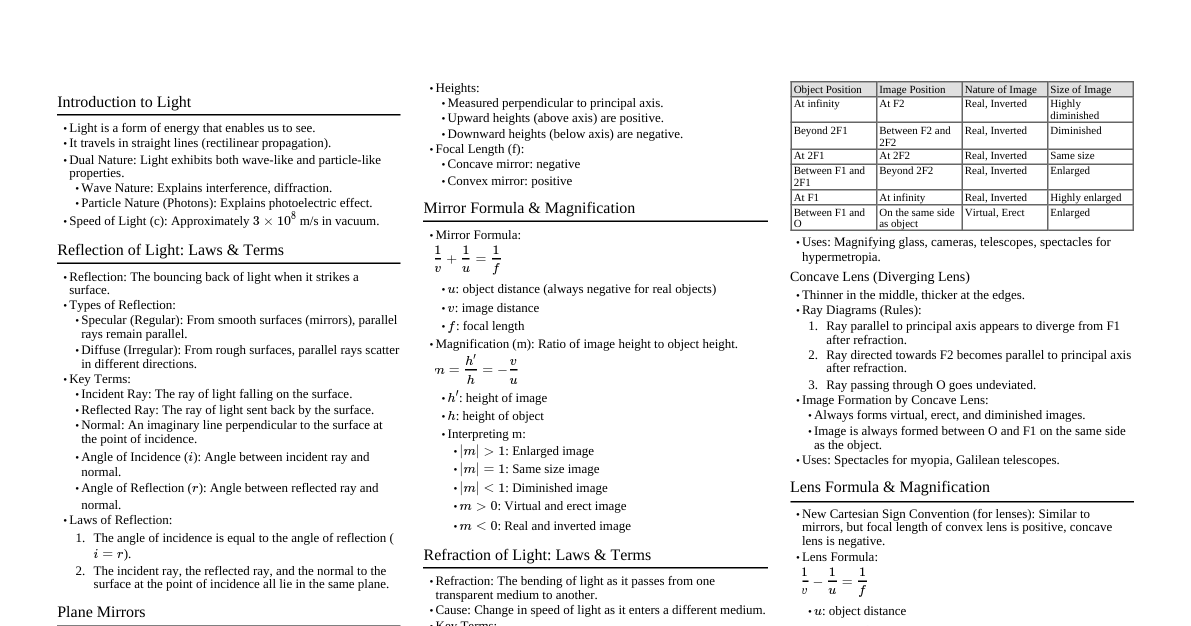
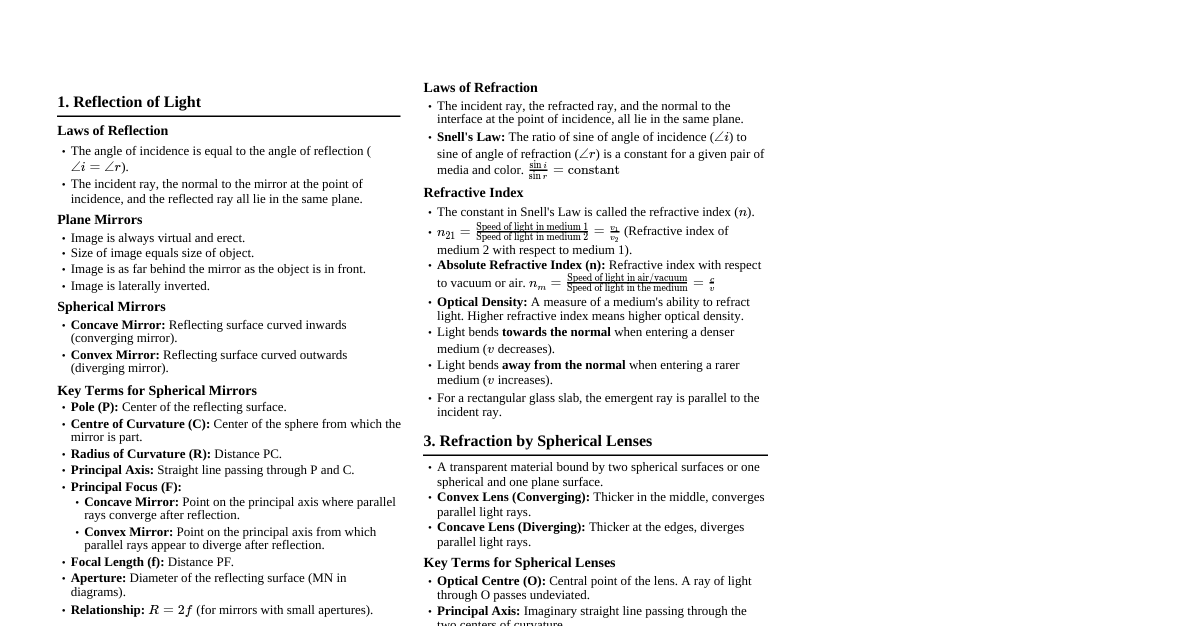
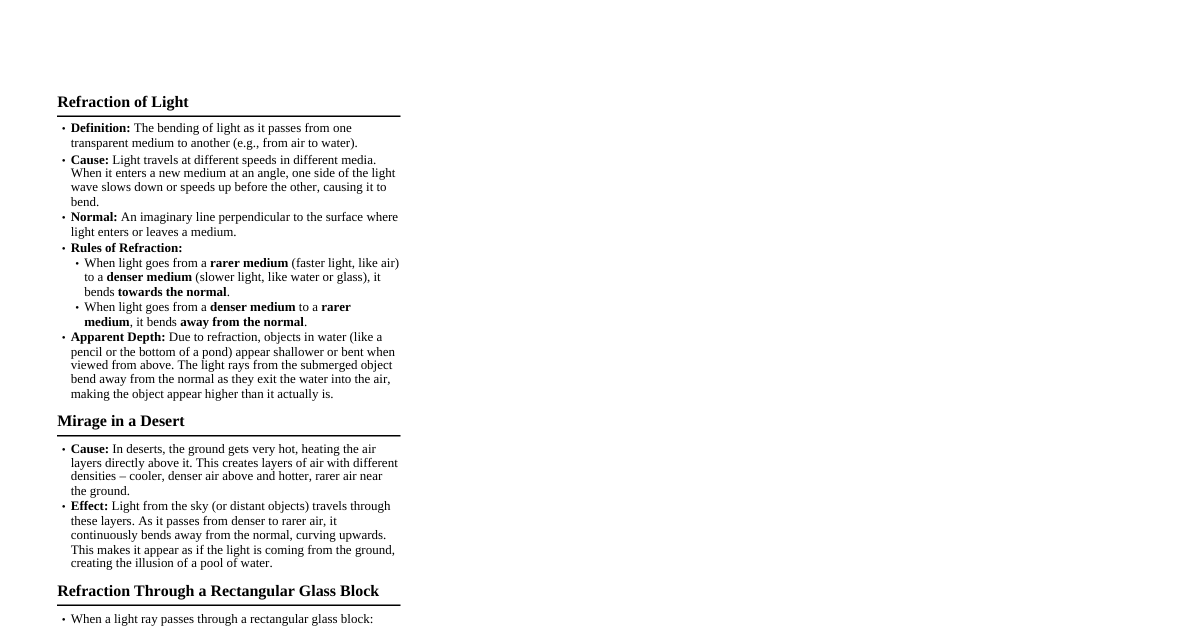
### Light: Introduction - **Definition:** Light is a form of energy that enables us to see. - **Nature:** Exhibits dual nature (wave and particle). - **Speed of Light (c):** Approx. $3 \times 10^8$ m/s in vacuum. - **Ray:** A straight line path of light. - **Beam:** A collection of light rays. ### Reflection of Light - **Definition:** The bouncing back of light when it strikes a surface. - **Laws of Reflection:** 1. The angle of incidence ($\angle i$) is equal to the angle of reflection ($\angle r$). 2. The incident ray, the reflected ray, and the normal to the surface at the point of incidence all lie in the same plane. - **Types of Reflection:** - **Regular Reflection:** From smooth surfaces (e.g., mirror). - **Diffused Reflection:** From rough surfaces (e.g., wall). ### Plane Mirrors - **Image Formation:** - Virtual and Erect - Laterally Inverted - Same size as the object - Same distance behind the mirror as the object is in front - **Uses:** Looking glass, periscopes, kaleidoscopes. ### Spherical Mirrors - **Types:** - **Concave Mirror:** Reflecting surface is curved inwards. Converging mirror. - **Convex Mirror:** Reflecting surface is curved outwards. Diverging mirror. - **Key Terms:** - **Pole (P):** Centre of the spherical mirror. - **Centre of Curvature (C):** Centre of the sphere from which the mirror is cut. - **Radius of Curvature (R):** Distance PC. - **Principal Axis:** Line joining P and C. - **Principal Focus (F):** Point on the principal axis where parallel rays converge (concave) or appear to diverge from (convex) after reflection. - **Focal Length (f):** Distance PF. $f = R/2$. - **Sign Convention (New Cartesian):** - Origin at Pole (P). - Incident light from left. - Distances to the right of P are positive, to the left are negative. - Heights above principal axis are positive, below are negative. - **Mirror Formula:** $$\frac{1}{v} + \frac{1}{u} = \frac{1}{f}$$ - $u$: object distance - $v$: image distance - $f$: focal length - **Magnification (m):** $$m = \frac{h'}{h} = -\frac{v}{u}$$ - $h'$: height of image - $h$: height of object - $m > 0$: virtual and erect image - $m 1$: magnified image - $|m| ### Refraction of Light - **Definition:** The bending of light as it passes from one transparent medium to another. - **Cause:** Change in speed of light in different media. - **Laws of Refraction:** 1. The incident ray, the refracted ray, and the normal to the interface at the point of incidence all lie in the same plane. 2. **Snell's Law:** The ratio of the sine of the angle of incidence ($\sin i$) to the sine of the angle of refraction ($\sin r$) is constant for a given pair of media. $$\frac{\sin i}{\sin r} = n_{21} = \frac{n_2}{n_1}$$ where $n_{21}$ is the refractive index of medium 2 with respect to medium 1. - **Refractive Index (n):** - Absolute Refractive Index ($n_m$): $$n_m = \frac{\text{speed of light in vacuum (c)}}{\text{speed of light in medium (v)}}$$ - Relative Refractive Index ($n_{21}$): $$n_{21} = \frac{v_1}{v_2}$$ - Optically Denser Medium: Higher refractive index, light slows down, bends towards normal. - Optically Rarer Medium: Lower refractive index, light speeds up, bends away from normal. ### Lenses - **Definition:** Transparent material bounded by two spherical surfaces or one spherical and one plane surface. - **Types:** - **Convex Lens (Converging Lens):** Thicker in the middle, converges parallel rays. - **Concave Lens (Diverging Lens):** Thinner in the middle, diverges parallel rays. - **Key Terms:** - **Optical Centre (O):** Central point of the lens. - **Principal Axis:** Line passing through O and perpendicular to the lens. - **Principal Focus (F):** For convex, parallel rays converge to F after refraction. For concave, parallel rays appear to diverge from F. Each lens has two principal foci ($F_1, F_2$). - **Focal Length (f):** Distance OF. - **Sign Convention (New Cartesian):** Same as mirrors, but origin at Optical Centre (O). - **Lens Formula:** $$\frac{1}{v} - \frac{1}{u} = \frac{1}{f}$$ - **Magnification (m):** $$m = \frac{h'}{h} = \frac{v}{u}$$ #### Image Formation by Convex Lens | Object Position | Image Position | Nature of Image | Size of Image | |-----------------|----------------|-----------------|---------------| | At infinity | At $F_2$ | Real, Inverted | Highly Diminished | | Beyond $2F_1$ | Between $F_2$ and $2F_2$ | Real, Inverted | Diminished | | At $2F_1$ | At $2F_2$ | Real, Inverted | Same Size | | Between $F_1$ and $2F_1$ | Beyond $2F_2$ | Real, Inverted | Magnified | | At $F_1$ | At infinity | Real, Inverted | Highly Magnified | | Between $F_1$ and O | On same side as object | Virtual, Erect | Magnified | #### Uses of Convex Lens - Magnifying glass, cameras, telescopes, microscopes, correcting hypermetropia. #### Image Formation by Concave Lens | Object Position | Image Position | Nature of Image | Size of Image | |-----------------|----------------|-----------------|---------------| | At infinity | At $F_1$ (on same side) | Virtual, Erect | Highly Diminished | | Between infinity and O | Between $F_1$ and O (on same side) | Virtual, Erect | Diminished | #### Uses of Concave Lens - Correcting myopia, peep holes in doors. ### Power of a Lens (P) - **Definition:** The degree of convergence or divergence of light rays achieved by a lens. - **Formula:** $$P = \frac{1}{f}$$ (where $f$ is in meters) - **Unit:** Dioptre (D). 1 D = $1 \text{ m}^{-1}$. - **Convex Lens:** Positive power (focal length is positive). - **Concave Lens:** Negative power (focal length is negative). - **Power of combination of lenses:** $$P = P_1 + P_2 + P_3 + ...$$