Light Refraction & Prisms
Cheatsheet Content
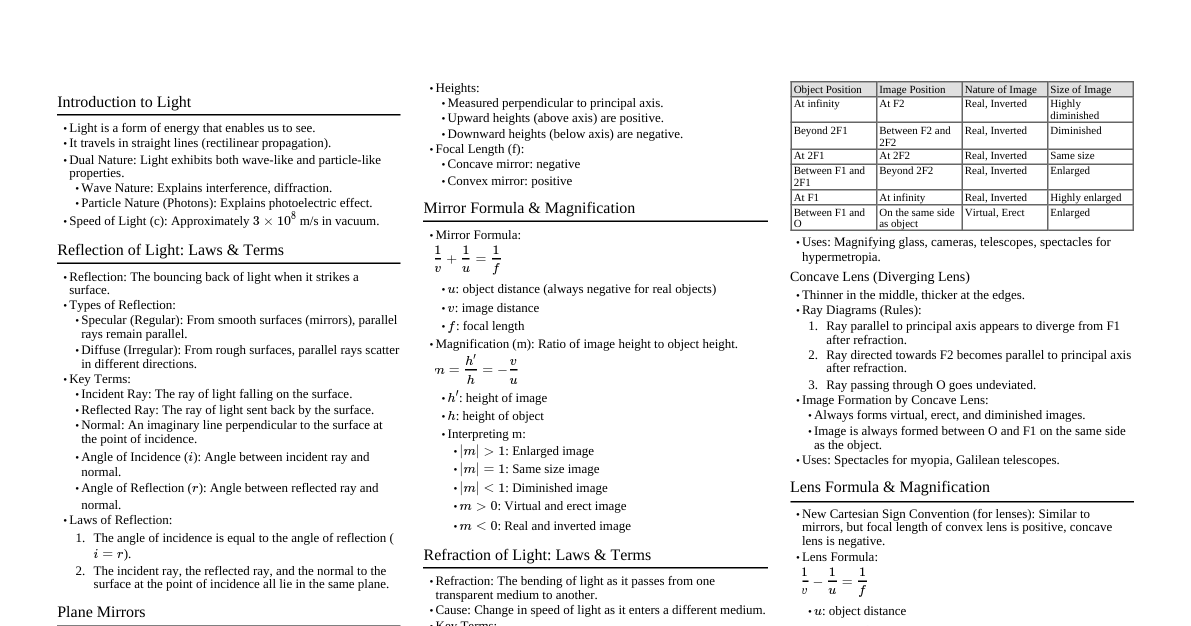
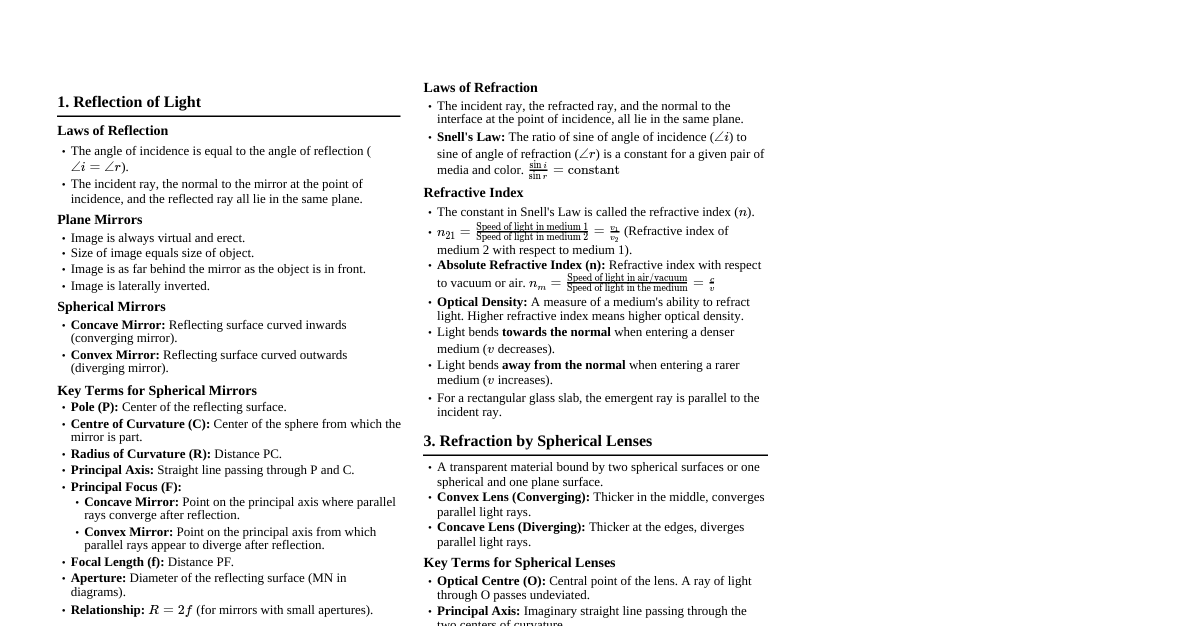
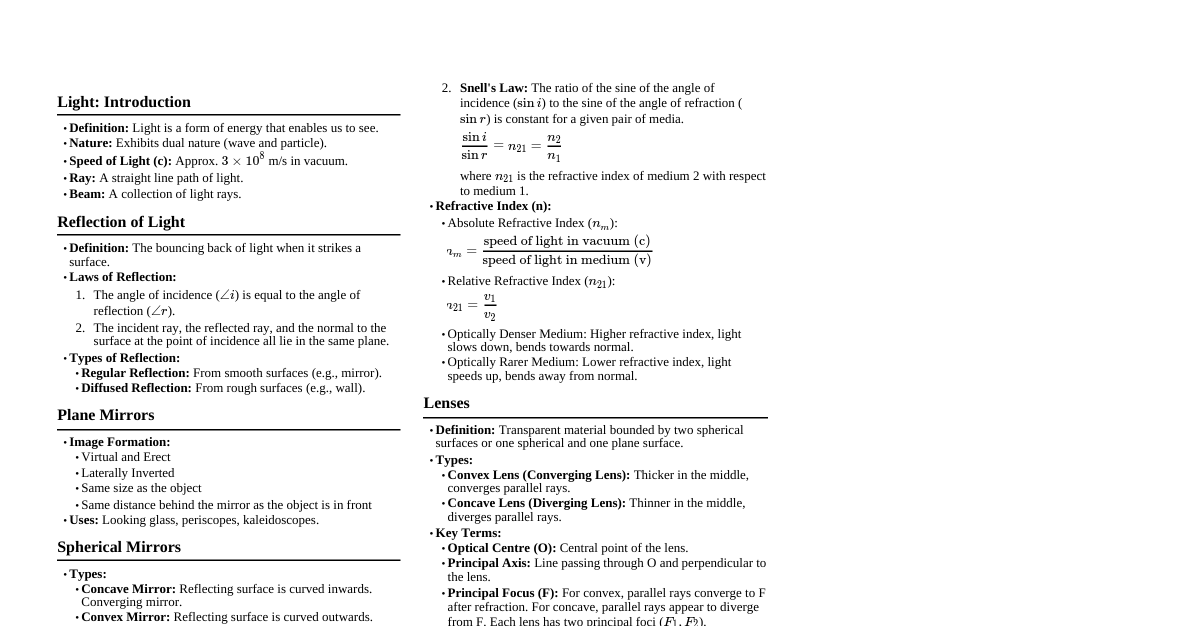
Refraction of Light Definition: The bending of light as it passes from one transparent medium to another (e.g., from air to water). Cause: Light travels at different speeds in different media. When it enters a new medium at an angle, one side of the light wave slows down or speeds up before the other, causing it to bend. Normal: An imaginary line perpendicular to the surface where light enters or leaves a medium. Rules of Refraction: When light goes from a rarer medium (faster light, like air) to a denser medium (slower light, like water or glass), it bends towards the normal . When light goes from a denser medium to a rarer medium , it bends away from the normal . Apparent Depth: Due to refraction, objects in water (like a pencil or the bottom of a pond) appear shallower or bent when viewed from above. The light rays from the submerged object bend away from the normal as they exit the water into the air, making the object appear higher than it actually is. Mirage in a Desert Cause: In deserts, the ground gets very hot, heating the air layers directly above it. This creates layers of air with different densities – cooler, denser air above and hotter, rarer air near the ground. Effect: Light from the sky (or distant objects) travels through these layers. As it passes from denser to rarer air, it continuously bends away from the normal, curving upwards. This makes it appear as if the light is coming from the ground, creating the illusion of a pool of water. Refraction Through a Rectangular Glass Block When a light ray passes through a rectangular glass block: It bends towards the normal as it enters the glass (rarer to denser). It travels in a straight line inside the glass. It bends away from the normal as it exits the glass into the air (denser to rarer). The emergent ray (the ray leaving the block) is parallel to the incident ray (the ray entering the block), but it is laterally displaced (shifted sideways). Dispersion of White Light by a Prism Prism: A transparent medium (usually glass or plastic) with at least two plane surfaces inclined at an angle. Dispersion: The phenomenon where white light splits into its constituent colors (spectrum) when passing through a prism. The Spectrum: The band of colors produced is commonly remembered as VIBGYOR (Violet, Indigo, Blue, Green, Yellow, Orange, Red). Cause: Different colors of light have slightly different speeds in a medium like glass, meaning they have different refractive indices. Violet light bends the most (has the shortest wavelength). Red light bends the least (has the longest wavelength). Because each color bends at a slightly different angle, they separate, and we see the spectrum. Note: A prism produces a spectrum, but it does not produce new colors; it only separates the colors already present in white light. Why is the Sky Blue and Sunsets Red? This relates to scattering of light, not just refraction. Blue Sky: Short-wavelength blue light is scattered more efficiently by tiny air molecules than longer-wavelength red light. This scattered blue light reaches our eyes from all directions, making the sky appear blue. Red Sunsets: When the sun is low on the horizon, its light travels through a much thicker layer of atmosphere. Most of the blue light is scattered away, leaving the longer-wavelength red and orange light to reach our eyes directly, creating beautiful sunsets.