Calculus I, II, III Cheatsheet
Cheatsheet Content
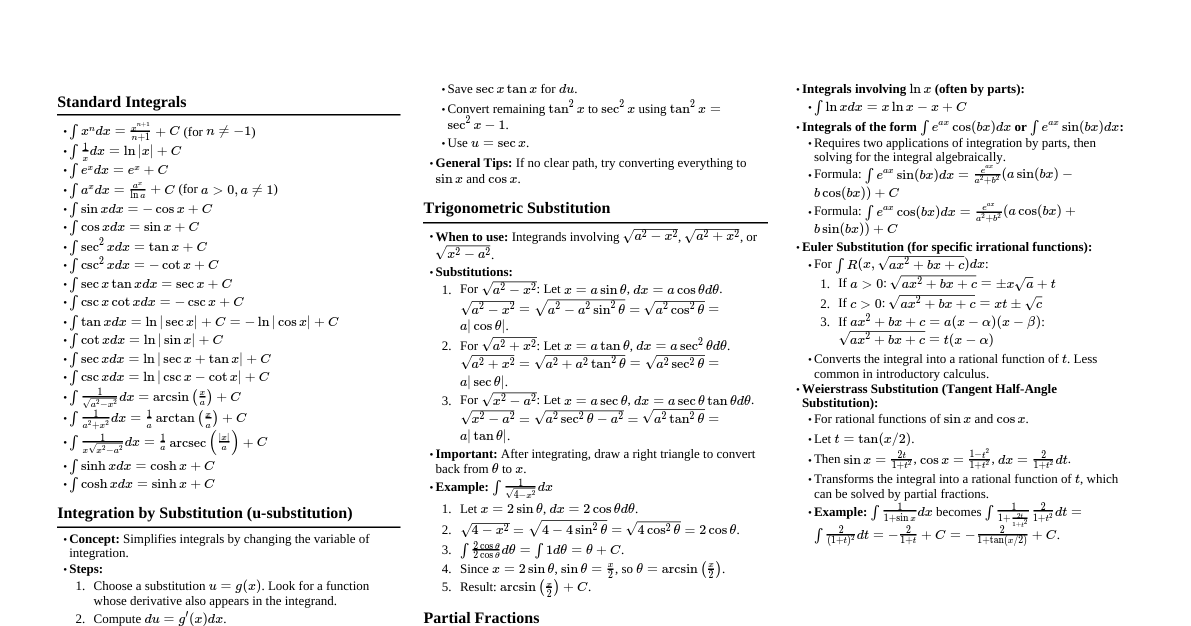
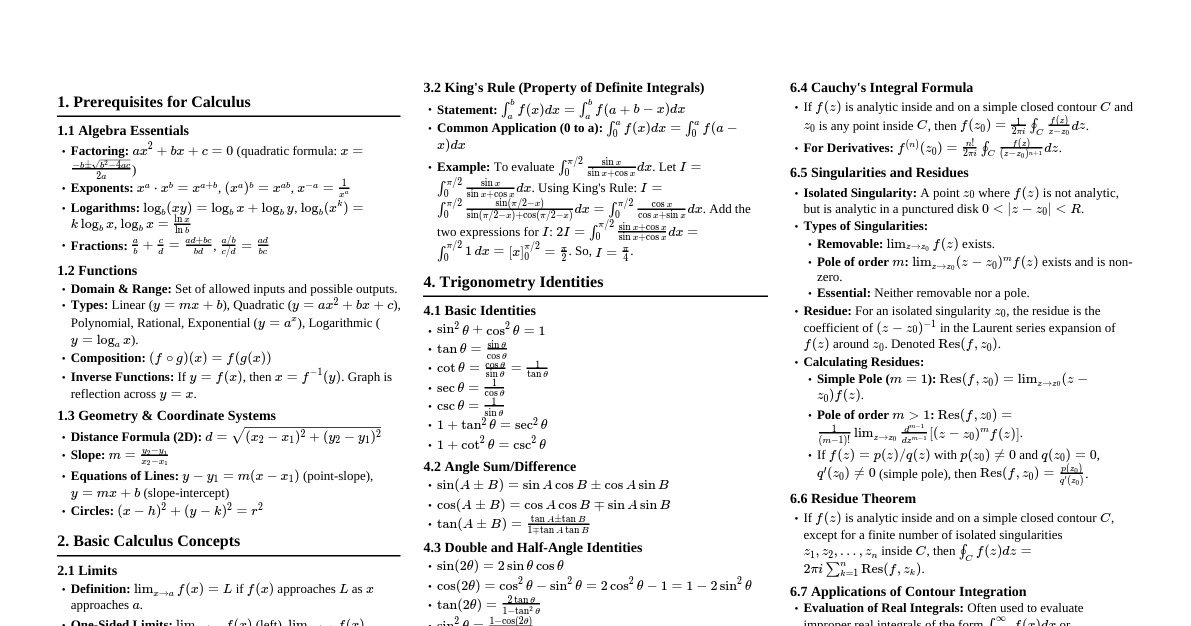
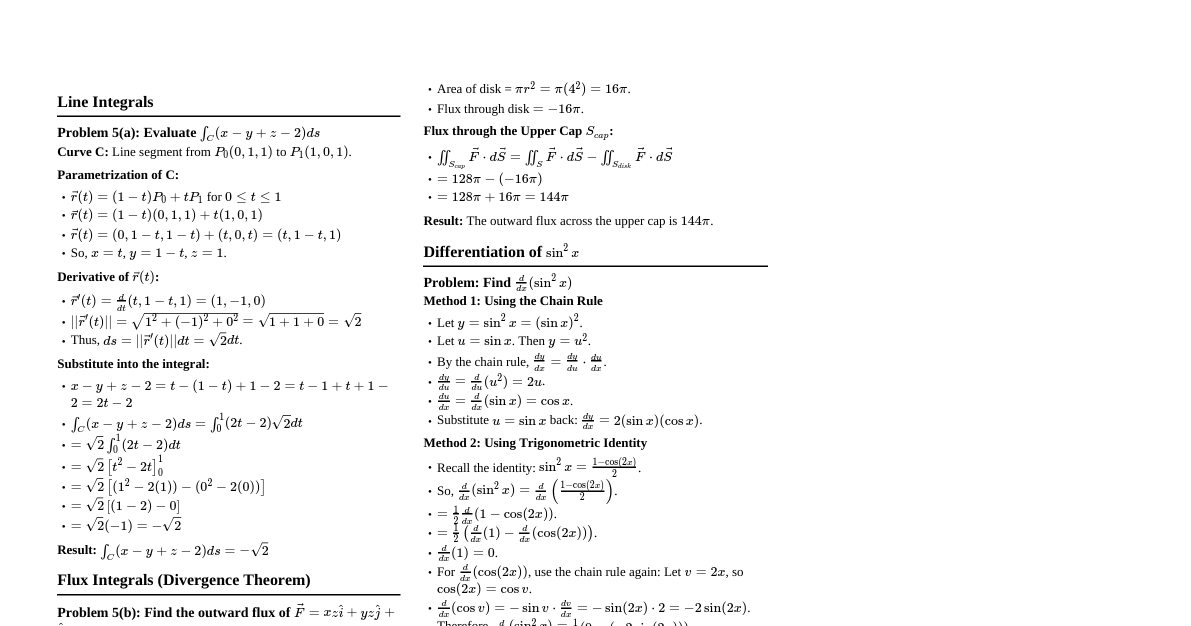
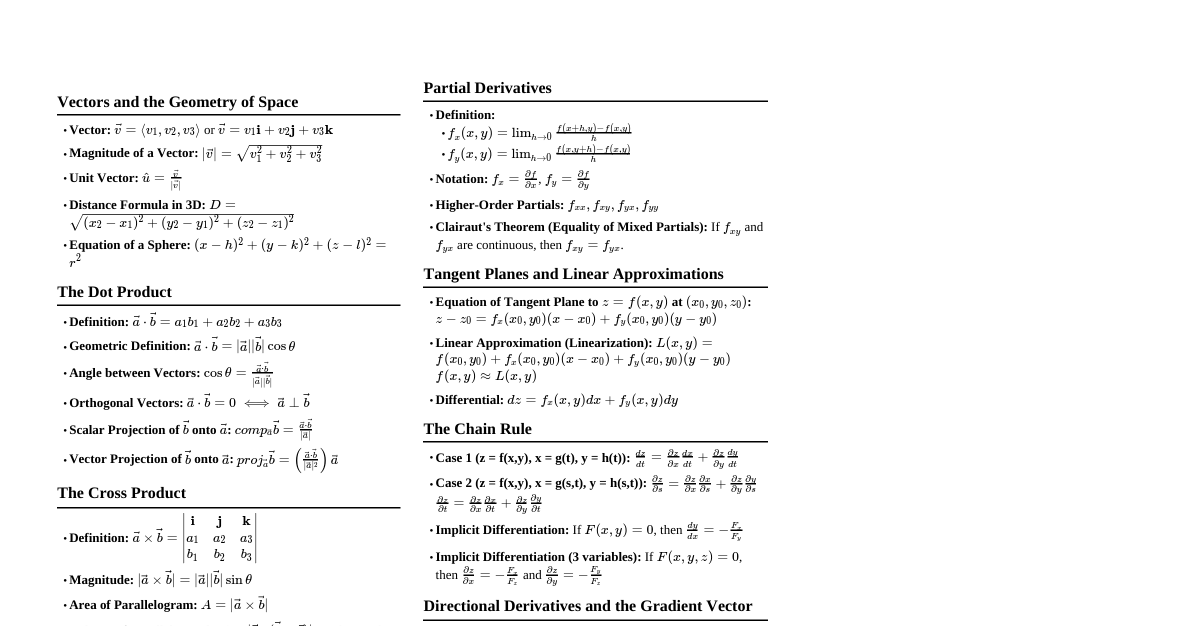
### Calculus I: Limits & Continuity - **Definition of a Limit:** $\lim_{x \to a} f(x) = L$ if for every $\epsilon > 0$ there exists a $\delta > 0$ such that if $0 ### Calculus I: Derivatives - **Definition of Derivative:** $f'(x) = \lim_{h \to 0} \frac{f(x+h) - f(x)}{h}$ (slope of tangent line) - **Differentiation Rules:** - **Constant Rule:** $\frac{d}{dx}(c) = 0$ - **Power Rule:** $\frac{d}{dx}(x^n) = nx^{n-1}$ - **Constant Multiple Rule:** $\frac{d}{dx}(cf(x)) = c f'(x)$ - **Sum/Difference Rule:** $\frac{d}{dx}(f(x) \pm g(x)) = f'(x) \pm g'(x)$ - **Product Rule:** $\frac{d}{dx}(f(x)g(x)) = f'(x)g(x) + f(x)g'(x)$ - **Quotient Rule:** $\frac{d}{dx}\left(\frac{f(x)}{g(x)}\right) = \frac{f'(x)g(x) - f(x)g'(x)}{[g(x)]^2}$ - **Chain Rule:** $\frac{d}{dx}(f(g(x))) = f'(g(x))g'(x)$ - **Derivatives of Common Functions:** - $\frac{d}{dx}(e^x) = e^x$ - $\frac{d}{dx}(a^x) = a^x \ln a$ - $\frac{d}{dx}(\ln x) = \frac{1}{x}$ - $\frac{d}{dx}(\log_a x) = \frac{1}{x \ln a}$ - $\frac{d}{dx}(\sin x) = \cos x$ - $\frac{d}{dx}(\cos x) = -\sin x$ - $\frac{d}{dx}(\tan x) = \sec^2 x$ - $\frac{d}{dx}(\cot x) = -\csc^2 x$ - $\frac{d}{dx}(\sec x) = \sec x \tan x$ - $\frac{d}{dx}(\csc x) = -\csc x \cot x$ - $\frac{d}{dx}(\arcsin x) = \frac{1}{\sqrt{1-x^2}}$ - $\frac{d}{dx}(\arctan x) = \frac{1}{1+x^2}$ - **Implicit Differentiation:** Differentiate both sides of an equation with respect to $x$, treating $y$ as a function of $x$ (use chain rule for $y$ terms: e.g., $\frac{d}{dx}(y^2) = 2y \frac{dy}{dx}$). - **Related Rates:** Use chain rule to relate rates of change of two or more variables. - **Linear Approximation:** $L(x) = f(a) + f'(a)(x-a)$ for $x$ near $a$. - **Mean Value Theorem (MVT):** If $f$ is continuous on $[a,b]$ and differentiable on $(a,b)$, then there exists a number $c$ in $(a,b)$ such that $f'(c) = \frac{f(b)-f(a)}{b-a}$. - **Rolle's Theorem:** A special case of MVT where $f(a)=f(b)$, implying $f'(c)=0$ for some $c \in (a,b)$. - **L'Hôpital's Rule:** If $\lim_{x \to a} \frac{f(x)}{g(x)}$ is of the form $\frac{0}{0}$ or $\frac{\pm\infty}{\pm\infty}$, then $\lim_{x \to a} \frac{f(x)}{g(x)} = \lim_{x \to a} \frac{f'(x)}{g'(x)}$, provided the latter limit exists. ### Calculus I: Applications of Derivatives - **Extrema:** - **Critical Points:** $f'(c) = 0$ or $f'(c)$ is undefined. - **First Derivative Test:** Determines local max/min by sign change of $f'(x)$. - $f'(x)$ changes from $+$ to $-$ at $c \implies$ local max. - $f'(x)$ changes from $-$ to $+$ at $c \implies$ local min. - **Second Derivative Test:** Determines local max/min using $f''(x)$. - If $f'(c)=0$ and $f''(c) > 0 \implies$ local min. - If $f'(c)=0$ and $f''(c) 0 \implies$ concave up (graph holds water) - $f''(x) ### Calculus I: Integrals - **Antiderivative:** $F(x)$ is an antiderivative of $f(x)$ if $F'(x) = f(x)$. - **Indefinite Integral:** $\int f(x) dx = F(x) + C$ (C is constant of integration). - **Basic Integration Formulas:** - $\int x^n dx = \frac{x^{n+1}}{n+1} + C$ ($n \ne -1$) - $\int \frac{1}{x} dx = \ln|x| + C$ - $\int e^x dx = e^x + C$ - $\int a^x dx = \frac{a^x}{\ln a} + C$ - $\int \sin x dx = -\cos x + C$ - $\int \cos x dx = \sin x + C$ - $\int \sec^2 x dx = \tan x + C$ - $\int \csc^2 x dx = -\cot x + C$ - $\int \sec x \tan x dx = \sec x + C$ - $\int \csc x \cot x dx = -\csc x + C$ - $\int \frac{1}{\sqrt{1-x^2}} dx = \arcsin x + C$ - $\int \frac{1}{1+x^2} dx = \arctan x + C$ - **Definite Integral:** $\int_a^b f(x) dx = \lim_{n \to \infty} \sum_{i=1}^n f(x_i^*) \Delta x$ (Area under curve). - **Fundamental Theorem of Calculus (FTC):** - **Part 1:** If $F(x) = \int_a^x f(t) dt$, then $F'(x) = f(x)$. - **Part 2:** $\int_a^b f(x) dx = F(b) - F(a)$, where $F$ is any antiderivative of $f$. - **U-Substitution:** Technique for integrating composite functions. Let $u = g(x)$, then $du = g'(x) dx$. - $\int f(g(x))g'(x) dx = \int f(u) du$ ### Calculus II: Techniques of Integration - **Integration by Parts:** $\int u dv = uv - \int v du$ (LIATE for choosing $u$: Log, Inverse Trig, Algebraic, Trig, Exponential). - **Trigonometric Integrals:** - Involving $\sin^m x \cos^n x$: - If $m$ is odd, save one $\sin x$, convert rest to $\cos x$ using $\sin^2 x = 1-\cos^2 x$. Let $u=\cos x$. - If $n$ is odd, save one $\cos x$, convert rest to $\sin x$ using $\cos^2 x = 1-\sin^2 x$. Let $u=\sin x$. - If both $m,n$ are even, use half-angle identities: $\sin^2 x = \frac{1-\cos(2x)}{2}$, $\cos^2 x = \frac{1+\cos(2x)}{2}$. - Involving $\tan^m x \sec^n x$: - If $n$ is even ($n \ge 2$), save $\sec^2 x$, convert rest to $\tan x$ using $\sec^2 x = 1+\tan^2 x$. Let $u=\tan x$. - If $m$ is odd ($m \ge 1$), save $\sec x \tan x$, convert rest to $\sec x$ using $\tan^2 x = \sec^2 x - 1$. Let $u=\sec x$. - **Trigonometric Substitution:** - For $\sqrt{a^2-x^2}$, let $x = a \sin \theta$, $dx = a \cos \theta d\theta$. - For $\sqrt{a^2+x^2}$, let $x = a \tan \theta$, $dx = a \sec^2 \theta d\theta$. - For $\sqrt{x^2-a^2}$, let $x = a \sec \theta$, $dx = a \sec \theta \tan \theta d\theta$. - **Partial Fraction Decomposition:** For rational functions $\frac{P(x)}{Q(x)}$. - Degree of $P(x)$ must be less than degree of $Q(x)$. If not, use polynomial long division first. - Factor $Q(x)$ into linear and irreducible quadratic factors. - Each linear factor $(ax+b)^k$ gets $\frac{A_1}{ax+b} + \dots + \frac{A_k}{(ax+b)^k}$. - Each irreducible quadratic factor $(ax^2+bx+c)^k$ gets $\frac{A_1x+B_1}{ax^2+bx+c} + \dots + \frac{A_kx+B_k}{(ax^2+bx+c)^k}$. - **Improper Integrals:** - Type 1: Infinite limits of integration. $\int_a^\infty f(x) dx = \lim_{b \to \infty} \int_a^b f(x) dx$. - Type 2: Discontinuities within the interval. $\int_a^b f(x) dx = \lim_{c \to k^-} \int_a^c f(x) dx$ if $f$ is discontinuous at $x=k$. - **Comparison Test for Improper Integrals:** - If $0 \le f(x) \le g(x)$ for $x \ge a$: - If $\int_a^\infty g(x) dx$ converges, then $\int_a^\infty f(x) dx$ converges. - If $\int_a^\infty f(x) dx$ diverges, then $\int_a^\infty g(x) dx$ diverges. ### Calculus II: Applications of Integration - **Area Between Curves:** $A = \int_a^b |f(x) - g(x)| dx$. - **Volumes of Solids of Revolution:** - **Disk Method:** $V = \pi \int_a^b [R(x)]^2 dx$ (no hole). - **Washer Method:** $V = \pi \int_a^b ([R(x)]^2 - [r(x)]^2) dx$ (with hole). - **Shell Method:** $V = 2\pi \int_a^b x h(x) dx$ (for rotation about y-axis). - **Arc Length:** $L = \int_a^b \sqrt{1 + [f'(x)]^2} dx$ or $L = \int_c^d \sqrt{1 + [g'(y)]^2} dy$. - **Surface Area of Revolution:** - About x-axis: $S = 2\pi \int_a^b f(x) \sqrt{1 + [f'(x)]^2} dx$. - About y-axis: $S = 2\pi \int_a^b x \sqrt{1 + [f'(x)]^2} dx$. - **Work:** $W = \int_a^b F(x) dx$. - **Hydrostatic Force:** $F = \int_a^b \rho g A(y) dy$, where $\rho$ is density, $g$ is acceleration due to gravity, $A(y)$ is width of object at depth $y$. ### Calculus II: Sequences and Series - **Sequences:** A list of numbers $a_1, a_2, ..., a_n, ...$. - **Convergence:** $\lim_{n \to \infty} a_n = L$. - **Series:** Sum of terms in a sequence, $\sum_{n=1}^\infty a_n$. - **Geometric Series:** $\sum_{n=0}^\infty ar^n = \frac{a}{1-r}$ if $|r| 1$, diverges if $p \le 1$. - **Harmonic Series:** $\sum_{n=1}^\infty \frac{1}{n}$ (diverges). - **Tests for Convergence/Divergence:** - **Divergence Test:** If $\lim_{n \to \infty} a_n \ne 0$, then $\sum a_n$ diverges. (If $\lim_{n \to \infty} a_n = 0$, test is inconclusive). - **Integral Test:** If $f(x)$ is positive, continuous, and decreasing for $x \ge 1$, then $\sum_{n=1}^\infty a_n$ and $\int_1^\infty f(x) dx$ either both converge or both diverge. - **Comparison Test:** If $0 \le a_n \le b_n$ for all $n$: - If $\sum b_n$ converges, then $\sum a_n$ converges. - If $\sum a_n$ diverges, then $\sum b_n$ diverges. - **Limit Comparison Test:** If $\lim_{n \to \infty} \frac{a_n}{b_n} = c$ where $c > 0$ (finite), then $\sum a_n$ and $\sum b_n$ either both converge or both diverge. - **Alternating Series Test:** For $\sum (-1)^n b_n$ or $\sum (-1)^{n+1} b_n$ where $b_n > 0$: - If $b_n$ is decreasing and $\lim_{n \to \infty} b_n = 0$, then the series converges. - **Ratio Test:** Let $L = \lim_{n \to \infty} \left|\frac{a_{n+1}}{a_n}\right|$. - If $L 1$, series diverges. - If $L = 1$, test is inconclusive. - **Root Test:** Let $L = \lim_{n \to \infty} \sqrt[n]{|a_n|}$. - If $L 1$, series diverges. - If $L = 1$, test is inconclusive. - **Absolute vs. Conditional Convergence:** - **Absolute Convergence:** $\sum |a_n|$ converges. (Implies $\sum a_n$ converges). - **Conditional Convergence:** $\sum a_n$ converges but $\sum |a_n|$ diverges. - **Power Series:** $\sum_{n=0}^\infty c_n (x-a)^n$. - **Radius of Convergence (R):** Interval $(a-R, a+R)$ where series converges. Find using Ratio Test. - **Interval of Convergence:** Check endpoints $x=a-R$ and $x=a+R)$ separately. - **Taylor and Maclaurin Series:** - **Taylor Series:** $f(x) = \sum_{n=0}^\infty \frac{f^{(n)}(a)}{n!}(x-a)^n$. - **Maclaurin Series:** Taylor series with $a=0$. $f(x) = \sum_{n=0}^\infty \frac{f^{(n)}(0)}{n!}x^n$. - **Common Maclaurin Series:** - $e^x = \sum_{n=0}^\infty \frac{x^n}{n!}$ (R = $\infty$) - $\sin x = \sum_{n=0}^\infty (-1)^n \frac{x^{2n+1}}{(2n+1)!}$ (R = $\infty$) - $\cos x = \sum_{n=0}^\infty (-1)^n \frac{x^{2n}}{(2n)!}$ (R = $\infty$) - $\frac{1}{1-x} = \sum_{n=0}^\infty x^n$ (R = 1) - $\ln(1+x) = \sum_{n=1}^\infty (-1)^{n-1} \frac{x^n}{n}$ (R = 1) - $\arctan x = \sum_{n=0}^\infty (-1)^n \frac{x^{2n+1}}{2n+1}$ (R = 1) ### Calculus II: Polar & Parametric Coordinates - **Parametric Equations:** $x = f(t), y = g(t)$. - $\frac{dy}{dx} = \frac{dy/dt}{dx/dt}$ - $\frac{d^2y}{dx^2} = \frac{d}{dt}\left(\frac{dy}{dx}\right) / \frac{dx}{dt}$ - **Arc Length:** $L = \int_{t_1}^{t_2} \sqrt{\left(\frac{dx}{dt}\right)^2 + \left(\frac{dy}{dt}\right)^2} dt$. - **Polar Coordinates:** $(r, \theta)$. - **Conversion:** $x = r \cos \theta$, $y = r \sin \theta$, $r^2 = x^2+y^2$, $\tan \theta = y/x$. - **Slope:** $\frac{dy}{dx} = \frac{r' \sin \theta + r \cos \theta}{r' \cos \theta - r \sin \theta}$ (where $r' = \frac{dr}{d\theta}$). - **Area:** $A = \frac{1}{2} \int_{\alpha}^{\beta} r^2 d\theta$. - **Arc Length:** $L = \int_{\alpha}^{\beta} \sqrt{r^2 + \left(\frac{dr}{d\theta}\right)^2} d\theta$. ### Calculus III: Vectors and Geometry of Space - **Vectors:** $\vec{a} = \langle a_1, a_2, a_3 \rangle$. - **Magnitude:** $|\vec{a}| = \sqrt{a_1^2 + a_2^2 + a_3^2}$. - **Unit Vector:** $\hat{u} = \frac{\vec{u}}{|\vec{u}|}$. - **Dot Product:** $\vec{a} \cdot \vec{b} = a_1b_1 + a_2b_2 + a_3b_3 = |\vec{a}||\vec{b}|\cos\theta$. - Orthogonal if $\vec{a} \cdot \vec{b} = 0$. - **Cross Product:** $\vec{a} \times \vec{b} = \begin{vmatrix} \mathbf{i} & \mathbf{j} & \mathbf{k} \\ a_1 & a_2 & a_3 \\ b_1 & b_2 & b_3 \end{vmatrix}$. - Magnitude: $|\vec{a} \times \vec{b}| = |\vec{a}||\vec{b}|\sin\theta$ (Area of parallelogram). - Vector is orthogonal to both $\vec{a}$ and $\vec{b}$. - Parallel if $\vec{a} \times \vec{b} = \vec{0}$. - **Lines in Space:** - **Vector Equation:** $\vec{r}(t) = \vec{r}_0 + t\vec{v}$. - **Parametric Equations:** $x = x_0 + at, y = y_0 + bt, z = z_0 + ct$. - **Symmetric Equations:** $\frac{x-x_0}{a} = \frac{y-y_0}{b} = \frac{z-z_0}{c}$. - **Planes in Space:** - **Vector Equation:** $\vec{n} \cdot (\vec{r} - \vec{r}_0) = 0$. - **Scalar Equation:** $a(x-x_0) + b(y-y_0) + c(z-z_0) = 0$. - **General Equation:** $ax + by + cz + d = 0$. - Normal vector to the plane: $\vec{n} = \langle a, b, c \rangle$. - **Quadratic Surfaces (Quadrics):** Ellipsoid, Hyperboloid, Paraboloid, Cone, Cylinder. - Identify by examining the equation and traces in coordinate planes. ### Calculus III: Vector Functions - **Vector-Valued Functions:** $\vec{r}(t) = \langle f(t), g(t), h(t) \rangle$. - **Derivative:** $\vec{r}'(t) = \langle f'(t), g'(t), h'(t) \rangle$. - **Tangent Vector:** $\vec{r}'(t)$. Unit tangent vector: $\vec{T}(t) = \frac{\vec{r}'(t)}{|\vec{r}'(t)|}$. - **Arc Length:** $L = \int_a^b |\vec{r}'(t)| dt$. - **Curvature:** $\kappa = \frac{|\vec{T}'(t)|}{|\vec{r}'(t)|} = \frac{|\vec{r}'(t) \times \vec{r}''(t)|}{|\vec{r}'(t)|^3}$. - **Normal Vector:** $\vec{N}(t) = \frac{\vec{T}'(t)}{|\vec{T}'(t)|}$. - **Binormal Vector:** $\vec{B}(t) = \vec{T}(t) \times \vec{N}(t)$. - **Velocity, Acceleration, Speed:** - Position: $\vec{r}(t)$ - Velocity: $\vec{v}(t) = \vec{r}'(t)$ - Speed: $|\vec{v}(t)| = |\vec{r}'(t)|$ - Acceleration: $\vec{a}(t) = \vec{v}'(t) = \vec{r}''(t)$ ### Calculus III: Partial Derivatives - **Functions of Several Variables:** $z = f(x,y)$. - **Partial Derivatives:** - $\frac{\partial f}{\partial x}$ (treat $y$ as a constant). - $\frac{\partial f}{\partial y}$ (treat $x$ as a constant). - **Higher-Order Partial Derivatives:** $\frac{\partial^2 f}{\partial x^2}$, $\frac{\partial^2 f}{\partial y^2}$. - **Mixed Partial Derivatives:** $\frac{\partial^2 f}{\partial y \partial x} = \frac{\partial}{\partial y}\left(\frac{\partial f}{\partial x}\right)$, $\frac{\partial^2 f}{\partial x \partial y} = \frac{\partial}{\partial x}\left(\frac{\partial f}{\partial y}\right)$. - **Clairaut's Theorem:** If $f_{xy}$ and $f_{yx}$ are continuous, then $f_{xy} = f_{yx}$. - **Chain Rule for Multivariable Functions:** - If $z = f(x,y)$ and $x=g(t), y=h(t)$, then $\frac{dz}{dt} = \frac{\partial f}{\partial x}\frac{dx}{dt} + \frac{\partial f}{\partial y}\frac{dy}{dt}$. - If $z = f(x,y)$ and $x=g(s,t), y=h(s,t)$, then: - $\frac{\partial z}{\partial s} = \frac{\partial f}{\partial x}\frac{\partial x}{\partial s} + \frac{\partial f}{\partial y}\frac{\partial y}{\partial s}$ - $\frac{\partial z}{\partial t} = \frac{\partial f}{\partial x}\frac{\partial x}{\partial t} + \frac{\partial f}{\partial y}\frac{\partial y}{\partial t}$ - **Directional Derivatives:** $D_{\vec{u}}f(x,y) = \nabla f(x,y) \cdot \vec{u}$, where $\vec{u}$ is a unit vector. - **Gradient Vector:** $\nabla f(x,y) = \langle \frac{\partial f}{\partial x}, \frac{\partial f}{\partial y} \rangle$. - Points in the direction of maximum increase of $f$. - $|\nabla f|$ is the maximum rate of increase. - $\nabla f$ is orthogonal to level curves/surfaces. - **Tangent Planes to Surfaces:** For $F(x,y,z)=k$, the tangent plane at $(x_0,y_0,z_0)$ is: $F_x(x_0,y_0,z_0)(x-x_0) + F_y(x_0,y_0,z_0)(y-y_0) + F_z(x_0,y_0,z_0)(z-z_0) = 0$. - **Local Extrema (Critical Points):** - Find $(x,y)$ where $\nabla f = \vec{0}$ or is undefined. - **Second Derivative Test:** $D(x,y) = f_{xx}f_{yy} - (f_{xy})^2$. - If $D > 0$ and $f_{xx} > 0 \implies$ local min. - If $D > 0$ and $f_{xx} ### Calculus III: Multiple Integrals - **Double Integrals:** $\iint_R f(x,y) dA$. - **Iterated Integrals:** $\int_a^b \int_{g_1(x)}^{g_2(x)} f(x,y) dy dx$ or $\int_c^d \int_{h_1(y)}^{h_2(y)} f(x,y) dx dy$. - **Area:** $\iint_R dA$. - **Volume:** $\iint_R f(x,y) dA$. - **Double Integrals in Polar Coordinates:** - $x = r \cos \theta, y = r \sin \theta$. - $dA = r dr d\theta$. - $\iint_R f(x,y) dA = \iint_D f(r\cos\theta, r\sin\theta) r dr d\theta$. - **Triple Integrals:** $\iiint_E f(x,y,z) dV$. - **Volume:** $\iiint_E dV$. - **Triple Integrals in Cylindrical Coordinates:** - $x = r \cos \theta, y = r \sin \theta, z = z$. - $dV = r dz dr d\theta$. - $\iiint_E f(x,y,z) dV = \iiint_D f(r\cos\theta, r\sin\theta, z) r dz dr d\theta$. - **Triple Integrals in Spherical Coordinates:** - $x = \rho \sin \phi \cos \theta, y = \rho \sin \phi \sin \theta, z = \rho \cos \phi$. - $dV = \rho^2 \sin \phi d\rho d\phi d\theta$. - $\iiint_E f(x,y,z) dV = \iiint_D f(\rho\sin\phi\cos\theta, \rho\sin\phi\sin\theta, \rho\cos\phi) \rho^2 \sin \phi d\rho d\phi d\theta$. - **Change of Variables (Jacobian):** - For double integrals: $\iint_R f(x,y) dA = \iint_S f(x(u,v), y(u,v)) \left|\frac{\partial(x,y)}{\partial(u,v)}\right| du dv$. - Jacobian: $\frac{\partial(x,y)}{\partial(u,v)} = \begin{vmatrix} \frac{\partial x}{\partial u} & \frac{\partial x}{\partial v} \\ \frac{\partial y}{\partial u} & \frac{\partial y}{\partial v} \end{vmatrix}$. ### Calculus III: Vector Calculus - **Line Integrals:** - **Scalar Field:** $\int_C f(x,y,z) ds = \int_a^b f(\vec{r}(t)) |\vec{r}'(t)| dt$. - **Vector Field:** $\int_C \vec{F} \cdot d\vec{r} = \int_a^b \vec{F}(\vec{r}(t)) \cdot \vec{r}'(t) dt$. - **Fundamental Theorem for Line Integrals:** If $\vec{F} = \nabla f$, then $\int_C \vec{F} \cdot d\vec{r} = f(\vec{r}(b)) - f(\vec{r}(a))$. - **Conservative Vector Field:** A vector field $\vec{F}$ is conservative if $\vec{F} = \nabla f$ for some scalar function $f$ (potential function). - If $\vec{F} = \langle P, Q \rangle$ is conservative, then $\frac{\partial P}{\partial y} = \frac{\partial Q}{\partial x}$. - If $\vec{F} = \langle P, Q, R \rangle$ is conservative, then $\text{curl } \vec{F} = \vec{0}$. - **Green's Theorem:** Relates a line integral around a simple closed curve $C$ to a double integral over the plane region $D$ bounded by $C$. - $\oint_C P dx + Q dy = \iint_D \left(\frac{\partial Q}{\partial x} - \frac{\partial P}{\partial y}\right) dA$. - **Curl and Divergence:** - **Curl:** $\text{curl } \vec{F} = \nabla \times \vec{F} = \begin{vmatrix} \mathbf{i} & \mathbf{j} & \mathbf{k} \\ \frac{\partial}{\partial x} & \frac{\partial}{\partial y} & \frac{\partial}{\partial z} \\ P & Q & R \end{vmatrix}$. Measures rotation. - **Divergence:** $\text{div } \vec{F} = \nabla \cdot \vec{F} = \frac{\partial P}{\partial x} + \frac{\partial Q}{\partial y} + \frac{\partial R}{\partial z}$. Measures expansion/compression. - **Surface Integrals:** - **Scalar Field:** $\iint_S f(x,y,z) dS = \iint_D f(\vec{r}(u,v)) |\vec{r}_u \times \vec{r}_v| dA$. - **Vector Field (Flux):** $\iint_S \vec{F} \cdot d\vec{S} = \iint_D \vec{F}(\vec{r}(u,v)) \cdot (\vec{r}_u \times \vec{r}_v) dA$. - **Stokes' Theorem:** Relates a line integral around a closed curve $C$ to a surface integral over a surface $S$ whose boundary is $C$. - $\oint_C \vec{F} \cdot d\vec{r} = \iint_S (\nabla \times \vec{F}) \cdot d\vec{S}$. - **Divergence Theorem (Gauss's Theorem):** Relates a surface integral over a closed surface $S$ to a triple integral over the solid region $E$ bounded by $S$. - $\iint_S \vec{F} \cdot d\vec{S} = \iiint_E \nabla \cdot \vec{F} dV$.