English Literature Overview
Cheatsheet Content
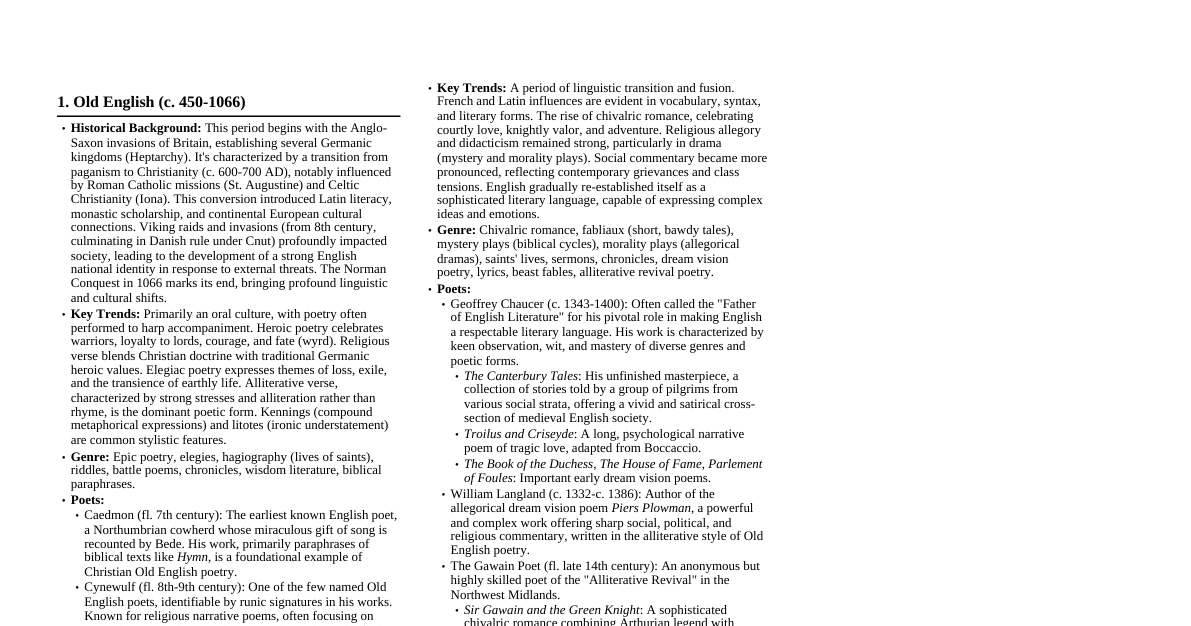
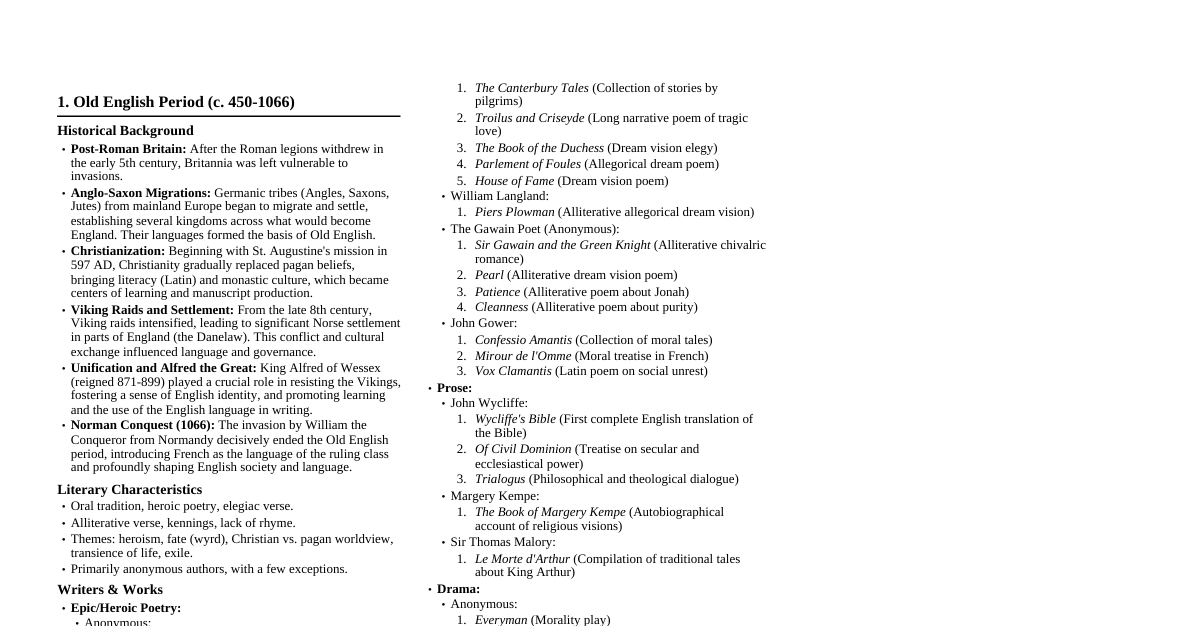
### Old English Period (c. 450-1066) The Old English period, also known as the Anglo-Saxon period, marks the beginning of English literature. It's characterized by oral traditions, heroic poetry, and religious themes. The language is Old English, which is quite different from modern English. #### Major Characteristics: - **Oral Tradition:** Much of the literature was passed down orally. - **Heroic Ethos:** Focus on bravery, loyalty, fate (wyrd), and glory in battle. - **Christian Influence:** Gradual integration of Christian themes with pagan Germanic traditions. - **Alliterative Verse:** Poetic lines often linked by alliteration rather longer than by rhyme. - **Kennings:** Compound metaphorical expressions (e.g., "whale-road" for sea). #### Major Works & Writers: - **Beowulf:** - **Genre:** Epic Poem - **Author:** Anonymous - **Details:** The most famous work of Old English literature. It tells the story of the Geatish warrior Beowulf, who comes to the aid of the Danish king Hrothgar by fighting monsters Grendel, Grendel's mother, and later, a dragon. It explores themes of heroism, good vs. evil, fate, and the transient nature of life. - **Significance:** A foundational text for English literature, showcasing the heroic ideal and the blend of pagan and Christian elements. - **Caedmon's Hymn:** - **Genre:** Hymn/Religious Poem - **Author:** Caedmon - **Details:** The earliest recorded English poem, composed by a cowherd who miraculously received the gift of poetic song. It praises God the Creator. - **Significance:** Marks the beginning of Christian poetry in English literature. - **The Wanderer / The Seafarer:** - **Genre:** Elegiac Poems - **Author:** Anonymous - **Details:** These poems reflect on themes of exile, loss, the transience of earthly life, and the solace found in faith. They often feature a lone speaker contemplating their past and the harshness of the world. - **Significance:** Provide insight into the Anglo-Saxon worldview, melancholy, and the search for meaning. - **Dream of the Rood:** - **Genre:** Religious Visionary Poem - **Author:** Anonymous - **Details:** A dream vision in which the speaker beholds the cross (the "Rood") itself narrating the crucifixion of Christ. It blends heroic imagery with Christian theology. - **Significance:** A powerful example of early Christian poetry, personifying the cross as a loyal retainer to Christ. ### Middle English Period (1066-c. 1500) This era begins with the Norman Conquest of 1066, which brought French influence to England, profoundly impacting the language and culture. English gradually re-emerged as the dominant language, but with a significant infusion of French vocabulary and grammar, evolving into Middle English. #### Major Characteristics: - **Linguistic Shift:** Blending of Old English, Norman French, and Latin. - **Rise of Romance:** Popularity of chivalric romances, tales of knights, quests, and courtly love. - **Religious Literature:** Continued strong presence of religious works, often didactic or allegorical. - **Social Commentary:** Growing literary interest in social issues and satire. - **Emergence of Drama:** Early forms of drama (mystery plays, morality plays). #### Major Works & Writers: - **Geoffrey Chaucer (c. 1343-1400):** - **Major Work:** *The Canterbury Tales* - **Genre:** Frame Narrative / Collection of Tales - **Details:** A collection of stories told by a group of pilgrims traveling to Canterbury. Each pilgrim represents a different social class, and their tales range from comic to serious, moral to bawdy, providing a panoramic view of 14th-century English society. - **Significance:** Chaucer is considered the "Father of English Literature." He popularized the use of English (specifically the London dialect) in serious literary works and displayed an unprecedented ability to characterize and satirize. - **The Gawain Poet (Anonymous):** - **Major Work:** *Sir Gawain and the Green Knight* - **Genre:** Alliterative Romance - **Details:** A complex Arthurian romance combining elements of chivalry, temptation, and the supernatural. It uses the Old English alliterative verse form with a sophisticated narrative structure. - **Significance:** A masterpiece of Middle English alliterative poetry, exploring themes of honor, truth, and human fallibility. - **William Langland (c. 1332-1386):** - **Major Work:** *Piers Plowman* - **Genre:** Alliterative Allegory / Dream Vision - **Details:** A long allegorical poem criticizing social and religious corruption. The narrator, Will, has a series of dream visions concerning salvation and the state of England. - **Significance:** A powerful work of social and religious commentary, highlighting the struggles of the common people. - **Julian of Norwich (c. 1342-c. 1416):** - **Major Work:** *Revelations of Divine Love* - **Genre:** Mystical Theology - **Details:** The first book in English known to have been written by a woman. It records Julian's spiritual visions and her profound theological reflections on God's unconditional love. - **Significance:** A cornerstone of English mystical literature, offering a unique feminine perspective on divinity. - **Mystery Plays / Morality Plays:** - **Genre:** Early Drama - **Details:** - **Mystery Plays:** Dramatizations of biblical stories, performed by trade guilds. Cycles like the York Cycle or Chester Cycle depict events from creation to the Last Judgment. - **Morality Plays:** Allegorical dramas depicting the struggle for the human soul, with characters personifying virtues and vices (e.g., *Everyman*). - **Significance:** Paved the way for later Elizabethan drama, developing theatrical conventions and exploring moral themes. ### The Renaissance (c. 1500-1660) The English Renaissance was a period of intense cultural, artistic, and intellectual flourishing, inspired by classical learning and humanism. It saw the rise of modern English, the invention of the printing press, and a golden age of drama and poetry. #### Major Characteristics: - **Humanism:** Emphasis on human potential, achievements, and classical learning. - **Protestant Reformation:** Religious upheaval influencing literature and thought. - **Exploration & Discovery:** New worlds and scientific advancements expanding horizons. - **Golden Age of Drama:** Flourishing of tragedy, comedy, and historical plays. - **Poetic Innovation:** Development of new poetic forms (sonnet, blank verse). - **Patriotism:** Growing sense of national identity reflected in literature. #### Major Works & Writers: - **Early Renaissance (Tudor Period):** - **Sir Thomas More (1478-1535):** - **Major Work:** *Utopia* (1516) - **Genre:** Political Satire / Philosophical Fiction - **Details:** Describes a fictional island society with seemingly perfect political, religious, and social customs, used to critique contemporary European society. - **Significance:** Coined the term "utopia" and laid groundwork for speculative fiction. - **Sir Thomas Wyatt (1503-1542) & Henry Howard, Earl of Surrey (1517-1547):** - **Genre:** Poetry (Sonnet) - **Details:** Introduced the sonnet form to English literature from Italy. Surrey also developed blank verse. - **Significance:** Revolutionized English poetry by introducing new forms and meters. - **Elizabethan Age (Late 16th Century):** - **William Shakespeare (1564-1616):** - **Major Works:** *Hamlet*, *Romeo and Juliet*, *Macbeth*, *Othello*, *King Lear* (Tragedies); *A Midsummer Night's Dream*, *Twelfth Night* (Comedies); *Henry IV, Part 1* (History Plays); Sonnets. - **Genre:** Drama (Tragedy, Comedy, History), Poetry - **Details:** Widely regarded as the greatest writer in the English language. His plays explore universal themes of love, death, ambition, revenge, and human nature with unparalleled linguistic richness and psychological depth. His sonnets are masterpieces of lyric poetry. - **Significance:** Transformed English drama and language, creating an enduring legacy that continues to influence literature worldwide. - **Christopher Marlowe (1564-1593):** - **Major Works:** *Doctor Faustus*, *Tamburlaine the Great*, *The Jew of Malta* - **Genre:** Tragedy - **Details:** A contemporary of Shakespeare, known for his "mighty line" (blank verse) and powerful, ambitious protagonists who challenge moral boundaries. - **Significance:** Paved the way for Shakespearean tragedy and established blank verse as the dominant form for English drama. - **Edmund Spenser (c. 1552-1599):** - **Major Work:** *The Faerie Queene* - **Genre:** Epic Poem / Allegory - **Details:** An unfinished allegorical epic poem celebrating Queen Elizabeth I and exploring moral virtues through the adventures of various knights in a fantastical realm. - **Significance:** Introduced the "Spenserian stanza" and created one of the longest and most complex poems in English. - **Sir Philip Sidney (1554-1586):** - **Major Works:** *Astrophil and Stella* (Sonnet Cycle), *A Defence of Poesie* (Literary Criticism) - **Genre:** Poetry, Prose - **Details:** A prominent courtier and poet, known for his eloquent sonnets exploring unrequited love and his influential critical work defending the value of poetry. - **Significance:** Exemplified the ideal Renaissance courtier and contributed significantly to English literary theory and sonnet tradition. - **Jacobean and Caroline Periods (Early 17th Century):** - **Ben Jonson (1572-1637):** - **Major Works:** *Volpone*, *The Alchemist* (Comedies of Humours) - **Genre:** Drama, Poetry - **Details:** A classical scholar and rival of Shakespeare, known for his satirical comedies that exposed human folly and vice, and for his meticulous craftsmanship in poetry. - **Significance:** Master of the "comedy of humours" and an influential literary figure who championed classical principles. - **John Donne (1572-1631):** - **Major Works:** *Holy Sonnets*, *Songs and Sonnets*, Sermons - **Genre:** Metaphysical Poetry, Sermons - **Details:** Leader of the Metaphysical Poets, known for his intellectual, witty, and often complex poems that explore themes of love, death, and religion using elaborate metaphors (conceits). - **Significance:** Revolutionized English lyric poetry with his intellectual intensity and psychological realism. - **George Herbert (1593-1633):** - **Major Work:** *The Temple* - **Genre:** Metaphysical Poetry (Religious) - **Details:** Angican priest and poet, known for his devotional poems that explore personal spiritual struggles and the relationship with God, often using ingenious poetic forms. - **Significance:** One of the most important English religious poets, admired for his sincerity and craftsmanship. - **Robert Herrick (1591-1674):** - **Major Work:** *Hesperides* - **Genre:** Cavalier Poetry - **Details:** A Cavalier Poet, known for his lyrical poems celebrating love, beauty, and carpe diem ("seize the day"), often with a light, elegant touch. - **Significance:** Representative of the Cavalier school, emphasizing pleasure and classical themes. - **Commonwealth Period (1649-1660):** - **John Milton (1608-1674):** - **Major Works:** *Paradise Lost*, *Paradise Regained*, *Samson Agonistes*, *Areopagitica* (Prose) - **Genre:** Epic Poetry, Drama, Prose - **Details:** A towering figure of English literature, known for his epic poem *Paradise Lost*, which retells the biblical story of the Fall of Man with profound theological, philosophical, and political insights. - **Significance:** Considered one of the greatest English poets, his work combines classical erudition with Protestant conviction, shaping the epic tradition. ### The Restoration and 18th Century (1660-1785) This period, often called the Augustan Age or the Neoclassical Period, marked a return to order and reason after the turmoil of the Civil War. It emphasized classical ideals of balance, clarity, and wit, and saw the rise of the novel. #### Major Characteristics: - **Neoclassicism:** Admiration for classical (Greek and Roman) models, emphasizing reason, order, decorum, and universal truths. - **Satire:** Prominent use of satire to critique society, politics, and human folly. - **Rise of Prose:** Development of essays, journalism, and the novel as dominant forms. - **Rationalism & Empiricism:** Influence of Enlightenment thinkers like Locke and Newton. - **Restoration Drama:** Reopening of theaters, with a focus on comedies of manners. #### Major Works & Writers: - **Restoration (1660-1688):** - **John Dryden (1631-1700):** - **Major Works:** *Absalom and Achitophel* (Satirical Verse), *Mac Flecknoe* (Mock-Heroic), *All for Love* (Tragedy) - **Genre:** Poetry, Drama, Literary Criticism - **Details:** The dominant literary figure of the Restoration, known for his masterful satirical verse, his neoclassical tragedies, and his influential literary criticism. - **Significance:** Established heroic couplet as the standard poetic form and shaped English literary taste for decades. - **Aphra Behn (1640-1689):** - **Major Works:** *Oroonoko* (Novel), *The Rover* (Comedy) - **Genre:** Novel, Drama - **Details:** One of the first professional female writers in English. Her works often explored themes of love, freedom, and social convention, sometimes with a proto-feminist perspective. - **Significance:** A groundbreaking female author who challenged gender norms and contributed to the development of the novel. - **William Wycherley (c. 1641-1716) & William Congreve (1670-1729):** - **Genre:** Comedy of Manners - **Major Works:** Wycherley's *The Country Wife*, Congreve's *The Way of the World* - **Details:** Witty, cynical plays satirizing the decadent upper-class society of the Restoration, focusing on sexual intrigue, social status, and marital arrangements. - **Significance:** Defined Restoration comedy, known for its sparkling dialogue and exploration of social hypocrisy. - **Augustan Age (Early 18th Century):** - **Alexander Pope (1688-1744):** - **Major Works:** *The Rape of the Lock* (Mock-Epic), *An Essay on Criticism*, *An Essay on Man*, *The Dunciad* (Satire) - **Genre:** Poetry, Satire, Literary Criticism - **Details:** The greatest poet of the early 18th century, known for his perfect use of the heroic couplet, his sharp wit, and his satirical critiques of human vanity and intellectual pretension. - **Significance:** Epitomized Neoclassical ideals of order, reason, and elegant expression in verse. - **Jonathan Swift (1667-1745):** - **Major Works:** *Gulliver's Travels*, *A Modest Proposal*, *A Tale of a Tub* - **Genre:** Satire, Prose Fiction - **Details:** A master satirist and clergyman, whose works savagely critique human nature, politics, and religious extremism, often through irony and allegory. - **Significance:** One of the greatest satirists in English literature, exposing the absurdities of society with biting wit. - **Daniel Defoe (c. 1660-1731):** - **Major Works:** *Robinson Crusoe*, *Moll Flanders*, *A Journal of the Plague Year* - **Genre:** Novel, Journalism - **Details:** Often considered a pioneer of the English novel, known for his realistic and detailed narratives, often presented as autobiographical accounts. - **Significance:** Helped establish the novel as a popular literary form, focusing on individualism and economic realities. - **Age of Sensibility (Mid-Late 18th Century):** - **Samuel Richardson (1689-1761):** - **Major Works:** *Pamela*, *Clarissa* - **Genre:** Epistolary Novel - **Details:** Developed the epistolary novel (told through letters), focusing on psychological depth and moral dilemmas, particularly for female characters. - **Significance:** A key figure in the development of the novel, emphasizing character psychology and moral instruction. - **Henry Fielding (1707-1754):** - **Major Works:** *Tom Jones*, *Joseph Andrews* - **Genre:** Novel (Picaresque) - **Details:** Reacted against Richardson's moralizing with more sprawling, humorous, and satirical novels, often featuring roguish heroes and complex plots. - **Significance:** Further shaped the novel with his comic realism, social commentary, and omniscient narration. - **Laurence Sterne (1713-1768):** - **Major Work:** *The Life and Opinions of Tristram Shandy, Gentleman* - **Genre:** Experimental Novel - **Details:** A highly experimental, digressive, and humorous novel that plays with narrative structure, typography, and reader expectations. - **Significance:** A precursor to modernist and postmodernist fiction, challenging conventional narrative forms. - **Oliver Goldsmith (1728-1774):** - **Major Works:** *The Vicar of Wakefield* (Novel), *She Stoops to Conquer* (Comedy) - **Genre:** Novel, Drama, Poetry - **Details:** Known for his sentimental novel and his successful comedy, which reacted against the artificiality of earlier comedies of manners. - **Significance:** Bridged the gap between neoclassical wit and emerging sentimentalism. - **Samuel Johnson (1709-1784):** - **Major Works:** *A Dictionary of the English Language*, *Rasselas*, *Lives of the Most Eminent English Poets* - **Genre:** Lexicography, Philosophical Tale, Literary Criticism - **Details:** A towering literary figure, critic, essayist, and conversationalist. His dictionary was a monumental achievement, and his critical works were highly influential. - **Significance:** Dominated the literary scene of his era, embodying the intellectual rigor and moral seriousness of the age. - **Pre-Romantic Poets (e.g., Thomas Gray, William Cowper):** - **Major Works:** Gray's *Elegy Written in a Country Churchyard* - **Genre:** Poetry - **Details:** Showed early signs of Romanticism, focusing on nature, melancholy, the individual, and the common person, moving away from purely neoclassical themes. - **Significance:** Bridged the gap between the Augustan and Romantic periods, introducing elements of sensibility and individualism. ### The Romantic Period (c. 1785-1832) A revolutionary period in literature, characterized by a reaction against the Enlightenment's emphasis on reason and order. Romantics valued emotion, individualism, the sublime in nature, the supernatural, and the power of imagination. #### Major Characteristics: - **Emphasis on Emotion & Imagination:** Rejection of cold reason in favor of feeling and intuition. - **Individualism:** Focus on the unique experience and potential of the individual. - **Nature:** Deep reverence for nature, often seen as a source of spiritual truth and inspiration. - **The Sublime:** Awe-inspiring, sometimes terrifying beauty, especially in nature. - **Supernatural & Exotic:** Interest in mystery, folklore, and distant lands. - **Common Man:** Sympathy for the poor and oppressed, use of everyday language. - **Nostalgia:** Longing for a simpler past, often the medieval era. #### Major Works & Writers: - **First Generation Romantics ("Lake Poets"):** - **William Wordsworth (1770-1850):** - **Major Works:** *Lyrical Ballads* (with Coleridge), *The Prelude*, "Tintern Abbey" - **Genre:** Poetry - **Details:** Central figure of English Romanticism. He emphasized the power of nature to inspire and redeem, the importance of childhood, and the use of "language really used by men" in poetry. - **Significance:** Revolutionized English poetry by focusing on everyday subjects and language, and articulating a profound spiritual connection to nature. - **Samuel Taylor Coleridge (1772-1834):** - **Major Works:** *Lyrical Ballads* (with Wordsworth), *The Rime of the Ancient Mariner*, "Kubla Khan", *Biographia Literaria* (Literary Criticism) - **Genre:** Poetry, Literary Criticism - **Details:** Known for his imaginative and supernatural poems, and his profound theories of imagination. He explored themes of guilt, redemption, and the exotic. - **Significance:** Introduced the supernatural and psychological depth to Romantic poetry, and provided foundational literary theory. - **William Blake (1757-1827):** - **Major Works:** *Songs of Innocence and of Experience*, *The Marriage of Heaven and Hell*, *Jerusalem* (Prophetic Books) - **Genre:** Poetry, Engraved Art - **Details:** A visionary poet, painter, and printmaker who created his own complex mythology. His works explore the duality of innocence and experience, reason and imagination, often with strong social and political commentary. - **Significance:** A unique and highly original voice, whose work challenged conventional thought and blended art with poetry. - **Second Generation Romantics:** - **Lord Byron (George Gordon) (1788-1824):** - **Major Works:** *Childe Harold's Pilgrimage*, *Don Juan* - **Genre:** Narrative Poetry, Satire - **Details:** Embodied the "Byronic hero" – a brooding, rebellious, charismatic figure. His works often feature exotic settings, passionate individualism, and a cynical wit. - **Significance:** A celebrity poet of his age, whose influence extended across Europe, popularizing the romantic hero and narrative poetry. - **Percy Bysshe Shelley (1792-1822):** - **Major Works:** "Ode to the West Wind", "To a Skylark", *Prometheus Unbound* (Lyrical Drama) - **Genre:** Lyric Poetry, Verse Drama - **Details:** A radical idealist and revolutionary poet, known for his lyrical intensity, philosophical depth, and belief in poetry's power to inspire social change. - **Significance:** A master of lyrical verse, whose work expresses profound philosophical and political ideals. - **John Keats (1795-1821):** - **Major Works:** "Ode to a Nightingale", "Ode on a Grecian Urn", "La Belle Dame sans Merci", *Hyperion* (Epic Fragment) - **Genre:** Lyric Poetry - **Details:** Known for his sensuous imagery, exploration of beauty and mortality, and his concept of "Negative Capability" (the ability to dwell in uncertainty). - **Significance:** Achieved extraordinary poetic beauty and depth in his short life, influencing generations of poets with his rich language and philosophical insights. - **Romantic Novelists:** - **Jane Austen (1775-1817):** - **Major Works:** *Pride and Prejudice*, *Sense and Sensibility*, *Emma* - **Genre:** Novel of Manners - **Details:** Known for her witty social commentary, keen observations of human character, and exploration of relationships, marriage, and social class in Georgian England. - **Significance:** Mastered the novel of manners, creating enduring characters and influencing the development of realistic fiction. - **Mary Shelley (1797-1851):** - **Major Work:** *Frankenstein; or, The Modern Prometheus* - **Genre:** Gothic Novel / Science Fiction - **Details:** A groundbreaking novel exploring themes of creation, responsibility, ambition, and the dangers of unchecked scientific progress. - **Significance:** Credited with creating the first true science fiction novel and a classic of the Gothic genre. - **Sir Walter Scott (1771-1832):** - **Major Works:** *Waverley*, *Ivanhoe* - **Genre:** Historical Novel, Poetry - **Details:** Popularized the historical novel, blending romantic adventure with detailed historical settings and characters, often set in Scotland. - **Significance:** A hugely influential figure who shaped the historical romance genre. ### The Victorian Period (1832-1901) Named after Queen Victoria's reign, this era was marked by industrialization, scientific advancement (Darwin's theory of evolution), social change, and the expansion of the British Empire. Literature often reflected the era's anxieties, moral debates, and social issues. #### Major Characteristics: - **Social Realism:** Focus on depicting the realities of contemporary life, especially the impact of industrialization and urbanization. - **Moral Purpose:** Literature often aimed to instruct and improve society, reflecting Victorian earnestness and moralism. - **Industrialism vs. Nature:** Tension between technological progress and the loss of natural beauty. - **Doubt & Faith:** Intellectual and religious questioning in the face of scientific discovery and social change. - **Expansion of Empire:** Themes related to colonialism, exoticism, and national identity. - **Rise of the Novel:** The novel became the dominant literary form, often published serially. #### Major Works & Writers: - **Early & Mid-Victorian Novelists:** - **Charles Dickens (1812-1870):** - **Major Works:** *Oliver Twist*, *Great Expectations*, *A Tale of Two Cities*, *David Copperfield*, *Bleak House* - **Genre:** Social Novel - **Details:** The most popular novelist of the era, known for his vivid characters, intricate plots, and powerful social commentary, exposing the injustices of Victorian society (poverty, child labor, legal system). - **Significance:** His works remain classics, shaping public perception of the Victorian age and influencing countless writers. - **William Makepeace Thackeray (1811-1863):** - **Major Work:** *Vanity Fair* - **Genre:** Satirical Novel - **Details:** Known for his satirical novels that critique social climbing, hypocrisy, and the moral failings of the upper classes. - **Significance:** A major rival to Dickens, offering a more cynical and less sentimental view of society. - **The Brontë Sisters:** - **Charlotte Brontë (1816-1855):** *Jane Eyre* (Psychological/Gothic Novel) - Explores themes of independence, passion, and social class through the eyes of a strong female protagonist. - **Emily Brontë (1818-1848):** *Wuthering Heights* (Gothic/Romantic Novel) - A passionate and intense story of love, revenge, and social alienation set on the bleak Yorkshire moors. - **Significance:** Their novels brought intense psychological depth and emotional intensity to fiction, often challenging gender norms. - **Elizabeth Gaskell (1810-1865):** - **Major Works:** *Mary Barton*, *North and South*, *Cranford* - **Genre:** Social Novel - **Details:** Explored the social conditions of industrial towns, the conflicts between employers and workers, and the lives of women. - **Significance:** Provided a sympathetic and nuanced portrayal of working-class life and social issues. - **George Eliot (Mary Ann Evans) (1819-1880):** - **Major Works:** *Middlemarch*, *Adam Bede*, *Silas Marner* - **Genre:** Realist Novel - **Details:** Known for her psychological realism, moral complexity, and deep understanding of human motivation and social dynamics, often set in provincial England. - **Significance:** A master of realist fiction, whose novels offer profound insights into individual lives and community. - **Late Victorian Novelists:** - **Thomas Hardy (1840-1928):** - **Major Works:** *Tess of the d'Urbervilles*, *Jude the Obscure*, *Far from the Madding Crowd* - **Genre:** Naturalist Novel - **Details:** Known for his tragic novels set in the fictional Wessex, exploring themes of fate, social injustice, and the struggles of individuals against indifferent natural and social forces. - **Significance:** A powerful and often pessimistic voice, documenting the decline of rural life and challenging Victorian moral conventions. - **Robert Louis Stevenson (1850-1894):** - **Major Works:** *Strange Case of Dr. Jekyll and Mr. Hyde*, *Treasure Island* - **Genre:** Gothic/Adventure Fiction - **Details:** Explored themes of duality, good vs. evil, and adventure, often with psychological depth. - **Significance:** Master of adventure and psychological thrillers, contributing to popular and literary fiction. - **Oscar Wilde (1854-1900):** - **Major Works:** *The Picture of Dorian Gray* (Novel), *The Importance of Being Earnest* (Play) - **Genre:** Aestheticism, Comedy of Manners - **Details:** A leading figure of Aestheticism, known for his wit, paradoxes, and critiques of Victorian hypocrisy. His work championed "art for art's sake." - **Significance:** A brilliant satirist and dramatist, whose work challenged Victorian morality and celebrated beauty. - **Victorian Poets:** - **Alfred, Lord Tennyson (1809-1892):** - **Major Works:** *In Memoriam A.H.H.*, "Ulysses", "The Charge of the Light Brigade", *Idylls of the King* - **Genre:** Poetry - **Details:** The Poet Laureate for much of the Victorian era, known for his lyrical beauty, exploration of doubt and faith, and his ability to capture the spirit of the age. - **Significance:** A master of rhythm and sound, whose work grappled with scientific discovery and personal grief. - **Robert Browning (1812-1889):** - **Major Works:** *Men and Women*, *The Ring and the Book* - **Genre:** Dramatic Monologue - **Details:** Master of the dramatic monologue, revealing psychological insights into characters through their own speech. - **Significance:** Revolutionized poetic form with his innovative use of dramatic monologue, influencing modern poetry. - **Elizabeth Barrett Browning (1806-1861):** - **Major Work:** *Sonnets from the Portuguese*, *Aurora Leigh* (Novel in Verse) - **Genre:** Poetry - **Details:** A highly popular poet known for her passionate love sonnets and her verse novel that addressed social issues and women's roles. - **Significance:** A prominent female voice, whose work engaged with both personal and political themes. - **Matthew Arnold (1822-1888):** - **Major Works:** "Dover Beach", *Culture and Anarchy* (Prose) - **Genre:** Poetry, Literary Criticism - **Details:** Poet and cultural critic, known for his melancholic poetry expressing the loss of faith and his essays advocating for culture's role in society. - **Significance:** Articulated the spiritual anxieties of the Victorian age and influenced modern literary criticism. - **Pre-Raphaelite Brotherhood (Dante Gabriel Rossetti, Christina Rossetti):** - **Major Works:** D.G. Rossetti's "The Blessed Damozel"; C. Rossetti's "Goblin Market", "Remember" - **Genre:** Poetry, Art - **Details:** A group of artists and poets who sought to return to the detail, intense colors, and complex compositions of early Italian Renaissance art, rejecting Victorian academic conventions. Their poetry often had mystical, romantic, and sensual elements. - **Significance:** Influenced aestheticism and symbolism, bringing a unique blend of visual and literary artistry. ### Modernism (c. 1900-1945) The Modernist period was a radical break from traditional forms and narratives, spurred by two World Wars, rapid technological change, and new theories (Freud, Einstein). Writers experimented with form, language, and perspective to reflect a fragmented, uncertain world. #### Major Characteristics: - **Experimentation:** Rejection of traditional forms, narrative structures, and realism. - **Fragmentation:** Reflecting a shattered world, often non-linear narratives, multiple perspectives. - **Stream of Consciousness:** Technique to represent the flow of thoughts and feelings. - **Allusion & Symbolism:** Extensive use of references to myth, literature, and history. - **Alienation & Disillusionment:** Themes of loss, despair, and the isolation of the individual. - **Psychological Depth:** Focus on inner life, subconscious, and subjective experience. - **"Make it New":** Ezra Pound's famous dictum for artistic innovation. #### Major Works & Writers: - **Early Modernism & Transitional Figures:** - **Joseph Conrad (1857-1924):** - **Major Works:** *Heart of Darkness*, *Lord Jim*, *Nostromo* - **Genre:** Novel - **Details:** Explored themes of colonialism, morality, and the darker aspects of human nature, often set in exotic, remote locations. Known for his complex narrative structures and psychological insight. - **Significance:** Bridged Victorian and Modernist fiction, influencing a generation with his psychological depth and moral ambiguity. - **Thomas Hardy (1840-1928):** (Poetry) - **Major Works:** *Collected Poems* - **Genre:** Poetry - **Details:** Though a Victorian novelist, his poetry, published later, often displays a bleak realism and formal inventiveness that align with Modernist sensibilities. - **Significance:** His poetry is seen as a precursor to modern disillusionment and informal verse. - **A.E. Housman (1859-1936):** - **Major Work:** *A Shropshire Lad* - **Genre:** Poetry - **Details:** Known for his melancholic, elegiac poems dealing with themes of lost youth, mortality, and unrequited love, often set in a pastoral English landscape. - **Significance:** Popularized a distinctive lyrical style that combined classical restraint with a modern sense of pessimism. - **High Modernism:** - **T.S. Eliot (1888-1965):** - **Major Works:** *The Waste Land*, "The Love Song of J. Alfred Prufrock", *Four Quartets* - **Genre:** Poetry, Literary Criticism - **Details:** His poetry is characterized by its fragmentation, allusions, multiple voices, and exploration of spiritual and cultural decay. His critical essays were also highly influential. - **Significance:** A central figure of Modernism, whose work profoundly influenced 20th-century poetry and literary theory. - **James Joyce (1882-1941):** - **Major Works:** *Ulysses*, *A Portrait of the Artist as a Young Man*, *Dubliners*, *Finnegans Wake* - **Genre:** Novel, Short Story - **Details:** Revolutionized the novel with his use of stream of consciousness, complex linguistic experimentation, and intricate symbolism, often set in his native Dublin. - **Significance:** One of the most important and innovative novelists of the 20th century, pushing the boundaries of narrative and language. - **Virginia Woolf (1882-1941):** - **Major Works:** *Mrs Dalloway*, *To the Lighthouse*, *A Room of One's Own* (Essay) - **Genre:** Novel, Essay - **Details:** Pioneered stream of consciousness and explored the inner lives of her characters, challenging traditional narrative structures and feminist themes. - **Significance:** A leading figure of literary Modernism and feminist thought, known for her lyrical prose and psychological insight. - **W.B. Yeats (1865-1939):** - **Major Works:** "The Second Coming", "Sailing to Byzantium", *The Tower* - **Genre:** Poetry - **Details:** An Irish poet and Nobel laureate, whose early work was influenced by Irish mythology and mysticism, evolving into a more stark and symbolic Modernist style. - **Significance:** A pivotal figure in Irish and English literature, bridging the gap between Romanticism and Modernism. - **Ezra Pound (1885-1972):** - **Major Works:** *The Cantos*, *Hugh Selwyn Mauberley* - **Genre:** Poetry, Literary Criticism - **Details:** An American expatriate poet who was a guiding force behind Modernism, advocating for "Make it new" and developing Imagism. His later work is controversial due to his political views. **Significance:** Highly influential in shaping the aesthetic and direction of Modernist poetry. - **D.H. Lawrence (1885-1930):** - **Major Works:** *Sons and Lovers*, *Women in Love*, *Lady Chatterley's Lover* - **Genre:** Novel - **Details:** Explored themes of class, sexuality, modernity, and the conflict between instinct and intellect, often with controversial frankness. - **Significance:** A powerful and controversial voice, challenging Victorian morality and exploring psychological and sexual liberation. - **Modernist Drama:** - **George Bernard Shaw (1856-1950):** - **Major Works:** *Pygmalion*, *Man and Superman*, *Saint Joan* - **Genre:** Drama - **Details:** A witty and provocative playwright who used drama to critique social conventions, politics, and morality. - **Significance:** Revolutionized English theatre, bringing intellectual debate and social commentary to the stage. - **Samuel Beckett (1906-1989):** - **Major Works:** *Waiting for Godot*, *Endgame* - **Genre:** Absurdist Drama - **Details:** Pioneered the Theatre of the Absurd, with plays that explore the meaninglessness of existence, the breakdown of communication, and the human condition in a post-war world. - **Significance:** A Nobel laureate who profoundly influenced modern drama and philosophy. - **War Poets (WWI):** - **Wilfred Owen (1893-1918) & Siegfried Sassoon (1886-1967):** - **Genre:** Poetry - **Details:** Wrote powerful and visceral poems exposing the horrors and futility of trench warfare, shattering romantic illusions about war. - **Significance:** Their work fundamentally changed how war was depicted in literature, influencing subsequent generations. ### Postmodernism and Contemporary Literature (1945-Present) Postmodernism emerged after World War II, questioning the grand narratives and certainties of Modernism. Contemporary literature is diverse, often blending elements of earlier periods while engaging with globalism, technology, and identity. #### Major Characteristics (Postmodernism): - **Skepticism of Grand Narratives:** Rejection of universal truths, ideologies, and objective reality. - **Pastiche & Intertextuality:** Blending of genres, styles, and references to other texts. - **Metafiction:** Self-referential narratives that draw attention to their own constructedness. - **Irony & Parody:** Often playful, sometimes cynical, undermining seriousness. - **Questioning of Authority:** Challenging traditional power structures and literary conventions. - **Fragmented Identity:** Exploration of fluid, multiple, or uncertain identities. #### Major Works & Writers: - **Post-War & Early Postmodernism:** - **George Orwell (1903-1950):** - **Major Works:** *Nineteen Eighty-Four*, *Animal Farm* - **Genre:** Dystopian Novel, Political Satire - **Details:** Critiqued totalitarianism and political manipulation through allegorical and dystopian narratives. - **Significance:** His works are foundational texts for understanding totalitarianism and the dangers of propaganda. - **William Golding (1911-1993):** - **Major Work:** *Lord of the Flies* - **Genre:** Allegorical Novel - **Details:** Explores the dark side of human nature and the thin veneer of civilization through the story of schoolboys stranded on an island. - **Significance:** A powerful allegory about human savagery and the loss of innocence. - **Philip Larkin (1922-1985):** - **Major Work:** *The Whitsun Weddings*, *High Windows* - **Genre:** Poetry - **Details:** A leading figure of "The Movement," known for his accessible, often melancholic, and subtly ironic poems about everyday life in post-war Britain. - **Significance:** One of the most influential English poets of the latter 20th century. - **Kingsley Amis (1922-1995):** - **Major Work:** *Lucky Jim* - **Genre:** Comic Novel - **Details:** A satirical novel about an anti-heroic academic, marking a shift away from the earnestness of earlier literature. - **Significance:** A key figure in "The Movement" and a pioneer of the post-war comic novel. - **Late 20th Century & Contemporary:** - **Doris Lessing (1919-2013):** - **Major Works:** *The Golden Notebook*, *The Grass is Singing* - **Genre:** Novel, Science Fiction - **Details:** A Nobel laureate whose work explored themes of feminism, colonialism, psychology, and social critique, often with experimental structures. - **Significance:** A major voice in post-war literature, known for her intellectual breadth and engagement with contemporary issues. - **Iris Murdoch (1919-1999):** - **Major Works:** *Under the Net*, *The Sea, The Sea* - **Genre:** Philosophical Novel - **Details:** Her novels are characterized by their philosophical depth, intricate plots, and exploration of moral dilemmas, power dynamics, and the complexities of human relationships. - **Significance:** A leading philosophical novelist whose work combines intellectual rigor with compelling storytelling. - **Salman Rushdie (b. 1947):** - **Major Works:** *Midnight's Children*, *The Satanic Verses* - **Genre:** Magic Realism, Postcolonial Novel - **Details:** Known for his magic realist style, blending history, myth, and fantasy to explore themes of identity, migration, and postcolonial experience. - **Significance:** A highly influential and controversial writer, whose work has redefined the global novel. - **Ian McEwan (b. 1948):** - **Major Works:** *Atonement*, *Amsterdam*, *Saturday* - **Genre:** Literary Fiction - **Details:** Known for his elegant prose, psychological insight, and often tense narratives that explore moral choices, consequences, and the fragility of human existence. - **Significance:** A prominent contemporary novelist whose work combines literary craftsmanship with compelling storytelling. - **Zadie Smith (b. 1975):** - **Major Works:** *White Teeth*, *On Beauty* - **Genre:** Contemporary Novel - **Details:** Explores multiculturalism, identity, race, and family dynamics in contemporary London with wit and social commentary. - **Significance:** A leading voice in contemporary British fiction, capturing the complexities of modern urban life. - **Kazuo Ishiguro (b. 1954):** - **Major Works:** *The Remains of the Day*, *Never Let Me Go* - **Genre:** Literary Fiction, Science Fiction - **Details:** A Nobel laureate known for his subtle, often melancholic novels exploring memory, identity, self-deception, and the impact of the past, often with unreliable narrators. - **Significance:** Master of understated prose and psychological depth, exploring profound human questions. - **Margaret Atwood (b. 1939):** - **Major Works:** *The Handmaid's Tale*, *Alias Grace*, *The Blind Assassin* - **Genre:** Dystopian Novel, Historical Fiction, Poetry - **Details:** A Canadian writer whose work often explores themes of gender, power, environmentalism, and dystopian futures, often with a feminist perspective. - **Significance:** An internationally acclaimed writer whose work combines literary excellence with urgent social commentary. - **J.K. Rowling (b. 1965):** - **Major Works:** *Harry Potter* series - **Genre:** Fantasy (Children's/YA) - **Details:** Created one of the most successful and beloved book series of all time, redefining children's literature and inspiring a generation of readers. - **Significance:** A global phenomenon that revitalized the fantasy genre and had a massive cultural impact. - **Poetry (e.g., Carol Ann Duffy, Simon Armitage):** - **Details:** Contemporary poetry is highly diverse, often characterized by accessibility, engagement with social issues, and a blending of traditional and experimental forms. Carol Ann Duffy was the first female Poet Laureate. - **Significance:** Continues to evolve, reflecting the complexities of modern life and language.