UGC NET English Literature
Cheatsheet Content
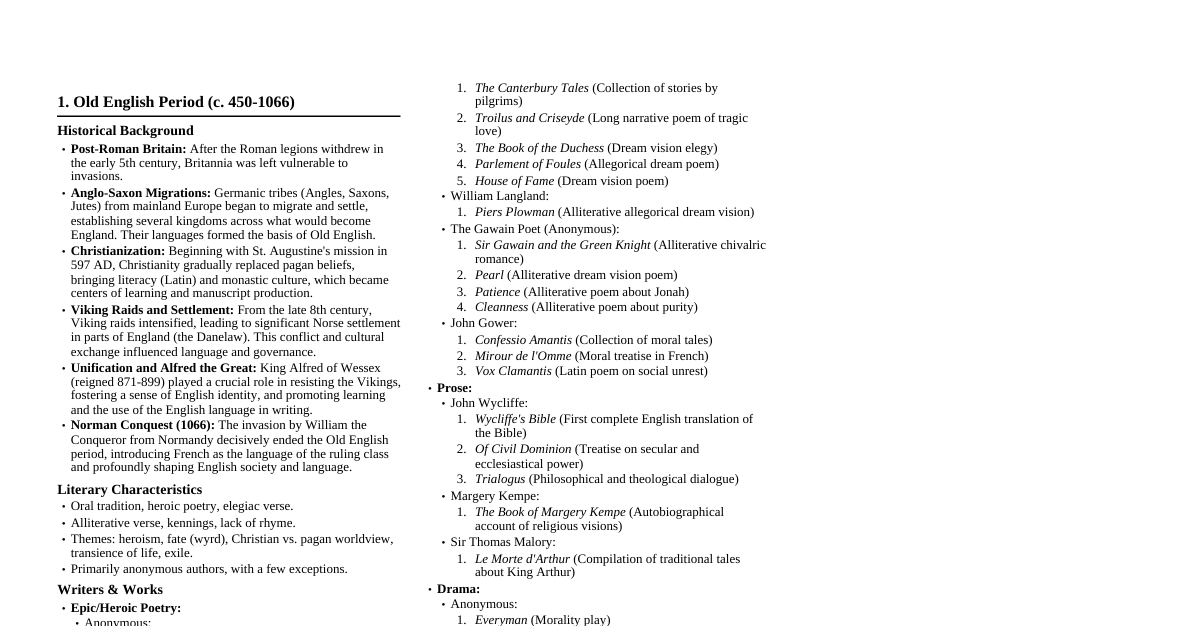
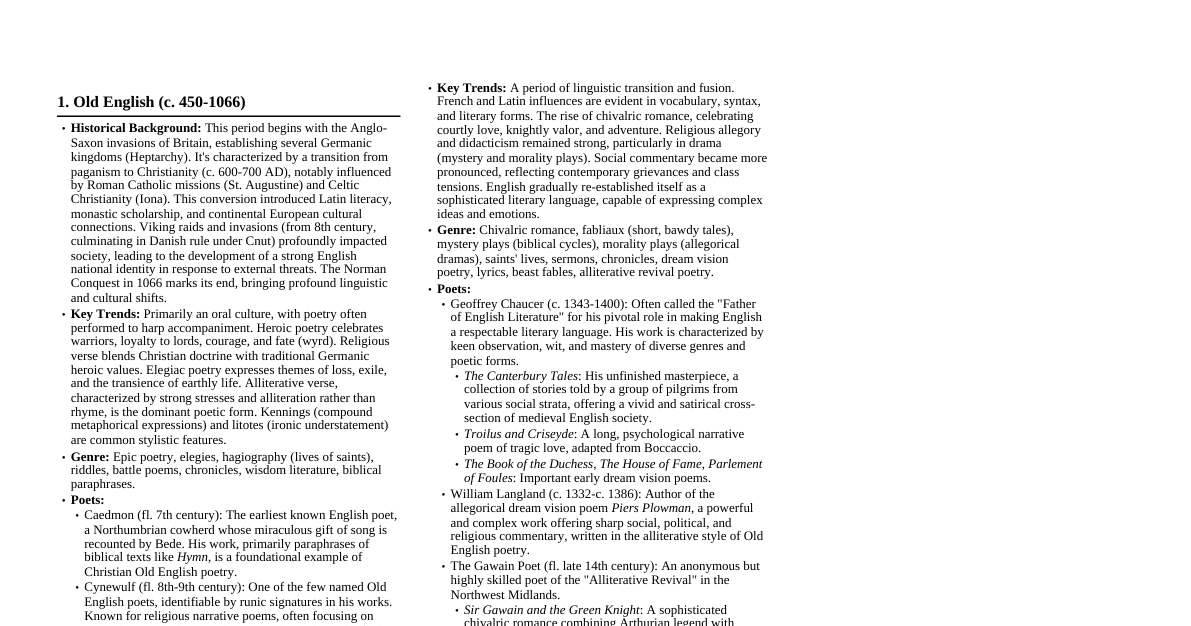
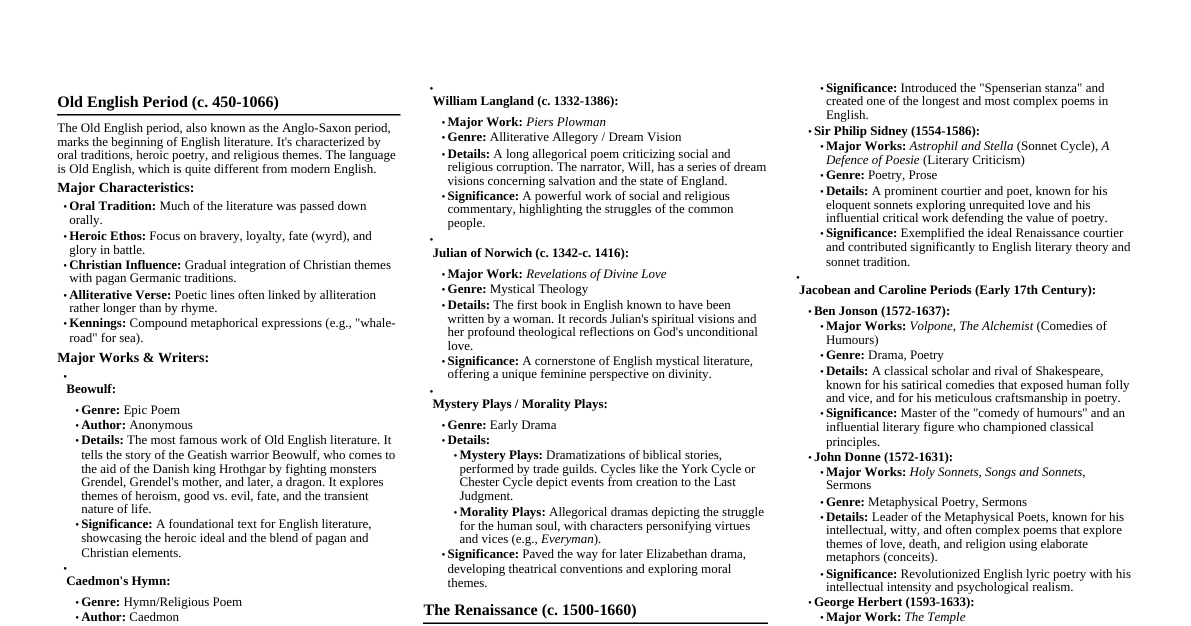
### UGC NET English Literature: Overview The UGC NET English Literature exam tests comprehensive knowledge of English literature, critical theory, cultural studies, and language teaching. It covers periods from Old English to contemporary literature, with a strong emphasis on British, American, and Postcolonial literatures. #### Exam Structure - **Paper I:** General Paper on Teaching & Research Aptitude (50 questions, 100 marks) - **Paper II:** English Literature (100 questions, 200 marks) - **Total:** 150 questions, 300 marks, 3 hours total. No negative marking. #### Key Areas of Focus 1. **Literary Periods & Movements:** Understanding the characteristics, major writers, and works of each period. 2. **Literary Genres:** Poetry, Drama, Prose (Fiction & Non-fiction), Literary Criticism, Theory. 3. **Literary Theory & Criticism:** Major schools of thought and their proponents. 4. **Cultural Studies & English Language Teaching (ELT):** Interdisciplinary approaches and pedagogical aspects. 5. **Indian English Literature:** Prominent writers and their contributions. 6. **World Literature in English:** Works from various Anglophone regions. 7. **Research Methodology:** Basic concepts relevant to literary studies. ### Repeated Writers and Works (Genre-wise) #### 1. Poetry - **Old English:** *Beowulf* (anonymous) - **Middle English:** Geoffrey Chaucer (*The Canterbury Tales*) - **Renaissance:** William Shakespeare (Sonnets), John Milton (*Paradise Lost*), Edmund Spenser (*The Faerie Queene*), John Donne (Metaphysical Poetry) - **Augustan/Neoclassical:** Alexander Pope (*The Rape of the Lock*), John Dryden - **Romantic:** William Wordsworth (*Lyrical Ballads*, *The Prelude*), S.T. Coleridge (*The Rime of the Ancient Mariner*), P.B. Shelley (*Ode to the West Wind*), John Keats (*Odes*) - **Victorian:** Alfred Lord Tennyson (*In Memoriam A.H.H.*), Robert Browning (Dramatic Monologues), Matthew Arnold, Christina Rossetti - **Modern:** T.S. Eliot (*The Waste Land*, *Four Quartets*), W.B. Yeats, Ezra Pound, W.H. Auden - **Postmodern/Contemporary:** Philip Larkin, Ted Hughes, Seamus Heaney, Sylvia Plath, Elizabeth Bishop, Derek Walcott - **Indian English Poetry:** Nissim Ezekiel, A.K. Ramanujan, Kamala Das, Jayanta Mahapatra, Arun Kolatkar. #### 2. Drama - **Classical/Medieval:** Morality Plays (*Everyman*) - **Renaissance:** William Shakespeare (Tragedies, Comedies, Histories), Christopher Marlowe (*Doctor Faustus*), Ben Jonson (*Volpone*) - **Restoration:** William Congreve (*The Way of the World*), William Wycherley - **18th Century:** Richard Brinsley Sheridan (*The School for Scandal*), Oliver Goldsmith - **Modern:** George Bernard Shaw (*Pygmalion*), Oscar Wilde (*The Importance of Being Earnest*), Samuel Beckett (*Waiting for Godot*), Harold Pinter, Bertolt Brecht - **Indian English Drama:** Girish Karnad (*Hayavadana*), Mahesh Dattani, Badal Sircar. #### 3. Prose (Fiction & Non-fiction) - **Renaissance:** Francis Bacon (Essays) - **Restoration/18th Century:** Daniel Defoe (*Robinson Crusoe*), Jonathan Swift (*Gulliver's Travels*), Henry Fielding (*Tom Jones*), Samuel Richardson (*Pamela*), Jane Austen (*Pride and Prejudice*, *Sense and Sensibility*) - **Victorian:** Charles Dickens (*Great Expectations*, *Hard Times*), George Eliot (*Middlemarch*), Thomas Hardy (*Tess of the d'Urbervilles*), Brontë Sisters (*Jane Eyre*, *Wuthering Heights*), R.L. Stevenson, Oscar Wilde (*The Picture of Dorian Gray*) - **Modern:** Joseph Conrad (*Heart of Darkness*), Virginia Woolf (*Mrs Dalloway*, *To the Lighthouse*), James Joyce (*Ulysses*), D.H. Lawrence (*Sons and Lovers*), E.M. Forster (*A Passage to India*), Franz Kafka, Albert Camus - **Postmodern/Contemporary:** George Orwell (*1984*, *Animal Farm*), Aldous Huxley (*Brave New World*), William Golding (*Lord of the Flies*), V.S. Naipaul, Kazuo Ishiguro, Margaret Atwood, Toni Morrison - **Indian English Fiction:** Mulk Raj Anand (*Untouchable*), R.K. Narayan (*Malgudi Days*), Raja Rao (*Kanthapura*), Anita Desai, Salman Rushdie (*Midnight's Children*), Arundhati Roy (*The God of Small Things*), Amitav Ghosh. #### 4. Literary Theory & Criticism - **Classical:** Plato, Aristotle (*Poetics*) - **Renaissance:** Philip Sidney (*An Apology for Poetry*) - **Neoclassical:** John Dryden, Samuel Johnson - **Romantic:** William Wordsworth, S.T. Coleridge - **Modern:** T.S. Eliot (*Tradition and the Individual Talent*), I.A. Richards, F.R. Leavis, Northrop Frye - **Contemporary Schools:** - **Structuralism:** Ferdinand de Saussure, Roland Barthes - **Post-Structuralism/Deconstruction:** Jacques Derrida, Michel Foucault - **Psychoanalytic Criticism:** Sigmund Freud, Jacques Lacan - **Feminist Criticism:** Elaine Showalter, Sandra Gilbert & Susan Gubar - **Marxist Criticism:** Raymond Williams, Louis Althusser - **Postcolonial Theory:** Edward Said (*Orientalism*), Homi K. Bhabha, Gayatri Chakravorty Spivak - **New Historicism:** Stephen Greenblatt - **Cultural Studies:** Raymond Williams, Stuart Hall ### Important Details for the Exam #### 1. Period-wise Study - **Old English (c. 450-1066):** Focus on heroic poetry, *Beowulf*. - **Middle English (1066-1500):** Chaucer, morality plays, romances. - **Renaissance (1500-1660):** Shakespeare, Marlowe, Sidney, Spenser, Metaphysical poets (Donne, Herbert). - **Restoration & 18th Century (1660-1785):** Dryden, Pope, Swift, Defoe, Fielding, Richardson, Sheridan. Rise of the novel. - **Romantic Period (1785-1832):** Wordsworth, Coleridge, Byron, Shelley, Keats, Jane Austen. Emphasis on nature, emotion, individualism. - **Victorian Period (1832-1901):** Dickens, Thackeray, Eliot, Brontës, Tennyson, Browning, Arnold. Social issues, realism. - **Modern Period (1901-1945):** W.B. Yeats, T.S. Eliot, Ezra Pound, James Joyce, Virginia Woolf, D.H. Lawrence. Experimentation, break from tradition. - **Postmodern & Contemporary (1945-Present):** Beckett, Pinter, Postcolonial writers, American writers (Faulkner, Hemingway, Fitzgerald), Contemporary British and World Literature. #### 2. Key Concepts & Terms - **Literary Devices:** Metaphor, Simile, Imagery, Symbolism, Irony, Allusion, etc. - **Poetic Forms:** Sonnet, Ode, Epic, Ballad, Lyric, Dramatic Monologue. - **Dramatic Terms:** Tragedy, Comedy, Farce, Melodrama, Catharsis, Hamartia, Hubris. - **Narrative Techniques:** Point of view, Stream of consciousness, Flashback, Foreshadowing. - **Critical Terms:** Canon, Hegemony, Patriarchy, Orientalism, Subaltern, Aporia, Intertextuality. #### 3. Literary Awards - Nobel Prize in Literature (know key laureates, especially those from Anglophone countries). - Booker Prize/Man Booker Prize (recent winners and significant past winners). - Pulitzer Prize (for American literature). #### 4. Important Journals and Magazines - *Criterion*, *Scrutiny*, *Edinburgh Review*, *Quarterly Review*. #### 5. English Language Teaching (ELT) - Approaches and Methods: Grammar-Translation, Direct Method, Audio-lingual, Communicative Language Teaching (CLT). - Key concepts: SLA (Second Language Acquisition), CALL (Computer-Assisted Language Learning). #### 6. Research Methodology - Types of Research: Qualitative, Quantitative, Mixed Methods. - Research Ethics, Plagiarism, Referencing Styles (MLA, APA). #### Strategy for Preparation - **Previous Year Papers:** Analyze trends, repeated questions, and important areas. - **Timeline:** Create a chronological understanding of literary periods. - **Notes:** Prepare concise notes on authors, works, movements, and theories. - **Revision:** Regular revision of key facts, dates, and definitions.