Free Radical Chemistry
Cheatsheet Content
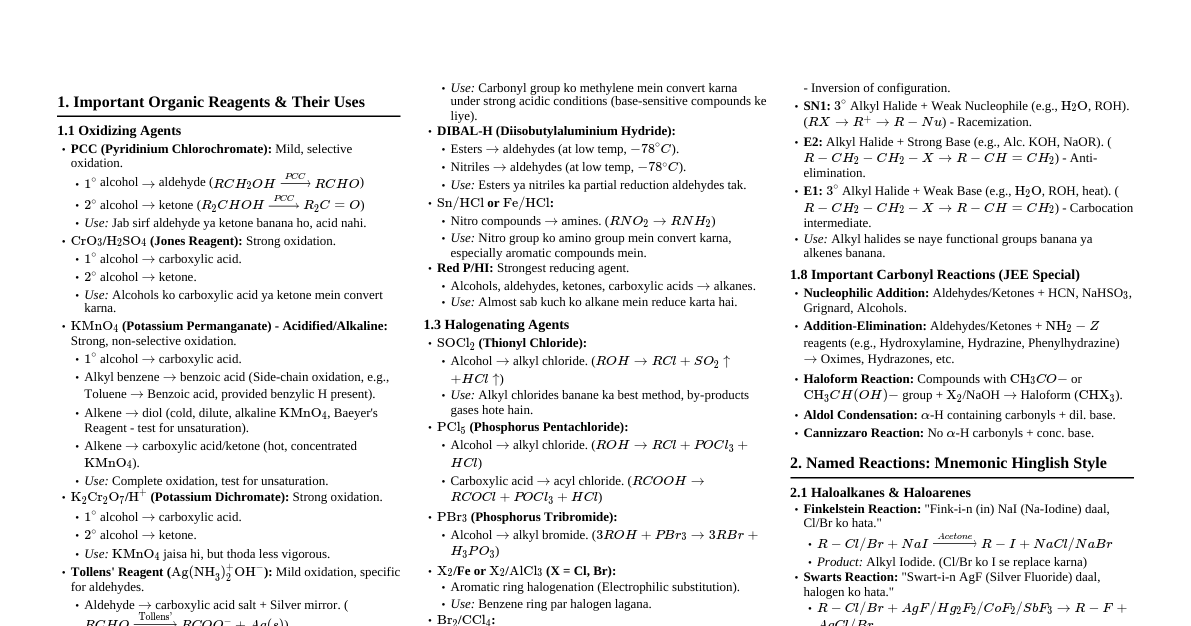
Free Radicals: Basics Definition: An atom or molecule with one or more unpaired electrons in its outermost shell. Notation: Represented by a dot ($\cdot$) next to the atom/group (e.g., $R\cdot$, $Cl\cdot$). Reactivity: Highly reactive due to the unpaired electron seeking to achieve a stable octet (or duet). Formation: Often formed by homolytic cleavage of a covalent bond. Formation of Free Radicals 1. Homolytic Cleavage Breaking of a covalent bond where each atom retains one electron from the shared pair. Requires energy input (heat, light). Example: $Cl_2 \xrightarrow{hv \text{ or } \Delta} 2 Cl\cdot$ Fishhook arrows ($\curvearrowright$) are used to show single electron movement. 2. Redox Reactions Electron transfer reactions can generate radicals. Example: $Fe^{2+} + H_2O_2 \rightarrow Fe^{3+} + HO\cdot + OH^-$ (Fenton reaction) 3. Initiators Compounds that readily undergo homolytic cleavage to form radicals. Examples: Peroxides: $RO-OR \xrightarrow{\Delta} 2 RO\cdot$ Azo compounds: $R-N=N-R \xrightarrow{\Delta} 2 R\cdot + N_2$ Free Radical Reactions: Mechanism 1. Initiation Formation of radicals from non-radical species. Often involves homolytic cleavage of a weak bond. Example (Chlorination of Methane): $Cl_2 \xrightarrow{hv} 2 Cl\cdot$ 2. Propagation A radical reacts with a non-radical molecule to form a new radical and a new molecule. These steps maintain the radical chain. Example (Chlorination of Methane): $Cl\cdot + CH_4 \rightarrow HCl + \cdot CH_3$ $\cdot CH_3 + Cl_2 \rightarrow CH_3Cl + Cl\cdot$ 3. Termination Two radicals combine to form a stable, non-radical molecule. Removes radicals from the reaction mixture, ending the chain. Example (Chlorination of Methane): $Cl\cdot + Cl\cdot \rightarrow Cl_2$ $\cdot CH_3 + \cdot CH_3 \rightarrow CH_3-CH_3$ $Cl\cdot + \cdot CH_3 \rightarrow CH_3Cl$ Types of Free Radicals Alkyl Radicals: $\cdot CH_3$, $\cdot CH_2CH_3$, etc. Stability order: $3^\circ > 2^\circ > 1^\circ > \text{methyl}$ (due to hyperconjugation). Allylic Radicals: $\cdot CH_2-CH=CH_2$ (stabilized by resonance). Benzylic Radicals: $\cdot CH_2-Ph$ (stabilized by resonance). Halogen Radicals: $Cl\cdot$, $Br\cdot$, $I\cdot$. Oxygen Radicals: $HO\cdot$ (hydroxyl radical), $RO\cdot$ (alkoxy radical), $ROO\cdot$ (peroxy radical). Reactions Involving Free Radicals 1. Halogenation of Alkanes Substitution of hydrogen atoms by halogens ($Cl_2$, $Br_2$) under UV light or heat. Mechanism: Radical chain reaction (Initiation, Propagation, Termination). Reactivity of halogens: $F_2 > Cl_2 > Br_2 > I_2$. Selectivity: $Br_2$ is more selective than $Cl_2$ (prefers $3^\circ H$). 2. Autooxidation Reaction of organic compounds (especially those with allylic hydrogens) with atmospheric oxygen to form hydroperoxides. Important in food spoilage, polymer degradation. Chain reaction: $RH + O_2 \rightarrow ROOH$. 3. Radical Polymerization Addition polymerization initiated by radicals. Monomers with double bonds (e.g., alkenes) react. Example: Polymerization of ethene to polyethylene. Initiation: $I_2 \rightarrow 2 I\cdot$ Propagation: $I\cdot + CH_2=CH_2 \rightarrow I-CH_2-CH_2\cdot$ ... $I-(CH_2-CH_2)_n-CH_2-CH_2\cdot$ 4. Anti-Markovnikov Addition (HBr only) Addition of HBr to alkenes in the presence of peroxides. The bromine atom adds to the less substituted carbon. Mechanism involves radical intermediates. Example: $R-CH=CH_2 + HBr \xrightarrow{ROOR} R-CH_2-CH_2Br$. Factors Affecting Radical Stability Hyperconjugation: Alkyl groups donate electron density to the radical center, stabilizing it. More substituted radicals are more stable. Resonance: Delocalization of the unpaired electron over multiple atoms through p-orbitals (e.g., allylic, benzylic radicals). Electronegativity: Radicals on more electronegative atoms are generally less stable (e.g., $C\cdot$ is more stable than $O\cdot$). Steric Effects: Bulky groups can sometimes stabilize radicals by preventing reaction, but can also destabilize if they hinder resonance. Radical Inhibitors/Antioxidants Substances that scavenge free radicals, stopping chain reactions. Often involve formation of a stable radical that doesn't propagate. Examples: Phenols (e.g., BHT): $Ar-OH + R\cdot \rightarrow Ar-O\cdot + RH$. The resulting phenoxy radical is resonance-stabilized and less reactive. Vitamin E (tocopherols), Vitamin C (ascorbic acid).