Mechanics Essentials
Cheatsheet Content
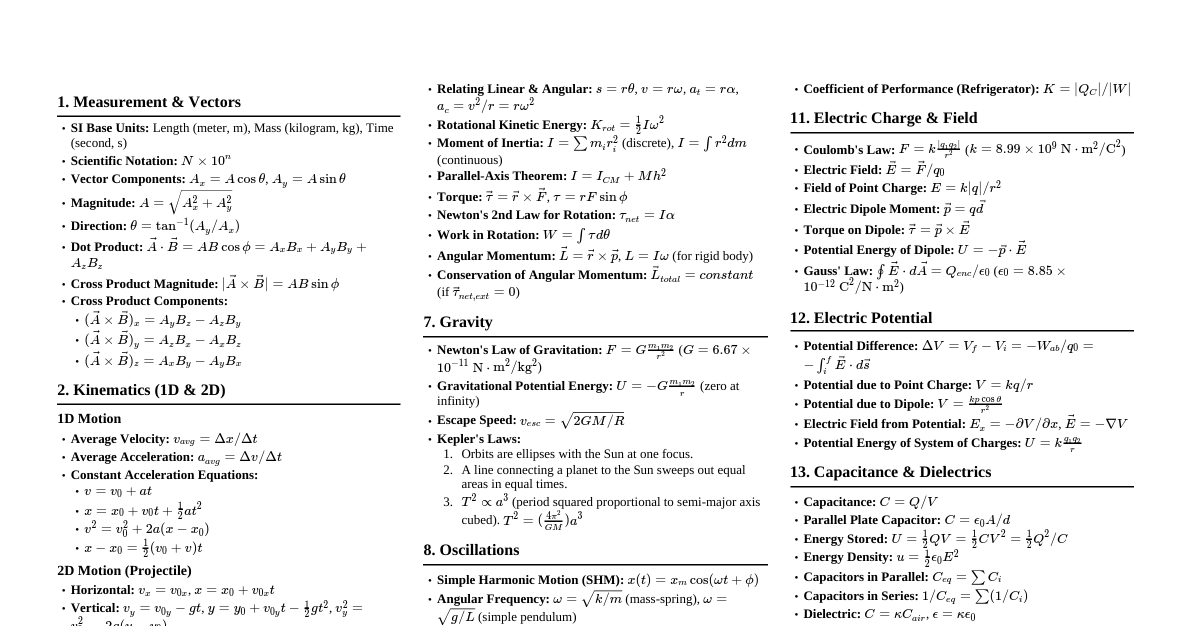
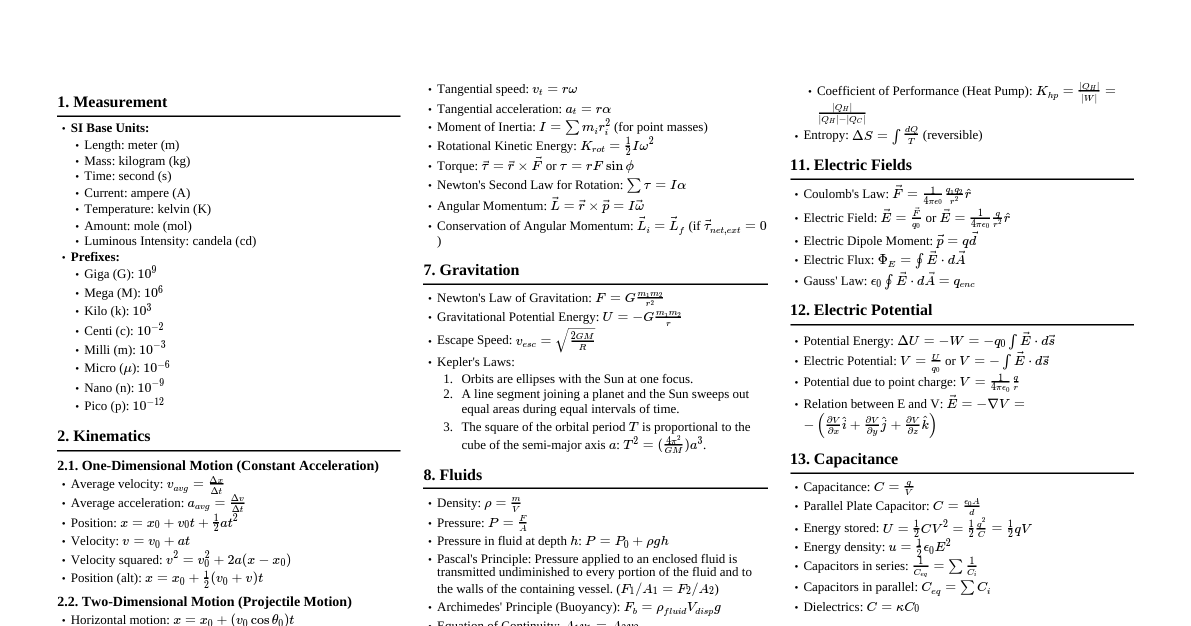
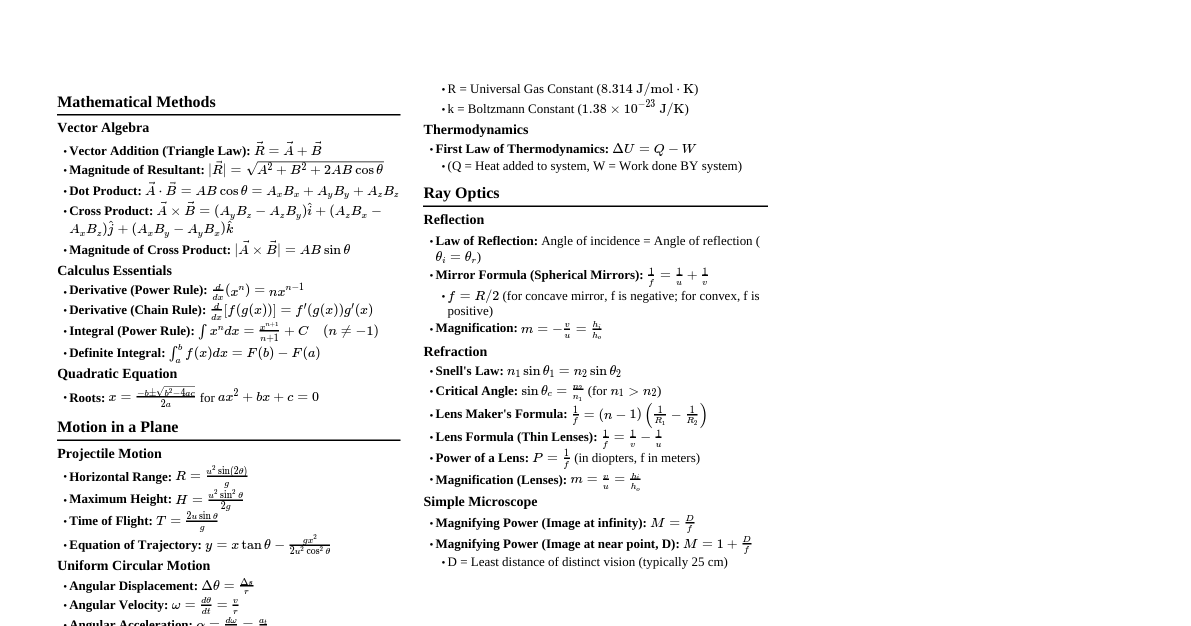
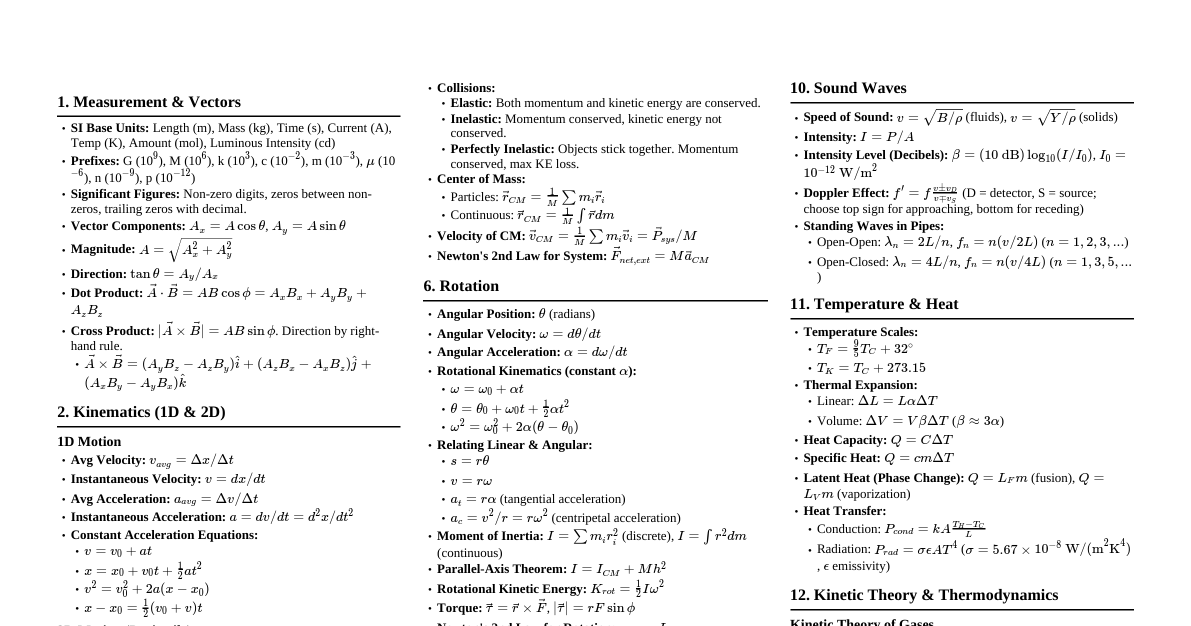
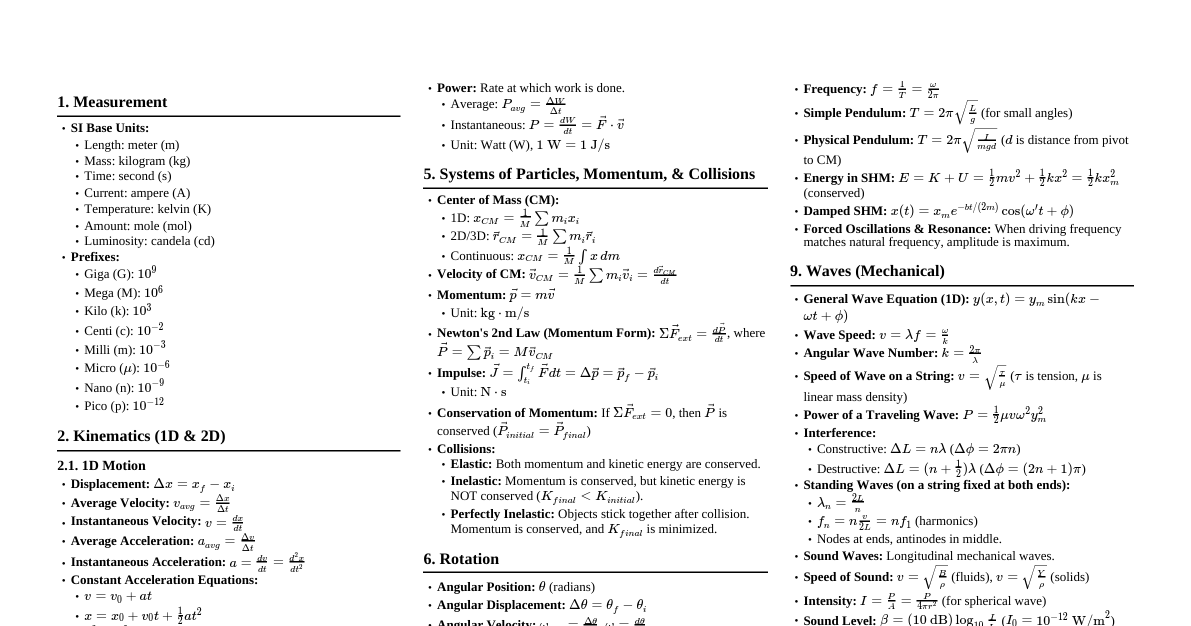
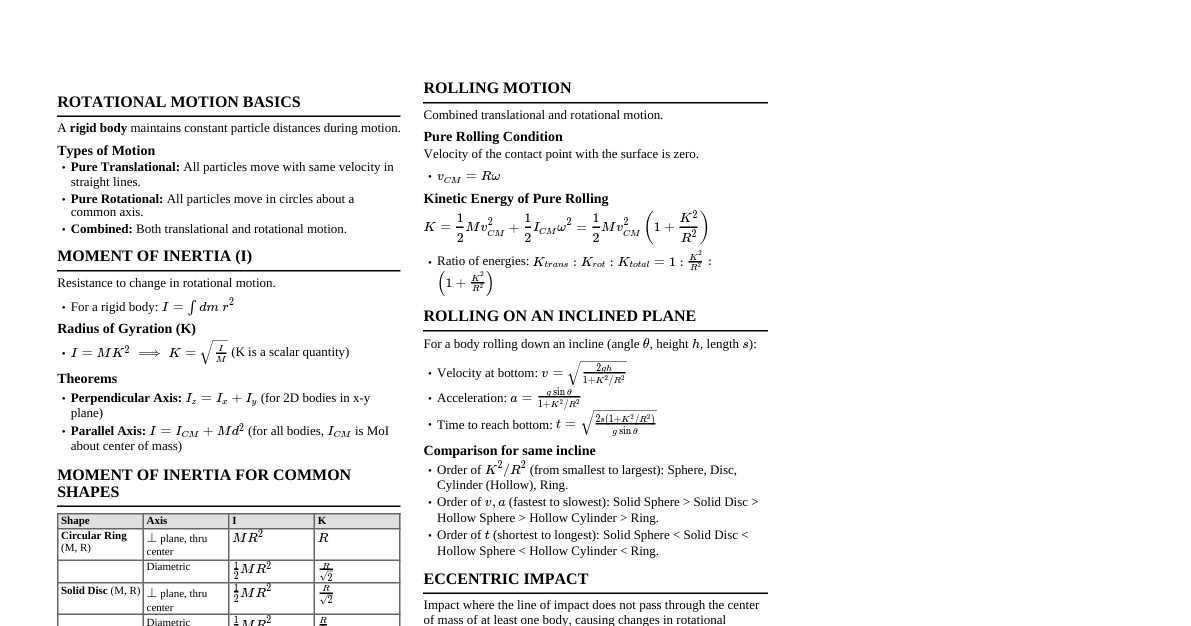
Newton's Laws of Motion First Law (Inertia): An object at rest stays at rest, and an object in motion stays in motion with the same speed and in the same direction unless acted upon by an unbalanced force. Second Law: $\vec{F}_{net} = \frac{d\vec{p}}{dt} = m\vec{a}$ (for constant mass) Units: Force (N), Mass (kg), Acceleration $(\text{m/s}^2)$ Third Law (Action-Reaction): $\vec{F}_{AB} = -\vec{F}_{BA}$ Forces Weight (Gravitational Force near Earth): $W = mg$ $g \approx 9.8 \, \text{m/s}^2$ (can be $10 \, \text{m/s}^2$ for approximations) Normal Force ($F_N$ or $N$): Perpendicular to surface. Friction Force ($F_f$): Opposes relative motion. Static Friction: $F_{f,s} \le \mu_s N$ Kinetic Friction: $F_{f,k} = \mu_k N$ $\mu_s > \mu_k$ typically. Tension ($T$): Along string/rope. Spring Force (Hooke's Law): $F_s = -kx$ Kinematics (Constant Acceleration) $v = u + at$ $s = ut + \frac{1}{2}at^2$ $v^2 = u^2 + 2as$ $s_n = u + \frac{a}{2}(2n-1)$ (displacement in $n$-th second) Variables: $u$ (initial velocity), $v$ (final velocity), $a$ (acceleration), $t$ (time), $s$ (displacement) Projectile Motion Horizontal Range: $R = \frac{u^2 \sin(2\theta)}{g}$ Maximum Height: $H = \frac{u^2 \sin^2\theta}{2g}$ Time of Flight: $T = \frac{2u \sin\theta}{g}$ Equation of Trajectory: $y = x\tan\theta - \frac{gx^2}{2u^2\cos^2\theta}$ Work, Energy, and Power Work: $W = \int \vec{F} \cdot d\vec{s}$ (general), $W = Fd\cos\theta$ (constant force) Kinetic Energy: $KE = \frac{1}{2}mv^2$ Gravitational Potential Energy: $PE_g = mgh$ (near Earth), $PE_g = -\frac{GMm}{r}$ (general) Elastic Potential Energy (Spring): $PE_s = \frac{1}{2}kx^2$ Work-Energy Theorem: $W_{net} = \Delta KE$ Conservative Forces: Work done is path independent, $\vec{F} = -\nabla PE$. Non-Conservative Forces: Work done depends on path (e.g., friction). Conservation of Mechanical Energy: $E = KE + PE = \text{constant}$ (if only conservative forces do work). Power: $P = \frac{dW}{dt} = \vec{F} \cdot \vec{v}$ (instantaneous) Momentum and Impulse Momentum: $\vec{p} = m\vec{v}$ Impulse: $\vec{J} = \int \vec{F} dt = \Delta \vec{p}$ Conservation of Momentum: $\sum \vec{p}_i = \sum \vec{p}_f$ (isolated system). Coefficient of Restitution ($e$): For 1D collision, $e = \frac{\text{relative speed after}}{\text{relative speed before}}$. $e=1$: Elastic collision ($KE$ conserved). $0 $e=0$: Perfectly inelastic collision (objects stick). Center of Mass: $\vec{r}_{CM} = \frac{\sum m_i \vec{r}_i}{\sum m_i}$ Velocity of CM: $\vec{v}_{CM} = \frac{\sum m_i \vec{v}_i}{\sum m_i}$ Acceleration of CM: $\vec{a}_{CM} = \frac{\sum m_i \vec{a}_i}{\sum m_i} = \frac{\vec{F}_{net, ext}}{M_{total}}$ Gravitation Newton's Law of Universal Gravitation: $F_g = G\frac{m_1 m_2}{r^2}$ Gravitational Field Intensity: $\vec{E}_g = \frac{\vec{F}_g}{m} = -\frac{GM}{r^2}\hat{r}$ Gravitational Potential: $V = -\frac{GM}{r}$ Orbital Velocity: $v_o = \sqrt{\frac{GM}{r}}$ (for circular orbit) Escape Velocity: $v_{esc} = \sqrt{\frac{2GM}{R}}$ Kepler's Laws: Planets move in ellipses with the Sun at one focus. A line segment joining a planet and the Sun sweeps out equal areas during equal intervals of time. The square of the orbital period $T$ is proportional to the cube of the semi-major axis $a$: $T^2 \propto a^3 \Rightarrow T^2 = \frac{4\pi^2}{GM}a^3$. Rotational Motion Angular Kinematics: $\omega = \omega_0 + \alpha t$, $\theta = \omega_0 t + \frac{1}{2}\alpha t^2$, $\omega^2 = \omega_0^2 + 2\alpha\theta$ Moment of Inertia ($I$): $I = \sum m_i r_i^2$ (discrete), $I = \int r^2 dm$ (continuous). Parallel Axis Theorem: $I = I_{CM} + Md^2$ Perpendicular Axis Theorem: $I_z = I_x + I_y$ (for planar objects). Torque: $\vec{\tau} = \vec{r} \times \vec{F}$, $\tau = I\alpha$ Rotational Kinetic Energy: $KE_R = \frac{1}{2}I\omega^2$ Angular Momentum: $\vec{L} = \vec{r} \times \vec{p}$, $\vec{L} = I\vec{\omega}$ Conservation of Angular Momentum: If $\vec{\tau}_{net, ext} = 0$, then $\vec{L} = \text{constant}$. Rolling Motion: Combination of translation and rotation. Pure rolling: $v_{CM} = R\omega$, $a_{CM} = R\alpha$. Total Kinetic Energy: $KE_{total} = KE_{trans} + KE_{rot} = \frac{1}{2}Mv_{CM}^2 + \frac{1}{2}I_{CM}\omega^2$. Simple Harmonic Motion (SHM) Differential Equation: $\frac{d^2x}{dt^2} + \omega^2 x = 0$ General Solution: $x(t) = A\sin(\omega t + \phi)$ or $x(t) = A\cos(\omega t + \phi)$ Angular Frequency: $\omega = \sqrt{k/m}$ (spring), $\omega = \sqrt{g/L}$ (simple pendulum) Period: $T = 2\pi/\omega$ Energy in SHM: $E = \frac{1}{2}kA^2 = \frac{1}{2}mv_{max}^2$ Damped Oscillations: $x(t) = Ae^{-bt/2m}\cos(\omega't + \phi)$ Forced Oscillations and Resonance: Amplitude peaks when driving frequency matches natural frequency. Fluid Mechanics (Brief) Pressure: $P = F/A$ Pressure at depth $h$: $P = P_0 + \rho gh$ Archimedes' Principle: Buoyant force $F_B = \rho_{fluid} V_{displaced} g$ Equation of Continuity: $A_1v_1 = A_2v_2$ (for incompressible fluids) Bernoulli's Equation: $P + \frac{1}{2}\rho v^2 + \rho gh = \text{constant}$