New sheet - 11/22 01:09
Cheatsheet Content
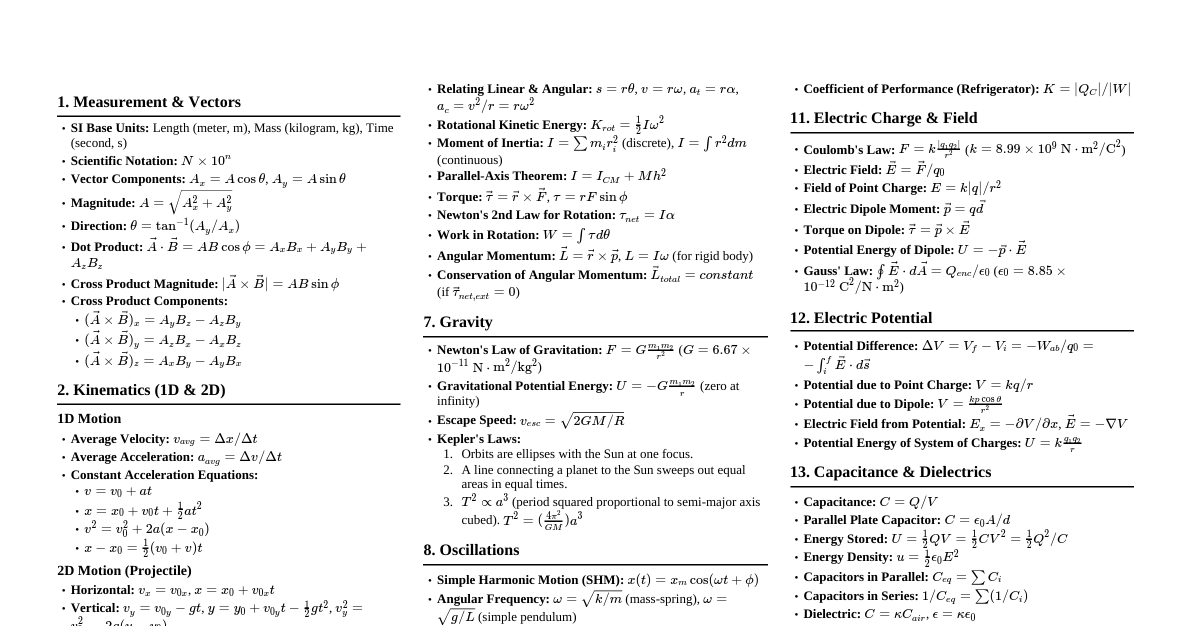
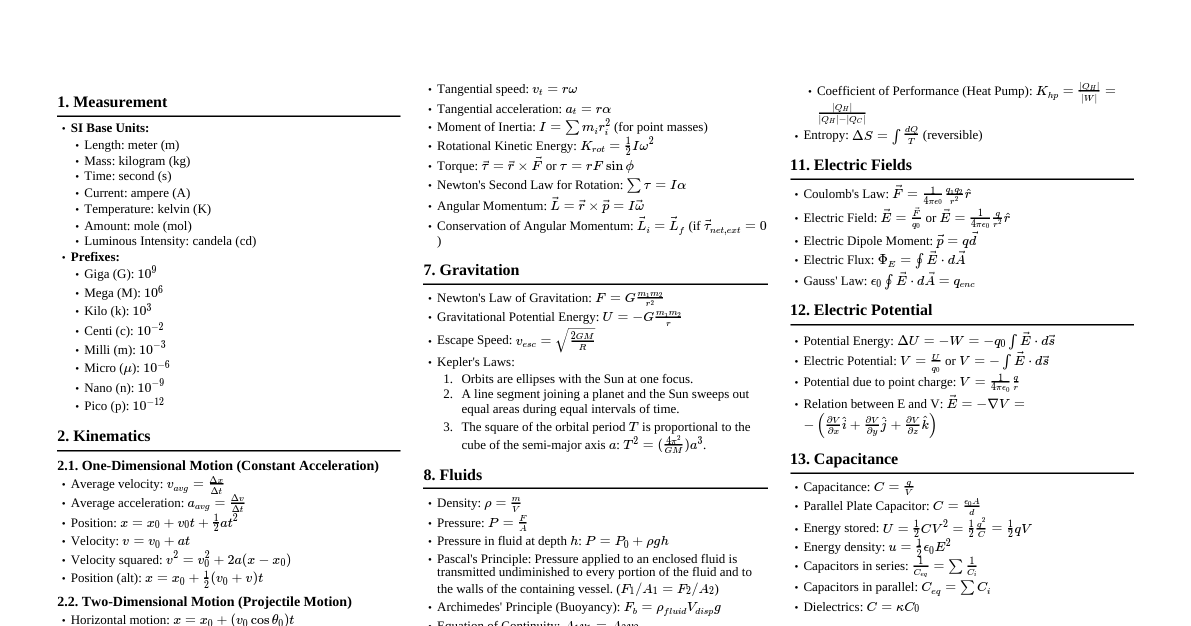
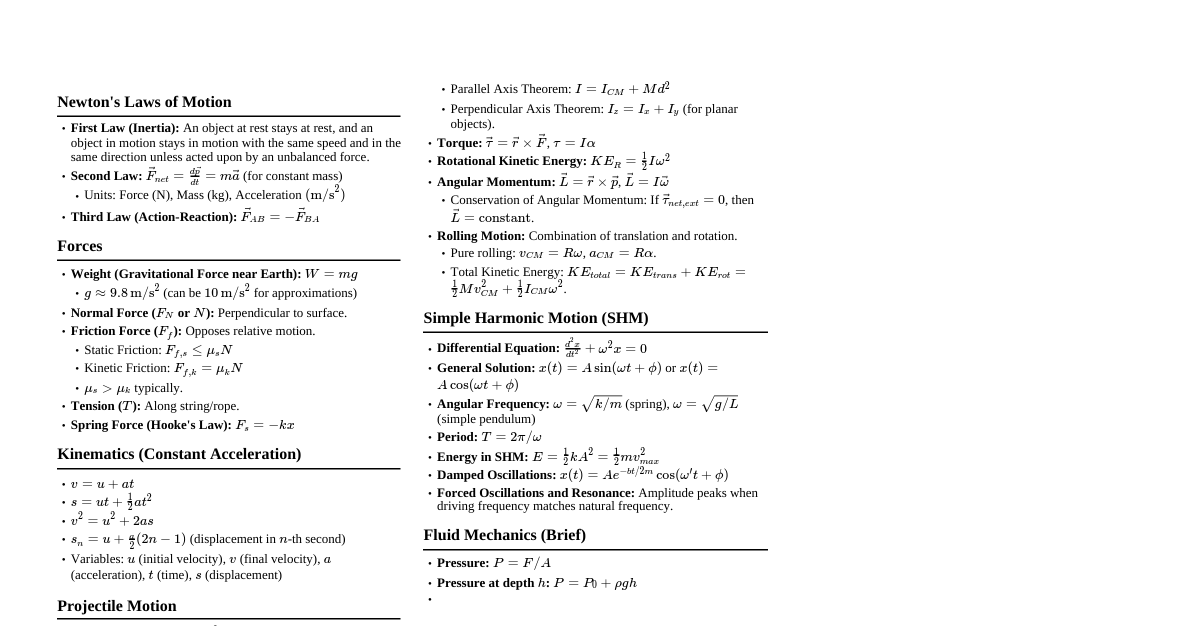
ROTATIONAL MOTION BASICS A rigid body maintains constant particle distances during motion. Types of Motion Pure Translational: All particles move with same velocity in straight lines. Pure Rotational: All particles move in circles about a common axis. Combined: Both translational and rotational motion. MOMENT OF INERTIA (I) Resistance to change in rotational motion. For a rigid body: $I = \int dm \ r^2$ Radius of Gyration (K) $I = MK^2 \implies K = \sqrt{\frac{I}{M}}$ (K is a scalar quantity) Theorems Perpendicular Axis: $I_z = I_x + I_y$ (for 2D bodies in x-y plane) Parallel Axis: $I = I_{CM} + Md^2$ (for all bodies, $I_{CM}$ is MoI about center of mass) MOMENT OF INERTIA FOR COMMON SHAPES Shape Axis I K Circular Ring (M, R) $\perp$ plane, thru center $MR^2$ $R$ Diametric $\frac{1}{2}MR^2$ $\frac{R}{\sqrt{2}}$ Solid Disc (M, R) $\perp$ plane, thru center $\frac{1}{2}MR^2$ $\frac{R}{\sqrt{2}}$ Diametric $\frac{1}{4}MR^2$ $\frac{R}{2}$ Annular Disc (M, $R_1$, $R_2$) $\perp$ plane, thru center $\frac{M}{2}(R_1^2 + R_2^2)$ $\sqrt{\frac{R_1^2 + R_2^2}{2}}$ Solid Sphere (M, R) Diametric $\frac{2}{5}MR^2$ $\sqrt{\frac{2}{5}}R$ Hollow Sphere (M, R) Diametric $\frac{2}{3}MR^2$ $\sqrt{\frac{2}{3}}R$ Hollow Cylinder (M, R, L) Axial $MR^2$ $R$ $\perp$ axis, thru CM $\frac{MR^2}{2} + \frac{ML^2}{12}$ $\sqrt{\frac{R^2}{2} + \frac{L^2}{12}}$ Solid Cylinder (M, R, L) Axial $\frac{1}{2}MR^2$ $\frac{R}{\sqrt{2}}$ $\perp$ axis, thru CM $\frac{MR^2}{4} + \frac{ML^2}{12}$ $\sqrt{\frac{R^2}{4} + \frac{L^2}{12}}$ Thin Rod (M, L) $\perp$ axis, thru CM $\frac{ML^2}{12}$ $\frac{L}{\sqrt{12}}$ $\perp$ axis, thru end $\frac{ML^2}{3}$ $\frac{L}{\sqrt{3}}$ Rectangular Plate (M, a, b) $\perp$ side b, thru CM $\frac{Mb^2}{12}$ $\frac{b}{2\sqrt{3}}$ Cube (M, a) $\perp$ face, thru CM $\frac{Ma^2}{6}$ $\frac{a}{\sqrt{6}}$ TORQUE ($\vec{\tau}$) $\vec{\tau} = \vec{r} \times \vec{F}$ Magnitude: $\tau = rF \sin\theta$ Direction: Right-hand thumb rule. ROTATIONAL EQUILIBRIUM For rotational equilibrium, the resultant torque about any axis must be zero: $\sum \vec{\tau}_P = 0$. Equilibrium of Rigid Bodies Both translational ($\sum \vec{F} = 0$) and rotational ($\sum \vec{\tau} = 0$) equilibrium must hold. ANGULAR MOMENTUM ($\vec{L}$) $\vec{L} = \vec{r} \times \vec{p}$ (for a particle) Magnitude $L = mv r \sin\theta$ Relation to Torque $\vec{\tau} = \frac{d\vec{L}}{dt}$ Angular Impulse: $\int \vec{\tau} dt = \Delta \vec{L}$ Conservation of Angular Momentum If net external torque is zero ($\sum \vec{\tau}_{ext} = 0$), then $\vec{L}$ is conserved. $$ \vec{L}_1 = \vec{L}_2 \implies I_1 \omega_1 = I_2 \omega_2 $$ ROTATIONAL KINETIC ENERGY ($K_{ER}$) $$ K_{ER} = \frac{1}{2}I\omega^2 = \frac{L^2}{2I} $$ Rotational Work (W) $\tau$ constant: $W = \tau \theta$ $\tau$ variable: $W = \int_{\theta_1}^{\theta_2} \tau d\theta$ Work-Energy Theorem: $W = \Delta K_{ER} = \frac{1}{2}I(\omega_2^2 - \omega_1^2)$ Power (P) Instantaneous: $P = \tau\omega$ Average: $P_{av} = \frac{\Delta W}{\Delta t}$ ROLLING MOTION Combined translational and rotational motion. Pure Rolling Condition Velocity of the contact point with the surface is zero. $v_{CM} = R\omega$ Kinetic Energy of Pure Rolling $$ K = \frac{1}{2}Mv_{CM}^2 + \frac{1}{2}I_{CM}\omega^2 = \frac{1}{2}Mv_{CM}^2 \left(1 + \frac{K^2}{R^2}\right) $$ Ratio of energies: $K_{trans} : K_{rot} : K_{total} = 1 : \frac{K^2}{R^2} : \left(1 + \frac{K^2}{R^2}\right)$ ROLLING ON AN INCLINED PLANE For a body rolling down an incline (angle $\theta$, height $h$, length $s$): Velocity at bottom: $v = \sqrt{\frac{2gh}{1 + K^2/R^2}}$ Acceleration: $a = \frac{g \sin\theta}{1 + K^2/R^2}$ Time to reach bottom: $t = \sqrt{\frac{2s(1 + K^2/R^2)}{g \sin\theta}}$ Comparison for same incline Order of $K^2/R^2$ (from smallest to largest): Sphere, Disc, Cylinder (Hollow), Ring. Order of $v, a$ (fastest to slowest): Solid Sphere > Solid Disc > Hollow Sphere > Hollow Cylinder > Ring. Order of $t$ (shortest to longest): Solid Sphere ECCENTRIC IMPACT Impact where the line of impact does not pass through the center of mass of at least one body, causing changes in rotational motion. Principles Free Bodies: Conservation of linear momentum, angular momentum (about a suitable point), and coefficient of restitution apply. Hinged Bodies: Linear momentum is generally NOT conserved. Angular momentum about the hinge axis (if hinge reaction impulse is zero) and coefficient of restitution are used.