Halliday
Cheatsheet Content
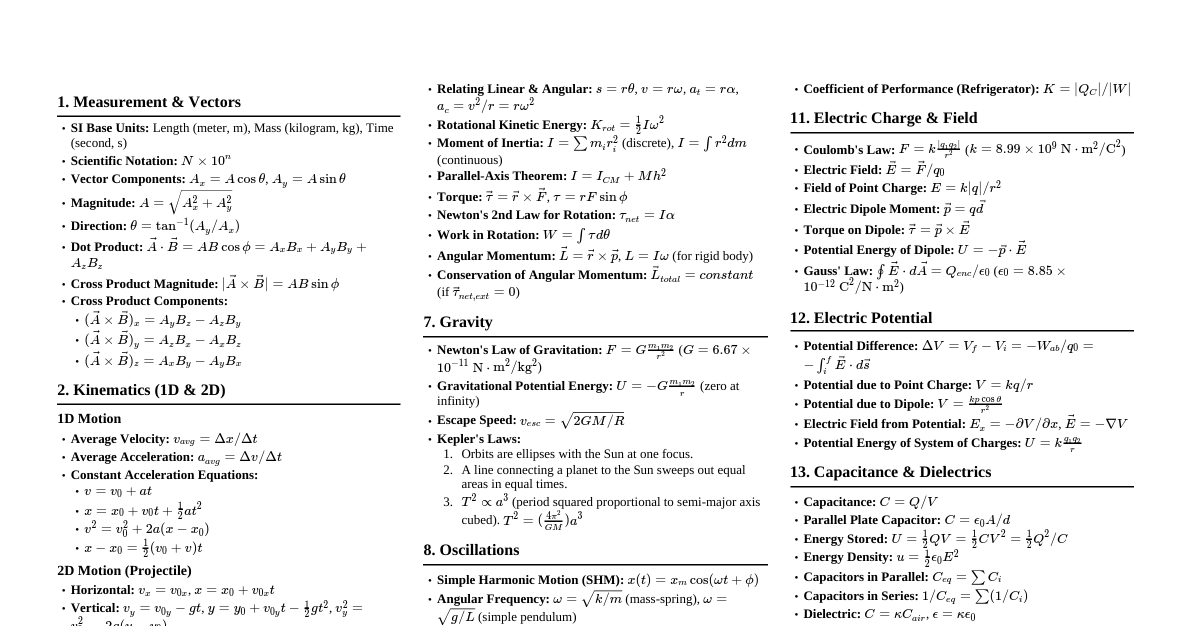
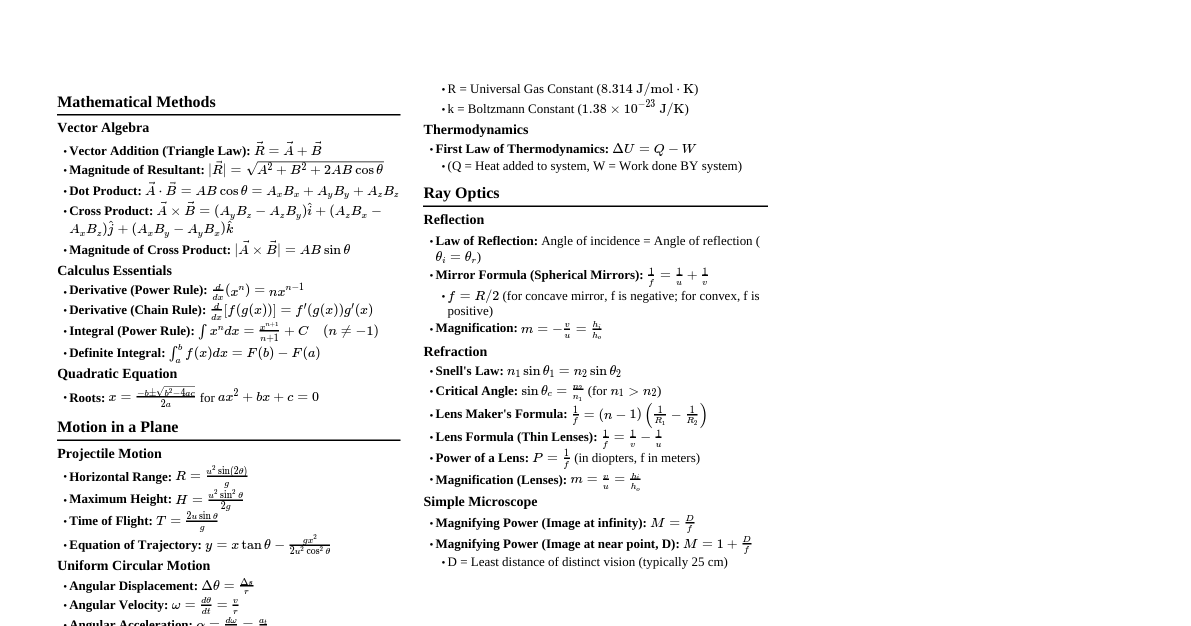
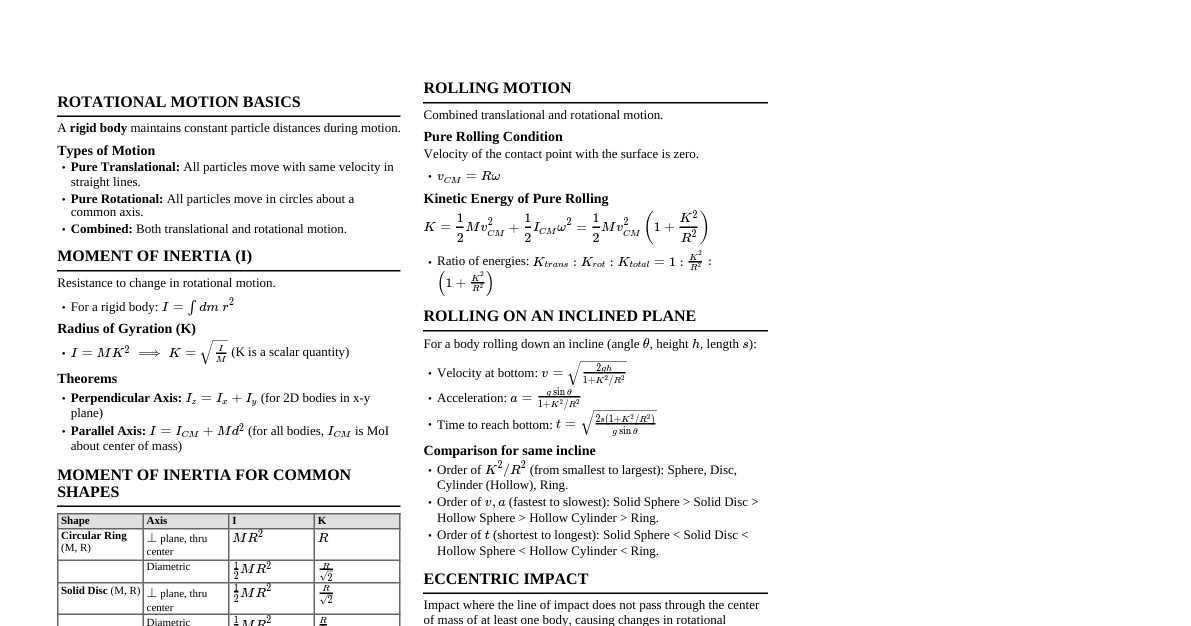
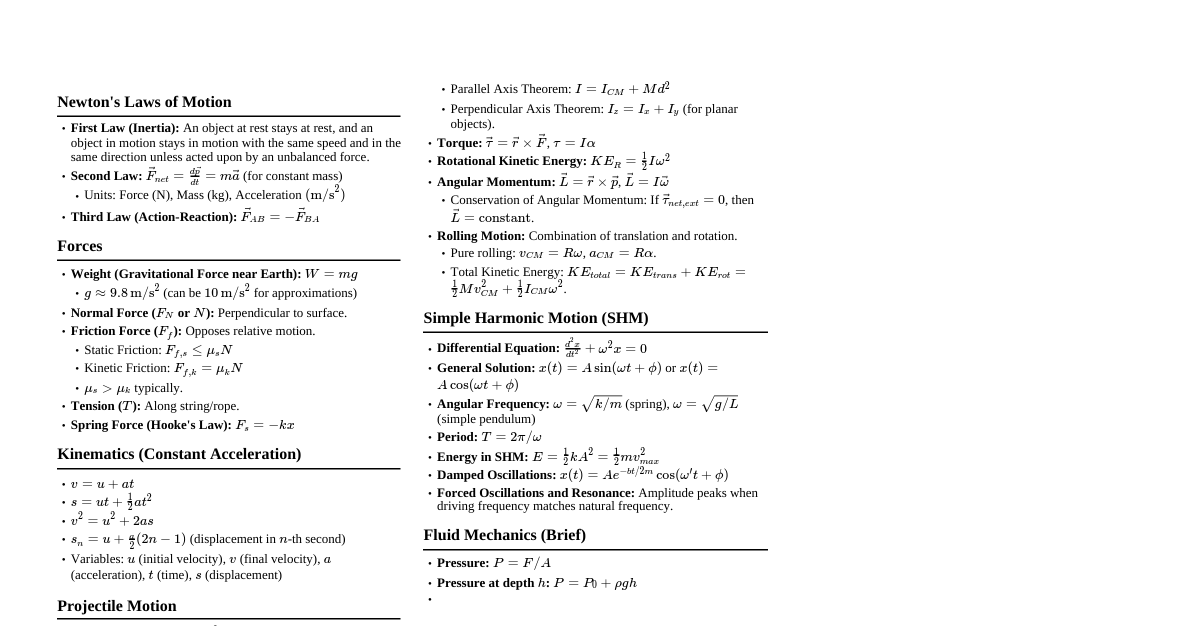
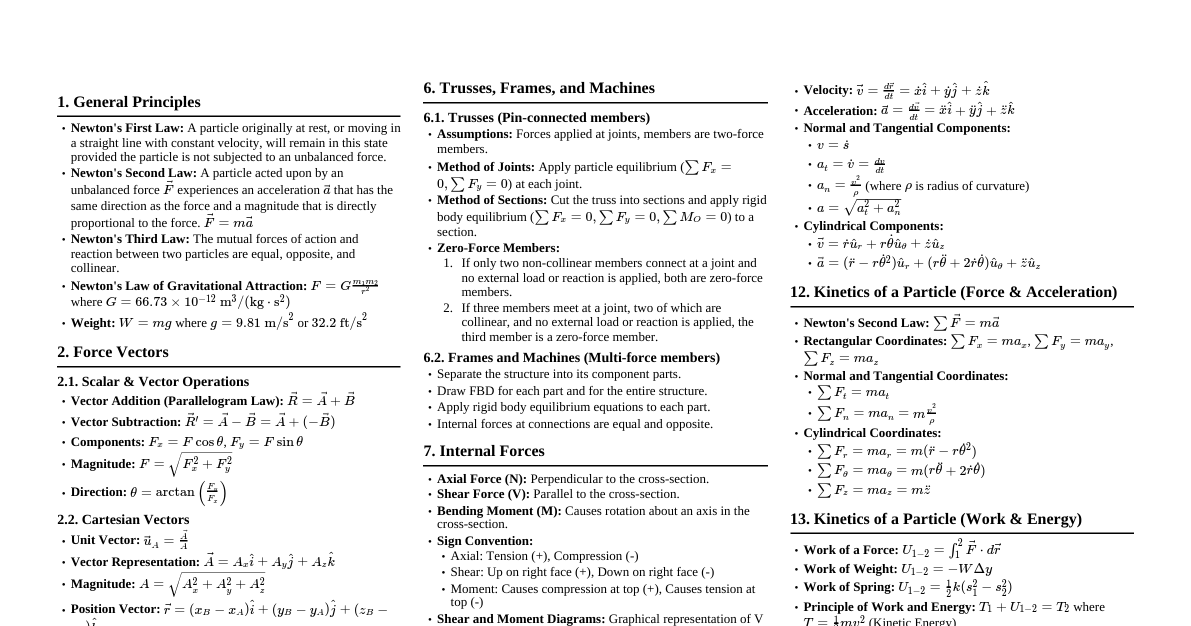
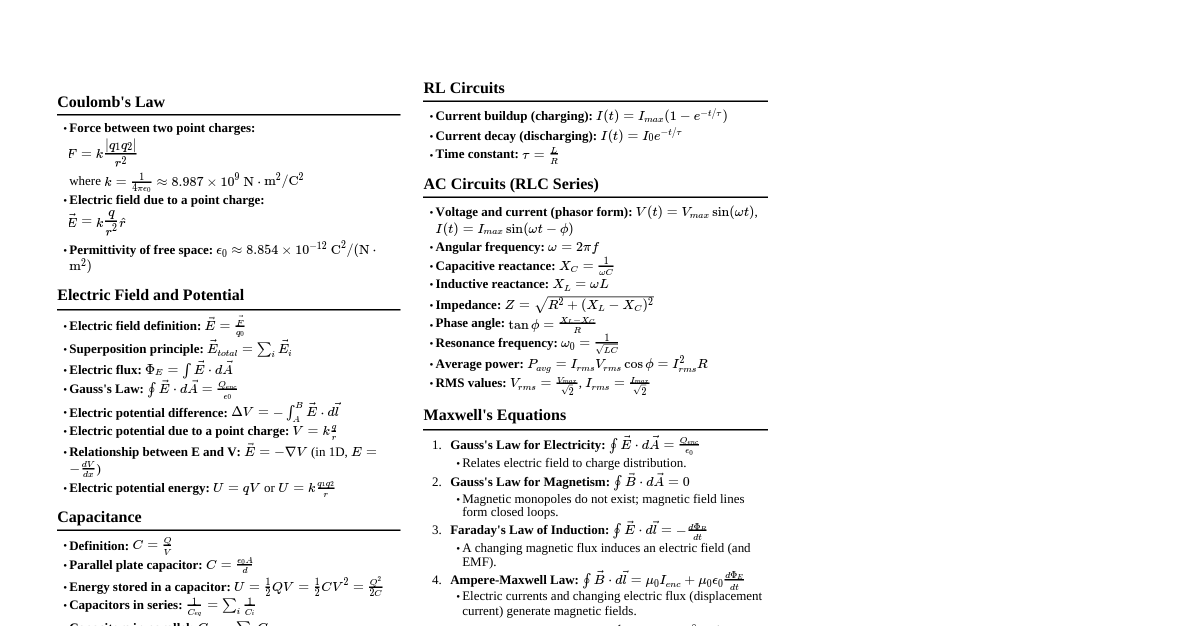
1. Measurement SI Base Units: Length: meter (m) Mass: kilogram (kg) Time: second (s) Current: ampere (A) Temperature: kelvin (K) Amount: mole (mol) Luminous Intensity: candela (cd) Prefixes: Giga (G): $10^9$ Mega (M): $10^6$ Kilo (k): $10^3$ Centi (c): $10^{-2}$ Milli (m): $10^{-3}$ Micro ($\mu$): $10^{-6}$ Nano (n): $10^{-9}$ Pico (p): $10^{-12}$ 2. Kinematics 2.1. One-Dimensional Motion (Constant Acceleration) Average velocity: $v_{avg} = \frac{\Delta x}{\Delta t}$ Average acceleration: $a_{avg} = \frac{\Delta v}{\Delta t}$ Position: $x = x_0 + v_0 t + \frac{1}{2}at^2$ Velocity: $v = v_0 + at$ Velocity squared: $v^2 = v_0^2 + 2a(x - x_0)$ Position (alt): $x = x_0 + \frac{1}{2}(v_0 + v)t$ 2.2. Two-Dimensional Motion (Projectile Motion) Horizontal motion: $x = x_0 + (v_0 \cos \theta_0)t$ Vertical motion: $y = y_0 + (v_0 \sin \theta_0)t - \frac{1}{2}gt^2$ Vertical velocity: $v_y = v_0 \sin \theta_0 - gt$ Horizontal velocity: $v_x = v_0 \cos \theta_0$ (constant) Range: $R = \frac{v_0^2 \sin(2\theta_0)}{g}$ 2.3. Uniform Circular Motion Centripetal acceleration: $a_c = \frac{v^2}{r}$ Period: $T = \frac{2\pi r}{v}$ 3. Newton's Laws of Motion First Law: An object at rest stays at rest, and an object in motion stays in motion with the same speed and in the same direction unless acted upon by an unbalanced force. Second Law: $\vec{F}_{net} = m\vec{a}$ Third Law: For every action, there is an equal and opposite reaction. Weight: $W = mg$ Friction: Static: $f_s \le \mu_s N$ Kinetic: $f_k = \mu_k N$ 4. Work, Energy, and Power Work done by constant force: $W = Fd \cos\theta = \vec{F} \cdot \vec{d}$ Work-Kinetic Energy Theorem: $W_{net} = \Delta K = K_f - K_i$ Kinetic Energy: $K = \frac{1}{2}mv^2$ Gravitational Potential Energy: $U_g = mgh$ Elastic Potential Energy: $U_s = \frac{1}{2}kx^2$ Mechanical Energy: $E_{mech} = K + U$ Conservation of Mechanical Energy: $E_{mech,i} = E_{mech,f}$ (if only conservative forces) Work done by non-conservative forces: $W_{nc} = \Delta E_{mech}$ Power: $P = \frac{dW}{dt} = \vec{F} \cdot \vec{v}$ 5. Systems of Particles & Conservation of Momentum Center of Mass: $x_{com} = \frac{1}{M}\sum m_i x_i$ Momentum: $\vec{p} = m\vec{v}$ Impulse: $\vec{J} = \Delta \vec{p} = \int \vec{F} dt$ Impulse-Momentum Theorem: $\vec{J} = \vec{F}_{avg} \Delta t$ Conservation of Momentum: $\vec{P}_{total,i} = \vec{P}_{total,f}$ (if $\vec{F}_{net,ext} = 0$) Collisions: Elastic: Momentum and Kinetic Energy conserved. Inelastic: Momentum conserved, Kinetic Energy NOT conserved. Perfectly Inelastic: Objects stick together, momentum conserved. 6. Rotation Angular displacement: $\Delta \theta$ (radians) Angular velocity: $\omega = \frac{d\theta}{dt}$ Angular acceleration: $\alpha = \frac{d\omega}{dt}$ Rotational Kinematics (constant $\alpha$): $\theta = \theta_0 + \omega_0 t + \frac{1}{2}\alpha t^2$ $\omega = \omega_0 + \alpha t$ $\omega^2 = \omega_0^2 + 2\alpha(\theta - \theta_0)$ Tangential speed: $v_t = r\omega$ Tangential acceleration: $a_t = r\alpha$ Moment of Inertia: $I = \sum m_i r_i^2$ (for point masses) Rotational Kinetic Energy: $K_{rot} = \frac{1}{2}I\omega^2$ Torque: $\vec{\tau} = \vec{r} \times \vec{F}$ or $\tau = rF \sin\phi$ Newton's Second Law for Rotation: $\sum \tau = I\alpha$ Angular Momentum: $\vec{L} = \vec{r} \times \vec{p} = I\vec{\omega}$ Conservation of Angular Momentum: $\vec{L}_i = \vec{L}_f$ (if $\vec{\tau}_{net,ext} = 0$) 7. Gravitation Newton's Law of Gravitation: $F = G\frac{m_1 m_2}{r^2}$ Gravitational Potential Energy: $U = -G\frac{m_1 m_2}{r}$ Escape Speed: $v_{esc} = \sqrt{\frac{2GM}{R}}$ Kepler's Laws: Orbits are ellipses with the Sun at one focus. A line segment joining a planet and the Sun sweeps out equal areas during equal intervals of time. The square of the orbital period $T$ is proportional to the cube of the semi-major axis $a$: $T^2 = (\frac{4\pi^2}{GM})a^3$. 8. Fluids Density: $\rho = \frac{m}{V}$ Pressure: $P = \frac{F}{A}$ Pressure in fluid at depth $h$: $P = P_0 + \rho g h$ Pascal's Principle: Pressure applied to an enclosed fluid is transmitted undiminished to every portion of the fluid and to the walls of the containing vessel. ($F_1/A_1 = F_2/A_2$) Archimedes' Principle (Buoyancy): $F_b = \rho_{fluid} V_{disp} g$ Equation of Continuity: $A_1 v_1 = A_2 v_2$ Bernoulli's Equation: $P + \frac{1}{2}\rho v^2 + \rho g y = \text{constant}$ 9. Oscillations and Waves 9.1. Simple Harmonic Motion (SHM) Displacement: $x(t) = A \cos(\omega t + \phi)$ Velocity: $v(t) = -\omega A \sin(\omega t + \phi)$ Acceleration: $a(t) = -\omega^2 A \cos(\omega t + \phi) = -\omega^2 x(t)$ Angular frequency: $\omega = \sqrt{\frac{k}{m}}$ (mass-spring), $\omega = \sqrt{\frac{g}{L}}$ (simple pendulum) Period: $T = \frac{2\pi}{\omega} = 2\pi\sqrt{\frac{m}{k}}$ or $2\pi\sqrt{\frac{L}{g}}$ Total Energy: $E = \frac{1}{2}kA^2 = \frac{1}{2}mv^2 + \frac{1}{2}kx^2$ 9.2. Waves Wave speed: $v = \lambda f$ Speed on a stretched string: $v = \sqrt{\frac{\tau}{\mu}}$ ($\tau$=tension, $\mu$=linear mass density) Intensity: $I = \frac{P}{A}$ Standing Waves on a String (fixed ends): $L = n\frac{\lambda}{2}$, $f_n = n\frac{v}{2L}$ Standing Waves in Pipes: Open at both ends: $L = n\frac{\lambda}{2}$, $f_n = n\frac{v}{2L}$ Closed at one end: $L = (2n-1)\frac{\lambda}{4}$, $f_n = (2n-1)\frac{v}{4L}$ Beat Frequency: $f_{beat} = |f_1 - f_2|$ Doppler Effect: $f' = f \frac{v \pm v_D}{v \mp v_S}$ (D for detector, S for source; $\pm$ means moving towards/away) 10. Thermodynamics Temperature Scales: $T_F = \frac{9}{5}T_C + 32^\circ$ $T_K = T_C + 273.15$ Thermal Expansion: Linear: $\Delta L = L\alpha\Delta T$ Volume: $\Delta V = V\beta\Delta T$, where $\beta = 3\alpha$ Heat and Work: Heat capacity: $Q = C\Delta T$ Specific heat: $Q = mc\Delta T$ Latent heat (phase change): $Q = mL$ Work done by gas: $W = \int P dV$ First Law of Thermodynamics: $\Delta E_{int} = Q - W$ Heat Transfer: Conduction: $P_{cond} = kA\frac{\Delta T}{L}$ Radiation: $P_{rad} = \epsilon \sigma A T^4$ ($\sigma$ = Stefan-Boltzmann const) Kinetic Theory of Gases: Average kinetic energy per molecule: $K_{avg} = \frac{3}{2}kT$ RMS speed: $v_{rms} = \sqrt{\frac{3RT}{M}}$ Second Law of Thermodynamics: Heat flows spontaneously from hot to cold. Entropy of an isolated system never decreases. Heat Engines: Efficiency: $\epsilon = \frac{|W|}{|Q_H|} = 1 - \frac{|Q_C|}{|Q_H|}$ Carnot efficiency: $\epsilon_C = 1 - \frac{T_C}{T_H}$ Refrigerators/Heat Pumps: Coefficient of Performance (Refrigerator): $K = \frac{|Q_C|}{|W|} = \frac{|Q_C|}{|Q_H| - |Q_C|}$ Coefficient of Performance (Heat Pump): $K_{hp} = \frac{|Q_H|}{|W|} = \frac{|Q_H|}{|Q_H| - |Q_C|}$ Entropy: $\Delta S = \int \frac{dQ}{T}$ (reversible) 11. Electric Fields Coulomb's Law: $\vec{F} = \frac{1}{4\pi\epsilon_0} \frac{q_1 q_2}{r^2} \hat{r}$ Electric Field: $\vec{E} = \frac{\vec{F}}{q_0}$ or $\vec{E} = \frac{1}{4\pi\epsilon_0} \frac{q}{r^2} \hat{r}$ Electric Dipole Moment: $\vec{p} = q\vec{d}$ Electric Flux: $\Phi_E = \oint \vec{E} \cdot d\vec{A}$ Gauss' Law: $\epsilon_0 \oint \vec{E} \cdot d\vec{A} = q_{enc}$ 12. Electric Potential Potential Energy: $\Delta U = -W = -q_0 \int \vec{E} \cdot d\vec{s}$ Electric Potential: $V = \frac{U}{q_0}$ or $V = -\int \vec{E} \cdot d\vec{s}$ Potential due to point charge: $V = \frac{1}{4\pi\epsilon_0} \frac{q}{r}$ Relation between E and V: $\vec{E} = -\nabla V = -\left(\frac{\partial V}{\partial x}\hat{i} + \frac{\partial V}{\partial y}\hat{j} + \frac{\partial V}{\partial z}\hat{k}\right)$ 13. Capacitance Capacitance: $C = \frac{q}{V}$ Parallel Plate Capacitor: $C = \frac{\epsilon_0 A}{d}$ Energy stored: $U = \frac{1}{2}CV^2 = \frac{1}{2}\frac{q^2}{C} = \frac{1}{2}qV$ Energy density: $u = \frac{1}{2}\epsilon_0 E^2$ Capacitors in series: $\frac{1}{C_{eq}} = \sum \frac{1}{C_i}$ Capacitors in parallel: $C_{eq} = \sum C_i$ Dielectrics: $C = \kappa C_0$ 14. Current and Resistance Electric Current: $I = \frac{dq}{dt}$ Current density: $\vec{J} = nq\vec{v}_d$ Ohm's Law: $V = IR$ Resistance: $R = \rho \frac{L}{A}$ Resistivity: $\rho = \rho_0 [1 + \alpha(T-T_0)]$ Power dissipation: $P = IV = I^2 R = \frac{V^2}{R}$ Resistors in series: $R_{eq} = \sum R_i$ Resistors in parallel: $\frac{1}{R_{eq}} = \sum \frac{1}{R_i}$ 15. DC Circuits Kirchhoff's Rules: Junction Rule: $\sum I_{in} = \sum I_{out}$ Loop Rule: $\sum \Delta V = 0$ RC Circuits (Charging Capacitor): Charge: $q(t) = C\mathcal{E}(1 - e^{-t/RC})$ Current: $I(t) = \frac{\mathcal{E}}{R}e^{-t/RC}$ Time constant: $\tau = RC$ RC Circuits (Discharging Capacitor): Charge: $q(t) = Q_0 e^{-t/RC}$ Current: $I(t) = -\frac{Q_0}{RC}e^{-t/RC}$ 16. Magnetic Fields Magnetic Force on a charge: $\vec{F}_B = q\vec{v} \times \vec{B}$ ($F_B = qvB\sin\theta$) Magnetic Force on a current: $\vec{F}_B = I\vec{L} \times \vec{B}$ ($F_B = ILB\sin\theta$) Magnetic Dipole Moment: $\vec{\mu} = NIA\hat{n}$ Torque on a current loop: $\vec{\tau} = \vec{\mu} \times \vec{B}$ Potential Energy of a dipole: $U = -\vec{\mu} \cdot \vec{B}$ Hall Effect: $V_H = \frac{IB}{net}$ 17. Sources of Magnetic Field Biot-Savart Law: $d\vec{B} = \frac{\mu_0}{4\pi} \frac{I d\vec{s} \times \hat{r}}{r^2}$ Magnetic field of long straight wire: $B = \frac{\mu_0 I}{2\pi r}$ Magnetic field at center of circular loop: $B = \frac{\mu_0 I}{2R}$ Magnetic field of a solenoid: $B = \mu_0 n I$ ($n$=turns per unit length) Ampere's Law: $\oint \vec{B} \cdot d\vec{s} = \mu_0 I_{enc}$ 18. Induction and Inductance Magnetic Flux: $\Phi_B = \int \vec{B} \cdot d\vec{A}$ Faraday's Law of Induction: $\mathcal{E} = -\frac{d\Phi_B}{dt}$ Lenz's Law: Induced current opposes the change in magnetic flux. Motional EMF: $\mathcal{E} = BLv$ Inductance: $L = \frac{N\Phi_B}{I}$ Energy stored in inductor: $U_L = \frac{1}{2}LI^2$ Energy density of magnetic field: $u_B = \frac{B^2}{2\mu_0}$ RL Circuits (Current buildup): $I(t) = \frac{\mathcal{E}}{R}(1 - e^{-t/\tau_L})$, where $\tau_L = L/R$ RL Circuits (Current decay): $I(t) = I_0 e^{-t/\tau_L}$ 19. Electromagnetic Oscillations and AC Circuits LC Oscillations: Angular frequency: $\omega = \frac{1}{\sqrt{LC}}$ Charge: $q(t) = Q \cos(\omega t + \phi)$ Current: $I(t) = -\omega Q \sin(\omega t + \phi)$ Driven RLC Series Circuit: Inductive reactance: $X_L = \omega L$ Capacitive reactance: $X_C = \frac{1}{\omega C}$ Impedance: $Z = \sqrt{R^2 + (X_L - X_C)^2}$ Phase angle: $\tan \phi = \frac{X_L - X_C}{R}$ Resonance frequency: $\omega_0 = \frac{1}{\sqrt{LC}}$ Average Power: $P_{avg} = I_{rms} V_{rms} \cos\phi = I_{rms}^2 R$ 20. Electromagnetic Waves Speed of light in vacuum: $c = \frac{1}{\sqrt{\mu_0 \epsilon_0}}$ Wave speed: $c = \lambda f$ Relation between E and B field magnitudes: $E = cB$ Poynting Vector: $\vec{S} = \frac{1}{\mu_0}(\vec{E} \times \vec{B})$ (direction of propagation) Intensity: $I = S_{avg} = \frac{E_{max}B_{max}}{2\mu_0} = \frac{E_{rms}^2}{c\mu_0}$ Radiation Pressure: $P_{rad} = \frac{I}{c}$ (absorbed), $P_{rad} = \frac{2I}{c}$ (reflected) 21. Light: Reflection and Refraction Law of Reflection: $\theta_i = \theta_r$ Snell's Law (Refraction): $n_1 \sin\theta_1 = n_2 \sin\theta_2$ Index of Refraction: $n = \frac{c}{v}$ Critical Angle (Total Internal Reflection): $\sin\theta_c = \frac{n_2}{n_1}$ (for $n_1 > n_2$) 22. Lenses and Mirrors Mirror/Lens Equation: $\frac{1}{p} + \frac{1}{i} = \frac{1}{f}$ Magnification: $m = -\frac{i}{p}$ Focal length for spherical mirror: $f = \frac{r}{2}$ Lensmaker's Equation: $\frac{1}{f} = (n-1)(\frac{1}{r_1} - \frac{1}{r_2})$ Sign Conventions: $p$: + real object, - virtual object $i$: + real image, - virtual image $f$: + converging lens/concave mirror, - diverging lens/convex mirror $r$: + center of curvature on side of outgoing light, - opposite $m$: + upright, - inverted 23. Interference Young's Double Slit: Constructive (bright fringes): $d \sin\theta = m\lambda$, $y_m = \frac{m\lambda L}{d}$ Destructive (dark fringes): $d \sin\theta = (m+\frac{1}{2})\lambda$, $y_m = \frac{(m+\frac{1}{2})\lambda L}{d}$ Thin Films: Path difference: $2n_2 t$ Phase change on reflection: $\pi$ (if $n_1 n_2$) Consider phase changes for constructive/destructive interference. 24. Diffraction Single Slit Diffraction: Minima (dark fringes): $a \sin\theta = m\lambda$ ($m = \pm 1, \pm 2, ...$) Diffraction Grating: Maxima (bright fringes): $d \sin\theta = m\lambda$ ($m = 0, \pm 1, \pm 2, ...$) Rayleigh's Criterion: $\theta_R = 1.22 \frac{\lambda}{D}$ 25. Special Relativity Lorentz Factor: $\gamma = \frac{1}{\sqrt{1 - (v/c)^2}}$ Length Contraction: $L = L_0/\gamma$ Time Dilation: $\Delta t = \gamma \Delta t_0$ Relativistic Momentum: $p = \gamma mv$ Relativistic Kinetic Energy: $K = (\gamma - 1)mc^2$ Total Energy: $E = \gamma mc^2 = K + mc^2$ Mass-Energy Equivalence: $E_0 = mc^2$ (rest energy) Energy-Momentum Relation: $E^2 = (pc)^2 + (mc^2)^2$ 26. Quantum Physics Planck's constant: $h = 6.626 \times 10^{-34} \text{ J}\cdot\text{s}$ Photon Energy: $E = hf = \frac{hc}{\lambda}$ Photoelectric Effect: $K_{max} = hf - \Phi$ ($\Phi$ = work function) Compton Effect: $\Delta\lambda = \frac{h}{mc}(1 - \cos\phi)$ De Broglie Wavelength: $\lambda = \frac{h}{p}$ Heisenberg Uncertainty Principle: $\Delta x \Delta p_x \ge \frac{\hbar}{2}$, $\Delta E \Delta t \ge \frac{\hbar}{2}$ ($\hbar = h/2\pi$) Schrödinger Equation (Time-Independent 1D): $-\frac{\hbar^2}{2m}\frac{d^2\psi}{dx^2} + U(x)\psi = E\psi$ 27. Atomic Physics Bohr Model (Hydrogen-like atoms): Energy levels: $E_n = -\frac{13.6 \text{ eV}}{n^2} Z^2$ Radius: $r_n = a_0 \frac{n^2}{Z}$ ($a_0$ = Bohr radius) Photon energy for transition: $\Delta E = E_f - E_i = hf$ Quantum Numbers: Principal ($n$): $1, 2, 3, ...$ (energy, size) Orbital ($l$): $0, 1, ..., n-1$ (shape) Magnetic ($m_l$): $-l, ..., 0, ..., +l$ (orientation) Spin ($m_s$): $\pm \frac{1}{2}$ (intrinsic angular momentum) Pauli Exclusion Principle: No two electrons in an atom can have the same set of four quantum numbers. 28. Nuclear Physics Atomic Number (Z): number of protons Mass Number (A): number of protons + neutrons Isotopes: same Z, different A Nuclear Radius: $R \approx R_0 A^{1/3}$ ($R_0 \approx 1.2 \text{ fm}$) Binding Energy: $E_b = (\sum m_{nucleons} - m_{nucleus})c^2$ Radioactive Decay Law: $N(t) = N_0 e^{-\lambda t}$ Half-life: $T_{1/2} = \frac{\ln 2}{\lambda}$ Activity: $R = \lambda N$ Types of Decay: $\alpha$-decay: emission of $^4_2$He nucleus $\beta^-$-decay: neutron to proton, electron and antineutrino emitted $\beta^+$-decay: proton to neutron, positron and neutrino emitted $\gamma$-decay: emission of photon from excited nucleus Constants Gravitational constant ($G$): $6.67 \times 10^{-11} \text{ N}\cdot\text{m}^2/\text{kg}^2$ Speed of light ($c$): $3.00 \times 10^8 \text{ m/s}$ Elementary charge ($e$): $1.60 \times 10^{-19} \text{ C}$ Permittivity of free space ($\epsilon_0$): $8.85 \times 10^{-12} \text{ F/m}$ Permeability of free space ($\mu_0$): $4\pi \times 10^{-7} \text{ H/m}$ Coulomb's constant ($k_e = 1/4\pi\epsilon_0$): $8.99 \times 10^9 \text{ N}\cdot\text{m}^2/\text{C}^2$ Planck's constant ($h$): $6.63 \times 10^{-34} \text{ J}\cdot\text{s}$ Boltzmann constant ($k$): $1.38 \times 10^{-23} \text{ J/K}$ Avogadro's number ($N_A$): $6.022 \times 10^{23} \text{ mol}^{-1}$ Ideal gas constant ($R$): $8.314 \text{ J/mol}\cdot\text{K}$ Mass of electron ($m_e$): $9.11 \times 10^{-31} \text{ kg}$ Mass of proton ($m_p$): $1.672 \times 10^{-27} \text{ kg}$ Mass of neutron ($m_n$): $1.675 \times 10^{-27} \text{ kg}$ Atomic mass unit (u): $1.6605 \times 10^{-27} \text{ kg} = 931.5 \text{ MeV}/c^2$ $1 \text{ eV} = 1.602 \times 10^{-19} \text{ J}$