Conics and 3D Geometry
Cheatsheet Content
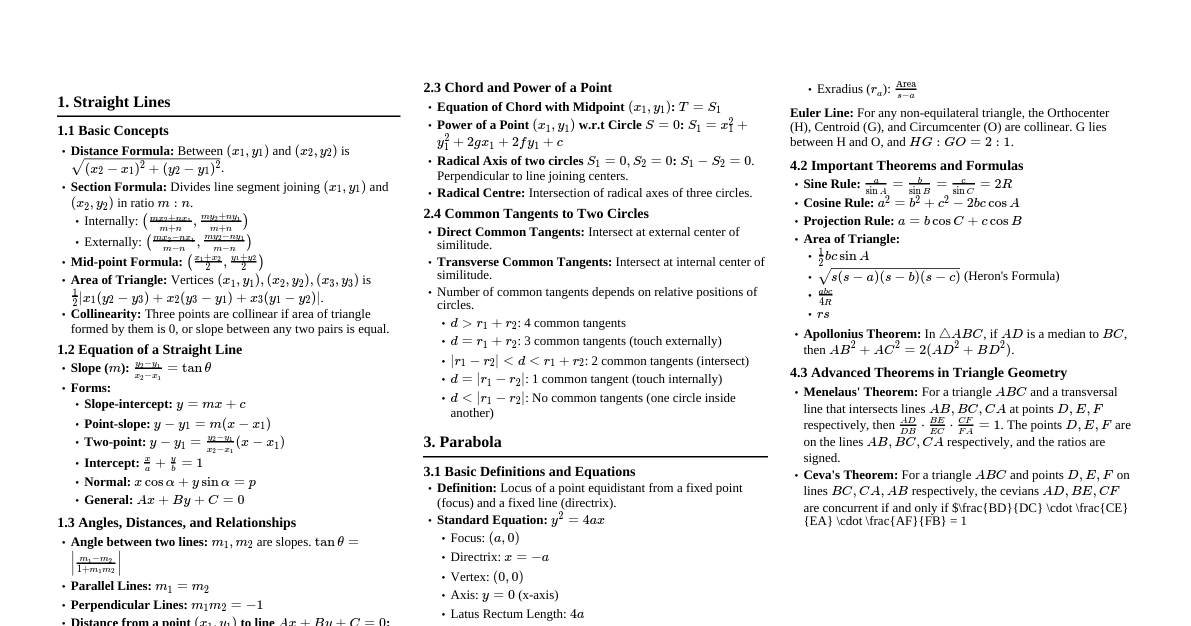
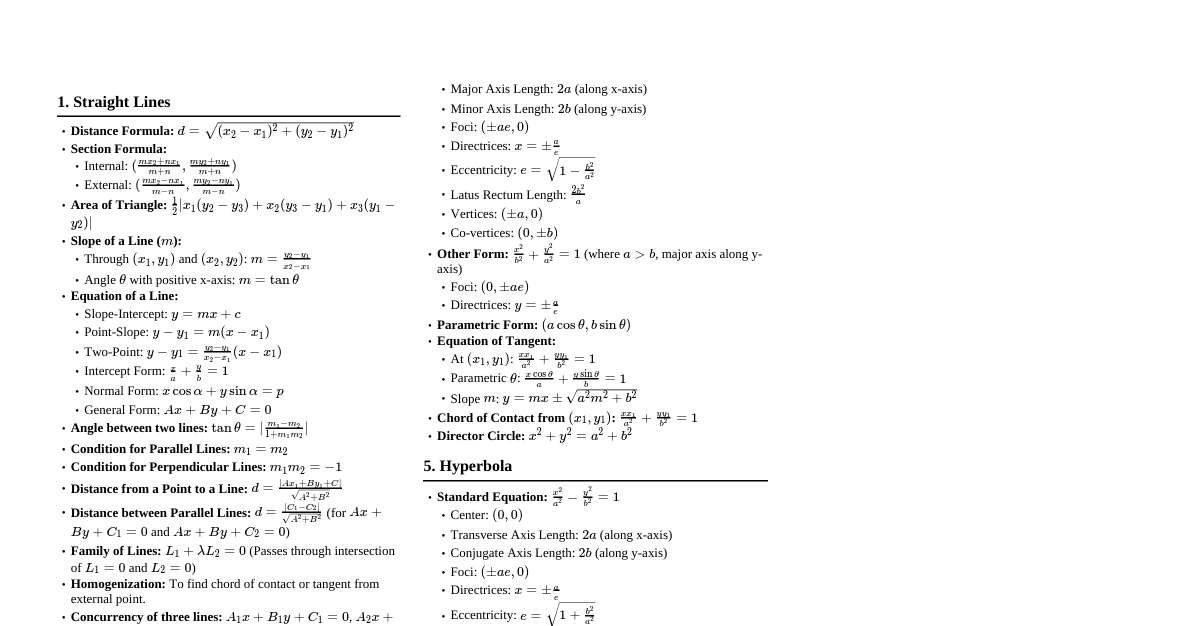
Conics: General Form The general equation of a second-degree curve is $Ax^2 + Bxy + Cy^2 + Dx + Ey + F = 0$. Parabola: $A=0, B=0, C=1, D=-4a, E=0, F=0$ (e.g., $y^2 = 4ax$) Ellipse: $A \neq C$, $B=0, D=0, E=0, F=-1$ (e.g., $\frac{x^2}{a^2} + \frac{y^2}{b^2} = 1$) Hyperbola: $A=-C$, $B=0, D=0, E=0, F=-1$ (e.g., $\frac{x^2}{a^2} - \frac{y^2}{b^2} = 1$) Eccentricity ($e$) Definition: $e = \frac{PS}{PM}$ (ratio of distance from focus to distance from directrix). Parabola: $e=1$ Ellipse: $0 b$) Hyperbola: $e > 1$ ($\frac{x^2}{a^2} - \frac{y^2}{b^2} = 1$, $e^2 = 1 + \frac{b^2}{a^2}$) Parabola ($y^2 = 4ax$) Focus: $(a, 0)$ Directrix: $x = -a$ Eccentricity: $e=1$ Ellipse ($\frac{x^2}{a^2} + \frac{y^2}{b^2} = 1$) Foci: $(\pm ae, 0)$ Directrices: $x = \pm \frac{a}{e}$ Eccentricity: $e = \sqrt{1 - \frac{b^2}{a^2}}$ (for $a>b$) Sum of distances from foci: $S'P + SP = 2a$ Hyperbola ($\frac{x^2}{a^2} - \frac{y^2}{b^2} = 1$) Foci: $(\pm ae, 0)$ Directrices: $x = \pm \frac{a}{e}$ Eccentricity: $e = \sqrt{1 + \frac{b^2}{a^2}}$ Rotation of Axes If the coordinate axes are rotated by an angle $\alpha$, the new coordinates $(x', y')$ are related to the old coordinates $(x, y)$ by: $x = x' \cos\alpha - y' \sin\alpha$ $y = x' \sin\alpha + y' \cos\alpha$ The general equation $Ax^2 + Bxy + Cy^2 + Dx + Ey + F = 0$ transforms to $A'x'^2 + B'x'y' + C'y'^2 + D'x' + E'y' + F' = 0$. To eliminate the $xy$ term ($B' = 0$), rotate by $\alpha$ such that $\tan(2\alpha) = \frac{B}{A-C}$. The discriminant $B^2 - 4AC$ is invariant under rotation: $B'^2 - 4A'C' = B^2 - 4AC$. Classification of Conics by Discriminant For $Ax^2 + Bxy + Cy^2 + Dx + Ey + F = 0$: If $B^2 - 4AC = 0$: Parabola If $B^2 - 4AC If $B^2 - 4AC > 0$: Hyperbola Parametric Forms Parabola ($y^2 = 4ax$) $x = at^2$ $y = 2at$ Ellipse ($\frac{x^2}{a^2} + \frac{y^2}{b^2} = 1$) $x = a \cos\theta$ $y = b \sin\theta$ 3D Geometry: Direction Cosines and Ratios Direction Cosines (d.c.'s) If a line makes angles $\alpha, \beta, \gamma$ with the positive $x, y, z$ axes, its direction cosines are $l = \cos\alpha$, $m = \cos\beta$, $n = \cos\gamma$. Property: $l^2 + m^2 + n^2 = 1$ Direction Ratios (d.r.'s) Any set of numbers $a, b, c$ proportional to the direction cosines $l, m, n$ are called direction ratios. So, $\frac{l}{a} = \frac{m}{b} = \frac{n}{c} = k$. If $(a, b, c)$ are d.r.'s, then d.c.'s are: $l = \frac{a}{\sqrt{a^2+b^2+c^2}}$, $m = \frac{b}{\sqrt{a^2+b^2+c^2}}$, $n = \frac{c}{\sqrt{a^2+b^2+c^2}}$ A line passing through points $(x_1, y_1, z_1)$ and $(x_2, y_2, z_2)$ has d.r.'s $(x_2-x_1, y_2-y_1, z_2-z_1)$.