Control & Coordination
Shared 5/9/2026•27 views
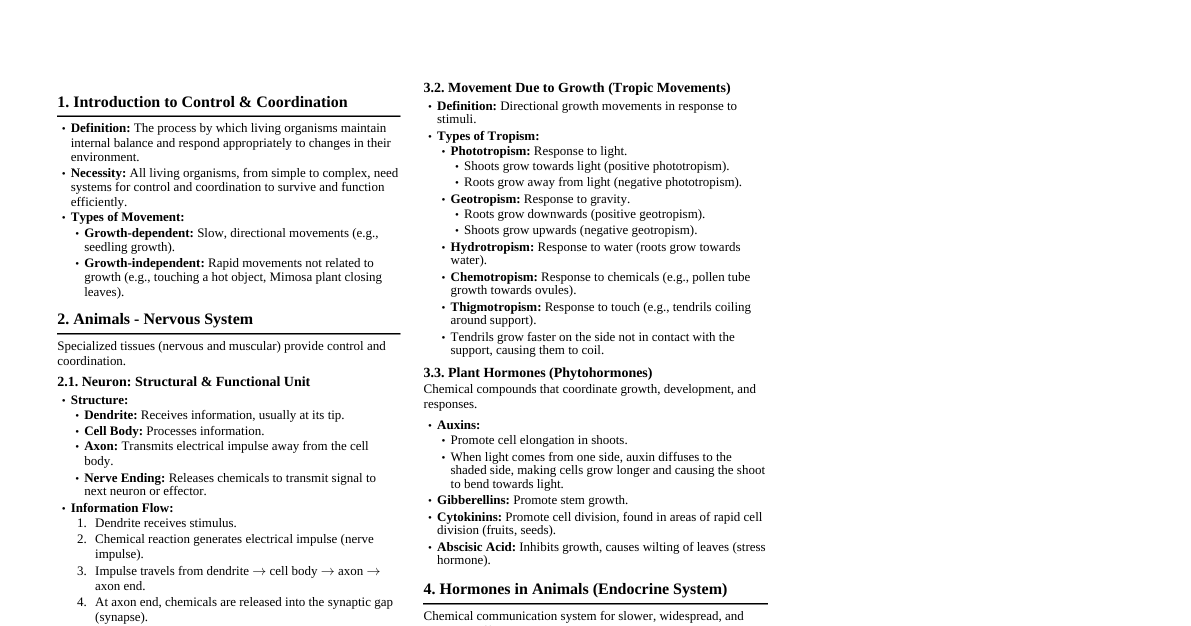
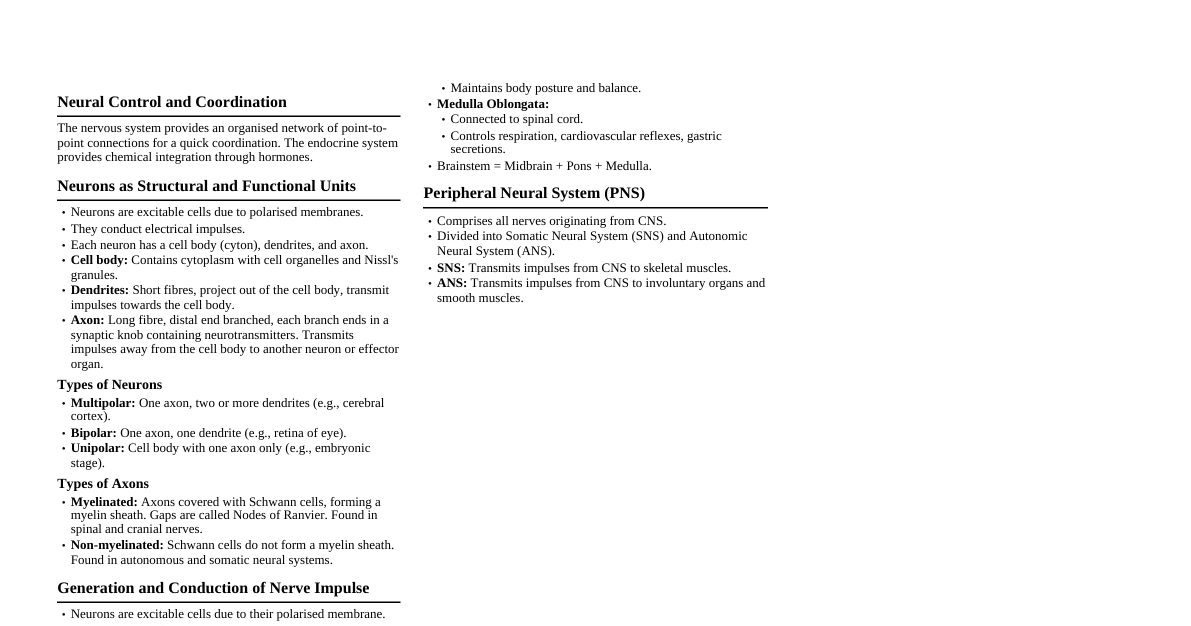
### Introduction - **Coordination:** The working together of various organs of an organism to adjust various activities of life. - **Control & coordination ensures:** - Correct movement for each specific change (stimulus). - No wrong or unnecessary actions. #### Control & Coordination Branches - **Coordination in Animals:** - Nervous System (Associated with Neurons) - Endocrine System (Associated with Hormones) - **Coordination in Plants:** - Plant Movements - Plant Hormones ### Coordination in Animals #### Nervous System - **Central Nervous System (CNS):** - **Brain:** - Fore-Brain - Mid-Brain - Hind-Brain - **Spinal Cord** - **Peripheral Nervous System (PNS):** - **Cranial Nerves:** Arise from the brain. - **Spinal Nerves:** Arise from the spinal cord. #### Endocrine System - **Hormones** ### Stimulus & Receptors - **Stimulus (Stimuli):** Any change in the environment (internal or external) that produces a response in an organism. - *Example:* Light, sound, smell, touch, temperature. - **Receptors:** Cells or groups of cells present in sense organs that detect stimuli and convert them into nerve impulses. #### Types of Receptors - **Photoreceptors:** - **Location:** Eye (retina) - **Function:** Detect light and help in vision. - **Thermoreceptors:** - **Location:** Skin - **Function:** Detect temperature changes (hot or cold). - **Gustatoryreceptors:** - **Location:** Tongue - **Function:** Detect taste (sweet, sour, salty, bitter, umami). - **Phonoreceptors:** - **Location:** Inner ear - **Function:** Detect sound vibrations and help in hearing. - **Olfactoryreceptors:** - **Location:** Nose - **Function:** Detect smells/odours. ### Response & Effectors - **Response:** The reaction of the organism to a stimulus. - *Example:* Moving hand away from a hot object. - **Effectors:** Parts of the body that respond to impulses sent by the nervous system, converting them into actions. - *Example:* Muscles and glands. ### Neuron - Neurons are the basic, structural, and functional units of the nervous system. - They are specialized cells that transmit information in the form of electrical impulses. #### Functions of Neurons - Receive signals from sensory organs (eyes, ears, skin, etc.). - Process and interpret those signals. - Send responses to effectors (muscles and glands) for action. ### Parts of Neuron - **Cell Body (Cyton):** Part of a neuron containing the nucleus; processes incoming information and passes it to the axon. - Present inside the cell body; controls neuron functioning and contains genetic material (DNA). - **Dendrites:** Branch-like extensions from the cell body that receive information from receptors or other neurons. - **Axon:** The longest fibre extending from the cell body; carries electrical impulses from the cell body to the axon terminal, passing the impulse to the next neuron's dendrite. - **Nerve Ending (Axon Terminal):** The end part of an axon where chemicals are released to transmit impulses across the synapse to the next neuron, muscle cell, or gland cell. - **Myelin Sheath:** - A fatty layer around the axon of some neurons. - Acts as an insulating layer and speeds up nerve impulse transmission. ### Synapse & Nerve Impulse #### Synapse - The gap between the nerve ending of one neuron and the dendrite of the next neuron. - Across this gap, the electrical impulse from the first neuron is converted into a chemical signal, which crosses the gap and starts a similar electrical impulse in the next neuron. #### Nerve Impulse - An electrical signal that travels along the neuron. - Generated when a stimulus is detected by receptors and transmitted through neurons. - **Impulse Travel Path:** Dendrites → Cell body → Axon → Axon terminal → Synapse → Next neuron / muscle / gland. - This is how information is carried quickly from one part of the body to another. #### How Neurons Work (Flowchart) 1. Stimulus detected by receptors 2. Chemical reaction at dendritic tip → Electrical impulse generated 3. Impulse travels through Dendrite → Cell Body → Axon → Axon Terminal 4. Electrical impulse triggers release of chemicals (neurotransmitters) 5. Chemicals cross synapse and start new electrical impulse in next cell ### Neuromuscular Junction - The point where a nerve ending meets a muscle, so that the nerve's message can make the muscle contract. #### Neurotransmitters - Chemical messengers released from the axon terminals of a neuron. - Help in transmitting nerve impulses across the synapse (gap between two neurons). - At the synapse, the electrical impulse is converted into a chemical signal (neurotransmitter). - These chemicals quickly cross the gap and generate a new electrical impulse in the next neuron, muscle cell, or gland cell. ### Types of Neurons - **Sensory Neurons:** Carry messages from sense organs to the brain or spinal cord. - **Motor Neurons:** Carry messages from the brain or spinal cord to muscles or glands. - **Interneurons (Relay Neurons):** Connect sensory and motor neurons within the brain and spinal cord. #### Differentiating Neurons | Sensory Neuron | Motor Neuron | Relay Neuron | |---|---|---| | Carries messages from receptors to the central nervous system (CNS). | Carries messages from CNS to muscles or glands (effectors). | Connects sensory neurons to motor neurons within the CNS. | | *Example:* From skin to spinal cord. | *Example:* From spinal cord to hand muscle. | *Example:* In spinal cord between sensory and motor pathways. | #### Why Neuron is the Structural and Functional Unit - It is the basic cell that receives, processes, and transmits information through electrical and chemical signals, enabling control and coordination in the body. ### Types of Actions | Voluntary Action | Involuntary Action | Reflex Action | |---|---|---| | These actions can be controlled by our own will. | These actions cannot be controlled by our own will. | These actions cannot be controlled by our own will. | | Thinking is involved. | Thinking is not involved. | Thinking is not involved. | | Brain is involved. | Brain is involved. | Spinal cord is involved. | | *Example:* Walking, Writing, Dancing, Jumping | *Example:* Pumping of Blood, Peristaltic movements, Contraction and relaxation of blood vessels | *Example:* Withdrawal of hand when touching a hot object. | ### Reflex Action - A sudden, automatic, and involuntary response to a stimulus without conscious thinking. - *Examples:* Jumping away from a bus, withdrawing the hand from a flame, or mouth watering when hungry. - Helps in quick protection from danger and saves time by avoiding the slow thinking process. #### Reflex Arc - **Definition:** Pathway for reflex action connecting sensory nerve to motor nerve. - **Five main parts:** 1. **Stimulus:** E.g., heat detected by skin receptors. 2. **Sensory neuron:** Carries message to spinal cord. 3. **Spinal cord:** Processes the message. 4. **Motor neuron:** Carries command from spinal cord. 5. **Effector (muscle):** Contracts and withdraws the hand. #### Importance of Reflex Action - Provides immediate and automatic response to harmful stimuli. - Protects the body from injury (e.g., withdrawing hand from hot object). - Saves time by avoiding delay of thinking in the brain. - Helps in survival and safety by giving quick reactions in emergencies. #### Evolution of Reflex Arcs - Reflex arcs have evolved in animals to provide rapid and automatic responses to harmful or sudden stimuli, helping animals protect themselves quickly without waiting for the brain to process the information. - Located mainly in the spinal cord, reflex arcs skip the brain's detailed processing. - This makes the reaction faster and more efficient. - They give animals a survival advantage by helping them escape danger or prevent injury in emergency situations. ### Brain - The brain, inside the skull, is the main coordinating centre of the body. - It is surrounded by three membranes (meninges) with cerebrospinal fluid in between, which cushions it from shocks. #### Parts of Brain - **Forebrain:** - **Cerebrum:** Controls intelligence, memory, learning, emotions, and voluntary movements. - **Hypothalamus:** Regulates hunger, thirst, sleep, body temperature, and emotions; controls the pituitary gland. - **Thalamus:** Acts as a relay station, directing sensory signals to the cerebrum. - **Midbrain:** - Connects forebrain and hindbrain. - Controls certain involuntary actions. - Regulates reflex movements of eyes, head, and neck in response to visual and auditory stimuli. - Helps in processing sensory information and keeps the body alert. - **Hindbrain:** - **Cerebellum:** Controls balance, posture, and coordination of body movements. - **Pons:** Helps in relaying signals between different parts of the brain and controls breathing. - **Medulla Oblongata:** Controls involuntary actions like heartbeat, breathing, blood pressure, vomiting, salivation. #### Corpus Callosum - A thick band of nerve fibres in the brain. - Connects the left and right hemispheres of the cerebrum. - Allows communication between the two halves of the brain for coordinated function. ### Protection of Brain and Spinal Cord #### Protection of the Brain - The brain is protected by the bony skull (cranium). - It is covered by three membranes (meninges). - Cerebrospinal fluid (CSF) surrounds it, acting as a shock absorber and protecting it from injury. #### Protection of Spinal Cord - The spinal cord is protected by the vertebral column (backbone). - It is also covered by meninges. - Cerebrospinal fluid (CSF) around the spinal cord provides cushioning and prevents damage. ### Glands - Special organs in our body that make and release substances like hormones, enzymes, sweat, or saliva. #### Exocrine Glands - Release their secretions through ducts to a surface or organ. - Secrete substances like enzymes, saliva, sweat, mucus, etc. - Act locally (limited effect where ducts open). - *Examples:* Salivary glands, Sweat glands, Tear glands. #### Endocrine Glands - Release hormones directly into the blood (ductless glands). - Secrete hormones only. - Act on distant target organs/tissues through blood. - *Examples:* Pituitary gland (growth hormone), Thyroid gland (thyroxin), Adrenal gland (adrenaline), Pancreas (insulin), Testis (testosterone), Ovary (oestrogen). ### Hormones - Chemical messengers secreted by endocrine glands, transported by blood to target organs. - Provide control and coordination along with the nervous system. #### Pituitary Gland - Located just below the brain, below the hypothalamus. - Secretes several hormones, including growth hormone. - Growth hormone regulates the growth and development of bones and muscles. - The hypothalamus controls the pituitary gland by secreting releasing and inhibiting hormones. - Deficiency of growth hormone during childhood causes **dwarfism**. - Excess growth hormone leads to **gigantism**. #### Thyroid Gland - Attached to the windpipe in the neck. - Produces thyroxine hormone (contains iodine). - Thyroxine controls the rate of metabolism of carbohydrates, fats, and proteins. - **Goitre:** Swelling of the neck due to an enlarged thyroid gland, usually caused by lack of iodine in the diet. - **Iodine-rich sources:** Seaweed, fish, shellfish, iodized table salt, dairy, eggs, beef liver, chicken. #### Parathyroid Gland - Four small glands embedded in the thyroid gland. - Secrete parathormone. - Parathormone regulates calcium and phosphate levels in the blood. #### Thymus Gland - Located in the lower part of the neck and upper part of the chest. - Secretes thymus hormone, which helps in the development of the body's immune system. - Large in young children but shrinks after puberty. #### Pancreas (Dual / Mixed / Heterocrine Gland) - Located just below the stomach. - **Exocrine function:** Secretes pancreatic juice containing enzymes like trypsin and lipase for digestion. - **Endocrine function:** Secretes hormones insulin and glucagon. - **Insulin:** Lowers blood sugar level; controls sugar metabolism. - **Glucagon:** Raises blood sugar level. - Deficiency of insulin causes **diabetes**, characterized by high sugar level in blood and sugar present in urine. #### Adrenal Glands - Two glands located on top of the kidneys. - Secrete adrenaline hormone. - **Functions:** Regulates heart rate, breathing rate, blood pressure, and carbohydrate metabolism. - Secreted in small amounts normally, but in large amounts during fear or excitement. - Large secretion prepares the body for action ("fight or flight" response). - Known as the glands of emergency. #### Testes - Present only in males. - Produce the male sex hormone testosterone. - Also produce male gametes (sperms). - Testosterone controls the development of male sex organs and male features such as deeper voice, moustache, beard, and more body hair. - Changes caused by testosterone are associated with male puberty (13-14 years of age). #### Ovaries - Present only in females. - Produce two hormones: Oestrogen and Progesterone. - **Oestrogen:** Controls development of female sex organs, secondary sexual characteristics (soft skin, feminine voice, mammary glands). - **Progesterone:** Prepares uterus for implantation & maintains pregnancy. - Changes due to oestrogen are associated with puberty (10-12 years of age). ### Feedback Mechanism - **Hormonal Imbalance:** Excess or deficiency of hormones harms the body. - *Example:* Insufficient insulin → Diabetes; Excess insulin → May lead to coma. - **Feedback Mechanism:** Controls hormone release timing and amount. - *Example (High Blood Sugar):* High blood sugar → pancreas secretes more insulin. As sugar level falls to normal → insulin secretion automatically decreases. ### Summary of Hormones | Hormone | Gland (Location) | Function | |---|---|---| | Growth Hormone | Pituitary gland (just below brain) | Regulates growth and development of bones and muscles | | Thyroxine | Thyroid gland (attached to windpipe in neck) | Controls metabolism of carbohydrates, fats, and proteins | | Parathormone | Parathyroid glands (embedded in thyroid gland) | Regulates calcium and phosphate levels in blood | | Thymus Hormone | Thymus gland (lower neck, upper chest) | Helps in development of immune system | | Insulin | Pancreas (below stomach) | Lowers blood sugar level | | Glucagon | Pancreas (below stomach) | Raises blood sugar level | | Adrenaline | Adrenal glands (on top of kidneys) | Prepares body for emergency – increases heartbeat, breathing rate, blood pressure | | Testosterone | Testes (in males) | Controls development of male sex organs and secondary sexual characters | | Oestrogen | Ovaries (in females) | Controls development of female sex organs and secondary sexual characters | ### Chemical vs. Electrical Communication - **Why chemical communication is better for multicellular organisms:** - **Electrical impulses have limited range:** Only pass through connected neurons, not every cell. Neurons need recovery time. - **Chemical communication (hormones) has wider range:** Hormones travel through blood to all parts of the body. - **Long-lasting effect:** Chemical signals act for longer duration than short-lived electrical impulses. - **Target-specific:** Hormones act only on specific target tissues or organs. ### Coordination in Plants - Plants lack a nervous system and muscles. - They still respond to stimuli (e.g., touch-me-not folds leaves on touch). #### Differences from Animals | Animals | Plants | |---|---| | Have specialised tissues (nerves, muscles) for conduction of information. | No specialised tissues for conduction of information. | | Movement happens due to change in shape of muscle cells (caused by special proteins). | Movement happens due to change in amount of water in cells (swelling/shrinking). | #### Similarities with Animals - Both use chemical signals (hormones) for control and coordination. - In both, cells change shape to bring about response. - Both help the organism adapt and survive in changing environments. #### Plant Movements - **Nastic Movements:** - Non-directional response to stimulus. - Independent of growth. - Temporary and reversible. - Immediate action. - *Examples:* - **Thigmonasty:** Non-directional movement in response to touch. E.g., *Mimosa pudica* (touch-me-not) leaves fold quickly. - **Photonasty:** Non-directional movement of flower petals in response to light. E.g., Dandelion and Tulip (open in light), Moonflower or Evening Primrose (open in dark). - **Tropic Movements:** - Unidirectional response to the stimulus. - Dependent on growth. - More or less permanent and irreversible. - Slow action. - **Positive Tropism:** Plant part grows or moves towards the stimulus. - **Negative Tropism:** Plant part grows or moves away from the stimulus. #### Types of Tropism 1. **Phototropism:** Movement of a plant part in response to light. - **Positive Phototropism:** Stem grows toward light. - **Negative Phototropism:** Roots grow away from light. - *Role of Auxin:* When light falls on one side, auxin moves to the shaded side, causing cells there to grow longer and the stem to bend towards light. 2. **Geotropism:** Movement of a plant part in response to gravity. - **Positive Geotropism:** Plant part grows toward gravity (e.g., roots). - **Negative Geotropism:** Plant part grows against gravity (e.g., stem). 3. **Chemotropism:** Movement of a plant part in response to chemical stimulus. - **Positive Chemotropism:** Growth toward the chemical (e.g., pollen tube growing towards ovules). - **Negative Chemotropism:** Growth away from the chemical. 4. **Hydrotropism:** Movement of a plant part in response to water. - **Positive Hydrotropism:** Plant part moves towards water. - **Negative Hydrotropism:** Plant part moves away from water. 5. **Thigmotropism:** Tendrils (thin, thread-like structures) in climbing plants attach to a support; sensitive to touch and grow towards the object they touch. ### Plant Hormones (Phytohormones) - Carried out by plant hormones. - Growth of a plant occurs in three stages: 1. **Cell division:** Formation of new cells by mitosis. 2. **Cell enlargement:** Increase in size of cells. 3. **Cell differentiation (cell specialization):** Cells become specialized for specific functions. #### Types of Plant Hormones 1. **Auxin:** - **Location:** Shoot tips. - **Functions:** - Promote cell elongation in shoots. - Control phototropism (light) and geotropism (gravity). - When light falls on one side, auxin moves to the shaded side → cells grow longer → stem bends towards light. - Help in fruit development. 2. **Gibberellins:** - **Location:** Stem regions. - **Functions:** - Help in seed germination. - Promote flowering. - Promote fruit development. 3. **Cytokinins:** - **Location:** Fruits and seeds (rapid growth regions). - **Functions:** - Promote cell division. - Found in high concentration in fruits and seeds. 4. **Abscisic Acid (ABA):** - **Location:** Various plant parts. - **Functions:** - Inhibits growth (opposite of auxin/gibberellins). - Causes wilting of leaves. - Induces dormancy in seeds and buds. - Acts as a stress hormone (helps plant respond to stress - drought). - Closes stomata during water stress to reduce water loss. 5. **Ethylene:** - **Location:** Fruits (ripening regions). - **Functions:** - Stimulates fruit ripening. - Promotes leaf fall and aging.