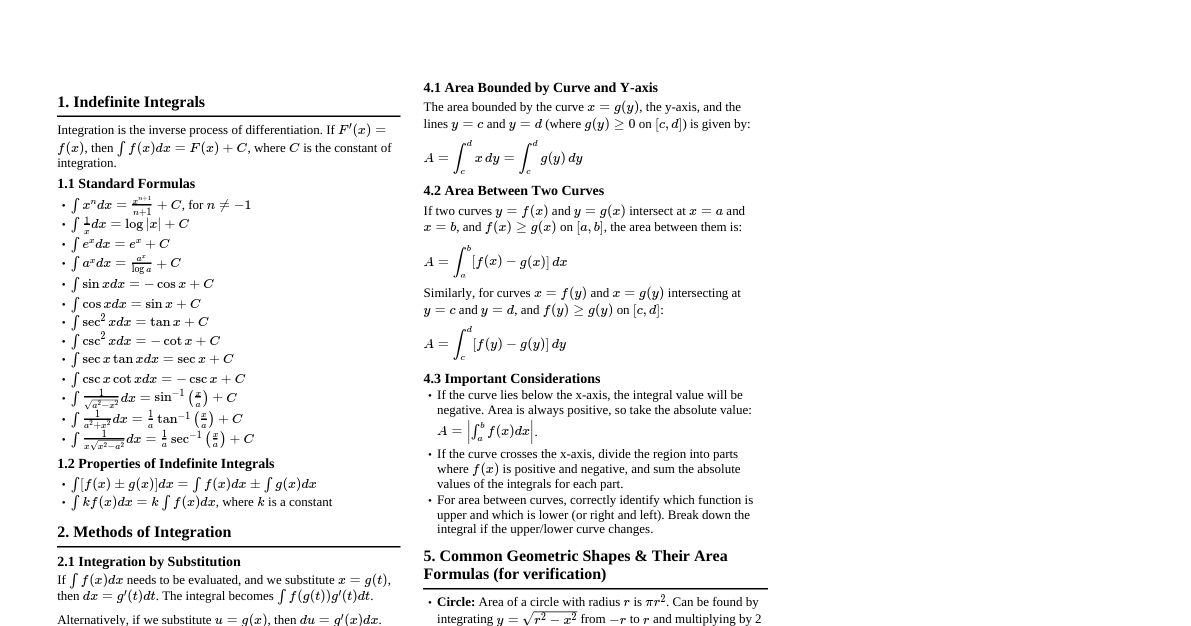
Indefinite Integrals: Substitu
Cheatsheet Content
### Integration by Substitution Integration by substitution (also known as u-substitution) is a technique for finding antiderivatives and definite integrals. It is essentially the reverse of the chain rule for differentiation. #### When to use it: - When the integrand contains a composite function, i.e., a function within another function. - When the derivative of the inner function (or a constant multiple of it) is also present in the integrand. #### Steps: 1. **Choose `u`**: Select a part of the integrand to be `u`. Often, this is the "inner" function of a composite function, or something whose derivative is also present. 2. **Find `du`**: Differentiate `u` with respect to `x` to find $\frac{du}{dx}$, then express `dx` in terms of `du`. 3. **Substitute**: Replace all `x` terms in the integral with `u` and `dx` with its `du` equivalent. The goal is to transform the integral into a simpler form involving only `u`. 4. **Integrate**: Solve the new integral with respect to `u`. 5. **Substitute Back**: Replace `u` with its original expression in terms of `x` to get the final answer. ### Example Problem: $\int \frac{x}{2-x^2+\sqrt{2-x^2}} dx$ Let's analyze the given integral: $$\int \frac{x}{2-x^2+\sqrt{2-x^2}} dx$$ #### Why choose $u = 2-x^2$? 1. **Composite Function:** We see $\sqrt{2-x^2}$, which is a composite function where $2-x^2$ is the "inner" function. 2. **Derivative Present:** The derivative of $2-x^2$ is $-2x$. We have an `x` in the numerator, which is a constant multiple of this derivative. This setup is ideal for u-substitution. 3. **Simplification:** Substituting $u = 2-x^2$ will transform the denominator from $2-x^2+\sqrt{2-x^2}$ to $u+\sqrt{u}$, which often simplifies the integral significantly. #### Step-by-step Solution: 1. **Choose `u`**: Let $u = 2-x^2$ 2. **Find `du`**: Differentiate `u` with respect to `x`: $\frac{du}{dx} = -2x$ Rearrange to find `dx` in terms of `du`: $du = -2x \, dx \implies x \, dx = -\frac{1}{2} du$ 3. **Substitute**: Replace $2-x^2$ with `u` and $x \, dx$ with $-\frac{1}{2} du$: $$\int \frac{1}{u+\sqrt{u}} \left(-\frac{1}{2}\right) du$$ $$= -\frac{1}{2} \int \frac{1}{u+\sqrt{u}} du$$ Further simplify the denominator: $u+\sqrt{u} = \sqrt{u}(\sqrt{u}+1)$. $$= -\frac{1}{2} \int \frac{1}{\sqrt{u}(\sqrt{u}+1)} du$$ 4. **Integrate (Second Substitution)**: This new integral is still complex, so we can use another substitution. Let $v = \sqrt{u}+1$. Then $\frac{dv}{du} = \frac{1}{2\sqrt{u}}$. So, $dv = \frac{1}{2\sqrt{u}} du \implies \frac{1}{\sqrt{u}} du = 2 \, dv$. Substitute `v` into the integral: $$= -\frac{1}{2} \int \frac{1}{v} (2 \, dv)$$ $$= -\frac{1}{2} \cdot 2 \int \frac{1}{v} dv$$ $$= - \int \frac{1}{v} dv$$ Now, integrate with respect to `v`: $$= -\ln|v| + C$$ 5. **Substitute Back**: First, substitute back `v` in terms of `u`: $$= -\ln|\sqrt{u}+1| + C$$ Then, substitute back `u` in terms of `x`: $$= -\ln|\sqrt{2-x^2}+1| + C$$ This example demonstrates how choosing the right substitution (and sometimes a second one) can transform a complicated integral into a manageable one. The key is to look for composite functions and their derivatives within the integrand.