Multiple Integrals Cheatsheet
Cheatsheet Content
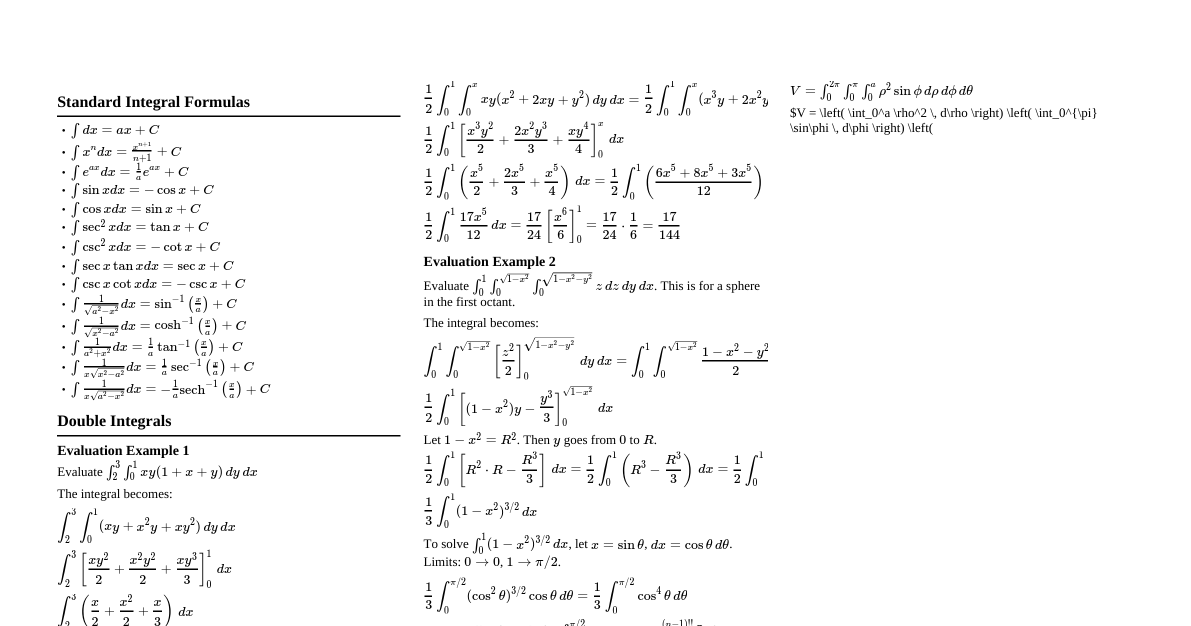
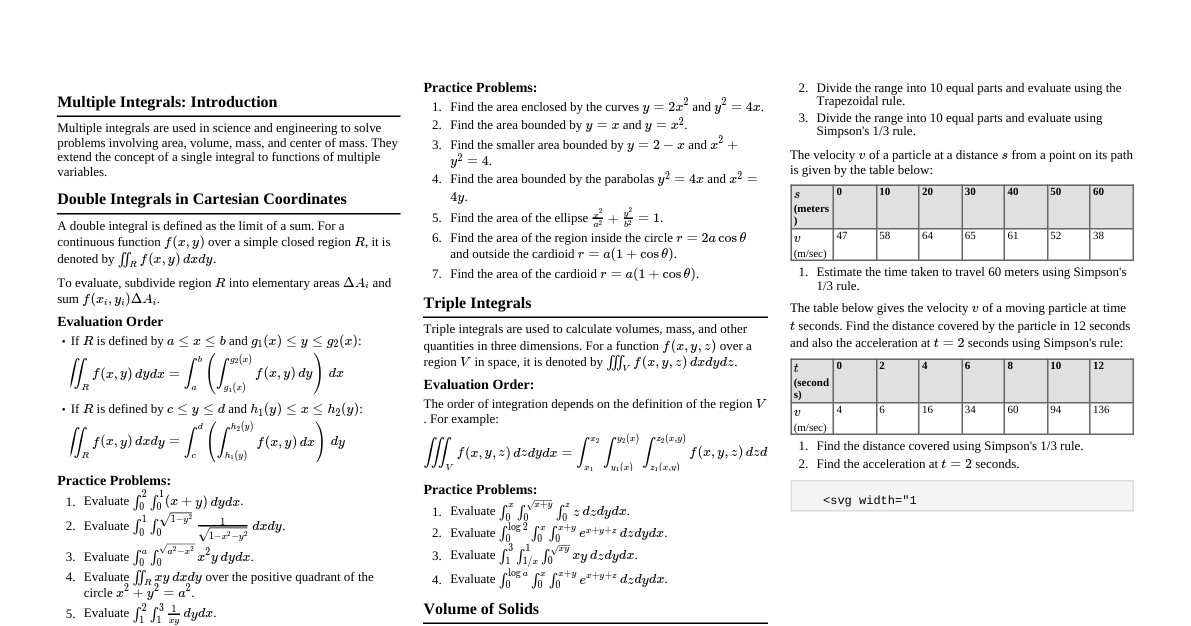
1. Double Integrals A double integral of a function $f(x,y)$ over a region $R$ in the $xy$-plane is denoted by $\iint_R f(x,y) dA$. It represents the volume under the surface $z=f(x,y)$ and above the region $R$. 1.1 Iterated Integrals If $R$ is defined by $a \le x \le b$ and $c \le y \le d$, then: $\iint_R f(x,y) dA = \int_a^b \int_c^d f(x,y) dy dx$ $\iint_R f(x,y) dA = \int_c^d \int_a^b f(x,y) dx dy$ If $R$ is defined by $a \le x \le b$ and $g_1(x) \le y \le g_2(x)$, then: $\iint_R f(x,y) dA = \int_a^b \int_{g_1(x)}^{g_2(x)} f(x,y) dy dx$ If $R$ is defined by $c \le y \le d$ and $h_1(y) \le x \le h_2(y)$, then: $\iint_R f(x,y) dA = \int_c^d \int_{h_1(y)}^{h_2(y)} f(x,y) dx dy$ Example 1: Evaluating a Double Integral Evaluate $\int_0^1 \int_0^{x} y dy dx$. Solution: $\int_0^1 \int_0^{x} y dy dx = \int_0^1 \left[\frac{y^2}{2}\right]_0^{x} dx$ $= \int_0^1 \frac{x^2}{2} dx$ $= \left[\frac{x^3}{6}\right]_0^1 = \frac{1}{6}$ Example 2: Another Double Integral Evaluate $\int_0^a \int_0^b (x^2 + y^2) dy dx$. Solution: $\int_0^a \int_0^b (x^2 + y^2) dy dx = \int_0^a \left[x^2y + \frac{y^3}{3}\right]_0^b dx$ $= \int_0^a \left(x^2b + \frac{b^3}{3}\right) dx$ $= \left[\frac{x^3b}{3} + \frac{b^3x}{3}\right]_0^a$ $= \frac{a^3b}{3} + \frac{b^3a}{3} = \frac{ab(a^2+b^2)}{3}$ 2. Change of Order of Integration Sometimes, reversing the order of integration can simplify the evaluation of a double integral, especially when the limits are functions of the other variable. Example 1: Changing Order Change the order of integration for $\int_0^a \int_0^{\sqrt{a^2-x^2}} f(x,y) dy dx$. Solution: The region is bounded by $x=0, x=a, y=0, y=\sqrt{a^2-x^2}$. This describes the quarter circle in the first quadrant. To change the order, we integrate with respect to $x$ first. The limits for $x$ will be from $x=0$ to $x=\sqrt{a^2-y^2}$. The limits for $y$ will be from $y=0$ to $y=a$. The integral becomes $\int_0^a \int_0^{\sqrt{a^2-y^2}} f(x,y) dx dy$. Example 2: Changing Order and Evaluating Evaluate $\int_0^1 \int_y^1 e^{-x^2} dx dy$ by changing the order of integration. Solution: The region is defined by $0 \le y \le 1$ and $y \le x \le 1$. This region is a triangle with vertices $(0,0), (1,0), (1,1)$. To change the order, we define the region as $0 \le x \le 1$ and $0 \le y \le x$. The integral becomes $\int_0^1 \int_0^x e^{-x^2} dy dx$. $\int_0^1 [e^{-x^2}y]_0^x dx = \int_0^1 x e^{-x^2} dx$ Let $u = -x^2$, then $du = -2x dx$, so $x dx = -\frac{1}{2} du$. When $x=0, u=0$. When $x=1, u=-1$. $= \int_0^{-1} e^u (-\frac{1}{2}) du = -\frac{1}{2} [e^u]_0^{-1}$ $= -\frac{1}{2} (e^{-1} - e^0) = -\frac{1}{2} (\frac{1}{e} - 1) = \frac{1}{2} (1 - \frac{1}{e})$ 3. Double Integrals in Polar Coordinates For regions with circular symmetry, polar coordinates can simplify integration. Transformation: $x = r \cos \theta$, $y = r \sin \theta$, $dA = dx dy = r dr d\theta$. If $R$ is defined by $\theta_1 \le \theta \le \theta_2$ and $r_1(\theta) \le r \le r_2(\theta)$, then: $\iint_R f(x,y) dA = \int_{\theta_1}^{\theta_2} \int_{r_1(\theta)}^{r_2(\theta)} f(r \cos \theta, r \sin \theta) r dr d\theta$ Example 1: Polar Double Integral Evaluate $\iint_R (x^2+y^2) dA$ where $R$ is the region $1 \le x^2+y^2 \le 4$. Solution: In polar coordinates, $x^2+y^2 = r^2$. The region is an annulus between $r=1$ and $r=2$. The angle $\theta$ goes from $0$ to $2\pi$. $\iint_R (x^2+y^2) dA = \int_0^{2\pi} \int_1^2 (r^2) r dr d\theta$ $= \int_0^{2\pi} \int_1^2 r^3 dr d\theta$ $= \int_0^{2\pi} \left[\frac{r^4}{4}\right]_1^2 d\theta$ $= \int_0^{2\pi} \left(\frac{2^4}{4} - \frac{1^4}{4}\right) d\theta$ $= \int_0^{2\pi} \left(\frac{16}{4} - \frac{1}{4}\right) d\theta = \int_0^{2\pi} \frac{15}{4} d\theta$ $= \left[\frac{15}{4}\theta\right]_0^{2\pi} = \frac{15}{4}(2\pi - 0) = \frac{15\pi}{2}$ Example 2: Area in Polar Coordinates Find the area of the region enclosed by the cardioid $r = a(1+\cos \theta)$. Solution: Area $A = \iint_R dA = \iint_R r dr d\theta$. The cardioid is traced for $0 \le \theta \le 2\pi$. $A = \int_0^{2\pi} \int_0^{a(1+\cos \theta)} r dr d\theta$ $= \int_0^{2\pi} \left[\frac{r^2}{2}\right]_0^{a(1+\cos \theta)} d\theta$ $= \int_0^{2\pi} \frac{a^2(1+\cos \theta)^2}{2} d\theta$ $= \frac{a^2}{2} \int_0^{2\pi} (1 + 2\cos \theta + \cos^2 \theta) d\theta$ Using $\cos^2 \theta = \frac{1+\cos(2\theta)}{2}$: $= \frac{a^2}{2} \int_0^{2\pi} \left(1 + 2\cos \theta + \frac{1+\cos(2\theta)}{2}\right) d\theta$ $= \frac{a^2}{2} \int_0^{2\pi} \left(\frac{3}{2} + 2\cos \theta + \frac{1}{2}\cos(2\theta)\right) d\theta$ $= \frac{a^2}{2} \left[\frac{3}{2}\theta + 2\sin \theta + \frac{1}{4}\sin(2\theta)\right]_0^{2\pi}$ $= \frac{a^2}{2} \left(\frac{3}{2}(2\pi) + 0 + 0 - (0+0+0)\right)$ $= \frac{a^2}{2} (3\pi) = \frac{3\pi a^2}{2}$ 4. Triple Integrals A triple integral of a function $f(x,y,z)$ over a region $E$ in $xyz$-space is denoted by $\iiint_E f(x,y,z) dV$. It represents the hypervolume of a 4D function, or if $f(x,y,z)=1$, it represents the volume of $E$. 4.1 Cartesian Coordinates For a region $E$ defined by $a \le x \le b$, $g_1(x) \le y \le g_2(x)$, and $h_1(x,y) \le z \le h_2(x,y)$: $\iiint_E f(x,y,z) dV = \int_a^b \int_{g_1(x)}^{g_2(x)} \int_{h_1(x,y)}^{h_2(x,y)} f(x,y,z) dz dy dx$ The order of integration can be permuted ($dx dy dz$, $dy dx dz$, etc.) as long as the limits are consistent with the integration variable. Example 1: Evaluating a Triple Integral Evaluate $\int_0^1 \int_0^x \int_0^{x+y} (x+y+z) dz dy dx$. Solution: $\int_0^1 \int_0^x \int_0^{x+y} (x+y+z) dz dy dx = \int_0^1 \int_0^x \left[(x+y)z + \frac{z^2}{2}\right]_0^{x+y} dy dx$ $= \int_0^1 \int_0^x \left((x+y)(x+y) + \frac{(x+y)^2}{2}\right) dy dx$ $= \int_0^1 \int_0^x \left((x+y)^2 + \frac{(x+y)^2}{2}\right) dy dx$ $= \int_0^1 \int_0^x \frac{3}{2}(x+y)^2 dy dx$ $= \frac{3}{2} \int_0^1 \left[\frac{(x+y)^3}{3}\right]_0^x dx$ $= \frac{3}{2} \int_0^1 \left(\frac{(x+x)^3}{3} - \frac{(x+0)^3}{3}\right) dx$ $= \frac{3}{2} \int_0^1 \left(\frac{8x^3}{3} - \frac{x^3}{3}\right) dx$ $= \frac{3}{2} \int_0^1 \frac{7x^3}{3} dx = \frac{7}{2} \int_0^1 x^3 dx$ $= \frac{7}{2} \left[\frac{x^4}{4}\right]_0^1 = \frac{7}{2} \left(\frac{1}{4} - 0\right) = \frac{7}{8}$ Example 2: Volume using Triple Integral Find the volume of the region bounded by $x=0, y=0, z=0, x+y+z=1$. Solution: The region is a tetrahedron. The limits are $0 \le x \le 1$, $0 \le y \le 1-x$, $0 \le z \le 1-x-y$. $V = \int_0^1 \int_0^{1-x} \int_0^{1-x-y} dz dy dx$ $= \int_0^1 \int_0^{1-x} [z]_0^{1-x-y} dy dx$ $= \int_0^1 \int_0^{1-x} (1-x-y) dy dx$ $= \int_0^1 \left[(1-x)y - \frac{y^2}{2}\right]_0^{1-x} dx$ $= \int_0^1 \left((1-x)(1-x) - \frac{(1-x)^2}{2}\right) dx$ $= \int_0^1 \left((1-x)^2 - \frac{(1-x)^2}{2}\right) dx$ $= \int_0^1 \frac{1}{2}(1-x)^2 dx$ Let $u = 1-x$, $du = -dx$. When $x=0, u=1$. When $x=1, u=0$. $= \frac{1}{2} \int_1^0 u^2 (-du) = -\frac{1}{2} \int_1^0 u^2 du$ $= \frac{1}{2} \int_0^1 u^2 du = \frac{1}{2} \left[\frac{u^3}{3}\right]_0^1 = \frac{1}{2} \left(\frac{1}{3} - 0\right) = \frac{1}{6}$ 5. Change of Variables in Triple Integrals To change variables from $(x,y,z)$ to $(u,v,w)$, we use the Jacobian determinant $J = \left|\frac{\partial(x,y,z)}{\partial(u,v,w)}\right|$. $dV = dx dy dz = |J| du dv dw$ 5.1 Cylindrical Coordinates Transformation: $x = r \cos \theta$, $y = r \sin \theta$, $z = z$. $J = \begin{vmatrix} \frac{\partial x}{\partial r} & \frac{\partial x}{\partial \theta} & \frac{\partial x}{\partial z} \\ \frac{\partial y}{\partial r} & \frac{\partial y}{\partial \theta} & \frac{\partial y}{\partial z} \\ \frac{\partial z}{\partial r} & \frac{\partial z}{\partial \theta} & \frac{\partial z}{\partial z} \end{vmatrix} = \begin{vmatrix} \cos \theta & -r \sin \theta & 0 \\ \sin \theta & r \cos \theta & 0 \\ 0 & 0 & 1 \end{vmatrix} = r$ $dV = r dz dr d\theta$ Example 1: Cylindrical Integral Find the volume of a cylinder with radius $a$ and height $h$. Solution: The cylinder is defined by $x^2+y^2 \le a^2$ and $0 \le z \le h$. In cylindrical coordinates: $0 \le r \le a$, $0 \le \theta \le 2\pi$, $0 \le z \le h$. $V = \iiint_E dV = \int_0^{2\pi} \int_0^a \int_0^h r dz dr d\theta$ $= \int_0^{2\pi} \int_0^a [rz]_0^h dr d\theta$ $= \int_0^{2\pi} \int_0^a hr dr d\theta$ $= \int_0^{2\pi} \left[h\frac{r^2}{2}\right]_0^a d\theta$ $= \int_0^{2\pi} \frac{ha^2}{2} d\theta$ $= \left[\frac{ha^2}{2}\theta\right]_0^{2\pi} = \frac{ha^2}{2}(2\pi - 0) = \pi a^2 h$ 5.2 Spherical Coordinates Transformation: $x = \rho \sin \phi \cos \theta$, $y = \rho \sin \phi \sin \theta$, $z = \rho \cos \phi$. $J = \rho^2 \sin \phi$ $dV = \rho^2 \sin \phi d\rho d\phi d\theta$ Common ranges: $\rho \ge 0$ $0 \le \phi \le \pi$ (angle from positive $z$-axis) $0 \le \theta \le 2\pi$ (angle in $xy$-plane from positive $x$-axis) Example 1: Spherical Integral Find the volume of a sphere with radius $a$. Solution: The sphere is defined by $x^2+y^2+z^2 \le a^2$. In spherical coordinates: $0 \le \rho \le a$, $0 \le \phi \le \pi$, $0 \le \theta \le 2\pi$. $V = \iiint_E dV = \int_0^{2\pi} \int_0^\pi \int_0^a \rho^2 \sin \phi d\rho d\phi d\theta$ $= \int_0^{2\pi} \int_0^\pi \left[\frac{\rho^3}{3}\right]_0^a \sin \phi d\phi d\theta$ $= \int_0^{2\pi} \frac{a^3}{3} [-\cos \phi]_0^\pi d\theta$ $= \int_0^{2\pi} \frac{a^3}{3} (-\cos \pi - (-\cos 0)) d\theta$ $= \int_0^{2\pi} \frac{a^3}{3} (-(-1) - (-1)) d\theta$ $= \int_0^{2\pi} \frac{a^3}{3} (1+1) d\theta = \int_0^{2\pi} \frac{2a^3}{3} d\theta$ $= \left[\frac{2a^3}{3}\theta\right]_0^{2\pi} = \frac{2a^3}{3}(2\pi - 0) = \frac{4}{3}\pi a^3$ Example 2: Triple Integral over a hemisphere Evaluate $\iiint_H (x^2+y^2) dV$ where $H$ is the upper hemisphere $x^2+y^2+z^2 \le a^2$, $z \ge 0$. Solution: In spherical coordinates, $x^2+y^2 = (\rho \sin \phi \cos \theta)^2 + (\rho \sin \phi \sin \theta)^2 = \rho^2 \sin^2 \phi$. The limits for the upper hemisphere are $0 \le \rho \le a$, $0 \le \phi \le \pi/2$ (since $z \ge 0$), $0 \le \theta \le 2\pi$. $\iiint_H (x^2+y^2) dV = \int_0^{2\pi} \int_0^{\pi/2} \int_0^a (\rho^2 \sin^2 \phi) \rho^2 \sin \phi d\rho d\phi d\theta$ $= \int_0^{2\pi} \int_0^{\pi/2} \int_0^a \rho^4 \sin^3 \phi d\rho d\phi d\theta$ $= \int_0^{2\pi} \int_0^{\pi/2} \left[\frac{\rho^5}{5}\right]_0^a \sin^3 \phi d\phi d\theta$ $= \int_0^{2\pi} \int_0^{\pi/2} \frac{a^5}{5} \sin^3 \phi d\phi d\theta$ Recall $\sin^3 \phi = \sin \phi (1-\cos^2 \phi)$. Let $u = \cos \phi$, $du = -\sin \phi d\phi$. When $\phi=0, u=1$. When $\phi=\pi/2, u=0$. $\int_0^{\pi/2} \sin^3 \phi d\phi = \int_1^0 (1-u^2)(-du) = \int_0^1 (1-u^2) du$ $= \left[u - \frac{u^3}{3}\right]_0^1 = 1 - \frac{1}{3} = \frac{2}{3}$ So, the integral becomes: $= \int_0^{2\pi} \frac{a^5}{5} \left(\frac{2}{3}\right) d\theta$ $= \frac{2a^5}{15} \int_0^{2\pi} d\theta = \frac{2a^5}{15} [\theta]_0^{2\pi} = \frac{2a^5}{15} (2\pi) = \frac{4\pi a^5}{15}$ 6. Applications of Multiple Integrals 6.1 Area and Volume Area: $\text{Area}(R) = \iint_R dA$ Volume: $\text{Volume}(E) = \iiint_E dV$ Example 1: Area using Double Integral Find the area of the region bounded by $y=x^2$ and $y=x+2$. Solution: First, find intersection points: $x^2 = x+2 \Rightarrow x^2-x-2=0 \Rightarrow (x-2)(x+1)=0$. So $x=-1, x=2$. The upper curve is $y=x+2$ and the lower curve is $y=x^2$. $\text{Area} = \int_{-1}^2 \int_{x^2}^{x+2} dy dx$ $= \int_{-1}^2 [y]_{x^2}^{x+2} dx$ $= \int_{-1}^2 (x+2-x^2) dx$ $= \left[\frac{x^2}{2} + 2x - \frac{x^3}{3}\right]_{-1}^2$ $= \left(\frac{2^2}{2} + 2(2) - \frac{2^3}{3}\right) - \left(\frac{(-1)^2}{2} + 2(-1) - \frac{(-1)^3}{3}\right)$ $= \left(2 + 4 - \frac{8}{3}\right) - \left(\frac{1}{2} - 2 + \frac{1}{3}\right)$ $= \left(6 - \frac{8}{3}\right) - \left(-\frac{3}{2} + \frac{1}{3}\right)$ $= \frac{18-8}{3} - \frac{-9+2}{6} = \frac{10}{3} - \frac{-7}{6} = \frac{10}{3} + \frac{7}{6}$ $= \frac{20}{6} + \frac{7}{6} = \frac{27}{6} = \frac{9}{2}$ Example 2: Volume of a solid using Triple Integral Find the volume of the region bounded by $z=x^2+y^2$ and $z=4$. Solution: The region is a paraboloid cut by a plane. The intersection is $x^2+y^2=4$, which is a circle of radius 2. In cylindrical coordinates: $0 \le \theta \le 2\pi$, $0 \le r \le 2$, and $r^2 \le z \le 4$. $V = \int_0^{2\pi} \int_0^2 \int_{r^2}^4 r dz dr d\theta$ $= \int_0^{2\pi} \int_0^2 r[z]_{r^2}^4 dr d\theta$ $= \int_0^{2\pi} \int_0^2 r(4-r^2) dr d\theta$ $= \int_0^{2\pi} \int_0^2 (4r-r^3) dr d\theta$ $= \int_0^{2\pi} \left[2r^2 - \frac{r^4}{4}\right]_0^2 d\theta$ $= \int_0^{2\pi} \left(2(2^2) - \frac{2^4}{4}\right) d\theta$ $= \int_0^{2\pi} \left(8 - \frac{16}{4}\right) d\theta = \int_0^{2\pi} (8-4) d\theta$ $= \int_0^{2\pi} 4 d\theta = [4\theta]_0^{2\pi} = 4(2\pi - 0) = 8\pi$