Integration Cheatsheet
Cheatsheet Content
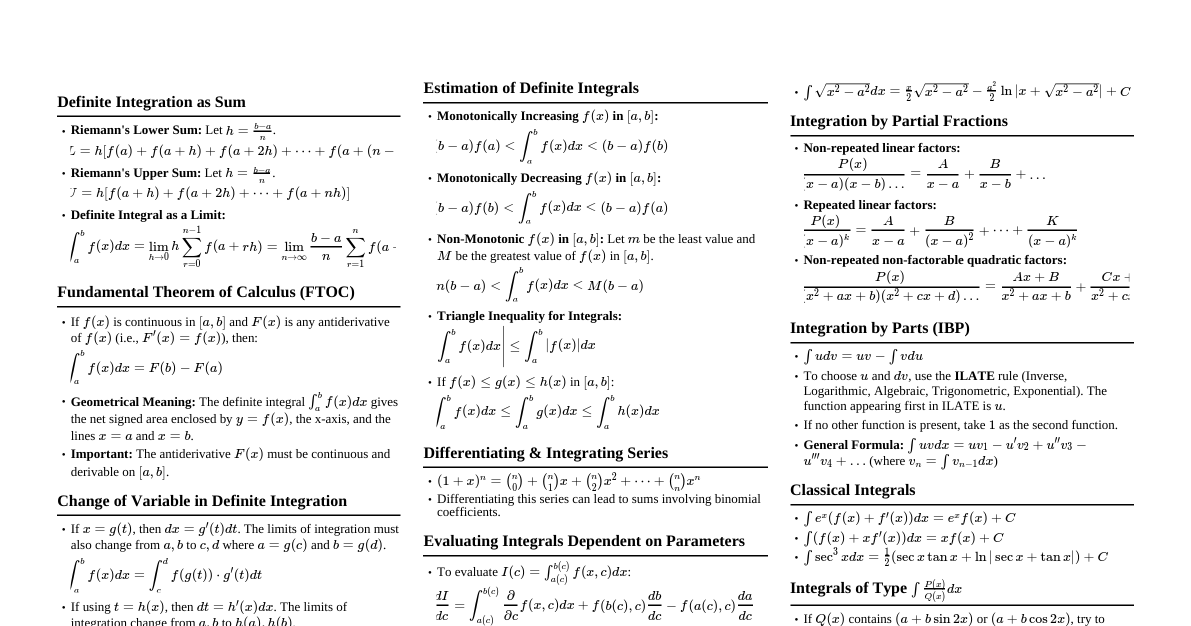
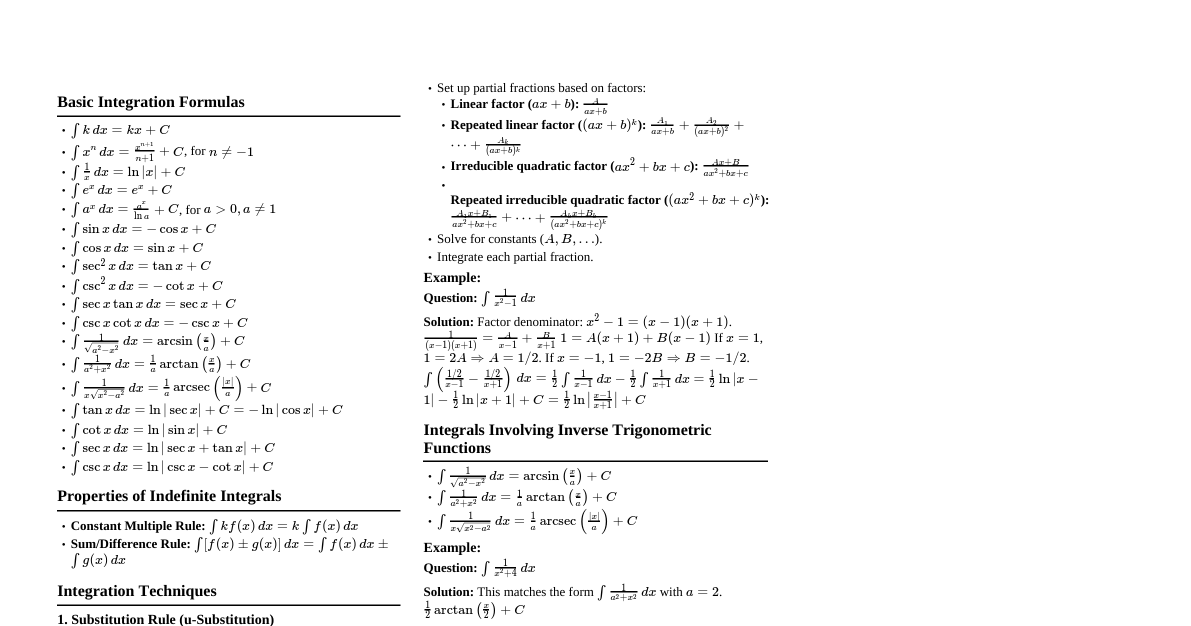
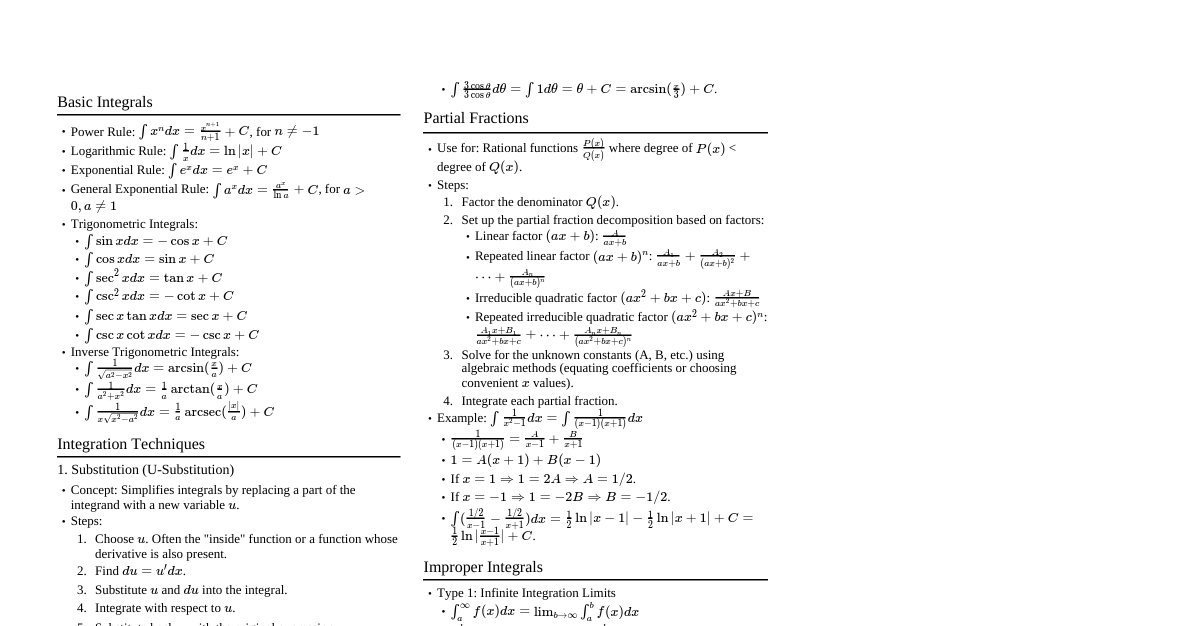
### Basic Integrals - **Power Rule:** $\int x^n dx = \frac{x^{n+1}}{n+1} + C \quad (n \neq -1)$ - **Logarithmic Rule:** $\int \frac{1}{x} dx = \ln|x| + C$ - **Exponential Rule:** $\int e^x dx = e^x + C$ - **General Exponential Rule:** $\int a^x dx = \frac{a^x}{\ln a} + C$ - **Trigonometric Integrals:** - $\int \sin x dx = -\cos x + C$ - $\int \cos x dx = \sin x + C$ - $\int \sec^2 x dx = \tan x + C$ - $\int \csc^2 x dx = -\cot x + C$ - $\int \sec x \tan x dx = \sec x + C$ - $\int \csc x \cot x dx = -\csc x + C$ - **Inverse Trigonometric Integrals:** - $\int \frac{1}{\sqrt{a^2 - x^2}} dx = \arcsin\left(\frac{x}{a}\right) + C$ - $\int \frac{1}{a^2 + x^2} dx = \frac{1}{a}\arctan\left(\frac{x}{a}\right) + C$ - $\int \frac{1}{x\sqrt{x^2 - a^2}} dx = \frac{1}{a}\operatorname{arcsec}\left(\frac{|x|}{a}\right) + C$ ### Integration Techniques #### Substitution (u-Substitution) - **Formula:** $\int f(g(x))g'(x) dx = \int f(u) du$ where $u = g(x)$ - **Steps:** 1. Choose $u = g(x)$ (often the "inner" function). 2. Find $du = g'(x) dx$. 3. Rewrite the integral in terms of $u$. 4. Integrate with respect to $u$. 5. Substitute back $u = g(x)$. #### Integration by Parts - **Formula:** $\int u \ dv = uv - \int v \ du$ - **LIATE Rule for choosing $u$:** 1. **L**ogarithmic functions ($\ln x$, $\log_b x$) 2. **I**nverse trigonometric functions ($\arctan x$, $\arcsin x$) 3. **A**lgebraic functions ($x^n$, polynomials) 4. **T**rigonometric functions ($\sin x$, $\cos x$) 5. **E**xponential functions ($e^x$, $a^x$) #### Trigonometric Integrals - **Powers of $\sin x$ and $\cos x$:** - If power of $\sin x$ is odd, save $\sin x$, convert rest to $\cos x$. Let $u = \cos x$. - If power of $\cos x$ is odd, save $\cos x$, convert rest to $\sin x$. Let $u = \sin x$. - If both powers are even, use half-angle identities: - $\sin^2 x = \frac{1 - \cos(2x)}{2}$ - $\cos^2 x = \frac{1 + \cos(2x)}{2}$ - $\sin x \cos x = \frac{\sin(2x)}{2}$ - **Powers of $\sec x$ and $\tan x$:** - If power of $\sec x$ is even, save $\sec^2 x$, convert rest to $\tan x$. Let $u = \tan x$. - If power of $\tan x$ is odd, save $\sec x \tan x$, convert rest to $\sec x$. Let $u = \sec x$. #### Trigonometric Substitution - **Form:** $\sqrt{a^2 - x^2} \implies x = a \sin \theta$ - **Form:** $\sqrt{a^2 + x^2} \implies x = a \tan \theta$ - **Form:** $\sqrt{x^2 - a^2} \implies x = a \sec \theta$ #### Partial Fraction Decomposition - Used for rational functions $\frac{P(x)}{Q(x)}$ where degree of $P(x)$ ### Definite Integrals - **Fundamental Theorem of Calculus (Part 2):** $\int_a^b f(x) dx = F(b) - F(a)$, where $F'(x) = f(x)$. - **Properties:** - $\int_a^b c f(x) dx = c \int_a^b f(x) dx$ - $\int_a^b (f(x) \pm g(x)) dx = \int_a^b f(x) dx \pm \int_a^b g(x) dx$ - $\int_a^b f(x) dx = -\int_b^a f(x) dx$ - $\int_a^a f(x) dx = 0$ - $\int_a^c f(x) dx + \int_c^b f(x) dx = \int_a^b f(x) dx$ - **Average Value of a Function:** $f_{avg} = \frac{1}{b-a}\int_a^b f(x) dx$ ### Improper Integrals - **Type 1: Infinite Intervals** - $\int_a^\infty f(x) dx = \lim_{b \to \infty} \int_a^b f(x) dx$ - $\int_{-\infty}^b f(x) dx = \lim_{a \to -\infty} \int_a^b f(x) dx$ - $\int_{-\infty}^\infty f(x) dx = \int_{-\infty}^c f(x) dx + \int_c^\infty f(x) dx$ (must converge separately) - **Type 2: Discontinuities** - If $f(x)$ is discontinuous at $b$: $\int_a^b f(x) dx = \lim_{t \to b^-} \int_a^t f(x) dx$ - If $f(x)$ is discontinuous at $a$: $\int_a^b f(x) dx = \lim_{t \to a^+} \int_t^b f(x) dx$ - If $f(x)$ is discontinuous at $c \in (a,b)$: $\int_a^b f(x) dx = \int_a^c f(x) dx + \int_c^b f(x) dx$ (must converge separately) - **Convergence of $p$-integrals:** - $\int_1^\infty \frac{1}{x^p} dx$ converges if $p > 1$ - $\int_0^1 \frac{1}{x^p} dx$ converges if $p ### Applications - **Area between curves:** $\int_a^b |f(x) - g(x)| dx$ - **Volume of Revolution (Disk/Washer Method):** - About x-axis: $V = \pi \int_a^b [R(x)^2 - r(x)^2] dx$ - About y-axis: $V = \pi \int_c^d [R(y)^2 - r(y)^2] dy$ - **Volume of Revolution (Cylindrical Shells):** - About y-axis: $V = 2\pi \int_a^b x f(x) dx$ - About x-axis: $V = 2\pi \int_c^d y f(y) dy$ - **Arc Length:** $L = \int_a^b \sqrt{1 + [f'(x)]^2} dx$ or $L = \int_c^d \sqrt{1 + [g'(y)]^2} dy$ - **Surface Area of Revolution:** - About x-axis: $S = 2\pi \int_a^b f(x)\sqrt{1 + [f'(x)]^2} dx$ - About y-axis: $S = 2\pi \int_c^d g(y)\sqrt{1 + [g'(y)]^2} dy$