Polynomials (Quadratic) Test
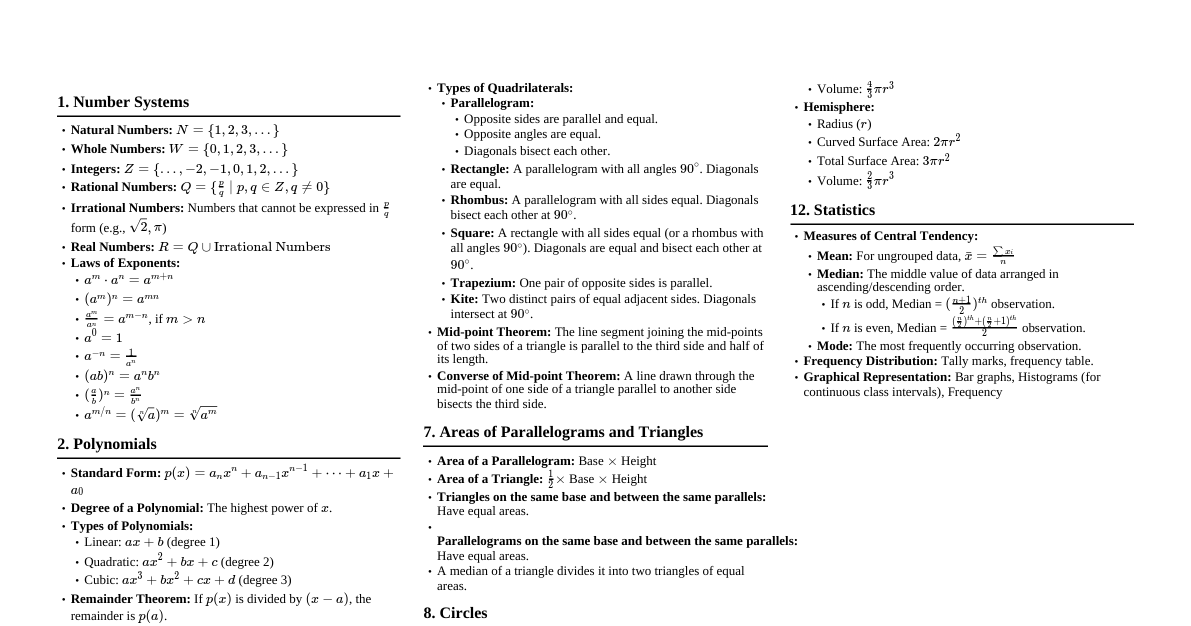
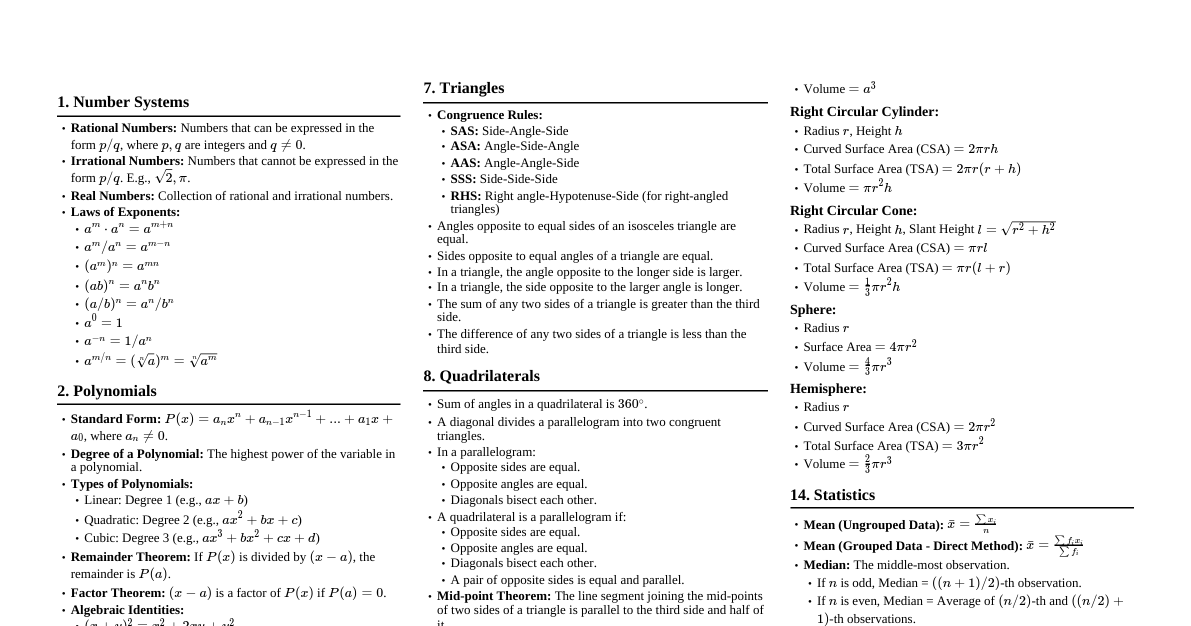
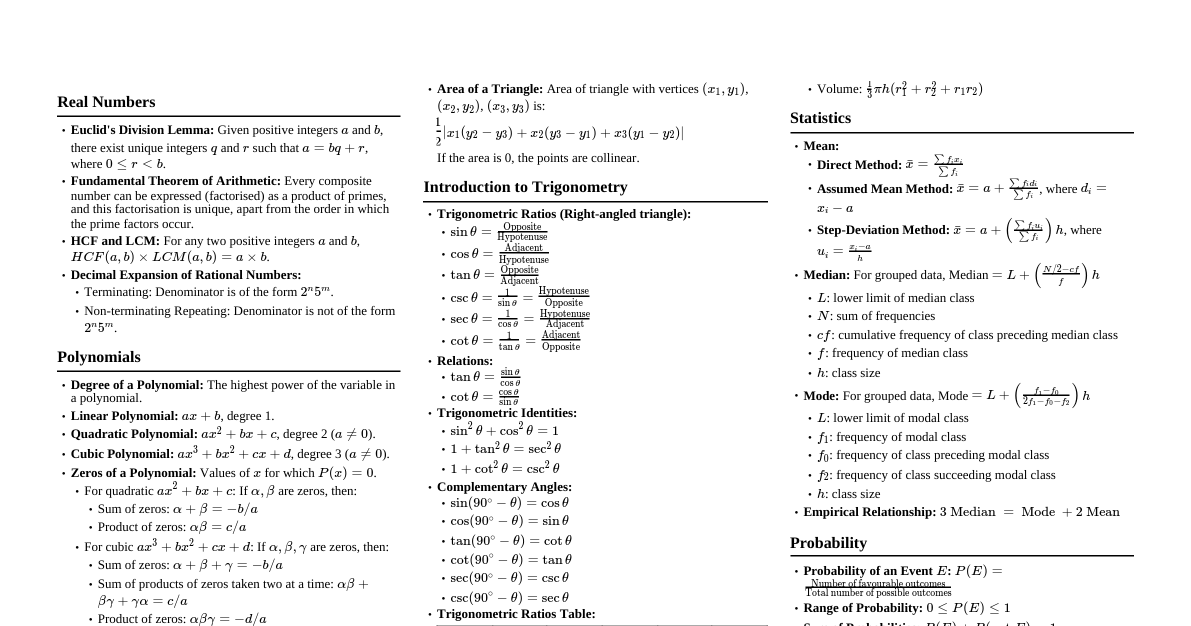
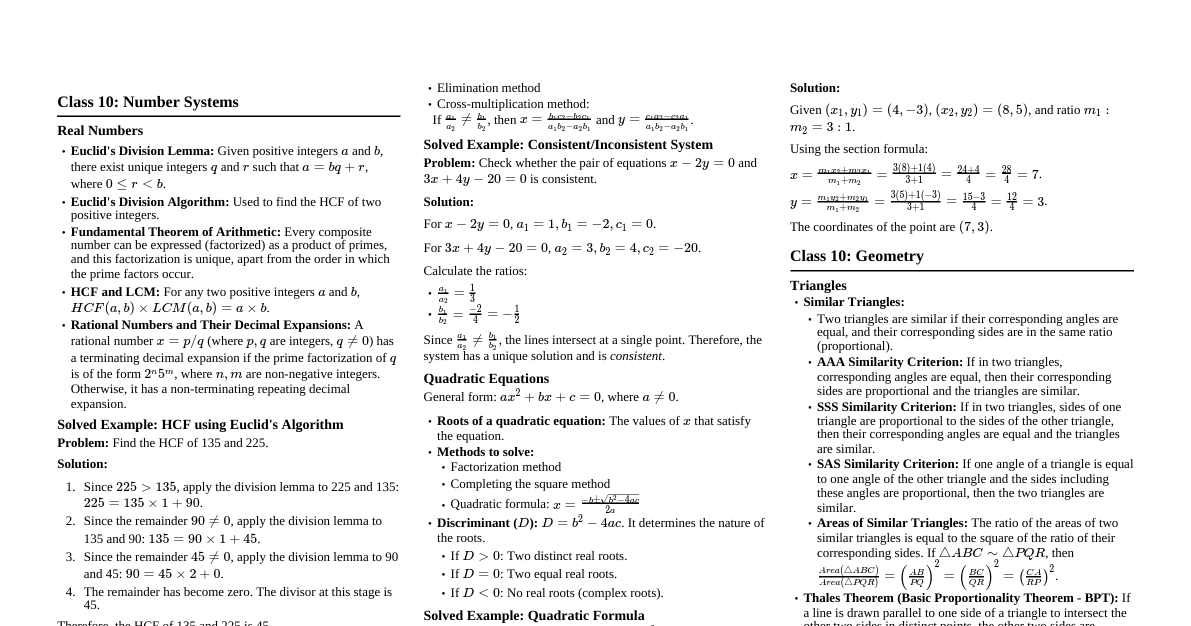
Cheatsheet Content
### General Instructions - All questions are compulsory. - The question paper consists of 30 questions divided into four sections A, B, C, and D. - Section A comprises 10 questions of 1 mark each. - Section B comprises 5 questions of 2 marks each. - Section C comprises 10 questions of 3 marks each. - Section D comprises 5 questions of 6 marks each. - There is no overall choice. However, an internal choice has been provided in one question of 2 marks, three questions of 3 marks, and two questions of 6 marks. You have to attempt only one of the alternatives in all such questions. - Use of calculators is not permitted. ### Section A: Objective Type Questions (1 Mark Each) **Directions for Q. No. 1 to 3:** In the following questions, a statement of Assertion (A) is followed by a statement of Reason (R). Choose the correct option. (a) Both A and R are true and R is the correct explanation of A. (b) Both A and R are true but R is not the correct explanation of A. (c) A is true but R is false. (d) A is false but R is true. 1. **Assertion (A):** The degree of the polynomial $P(x) = (x-1)(x^2+1)$ is 3. **Reason (R):** The degree of a polynomial is the highest power of the variable in the polynomial. 2. **Assertion (A):** If $\alpha$ and $\beta$ are the zeros of $x^2 + 5x + 8$, then $\alpha + \beta = -5$. **Reason (R):** The sum of the zeros of a quadratic polynomial $ax^2 + bx + c$ is given by $-b/a$. 3. **Assertion (A):** A quadratic polynomial can have at most two zeros. **Reason (R):** The graph of a quadratic polynomial is a parabola. 4. If one zero of the quadratic polynomial $x^2 + 3x + k$ is 2, then the value of $k$ is: (a) 10 (b) -10 (c) 5 (d) -5 5. The number of zeros of the polynomial $p(x)$ whose graph is given below is: (a) 1 (b) 2 (c) 3 (d) 0 6. A quadratic polynomial whose sum and product of zeros are -3 and 2 respectively, is: (a) $x^2 - 3x + 2$ (b) $x^2 + 3x - 2$ (c) $x^2 + 3x + 2$ (d) $x^2 - 3x - 2$ 7. If $\alpha$ and $\beta$ are the zeros of the polynomial $2x^2 + 5x - 10$, then the value of $\alpha \beta$ is: (a) $5/2$ (b) $-5/2$ (c) $-5$ (d) $5$ 8. If the zeros of the quadratic polynomial $x^2 + (a+1)x + b$ are 2 and -3, then: (a) $a = -7, b = -1$ (b) $a = 5, b = -1$ (c) $a = 2, b = -6$ (d) $a = 0, b = -6$ 9. If one zero of the polynomial $ky^2 + 3y + k$ is 1, then the value of $k$ is: (a) $3/2$ (b) $-3/2$ (c) $2/3$ (d) $-2/3$ 10. The sum of the zeros of $2x^2 - 8x + 6$ is: (a) 4 (b) -4 (c) 3 (d) -3 ### Section B: Short Answer Type Questions - I (2 Marks Each) 11. Find the zeros of the quadratic polynomial $x^2 - 2x - 8$. 12. Find a quadratic polynomial whose zeros are $3 + \sqrt{2}$ and $3 - \sqrt{2}$. 13. If $\alpha$ and $\beta$ are the zeros of the polynomial $x^2 - x - 4$, then find the value of $\frac{1}{\alpha} + \frac{1}{\beta}$. 14. Check whether $x^2 + 3x + 1$ is a factor of $3x^4 + 5x^3 - 7x^2 + 2x + 2$. **OR** Divide $p(x) = x^3 - 3x^2 + 5x - 3$ by $g(x) = x^2 - 2$ and find the quotient and remainder. 15. If the product of the zeros of the polynomial $ax^2 - 6x - 6$ is 4, find the value of 'a'. ### Section C: Short Answer Type Questions - II (3 Marks Each) 16. Find the zeros of the quadratic polynomial $6x^2 - 3 - 7x$ and verify the relationship between the zeros and the coefficients. 17. If $\alpha$ and $\beta$ are the zeros of the quadratic polynomial $p(x) = 4x^2 - 5x - 1$, find the value of $\alpha^2 \beta + \alpha \beta^2$. 18. Find a quadratic polynomial whose zeros are reciprocals of the zeros of the polynomial $f(x) = ax^2 + bx + c$, where $a \neq 0, c \neq 0$. 19. On dividing $x^3 - 3x^2 + x + 2$ by a polynomial $g(x)$, the quotient and remainder were $x - 2$ and $-2x + 4$ respectively. Find $g(x)$. 20. If the zeros of the polynomial $x^2 + px + q$ are double in value to the zeros of $2x^2 - 5x - 3$, find the values of $p$ and $q$. **OR** If $\alpha$ and $\beta$ are the zeros of the polynomial $f(x) = x^2 - 5x + k$ such that $\alpha - \beta = 1$, find the value of $k$. 21. If $\alpha$ and $\beta$ are the zeros of the polynomial $x^2 - 6x + k$, and $3\alpha + 2\beta = 20$, find the value of $k$. 22. What must be added to $2x^4 - 2x^3 - 7x^2 + 2x + 8$ so that the resulting polynomial is exactly divisible by $x^2 - x - 2$? 23. If two zeros of the polynomial $x^4 - 6x^3 - 26x^2 + 138x - 35$ are $2 + \sqrt{3}$ and $2 - \sqrt{3}$, find the other zeros. 24. For what value of $k$, is the polynomial $2x^3 + ax^2 + 11x + a + 3$ exactly divisible by $2x - 1$? **OR** If the polynomial $6x^4 + 8x^3 + 17x^2 + 21x + 7$ is divided by another polynomial $3x^2 + 4x + 1$, the remainder comes out to be $ax + b$. Find $a$ and $b$. 25. Frame a quadratic polynomial whose zeros are 2 and 3. ### Section D: Long Answer Type Questions (6 Marks Each) 26. Find all the zeros of $2x^4 - 3x^3 - 3x^2 + 6x - 2$, if you know that two of its zeros are $\sqrt{2}$ and $-\sqrt{2}$. 27. **Assertion (A):** If $\alpha$ and $\beta$ are the zeros of the quadratic polynomial $f(x) = x^2 - p(x+1) - c$, then $(\alpha+1)(\beta+1) = 1-c$. **Reason (R):** For a quadratic polynomial $ax^2 + bx + c$, the sum of zeros is $-b/a$ and product of zeros is $c/a$. Choose the correct option: (a) Both A and R are true and R is the correct explanation of A. (b) Both A and R are true but R is not the correct explanation of A. (c) A is true but R is false. (d) A is false but R is true. 28. If the polynomial $x^4 + 2x^3 + 8x^2 + 12x + 18$ is divided by another polynomial $x^2 + 5$, the remainder comes out to be $px + q$. Find the values of $p$ and $q$. **OR** If the zeros of the polynomial $x^3 - 3x^2 + x + 1$ are $a-b, a, a+b$, find $a$ and $b$. 29. Obtain all other zeros of the polynomial $x^4 + 4x^3 - 2x^2 - 20x - 15$, if two of its zeros are $\sqrt{5}$ and $-\sqrt{5}$. 30. **Assertion (A):** If $\alpha, \beta$ are the zeros of $2x^2 + 5x + k$, and $\alpha^2 + \beta^2 + \alpha \beta = 21/4$, then $k = 2$. **Reason (R):** For a quadratic polynomial $ax^2 + bx + c$, $\alpha^2 + \beta^2 = (\alpha+\beta)^2 - 2\alpha\beta$. Choose the correct option: (a) Both A and R are true and R is the correct explanation of A. (b) Both A and R are true but R is not the correct explanation of A. (c) A is true but R is false. (d) A is false but R is true. **OR** If the remainder on division of $x^3 + 2x^2 + kx + 3$ by $x-3$ is 21, find the quotient and the value of $k$. Hence, find the zeros of the polynomial $x^3 + 2x^2 + kx - 18$.