Metals and Non-metals
Cheatsheet Content
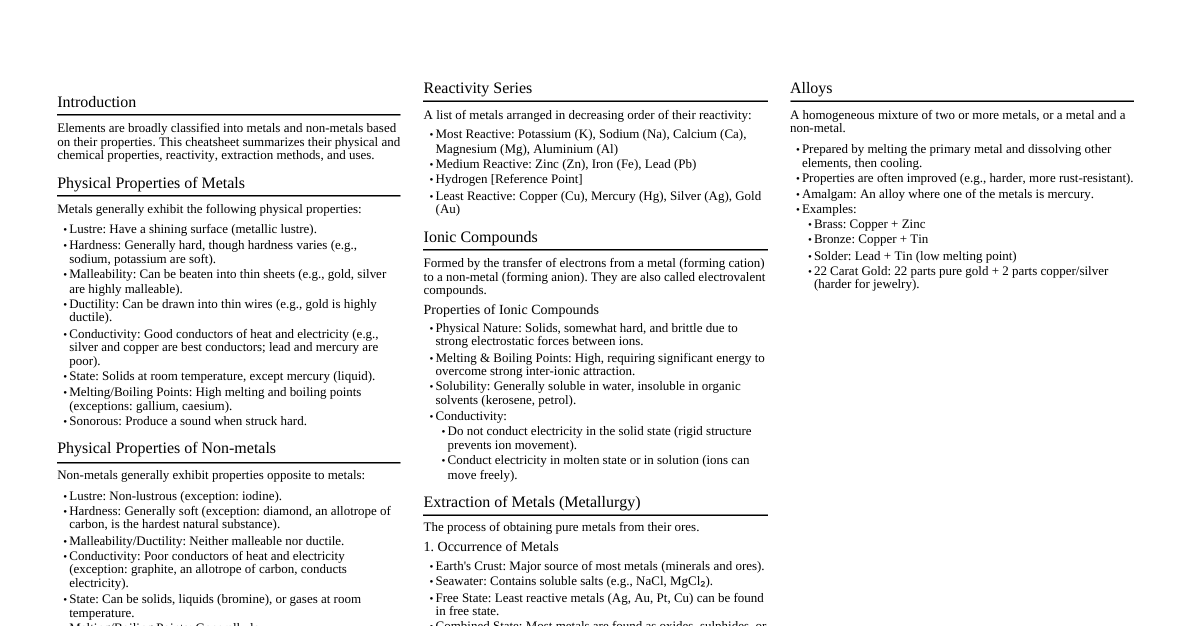
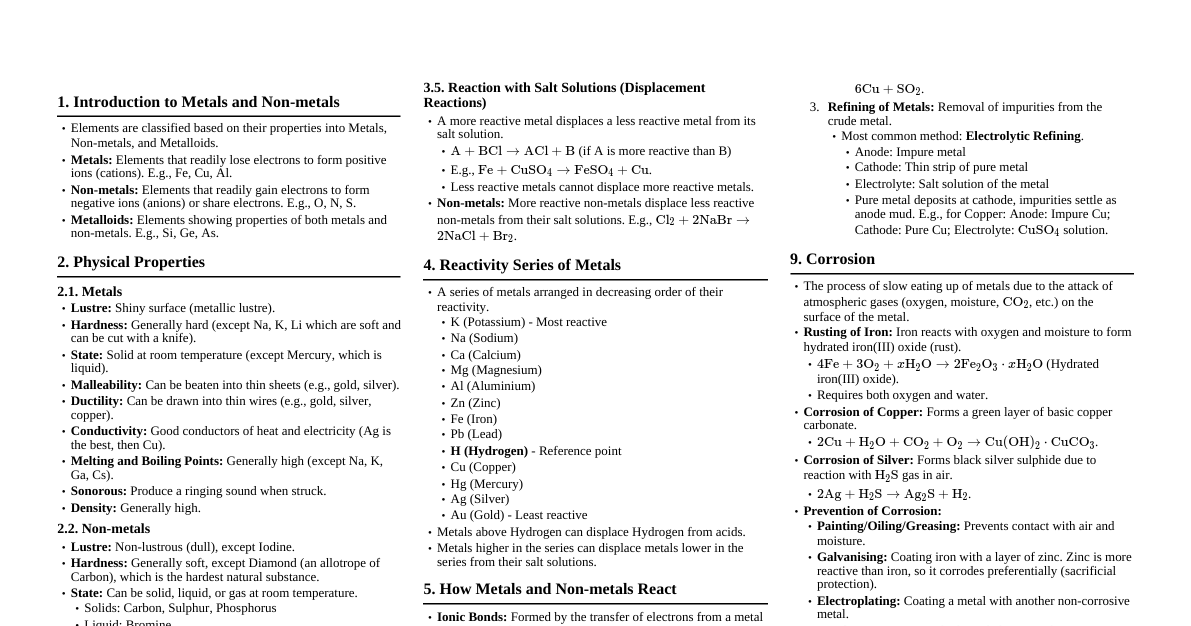
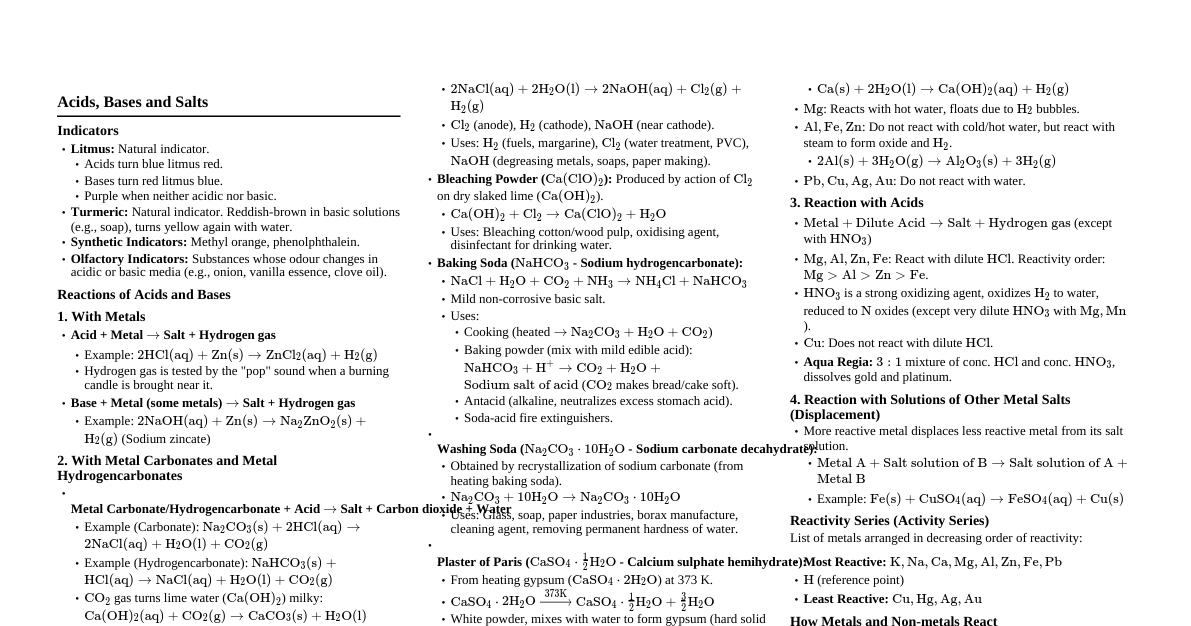
### Chapter Overview: Metals and Non-metals - A Comprehensive Guide Welcome, future scientists! This chapter is a cornerstone of chemistry, laying the foundation for understanding the vast diversity of elements around us. We'll delve deep into the fascinating world of metals and non-metals, exploring their distinct characteristics, how they interact, and their real-world applications. Mastering this chapter is crucial for your board exams, as it frequently features a variety of question types – from direct definitions to application-based problems and chemical equations. **Why is this chapter important?** * **Fundamental Chemistry:** It introduces basic classification of elements and chemical bonding. * **Everyday Relevance:** You'll understand why certain materials behave the way they do (e.g., why electrical wires are copper, why jewellery is gold). * **Industrial Applications:** Concepts like extraction of metals (metallurgy) and corrosion prevention have huge industrial significance. * **Problem-Solving Skills:** You'll learn to apply principles to predict reactions and properties. Let's begin our journey to mastering Metals and Non-metals! ### 1. Introduction to Elements: Metals vs. Non-metals At the most basic level, all matter is composed of elements. We classify these elements primarily into two major categories: **Metals** and **Non-metals**, based on their distinct physical and chemical properties. A third category, **Metalloids**, exhibits properties intermediate to both, but for your board exam, the focus is largely on the first two. **Key Idea:** The properties of an element are determined by its electronic configuration, particularly the number of valence electrons. Metals tend to lose electrons, while non-metals tend to gain or share electrons. ### 2. Physical Properties of Metals Metals are renowned for a set of characteristic physical properties that make them indispensable in technology and daily life. You *must* know these properties and their exceptions for the board exam. #### 2.1. Lustre (Shining Surface) * **Concept:** Metals have a characteristic shine, called **metallic lustre**. This is due to the free electrons present in their structure, which absorb and re-emit light. * **Board Tip:** Always mention "metallic lustre." * **Activity 3.1 Connection:** * **Observation:** Freshly cut surfaces of iron, copper, aluminium, and magnesium appear shiny. Sandpapering removes dull oxide layers, revealing the lustre. * **Exam Question:** "Why do metals lose their shine when exposed to air?" * **Answer:** Metals react with atmospheric gases (like oxygen, moisture, carbon dioxide) to form a thin, dull layer of metal oxide/carbonate/sulphide on their surface, which hides the metallic lustre. Sandpapering removes this layer. #### 2.2. Hardness * **Concept:** Most metals are generally hard and strong. This is due to the strong metallic bonds holding the atoms together. * **Exception (CRITICAL for exams!):** **Alkali metals** (Lithium, Sodium, Potassium) are exceptionally soft and can be easily cut with a knife. This is because they have only one valence electron and a relatively large atomic size, leading to weaker metallic bonding compared to other metals. * **Activity 3.2 Connection:** * **Observation:** You can easily cut sodium, but not iron or copper, with a knife. * **Exam Question:** "Name two metals which can be cut with a knife. Give a reason." * **Answer:** Sodium and Potassium. Reason: They are soft due to weak metallic bonding as they have only one valence electron. #### 2.3. Malleability * **Concept:** The property of metals due to which they can be beaten into thin sheets without breaking. This is possible because metal atoms can slide past each other without disrupting the metallic bond. * **Board Tip:** Gold and silver are the most malleable metals. * **Activity 3.3 Connection:** * **Observation:** When you strike pieces of iron, zinc, lead, or copper with a hammer, they flatten into sheets. * **Exam Question:** "Which property of metals makes them suitable for making jewellery and decorative items?" * **Answer:** Malleability and ductility. #### 2.4. Ductility * **Concept:** The property of metals due to which they can be drawn into thin wires. Similar to malleability, this is due to the ability of metal atoms to slide past each other. * **Board Tip:** Gold is the most ductile metal (1 gram of gold can be drawn into a 2 km long wire). * **Activity 3.4 Connection:** * **Observation:** We see copper and aluminium wires used in electrical circuits. * **Exam Question:** "Why are copper and aluminium preferred for making electrical wires?" * **Answer:** They are highly ductile and excellent conductors of electricity. #### 2.5. Good Conductors of Heat (Thermal Conductivity) * **Concept:** Metals are excellent conductors of heat. The free electrons in the metal lattice efficiently transfer thermal energy throughout the material. * **Board Tip:** Silver and copper are the best conductors of heat. * **Exceptions (Important!):** Lead and mercury are relatively poor conductors of heat among metals. * **Activity 3.5 Connection:** * **Observation:** When one end of a metal wire is heated, a pin fixed with wax at the other end falls off, indicating heat transfer. * **Exam Question:** "Explain why cooking utensils are made of metals like copper or aluminium." * **Answer:** Metals are good conductors of heat, ensuring efficient and even heating of food. #### 2.6. Good Conductors of Electricity (Electrical Conductivity) * **Concept:** Metals are excellent conductors of electricity. The delocalised (free) electrons can move throughout the metallic structure, carrying electric charge. * **Board Tip:** Silver is the best electrical conductor, followed by copper. * **Activity 3.6 Connection:** * **Observation:** A bulb glows when a metal sample is placed in a circuit. * **Exam Question:** "Why are electrical wires often coated with PVC or rubber?" * **Answer:** PVC and rubber are insulators, preventing electric shock and short circuits. This highlights the contrast between the conductive properties of metals and insulating properties of non-metals/polymers. #### 2.7. Sonorous * **Concept:** Metals produce a characteristic ringing sound when struck. This property is called **sonority**. It's due to the vibration of the tightly packed metal atoms. * **Board Tip:** This property is why bells are made of metals. #### 2.8. State at Room Temperature * **Concept:** Most metals exist as solids at room temperature due to strong metallic bonds. * **Exception (CRITICAL!):** **Mercury (Hg)** is the only metal that is a liquid at room temperature. * **Other Exceptions:** Gallium (Ga) and Caesium (Cs) have very low melting points (just above room temperature) and can melt in your palm. #### 2.9. Melting and Boiling Points * **Concept:** Metals generally have high melting and boiling points, reflecting the strong forces holding their atoms together. * **Exceptions:** Gallium and Caesium have very low melting points. Alkali metals (Li, Na, K) also have relatively lower melting and boiling points compared to most other metals. --- **SUMMARY TABLE: Physical Properties of Metals** | Property | Description | Exceptions | Importance | | :------------------- | :-------------------------------------------- | :---------------------------------------------- | :--------------------------------------------- | | **Lustre** | Shiny surface | None | Jewellery, decorative | | **Hardness** | Generally hard | Na, K, Li (soft, cut with knife) | Construction, tools | | **Malleability** | Beat into thin sheets | None (most malleable: Au, Ag) | Jewellery, foils | | **Ductility** | Drawn into thin wires | None (most ductile: Au) | Wires | | **Heat Conduction** | Good conductors | Pb, Hg (poor) | Cooking utensils | | **Elec. Conduction** | Good conductors | None (best: Ag, Cu) | Electrical wires | | **Sonorous** | Produce ringing sound | None | Bells | | **State** | Solids at room temp. | Hg (liquid) | Varies | | **M.P./B.P.** | High | Ga, Cs (low), Alkali metals (relatively low) | Industrial applications | --- ### 3. Physical Properties of Non-metals Non-metals generally exhibit properties opposite to metals. Understanding these contrasts is key. #### 3.1. Non-lustrous * **Concept:** Non-metals typically have a dull appearance. They do not reflect light in the same way metals do. * **Exception (CRITICAL!):** **Iodine** is a non-metal that has a distinct metallic lustre. #### 3.2. Softness * **Concept:** Most non-metals are soft or brittle. * **Exception (CRITICAL!):** **Diamond** (an allotrope of carbon) is the hardest natural substance known. This is due to its strong, covalent network structure. #### 3.3. Brittleness (Non-malleable and Non-ductile) * **Concept:** Non-metals are typically brittle. When struck, they break into pieces or powder. They cannot be beaten into sheets or drawn into wires. #### 3.4. Poor Conductors of Heat and Electricity * **Concept:** Non-metals generally lack free electrons, so they are poor conductors of both heat and electricity. They act as insulators. * **Exception (CRITICAL!):** **Graphite** (another allotrope of carbon) is a good conductor of electricity. This is because in graphite, each carbon atom is bonded to three others, leaving one free valence electron per atom which can move and conduct electricity. #### 3.5. State at Room Temperature * **Concept:** Non-metals can exist as solids, liquids, or gases at room temperature. * **Solids:** Carbon, Sulphur, Phosphorus * **Liquid:** **Bromine (Br)** – the only non-metal that is liquid at room temperature. * **Gases:** Oxygen, Nitrogen, Hydrogen, Chlorine, Fluorine, Helium, Neon, Argon (Noble gases) #### 3.6. Melting and Boiling Points * **Concept:** Non-metals generally have low melting and boiling points, as the forces between their molecules are relatively weak (except for network solids like diamond). --- **SUMMARY TABLE: Physical Properties of Non-metals** | Property | Description | Exceptions | | :------------------- | :-------------------------------------------- | :---------------------------------------------- | | **Lustre** | Dull | Iodine (lustrous) | | **Hardness** | Soft/Brittle | Diamond (hardest natural substance) | | **Malleability** | Non-malleable | None | | **Ductility** | Non-ductile | None | | **Heat Conduction** | Poor conductors | None | | **Elec. Conduction** | Poor conductors | Graphite (good conductor) | | **Sonorous** | Non-sonorous | None | | **State** | Solids, Liquids, Gases | Bromine (liquid) | | **M.P./B.P.** | Low | Diamond (very high) | --- **Activity 3.7 Connection (Non-metal Properties):** * **Observation:** Carbon (charcoal/coal) is dull and brittle. Sulphur is yellow and brittle. Iodine crystals are purplish-black and shiny. * **Testing Conductivity:** Carbon (graphite pencil lead) will conduct electricity, while sulphur and iodine will not. * **Exam Question:** "A student was given three samples: A, B, and C. A is shiny, hard, and conducts electricity. B is dull, brittle, and does not conduct electricity. C is dull, soft, and conducts electricity. Identify A, B, and C as metal/non-metal/allotrope, giving reasons." * **Answer:** * A: Metal (shiny, hard, good conductor). * B: Non-metal (dull, brittle, poor conductor). Example: Sulphur. * C: Non-metal (dull, soft, good conductor). Example: Graphite (an allotrope of carbon). **HOTS Question:** "Why are metals used in bells, but non-metals are not?" * **Answer:** Metals are sonorous, meaning they produce a ringing sound when struck. Non-metals are non-sonorous and would simply produce a dull thud or break. ### 4. Important Exceptions to General Properties (Board Exam Favourites!) This section is *highly important* for short answer questions and multiple-choice questions. Memorise these. * **Mercury (Hg):** A metal, but liquid at room temperature. (Common mistake: students forget it's a metal) * **Gallium (Ga) & Caesium (Cs):** Metals, but have very low melting points (melt in your palm). * **Iodine (I):** A non-metal, but is lustrous. * **Carbon (C) Allotropes:** * **Diamond:** A non-metal, but the hardest natural substance and has a very high melting/boiling point. * **Graphite:** A non-metal, but a good conductor of electricity. * **Alkali Metals (Lithium, Sodium, Potassium):** Metals, but very soft, have low densities, and low melting points. **Memory Aid:** Think of the "odd ones out" – these are the exceptions that examiners love to test! ### 5. Chemical Properties of Metals (Reactivity Series in Action!) The chemical properties of metals are fundamentally linked to their tendency to lose electrons and form positive ions (cations). This section will detail their reactions with oxygen, water, acids, and other metal salt solutions. #### 5.1. Reaction with Oxygen (Burning in Air) * **Basic Principle:** Most metals combine with oxygen to form metal oxides. **Metal + Oxygen → Metal oxide** * **WHY it happens:** Metals want to achieve a stable electronic configuration by losing valence electrons, and oxygen readily accepts electrons. * **Nature of Metal Oxides:** Metal oxides are generally **basic** in nature (react with acids). Some are **amphoteric**. * **Varying Reactivity:** The vigour of reaction with oxygen varies greatly among metals, forming the basis of the reactivity series. 1. **Highly Reactive Metals (K, Na):** * React vigorously (spontaneously catch fire) even at room temperature. * **Reason:** Extremely high affinity for oxygen. * **Equation:** $4Na(s) + O_2(g) \rightarrow 2Na_2O(s)$ (Sodium oxide) $4K(s) + O_2(g) \rightarrow 2K_2O(s)$ (Potassium oxide) * **Board Tip:** That's why they are stored under **kerosene oil** to prevent reaction with atmospheric oxygen and moisture. 2. **Moderately Reactive Metals (Mg, Al, Zn, Pb, Fe):** * **Magnesium (Mg):** Burns with a dazzling white flame. $2Mg(s) + O_2(g) \rightarrow 2MgO(s)$ (Magnesium oxide) * **Aluminium (Al), Zinc (Zn), Lead (Pb):** Their surfaces are covered with a thin, strong, protective layer of oxide. This layer prevents further oxidation, making them corrosion-resistant. $4Al(s) + 3O_2(g) \rightarrow 2Al_2O_3(s)$ (Aluminium oxide) * **Iron (Fe):** Does not burn readily, but iron filings burn vigorously when sprinkled in a flame (due to increased surface area). $3Fe(s) + 2O_2(g) \rightarrow Fe_3O_4(s)$ (Iron(II,III) oxide) 3. **Less Reactive Metals (Cu):** * **Copper (Cu):** Does not burn in air, but when heated, it forms a black coating of copper(II) oxide. $2Cu(s) + O_2(g) \xrightarrow{\text{Heat}} 2CuO(s)$ (Black copper(II) oxide) 4. **Least Reactive Metals (Ag, Au):** * Do not react with oxygen even at high temperatures. That's why they are found in the free state. * **Amphoteric Oxides (CRITICAL for exams!):** * **Concept:** Metal oxides that show both acidic and basic properties. They react with both acids and bases to produce salt and water. * **Examples:** Aluminium oxide ($Al_2O_3$) and Zinc oxide ($ZnO$). * **Equations (MUST know):** * **With Acid:** $Al_2O_3(s) + 6HCl(aq) \rightarrow 2AlCl_3(aq) + 3H_2O(l)$ * **With Base:** $Al_2O_3(s) + 2NaOH(aq) \rightarrow 2NaAlO_2(aq) + H_2O(l)$ (Sodium aluminate is the salt) * **WHY they are amphoteric:** They are formed by elements that are borderline between metals and non-metals, thus exhibiting dual characteristics. * **Solubility of Metal Oxides:** * Most metal oxides are insoluble in water. * Some dissolve in water to form alkalis (metal hydroxides). * $Na_2O(s) + H_2O(l) \rightarrow 2NaOH(aq)$ (Sodium hydroxide) * $K_2O(s) + H_2O(l) \rightarrow 2KOH(aq)$ (Potassium hydroxide) * **Anodising (Application-based question potential):** * **Concept:** An electrochemical process that forms a thick, protective oxide layer on aluminium. This layer is more durable and corrosion-resistant than the naturally formed thin layer. * **Process:** Aluminium article is made the anode in an electrolytic cell containing dilute sulphuric acid. Oxygen gas is evolved at the anode, which reacts with aluminium to form a thicker oxide layer. * **Purpose:** Enhances corrosion resistance, can be dyed for decorative purposes. #### 5.2. Reaction with Water * **Basic Principle:** Metals react with water to form metal oxide/hydroxide and hydrogen gas. **Metal + Water $\rightarrow$ Metal oxide + Hydrogen** **Metal oxide + Water $\rightarrow$ Metal hydroxide** * **Varying Reactivity (CRITICAL for comparing reactivity):** 1. **Highly Reactive Metals (K, Na, Ca):** * React vigorously with **cold water**. * **Potassium (K) & Sodium (Na):** Reaction is highly exothermic, producing enough heat to ignite the hydrogen gas evolved. Hydrogen catches fire and burns with a pop sound. $2K(s) + 2H_2O(l) \rightarrow 2KOH(aq) + H_2(g) + \text{Heat energy}$ (Hydrogen ignites) $2Na(s) + 2H_2O(l) \rightarrow 2NaOH(aq) + H_2(g) + \text{Heat energy}$ (Hydrogen ignites) * **Calcium (Ca):** Reacts less violently with cold water. The heat evolved is *not* sufficient to ignite hydrogen. Calcium starts floating because the hydrogen bubbles stick to its surface. $Ca(s) + 2H_2O(l) \rightarrow Ca(OH)_2(aq) + H_2(g)$ 2. **Moderately Reactive Metals (Mg):** * Does not react with cold water. * Reacts with **hot water** to form magnesium hydroxide and hydrogen. It also floats due to hydrogen bubbles. $Mg(s) + 2H_2O(l) \xrightarrow{\text{Hot}} Mg(OH)_2(aq) + H_2(g)$ 3. **Less Reactive Metals (Al, Fe, Zn):** * Do not react with cold or hot water. * React with **steam** (gaseous water) to form metal oxide and hydrogen gas. $2Al(s) + 3H_2O(g) \xrightarrow{\text{Heat}} Al_2O_3(s) + 3H_2(g)$ $3Fe(s) + 4H_2O(g) \xrightarrow{\text{Heat}} Fe_3O_4(s) + 4H_2(g)$ $Zn(s) + H_2O(g) \xrightarrow{\text{Heat}} ZnO(s) + H_2(g)$ 4. **Least Reactive Metals (Pb, Cu, Ag, Au):** * Do not react with water (cold, hot, or steam) at all. #### 5.3. Reaction with Acids * **Basic Principle:** Most metals react with dilute acids to form a salt and hydrogen gas. **Metal + Dilute acid → Salt + Hydrogen gas** * **WHY it happens:** Metals higher in the reactivity series are more eager to lose electrons and displace hydrogen from acids. * **Activity 3.8 Connection (Reactivity Comparison):** * **Observation:** Magnesium reacts fastest with dilute HCl (most vigorous bubble formation), followed by aluminium, zinc, and iron. Copper shows no reaction. * **Conclusion:** Reactivity order: Mg > Al > Zn > Fe > Cu. * **Equations:** * $Mg(s) + 2HCl(aq) \rightarrow MgCl_2(aq) + H_2(g)$ * $2Al(s) + 6HCl(aq) \rightarrow 2AlCl_3(aq) + 3H_2(g)$ * $Zn(s) + 2HCl(aq) \rightarrow ZnCl_2(aq) + H_2(g)$ * $Fe(s) + 2HCl(aq) \rightarrow FeCl_2(aq) + H_2(g)$ * $Cu(s) + HCl(aq) \rightarrow \text{No reaction}$ * **Reaction with Nitric Acid ($HNO_3$) (CRITICAL Exception!):** * **General Rule:** Hydrogen gas is *generally not evolved* when metals react with nitric acid. * **WHY:** Nitric acid ($HNO_3$) is a strong **oxidising agent**. It oxidises the hydrogen gas produced to water and itself gets reduced to various nitrogen oxides (e.g., $NO_2, NO, N_2O$). * **Exceptions:** Very dilute nitric acid reacts with **Magnesium (Mg)** and **Manganese (Mn)** to produce hydrogen gas. * $Mg(s) + 2HNO_3(\text{very dilute}) \rightarrow Mg(NO_3)_2(aq) + H_2(g)$ * **Aqua Regia (Royal Water) (Important definition/application):** * **Concept:** A freshly prepared mixture of concentrated hydrochloric acid (HCl) and concentrated nitric acid ($HNO_3$) in a **3:1 ratio by volume**. * **Property:** It is highly corrosive and can dissolve noble metals like gold and platinum, which single acids cannot. * **WHY:** Nitric acid acts as an oxidising agent, and HCl provides chloride ions which form stable complexes with gold ions, pulling the equilibrium forward. #### 5.4. Reaction with Solutions of Other Metal Salts (Displacement Reactions) * **Basic Principle:** A more reactive metal displaces a less reactive metal from its salt solution. This is a classic example of a **single displacement reaction**. **Metal A + Salt solution of B → Salt solution of A + Metal B** * **WHY it happens:** The more reactive metal has a greater tendency to lose electrons and form ions compared to the less reactive metal. * **Activity 3.9 Connection:** * **Observation:** When an iron nail is dipped in copper sulphate solution ($CuSO_4$), the blue colour of the solution fades, and a reddish-brown deposit of copper forms on the iron nail. * **Equation:** $Fe(s) + CuSO_4(aq) \rightarrow FeSO_4(aq) + Cu(s)$ * **Explanation:** Iron is more reactive than copper (refer to reactivity series). Iron displaces copper from its salt solution, forming iron(II) sulphate (green solution) and elemental copper. * **Observation:** If a copper wire is dipped in iron sulphate solution ($FeSO_4$), no reaction occurs. * **Explanation:** Copper is less reactive than iron, so it cannot displace iron from its salt solution. * **Board Tip:** These reactions are crucial for understanding the **Reactivity Series**. If you can predict displacement, you understand the series. ### 6. The Reactivity Series (Activity Series) - Your Key to Predicting Chemical Reactions The reactivity series is one of the most important concepts in this chapter. It's a list of metals arranged in decreasing order of their reactivity. You *must* be able to recall the order and apply it. | Metal | Symbol | Reactivity | Reaction with Oxygen | Reaction with Water | Reaction with Dilute Acids | | :--------- | :----- | :------------- | :------------------------- | :--------------------------- | :------------------------------ | | Potassium | K | Most reactive | Reacts violently (fire) | Reacts violently with cold H2O (fire) | Reacts violently | | Sodium | Na | | Reacts violently (fire) | Reacts violently with cold H2O (fire) | Reacts violently | | Calcium | Ca | | Burns brightly | Reacts with cold H2O (floats) | Reacts readily | | Magnesium | Mg | | Burns with dazzling flame | Reacts with hot H2O (floats) | Reacts readily | | Aluminium | Al | | Forms protective oxide | Reacts with steam | Reacts readily | | Zinc | Zn | | Forms protective oxide | Reacts with steam | Reacts readily | | Iron | Fe | | Burns as filings | Reacts with steam | Reacts readily | | Lead | Pb | | Forms protective oxide | No reaction with H2O | Reacts slowly | | **[Hydrogen]** | **[H]** | *Reference* | - | - | *Displacement reference* | | Copper | Cu | | Forms black oxide on heating | No reaction with H2O | No reaction | | Mercury | Hg | | No reaction | No reaction with H2O | No reaction | | Silver | Ag | | No reaction | No reaction with H2O | No reaction | | Gold | Au | Least reactive | No reaction | No reaction with H2O | No reaction | **Key Interpretations of the Reactivity Series:** 1. **Ease of Electron Loss:** Metals at the top lose electrons more easily and are more reactive. Metals at the bottom lose electrons with difficulty. 2. **Displacement Reactions:** A metal higher in the series can displace any metal below it from its salt solution. 3. **Reaction with Water:** Metals above hydrogen react with water (cold, hot, or steam). The higher the metal, the more vigorous the reaction. 4. **Reaction with Dilute Acids:** Metals above hydrogen can displace hydrogen from dilute acids. Metals below hydrogen cannot. 5. **Corrosion Tendency:** More reactive metals corrode more easily (e.g., Na, K) unless protected by an oxide layer (e.g., Al, Zn). **Memory Aid for Reactivity Series:** **K**edar **Na**th **Ca** **Ma**ali **Al**oo **Z**ara **F**eeke **P**akata **H**ai. **C**opper **H**ai **A**ap **G**old. (Potassium, Sodium, Calcium, Magnesium, Aluminium, Zinc, Iron, Lead, [Hydrogen], Copper, Mercury, Silver, Gold) **Expected Board Questions:** * "Arrange the following metals in decreasing order of reactivity: Zn, Na, Cu, Fe." * "Predict if a reaction will occur when copper is added to iron sulphate solution. Justify your answer." * "Why does sodium react vigorously with water, while iron reacts only with steam?" ### 7. Chemical Properties of Non-metals Non-metals tend to gain or share electrons to achieve a stable octet (or duplet for hydrogen). This fundamentally dictates their chemical behaviour. * **Formation of Oxides:** Non-metals react with oxygen to form non-metal oxides. * **Nature:** These oxides are typically **acidic** (e.g., $SO_2, CO_2$) or **neutral** (e.g., $CO, N_2O, H_2O$). * **Example:** Carbon burns in oxygen to form carbon dioxide. $C(s) + O_2(g) \rightarrow CO_2(g)$ (Carbon dioxide is acidic) * **Example:** Sulphur burns to form sulphur dioxide. $S(s) + O_2(g) \rightarrow SO_2(g)$ (Sulphur dioxide is acidic) * **Formation of Negatively Charged Ions:** When reacting with metals, non-metals gain electrons to form negatively charged ions (anions). * **Example:** Chlorine gaining an electron to form a chloride ion ($Cl^-$). * **Do Not Displace Hydrogen from Acids:** Due to their tendency to gain electrons, non-metals cannot donate electrons to displace hydrogen from acids. * **Reaction with Hydrogen:** Non-metals react with hydrogen to form hydrides (e.g., $H_2O, NH_3, CH_4$). **Key Contrast:** Metals *lose* electrons and form basic oxides; Non-metals *gain/share* electrons and form acidic/neutral oxides. ### 8. How Metals and Non-metals React: The Formation of Ionic Compounds This is a crucial section for understanding chemical bonding. Elements react to achieve a stable electron configuration, typically resembling that of the nearest noble gas (a full valence shell). #### 8.1. Formation of Ionic Compounds (Metal + Non-metal) * **Concept:** When a metal reacts with a non-metal, electrons are **transferred** from the metal atom to the non-metal atom. This leads to the formation of oppositely charged ions, which are held together by strong electrostatic forces of attraction, forming an **ionic bond**. * **WHY electron transfer?** * **Metals:** Have 1, 2, or 3 valence electrons. It's energetically favourable for them to *lose* these electrons to achieve a stable octet (or duplet) and become positively charged ions (cations). * **Non-metals:** Have 5, 6, or 7 valence electrons. It's energetically favourable for them to *gain* electrons to complete their octet and become negatively charged ions (anions). * **Example 1: Formation of Sodium Chloride (NaCl)** * **Sodium (Na):** Atomic number 11. Electronic configuration: 2, 8, 1. * Na loses 1 electron to form $Na^+$ ion (stable configuration 2, 8). * $Na \rightarrow Na^+ + e^-$ (Sodium ion) * **Chlorine (Cl):** Atomic number 17. Electronic configuration: 2, 8, 7. * Cl gains 1 electron to form $Cl^-$ ion (stable configuration 2, 8, 8). * $Cl + e^- \rightarrow Cl^-$ (Chloride ion) * **Ionic Bond Formation:** The positively charged $Na^+$ and negatively charged $Cl^-$ ions attract each other strongly. * $Na^+ + Cl^- \rightarrow NaCl$ (Sodium Chloride) * **Electron Dot Structure:** ``` Na . + :Cl: -> [Na]+ [:Cl:]- ¨ ¨ ``` (Representing valence electrons only) * **Example 2: Formation of Magnesium Chloride ($MgCl_2$)** * **Magnesium (Mg):** Atomic number 12. Electronic configuration: 2, 8, 2. * Mg loses 2 electrons to form $Mg^{2+}$ ion (stable configuration 2, 8). * $Mg \rightarrow Mg^{2+} + 2e^-$ * **Chlorine (Cl):** Atomic number 17. Electronic configuration: 2, 8, 7. * Each Cl atom needs to gain 1 electron. Since Mg loses 2 electrons, two Cl atoms are required. * $2Cl + 2e^- \rightarrow 2Cl^-$ * **Ionic Bond Formation:** * $Mg^{2+} + 2Cl^- \rightarrow MgCl_2$ (Magnesium Chloride) * **Electron Dot Structure:** ``` :Cl: ¨ .Mg. + :Cl: -> [Cl]- [Mg]2+ [Cl]- ¨ ``` (One Mg atom transfers one electron to each of the two Cl atoms) * **HOTS Question:** "Explain why calcium chloride has the formula $CaCl_2$ and not $CaCl$." * **Answer:** Calcium (Ca) has 2 valence electrons and tends to lose both to form $Ca^{2+}$ ion. Chlorine (Cl) has 7 valence electrons and tends to gain 1 electron to form $Cl^-$ ion. To balance the charges, one $Ca^{2+}$ ion requires two $Cl^-$ ions, hence the formula $CaCl_2$. #### 8.2. Properties of Ionic Compounds * **Board Exam Favourite:** Be prepared to list and explain these properties. 1. **Physical Nature:** * **Concept:** Ionic compounds are typically **solids** and are generally **hard** and **brittle**. * **WHY:** The strong electrostatic forces of attraction between the oppositely charged ions hold them in a rigid, crystal lattice structure. When pressure is applied, the lattice can shift, bringing like-charged ions together, causing repulsion and resulting in brittleness. 2. **Melting and Boiling Points:** * **Concept:** Ionic compounds have very **high melting and boiling points**. * **WHY:** A large amount of energy (heat) is required to overcome the strong inter-ionic electrostatic forces of attraction and break the crystal lattice. 3. **Solubility:** * **Concept:** Generally **soluble in water** but **insoluble in organic solvents** (like kerosene, petrol, carbon tetrachloride). * **WHY:** Water is a polar solvent and can effectively interact with and separate the charged ions. Organic solvents are non-polar and cannot overcome the strong electrostatic forces within the ionic compound. 4. **Conduction of Electricity:** * **Concept:** * **Solid state:** Do **not** conduct electricity. * **Molten state or in aqueous solution:** Conduct electricity. * **WHY:** * **Solid state:** The ions are rigidly held in fixed positions within the crystal lattice and are not free to move, so they cannot carry electric current. * **Molten state/Aqueous solution:** In the molten state (melted) or when dissolved in water, the strong electrostatic forces are overcome, and the ions become free to move. These mobile ions can then carry electric charge, allowing the substance to conduct electricity. ### 9. Occurrence and Extraction of Metals (Metallurgy) This section deals with how we obtain metals from the Earth's crust. It's a practical application of the reactivity series. #### 9.1. Occurrence of Metals * **Earth's Crust:** The primary source of most metals. * **Seawater:** Contains dissolved salts, including those of sodium, magnesium, etc. * **Minerals:** Naturally occurring chemical substances (elements or compounds) in the Earth's crust. * **Ores:** Minerals from which metals can be **profitably** and economically extracted. All ores are minerals, but not all minerals are ores. * **Example:** Bauxite ($Al_2O_3 \cdot 2H_2O$) is an ore of aluminium. Haematite ($Fe_2O_3$) is an ore of iron. Cinnabar (HgS) is an ore of mercury. #### 9.2. Steps in Metallurgy (Extraction of Metals) Metallurgy involves several steps: 1. **Enrichment of Ores (Concentration):** Removing unwanted impurities (gangue) from the ore. 2. **Extraction of the metal:** Converting the concentrated ore into the metal. 3. **Refining of the metal:** Purifying the extracted metal. The method of extraction depends heavily on the metal's position in the reactivity series. #### A. Extraction of Metals of Low Reactivity (Au, Ag, Pt, Hg, Cu) * **Characteristics:** These metals are at the bottom of the reactivity series. They are very unreactive. * **Occurrence:** Often found in the **free state** (native state) as well as in combined forms (e.g., sulphides). * **Extraction Method:** Their oxides can be reduced by **heating alone**. * **Example: Mercury from Cinnabar (HgS)** 1. **Roasting:** Sulphide ore is heated in excess air to convert it to its oxide. $2HgS(s) + 3O_2(g) \xrightarrow{\text{Heat}} 2HgO(s) + 2SO_2(g)$ 2. **Reduction:** The mercury(II) oxide is then heated further to reduce it to mercury metal. $2HgO(s) \xrightarrow{\text{Heat}} 2Hg(l) + O_2(g)$ * **Example: Copper from Copper Sulphide ($Cu_2S$)** 1. **Roasting:** $2Cu_2S(s) + 3O_2(g) \xrightarrow{\text{Heat}} 2Cu_2O(s) + 2SO_2(g)$ 2. **Self-reduction:** Copper(I) oxide reacts with unreacted copper(I) sulphide to form copper metal. $2Cu_2O(s) + Cu_2S(s) \xrightarrow{\text{Heat}} 6Cu(s) + SO_2(g)$ #### B. Extraction of Metals of Medium Reactivity (Zn, Fe, Pb, Cu) * **Characteristics:** These metals are in the middle of the reactivity series. They are typically found as sulphides or carbonates. * **Extraction Strategy:** Convert the sulphide or carbonate ore into a metal oxide first, then reduce the oxide to metal. 1. **Conversion to Oxide:** * **Roasting:** For sulphide ores. Heating in excess air. $2ZnS(s) + 3O_2(g) \xrightarrow{\text{Heat}} 2ZnO(s) + 2SO_2(g)$ * **Calcination:** For carbonate ores. Heating in limited air (or absence of air). $ZnCO_3(s) \xrightarrow{\text{Heat}} ZnO(s) + CO_2(g)$ (Note: Calcination is used for carbonates, roasting for sulphides. Both produce oxides.) 2. **Reduction of Metal Oxide to Metal:** * Mainly done using a reducing agent like **carbon (coke)**. Carbon is cheaper and reduces metal oxides because it is more reactive than these metals. $ZnO(s) + C(s) \xrightarrow{\text{Heat}} Zn(s) + CO(g)$ $Fe_2O_3(s) + 3CO(g) \xrightarrow{\text{Heat}} 2Fe(s) + 3CO_2(g)$ (In blast furnace) 3. **Displacement Reactions (Thermit Reaction - Important!):** * Highly reactive metals (like Aluminium) can displace less reactive metals from their compounds. This reaction is highly exothermic (produces a lot of heat). * **Thermit Reaction:** Used for welding railway tracks or cracked machine parts. Iron(III) oxide is reduced by aluminium powder. The iron produced is in a molten state. $Fe_2O_3(s) + 2Al(s) \xrightarrow{\text{Heat}} 2Fe(l) + Al_2O_3(s) + \text{Heat}$ * **Other Example:** Manganese dioxide with aluminium powder. $3MnO_2(s) + 4Al(s) \xrightarrow{\text{Heat}} 3Mn(l) + 2Al_2O_3(s) + \text{Heat}$ #### C. Extraction of Metals of High Reactivity (K, Na, Ca, Mg, Al) * **Characteristics:** These metals are at the top of the reactivity series. They are never found in the free state. * **Challenge:** They have a very strong affinity for oxygen. They cannot be reduced using carbon because carbon is less reactive than these metals, meaning carbon cannot displace them from their oxides. * **Extraction Method:** **Electrolytic Reduction** of their molten chlorides. * **WHY molten?** In the solid state, ions are not free to move. Melting the salt allows the ions to become mobile and conduct electricity. * **Process:** The molten metal chloride is electrolysed. * **At Cathode (Negative electrode):** Positively charged metal ions ($M^+$) gain electrons and are deposited as neutral metal atoms. $Na^+ + e^- \rightarrow Na(s)$ $Ca^{2+} + 2e^- \rightarrow Ca(s)$ $Mg^{2+} + 2e^- \rightarrow Mg(s)$ $Al^{3+} + 3e^- \rightarrow Al(s)$ * **At Anode (Positive electrode):** Negatively charged chloride ions ($Cl^-$) lose electrons and are liberated as chlorine gas. $2Cl^- \rightarrow Cl_2(g) + 2e^-$ * **Common Mistake:** Students often forget that for high reactivity metals, it's *electrolysis of molten salt*, not aqueous solution (as water would react or hydrogen would be produced). #### 9.3. Enrichment of Ores * **Gangue:** Undesirable impurities (like soil, sand, rocky material) present in the ore. * **Process:** The first step in metallurgy is to remove this gangue from the ore. This is done using various physical or chemical separation techniques based on the properties of the ore and gangue (e.g., gravity separation, froth flotation, magnetic separation). #### 9.4. Refining of Metals * **Concept:** Metals obtained from the various extraction processes are often impure. Refining is the process of purifying these crude metals. * **Electrolytic Refining (Most important method for board exams):** * **Principle:** Based on the difference in electrochemical potentials of the impure metal and its impurities. * **Setup:** * **Anode (Positive electrode):** A thick block of the **impure metal** to be refined. * **Cathode (Negative electrode):** A thin strip of **pure metal**. * **Electrolyte:** A solution of a salt of the metal being refined (e.g., for copper, $CuSO_4$ solution). * **Process (Example: Refining Copper):** 1. When current is passed, the impure metal at the anode oxidises, and metal atoms lose electrons to form metal ions ($Cu^{2+}$) which dissolve into the electrolyte. **At Anode:** $Cu(impure) \rightarrow Cu^{2+}(aq) + 2e^-$ 2. At the cathode, pure metal ions from the electrolyte gain electrons and are deposited as pure metal on the thin strip of pure metal. **At Cathode:** $Cu^{2+}(aq) + 2e^- \rightarrow Cu(pure)$ 3. **Anode mud (Anode sludge):** The more reactive impurities present in the impure anode dissolve into the electrolyte. The less reactive impurities (like gold, silver, platinum) do not dissolve and settle down at the bottom of the anode as anode mud. * **Metals refined by electrolysis:** Copper, Zinc, Nickel, Silver, Gold. **HOTS Question:** "During electrolytic refining of copper, some metals like Ag and Au are found in the anode mud. Why?" * **Answer:** Silver and gold are less reactive than copper. During electrolysis, when impure copper (anode) dissolves, these noble metals do not oxidise (do not lose electrons) and therefore do not dissolve into the electrolyte. Being heavier, they simply fall off from the anode and collect at the bottom as anode mud. ### 10. Corrosion: The Slow Destruction of Metals Corrosion is a natural process that gradually destroys materials (usually metals) by chemical and/or electrochemical reaction with their environment. It's a significant economic problem. * **Concept:** The process by which metals are slowly eaten away (deteriorate) due to the action of air, moisture, or chemicals on their surface. It's essentially an oxidation process. #### Examples of Corrosion: * **Silver:** Reacts with sulphur compounds (e.g., hydrogen sulphide, $H_2S$) in the air to form black **silver sulphide ($Ag_2S$)**. This is why silver ornaments tarnish. * **Copper:** Reacts with moist carbon dioxide in the air to form a green coating of basic copper carbonate ($CuCO_3 \cdot Cu(OH)_2$). * **Iron (Rusting):** The most common form of corrosion. Iron exposed to moist air forms a reddish-brown flaky substance called **rust**. * **Chemical Formula of Rust:** Hydrated iron(III) oxide, $Fe_2O_3 \cdot xH_2O$. (The 'x' indicates a variable amount of water molecules). * **Conditions for Rusting (CRITICAL Experiment/Question):** * **Requires both oxygen (air) AND water (moisture).** * **Activity 3.10 Connection:** You can demonstrate this by setting up three test tubes: 1. **Test tube A:** Iron nail in water, exposed to air. (Rusts) 2. **Test tube B:** Iron nail in boiled distilled water (to remove dissolved oxygen), covered with a layer of oil (to prevent air contact). (Does not rust) 3. **Test tube C:** Iron nail in dry air, with anhydrous calcium chloride (to absorb moisture). (Does not rust) * **Conclusion:** Rusting requires both air (oxygen) and water. #### Prevention of Corrosion (Practical Applications - Important!) Corrosion causes immense economic loss, so preventing it is vital. 1. **Painting:** Provides a barrier between the metal surface and the corrosive environment (air and moisture). 2. **Oiling/Greasing:** Similar to painting, forms a protective layer, preventing contact with air and moisture. Used for machine parts. 3. **Galvanisation (CRITICAL for exams!):** * **Concept:** Coating steel and iron objects with a thin layer of **zinc**. * **WHY zinc?** Zinc is more reactive than iron. It protects iron in two ways: 1. **Barrier Protection:** Prevents contact of iron with air and moisture. 2. **Sacrificial Protection:** Even if the zinc coating is broken, zinc corrodes preferentially (being more reactive) and protects the iron underneath. Zinc oxidises instead of iron. 4. **Chrome Plating:** Coating with a layer of chromium. Chromium is resistant to corrosion and gives a shiny, hard finish. 5. **Anodising:** (Already discussed) For aluminium, forming a thicker oxide layer. 6. **Making Alloys:** Changing the composition of the metal to improve its properties, including corrosion resistance. #### Alloys * **Concept:** A **homogeneous mixture** of two or more metals, or a metal and one or more non-metals. * **Preparation:** The primary metal is melted, other elements are dissolved in it, and then the mixture is cooled to solidify. * **Purpose:** To improve specific properties of the base metal (e.g., hardness, strength, corrosion resistance, appearance, melting point, electrical conductivity). * **Examples (MUST know for board exams):** * **Steel:** Iron + a small amount of **carbon** (makes iron hard and strong). * **Stainless Steel:** Iron + **nickel** + **chromium** (hard, strong, and highly rust-resistant). * **Amalgam:** Any alloy where one of the metals is **mercury**. (e.g., dental amalgam). * **Brass:** Copper + **zinc** (stronger than copper, used for utensils, statues). * **Bronze:** Copper + **tin** (stronger than copper, used for statues, medals). * **Solder:** Lead + **tin** (has a low melting point, used for welding electrical wires). * **22 Carat Gold:** Pure gold is 24 carat and very soft. 22 carat gold means 22 parts pure gold mixed with 2 parts copper or silver. This makes it harder and more durable for making jewellery. **HOTS Question:** "Why is galvanised iron preferred over plain iron for construction in coastal areas?" * **Answer:** Coastal areas have high humidity and salt content in the air, which accelerate rusting of plain iron. Galvanised iron is coated with zinc. Zinc provides both barrier and sacrificial protection. Even if the coating is scratched, zinc, being more reactive, corrodes instead of iron, thus preventing rusting of the underlying iron structure. --- ### Chapter Mastery Checklist - Are You Ready for the Exam? Before your board exam, ensure you can confidently tick off every point below: **I. Basic Concepts & Definitions:** * [ ] Define metals and non-metals based on general properties. * [ ] Define mineral and ore. * [ ] Define gangue. * [ ] Define corrosion and rusting. * [ ] Define alloy and amalgam. * [ ] Define amphoteric oxides. **II. Physical Properties:** * [ ] List and describe the 9 physical properties of metals. * [ ] List and describe the 9 physical properties of non-metals. * [ ] **Crucially:** List and explain ALL exceptions to these physical properties (Hg, Ga, Cs, I, Diamond, Graphite, Alkali metals). **III. Chemical Properties:** * [ ] Describe and write balanced equations for reactions of metals with: * [ ] Oxygen (including variations for K, Na, Mg, Al, Cu, Ag, Au). * [ ] Water (cold, hot, steam; including K, Na, Ca, Mg, Al, Fe, Cu). * [ ] Dilute acids (including the special case of $HNO_3$ and exceptions for Mg, Mn). * [ ] Solutions of other metal salts (displacement reactions). * [ ] Explain the nature of metal oxides (basic, amphoteric) and non-metal oxides (acidic, neutral). * [ ] Write equations for amphoteric oxides reacting with both acids and bases. * [ ] Describe Aqua Regia (composition and function). * [ ] Explain how non-metals generally react. **IV. Reactivity Series:** * [ ] State the reactivity series (at least the main metals). * [ ] Explain how the reactivity series helps predict: * [ ] Reaction with oxygen. * [ ] Reaction with water. * [ ] Reaction with acids. * [ ] Displacement reactions. **V. Chemical Bonding (Ionic Compounds):** * [ ] Explain the formation of ionic compounds between metals and non-metals (electron transfer). * [ ] Draw electron dot structures for formation of NaCl and $MgCl_2$. * [ ] List and explain the 4 key properties of ionic compounds (physical state, MP/BP, solubility, electrical conductivity) with reasons. **VI. Metallurgy:** * [ ] Outline the general steps involved in metal extraction. * [ ] Describe the extraction methods for: * [ ] Low reactivity metals (e.g., Hg from HgS, Cu from $Cu_2S$). * [ ] Medium reactivity metals (roasting, calcination, reduction with carbon, Thermit reaction). * [ ] High reactivity metals (electrolytic reduction, anode/cathode reactions). * [ ] Explain the purpose of enrichment of ores. * [ ] Describe electrolytic refining (setup, anode, cathode, electrolyte, anode mud, reactions). **VII. Corrosion & Prevention:** * [ ] Explain corrosion and provide examples (silver tarnish, copper green coating, iron rusting). * [ ] State the necessary conditions for rusting (experiment connection). * [ ] List and explain various methods of corrosion prevention (painting, oiling, galvanisation, chrome plating, anodising, alloying). * [ ] Explain the concept of sacrificial protection in galvanisation. * [ ] List important alloys and their compositions & uses (steel, stainless steel, amalgam, brass, bronze, solder, 22 carat gold). **VIII. Application & HOTS Questions:** * [ ] Be able to apply concepts to unfamiliar scenarios (e.g., why certain materials are used for specific purposes). * [ ] Predict reactions and explain observations based on principles. * [ ] Answer 'Why?' and 'How?' questions thoroughly. If you can confidently address all these points, you are well on your way to acing this chapter in your board exams! Good luck!