Metals and Non-metals
Cheatsheet Content
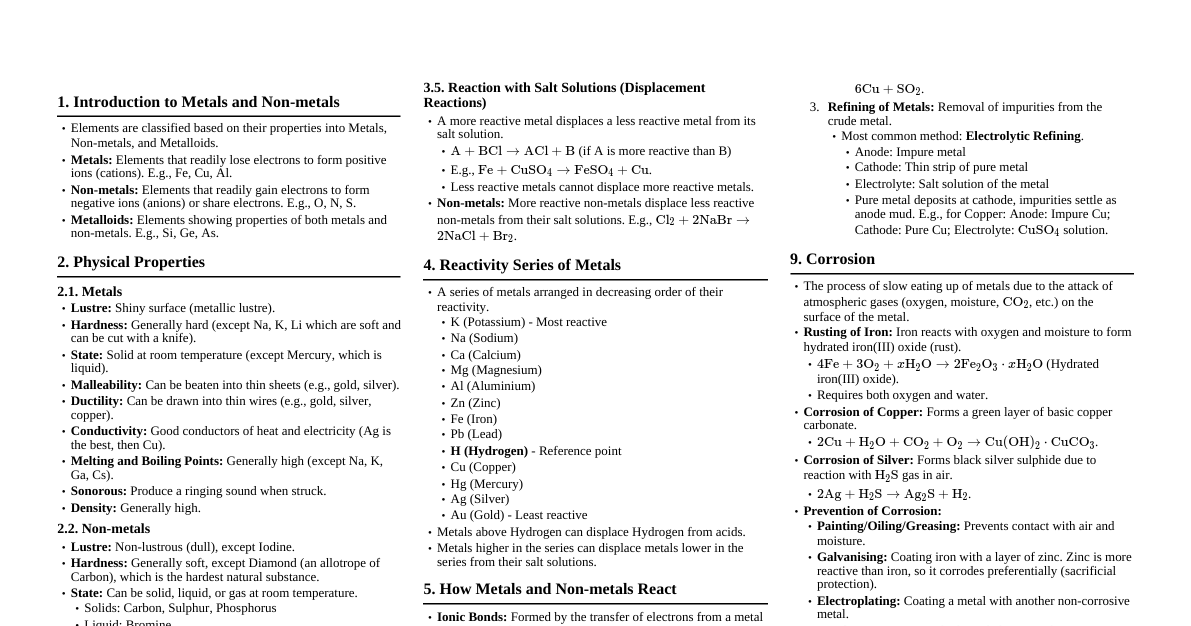
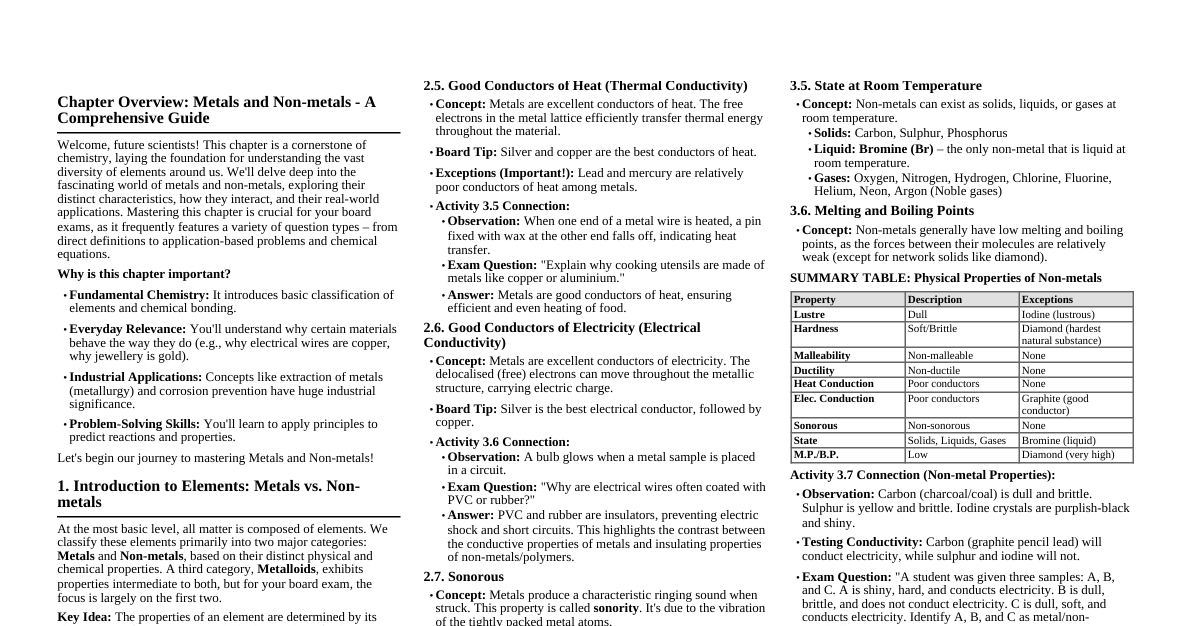
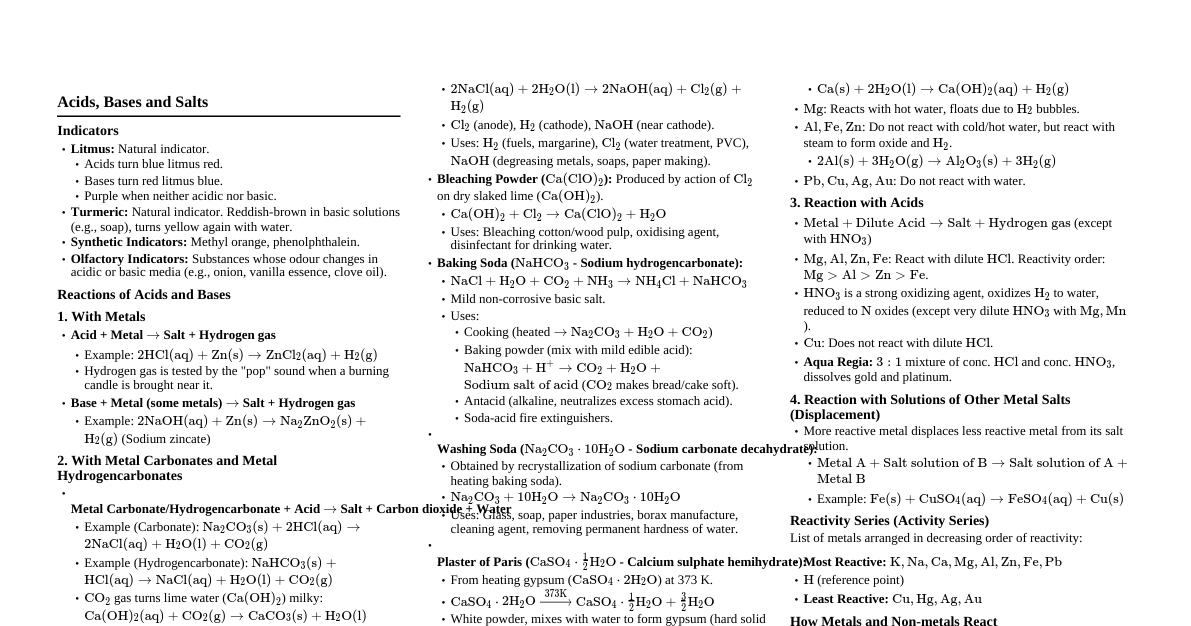
### Introduction Elements are broadly classified into metals and non-metals based on their properties. This cheatsheet summarizes their physical and chemical properties, reactivity, extraction methods, and uses. ### Physical Properties of Metals Metals generally exhibit the following physical properties: - **Lustre:** Have a shining surface (metallic lustre). - **Hardness:** Generally hard, though hardness varies (e.g., sodium, potassium are soft). - **Malleability:** Can be beaten into thin sheets (e.g., gold, silver are highly malleable). - **Ductility:** Can be drawn into thin wires (e.g., gold is highly ductile). - **Conductivity:** Good conductors of heat and electricity (e.g., silver and copper are best conductors; lead and mercury are poor). - **State:** Solids at room temperature, except mercury (liquid). - **Melting/Boiling Points:** High melting and boiling points (exceptions: gallium, caesium). - **Sonorous:** Produce a sound when struck hard. ### Physical Properties of Non-metals Non-metals generally exhibit properties opposite to metals: - **Lustre:** Non-lustrous (exception: iodine). - **Hardness:** Generally soft (exception: diamond, an allotrope of carbon, is the hardest natural substance). - **Malleability/Ductility:** Neither malleable nor ductile. - **Conductivity:** Poor conductors of heat and electricity (exception: graphite, an allotrope of carbon, conducts electricity). - **State:** Can be solids, liquids (bromine), or gases at room temperature. - **Melting/Boiling Points:** Generally low. ### Chemical Properties of Metals #### 1. Reaction with Oxygen Almost all metals combine with oxygen to form metal oxides. - Metal + Oxygen → Metal oxide - Metal oxides are generally basic in nature. - Some metal oxides (e.g., Al₂O₃, ZnO) are amphoteric, meaning they react with both acids and bases to produce salt and water. - Example: $2Cu(s) + O_2(g) \rightarrow 2CuO(s)$ (Copper(II) oxide) - Example (Amphoteric): $Al_2O_3(s) + 6HCl(aq) \rightarrow 2AlCl_3(aq) + 3H_2O(l)$ - Example (Amphoteric): $Al_2O_3(s) + 2NaOH(aq) \rightarrow 2NaAlO_2(aq) + H_2O(l)$ (Sodium aluminate) - Some metal oxides dissolve in water to form alkalis. - Example: $Na_2O(s) + H_2O(l) \rightarrow 2NaOH(aq)$ #### 2. Reaction with Water Metals react with water to produce metal oxide/hydroxide and hydrogen gas. - Metal + Water → Metal oxide + Hydrogen - Metal oxide + Water → Metal hydroxide - **Highly Reactive Metals (K, Na):** React violently with cold water, producing heat that ignites hydrogen. - Example: $2Na(s) + 2H_2O(l) \rightarrow 2NaOH(aq) + H_2(g) + \text{heat energy}$ - **Moderately Reactive Metals (Ca, Mg):** - Calcium reacts less violently with cold water; hydrogen bubbles stick to its surface, making it float. - Magnesium reacts with hot water; also floats due to hydrogen bubbles. - **Less Reactive Metals (Al, Fe, Zn):** Do not react with cold or hot water, but react with steam to form metal oxides and hydrogen. - Example: $2Al(s) + 3H_2O(g) \rightarrow Al_2O_3(s) + 3H_2(g)$ - **Least Reactive Metals (Pb, Cu, Ag, Au):** Do not react with water at all. #### 3. Reaction with Acids Metals react with dilute acids to form salt and hydrogen gas. - Metal + Dilute acid → Salt + Hydrogen - The reactivity of metals with dilute acids varies. - Hydrogen gas is not evolved when metals react with nitric acid ($HNO_3$) because $HNO_3$ is a strong oxidizing agent, oxidizing $H_2$ to water. (Exceptions: Mg and Mn react with very dilute $HNO_3$ to evolve $H_2$). - **Aqua Regia:** A mixture of concentrated $HCl$ and $HNO_3$ (3:1 ratio) that can dissolve gold and platinum. #### 4. Reaction with Salt Solutions of other Metals More reactive metals displace less reactive metals from their salt solutions. - Metal A + Salt solution of B → Salt solution of A + Metal B - This forms the basis of the reactivity series. ### Chemical Properties of Non-metals - **Reaction with Oxygen:** Non-metals produce acidic oxides when dissolved in water (e.g., Sulphur dioxide). Some form neutral oxides. - **Ion Formation:** Non-metals gain electrons to form negatively charged ions when reacting with metals. - **Hydrogen Displacement:** Do not displace hydrogen from dilute acids. - **Hydride Formation:** React with hydrogen to form hydrides. ### Reactivity Series A list of metals arranged in decreasing order of their reactivity: - **Most Reactive:** Potassium (K), Sodium (Na), Calcium (Ca), Magnesium (Mg), Aluminium (Al) - **Medium Reactive:** Zinc (Zn), Iron (Fe), Lead (Pb) - **Hydrogen [Reference Point]** - **Least Reactive:** Copper (Cu), Mercury (Hg), Silver (Ag), Gold (Au) ### Ionic Compounds Formed by the transfer of electrons from a metal (forming cation) to a non-metal (forming anion). They are also called electrovalent compounds. #### Properties of Ionic Compounds - **Physical Nature:** Solids, somewhat hard, and brittle due to strong electrostatic forces between ions. - **Melting & Boiling Points:** High, requiring significant energy to overcome strong inter-ionic attraction. - **Solubility:** Generally soluble in water, insoluble in organic solvents (kerosene, petrol). - **Conductivity:** - Do not conduct electricity in the solid state (rigid structure prevents ion movement). - Conduct electricity in molten state or in solution (ions can move freely). ### Extraction of Metals (Metallurgy) The process of obtaining pure metals from their ores. #### 1. Occurrence of Metals - **Earth's Crust:** Major source of most metals (minerals and ores). - **Seawater:** Contains soluble salts (e.g., NaCl, MgCl₂). - **Free State:** Least reactive metals (Ag, Au, Pt, Cu) can be found in free state. - **Combined State:** Most metals are found as oxides, sulphides, or carbonates. #### 2. Enrichment of Ores Removal of impurities (gangue) from the ore. #### 3. Extracting Metals Low in the Activity Series - Reduced by heating alone. - Example: Cinnabar (HgS) → Mercuric oxide (HgO) → Mercury (Hg) - $2HgS(s) + 3O_2(g) \xrightarrow{Heat} 2HgO(s) + 2SO_2(g)$ - $2HgO(s) \xrightarrow{Heat} 2Hg(l) + O_2(g)$ #### 4. Extracting Metals in the Middle of the Activity Series - Ores are typically sulphides or carbonates. - **Roasting:** Sulphide ores heated strongly in excess air to convert to oxide. - Example: $2ZnS(s) + 3O_2(g) \xrightarrow{Heat} 2ZnO(s) + 2SO_2(g)$ - **Calcination:** Carbonate ores heated strongly in limited air to convert to oxide. - Example: $ZnCO_3(s) \xrightarrow{Heat} ZnO(s) + CO_2(g)$ - **Reduction:** Metal oxides are then reduced using carbon (coke) or more reactive metals (displacement reactions). - Example: $ZnO(s) + C(s) \rightarrow Zn(s) + CO(g)$ - Thermit reaction: $Fe_2O_3(s) + 2Al(s) \rightarrow 2Fe(l) + Al_2O_3(s) + Heat$ #### 5. Extracting Metals towards the Top of the Activity Series - Highly reactive metals (K, Na, Ca, Mg, Al) cannot be reduced by carbon. - Obtained by **electrolytic reduction** of their molten chlorides. - Cathode (negative): Metal ions gain electrons and deposit as metal. - Anode (positive): Chloride ions lose electrons and liberate chlorine gas. - Example (Sodium): $Na^+ + e^- \rightarrow Na$ (at cathode) - Example (Chlorine): $2Cl^- \rightarrow Cl_2 + 2e^-$ (at anode) #### 6. Refining of Metals - **Electrolytic Refining:** Most common method for purifying impure metals (Cu, Zn, Ag, Au). - Impure metal acts as anode, a thin strip of pure metal as cathode. - Metal salt solution serves as electrolyte. - Pure metal from anode dissolves into electrolyte and deposits on cathode. - Insoluble impurities settle as anode mud. ### Corrosion The degradation of metals due to reaction with their environment (air, moisture, chemicals). - **Iron:** Rusts (forms reddish-brown flaky iron oxide) in the presence of both air and water. - **Copper:** Forms a green basic copper carbonate layer. - **Silver:** Tarnishes (forms black silver sulphide) when exposed to air containing sulphur. #### Prevention of Corrosion - **Painting, Oiling, Greasing:** Prevents contact with air and moisture. - **Galvanisation:** Coating iron/steel with a thin layer of zinc. - **Chrome Plating:** Coating with chromium. - **Anodising:** Forming a thick oxide layer on aluminium (electrolytic process). - **Making Alloys:** Creates rust-resistant materials (e.g., stainless steel is an alloy of iron with nickel and chromium). ### Alloys A homogeneous mixture of two or more metals, or a metal and a non-metal. - Prepared by melting the primary metal and dissolving other elements, then cooling. - Properties are often improved (e.g., harder, more rust-resistant). - **Amalgam:** An alloy where one of the metals is mercury. - Examples: - **Brass:** Copper + Zinc - **Bronze:** Copper + Tin - **Solder:** Lead + Tin (low melting point) - **22 Carat Gold:** 22 parts pure gold + 2 parts copper/silver (harder for jewelry).