Percentage Topic Math
Cheatsheet Content
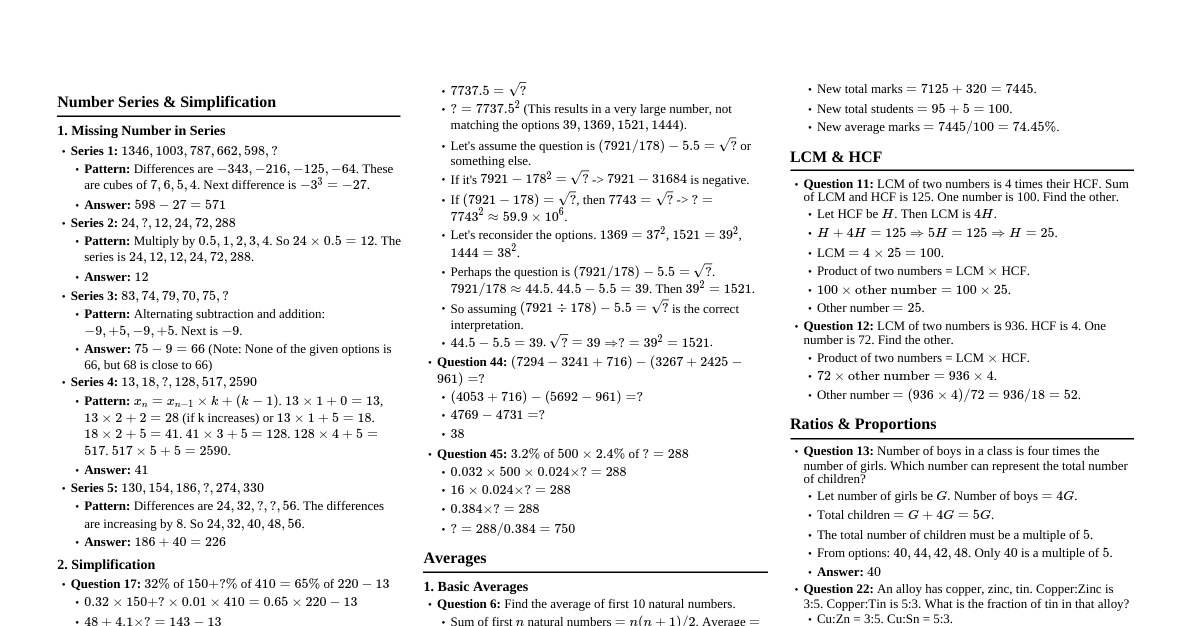
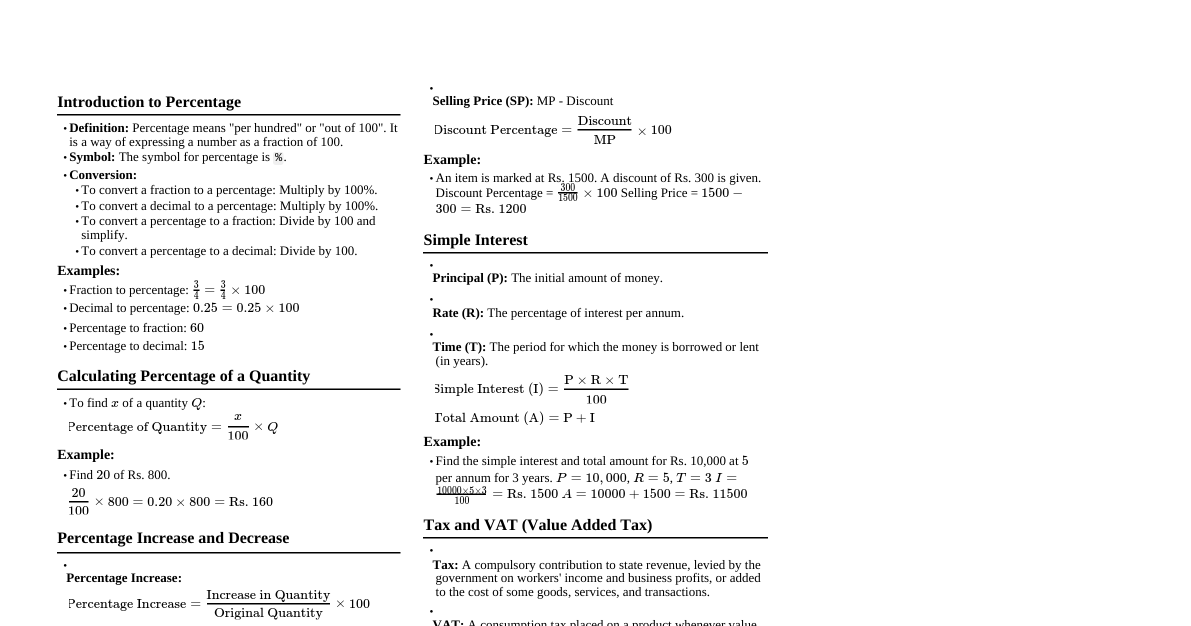
1. Profit & Loss CP: Cost Price, SP: Selling Price Profit: $SP - CP$ (if $SP > CP$) Loss: $CP - SP$ (if $SP $\text{Profit}\% = \frac{\text{Profit}}{\text{CP}} \times 100\%$ $\text{Loss}\% = \frac{\text{Loss}}{\text{CP}} \times 100\%$ Formulas & Tricks with Examples $\text{SP} = \text{CP} \times (1 \pm \frac{\text{Rate}\%}{100})$ Example: CP = $500, Profit = 20\%$. SP = $500 \times (1 + \frac{20}{100}) = 500 \times 1.2 = 600$. Example: CP = $500, Loss = 10\%$. SP = $500 \times (1 - \frac{10}{100}) = 500 \times 0.9 = 450$. $\text{CP} = \frac{\text{SP}}{1 \pm \frac{\text{Rate}\%}{100}}$ Example: SP = $600, Profit = 20\%$. CP = $\frac{600}{1 + \frac{20}{100}} = \frac{600}{1.2} = 500$. Dishonest Dealer: Profit % = $\frac{\text{Error}}{\text{True Value} - \text{Error}} \times 100\%$ Example: A shopkeeper sells goods at CP but uses a weight of 900g instead of 1kg. Error = $1000 - 900 = 100$g. Profit % = $\frac{100}{1000 - 100} \times 100\% = \frac{100}{900} \times 100\% = 11.11\%$. Two items, same SP, one P% profit, one P% loss: Always a loss. Loss % $= (\frac{P}{10})^2 \%$. Example: Two watches sold for $1000 each. One gains 10%, other loses 10%. Loss % = $(\frac{10}{10})^2 \% = 1^2 \% = 1\%$. Total SP = $2000$. Total CP = $\frac{2000}{1 - \frac{1}{100}} = \frac{2000}{0.99} \approx 2020.2$. Total Loss $\approx 20.2$. 2. Time & Work Work = Efficiency $\times$ Time If A completes work in D days, A's 1-day work = $\frac{1}{D}$. Formulas & Tricks with Examples A & B together: Time = $\frac{D_A \times D_B}{D_A + D_B}$ Example: A does a work in 10 days, B in 15 days. Together? Time = $\frac{10 \times 15}{10 + 15} = \frac{150}{25} = 6$ days. MDH Formula: $\frac{M_1 D_1 H_1}{W_1} = \frac{M_2 D_2 H_2}{W_2}$ Example: 10 men build a wall in 8 days (6 hrs/day). How many days for 12 men (5 hrs/day) for same wall? $10 \times 8 \times 6 = 12 \times D_2 \times 5 \Rightarrow 480 = 60 D_2 \Rightarrow D_2 = 8$ days. LCM Method: Example: A (10 days), B (15 days). LCM(10, 15) = 30 units (Total Work). A's efficiency = $30/10 = 3$ units/day. B's efficiency = $30/15 = 2$ units/day. Combined efficiency = $3 + 2 = 5$ units/day. Time together = $30/5 = 6$ days. Pipes & Cisterns: Inlet is positive (+), Outlet is negative (-). Example: Pipe A fills in 10 hrs, Pipe B empties in 15 hrs. LCM(10, 15) = 30 units (Tank Capacity). A's efficiency = $+30/10 = +3$ units/hr. B's efficiency = $-30/15 = -2$ units/hr. Combined efficiency = $3 - 2 = 1$ unit/hr. Time to fill tank = $30/1 = 30$ hours. 3. LCM & HCF LCM: Smallest common multiple. HCF (GCD): Largest common factor. Formulas & Tricks with Examples Prime Factorization: Example: LCM & HCF of 12 ($2^2 \times 3^1$), 18 ($2^1 \times 3^2$). HCF = $2^1 \times 3^1 = 6$. LCM = $2^2 \times 3^2 = 4 \times 9 = 36$. For two numbers 'a' and 'b': $\text{LCM}(a, b) \times \text{HCF}(a, b) = a \times b$. Example: For 12 and 18: $36 \times 6 = 216$. $12 \times 18 = 216$. (Holds true) LCM of Fractions: $\frac{\text{LCM of Numerators}}{\text{HCF of Denominators}}$ Example: LCM of $\frac{2}{3}, \frac{4}{5}$. Numerators (2,4) LCM=4. Denominators (3,5) HCF=1. So LCM = $\frac{4}{1} = 4$. HCF of Fractions: $\frac{\text{HCF of Numerators}}{\text{LCM of Denominators}}$ Example: HCF of $\frac{2}{3}, \frac{4}{5}$. Numerators (2,4) HCF=2. Denominators (3,5) LCM=15. So HCF = $\frac{2}{15}$. Application (LCM): When will 3 bells ring together if they ring every 10, 15, 20 mins? LCM(10, 15, 20) = 60 minutes. Application (HCF): Largest size of square tile for 12m x 18m room? HCF(12, 18) = 6m. 4. Simplification BODMAS/PEMDAS: Brackets/Parentheses, Orders/Exponents, Division/Multiplication (L-R), Addition/Subtraction (L-R). Formulas & Tricks with Examples Example: $10 + 4 \times 3 - (8 \div 2)$ $= 10 + 4 \times 3 - 4$ (Brackets) $= 10 + 12 - 4$ (Multiplication) $= 22 - 4 = 18$ (Addition, then Subtraction) Fractions: Example: $\frac{1}{3} + \frac{1}{2} = \frac{1 \times 2 + 1 \times 3}{3 \times 2} = \frac{5}{6}$. Example: $\frac{3}{4} \div \frac{1}{2} = \frac{3}{4} \times \frac{2}{1} = \frac{6}{4} = \frac{3}{2}$. Decimals: Example: $2.5 \times 0.3 = 0.75$. Example: $4.8 \div 0.4 = 48 \div 4 = 12$. Powers: Example: $2^3 \times 2^2 = 2^{3+2} = 2^5 = 32$. Example: $(3^2)^3 = 3^{2 \times 3} = 3^6 = 729$. Special Products: Example: $(x+3)^2 = x^2 + 2(x)(3) + 3^2 = x^2 + 6x + 9$. Example: $x^2 - 9 = (x-3)(x+3)$. Surds: Example: $\sqrt{12} + \sqrt{3} = \sqrt{4 \times 3} + \sqrt{3} = 2\sqrt{3} + \sqrt{3} = 3\sqrt{3}$. Example: Rationalize $\frac{1}{\sqrt{2}} = \frac{1 \times \sqrt{2}}{\sqrt{2} \times \sqrt{2}} = \frac{\sqrt{2}}{2}$. 5. Average $\text{Average} = \frac{\text{Sum of terms}}{\text{Number of terms}}$ Formulas & Tricks with Examples Sum = Avg $\times$ Count. Example: Avg of 5 students is 75. Sum = $75 \times 5 = 375$. Combined Average: $\frac{(N_1 A_1) + (N_2 A_2)}{N_1 + N_2}$ Example: 10 boys (Avg 40kg), 15 girls (Avg 30kg). Combined Avg = $\frac{(10 \times 40) + (15 \times 30)}{10 + 15} = \frac{400 + 450}{25} = \frac{850}{25} = 34$ kg. Replacement: New Avg = Old Avg + $\frac{\text{New Value} - \text{Old Value}}{\text{Number of items}}$. Example: 10 students, Avg 50kg. One (45kg) replaced by new (65kg). New Avg = $50 + \frac{65 - 45}{10} = 50 + \frac{20}{10} = 50 + 2 = 52$ kg. Average of AP: $\frac{\text{First Term} + \text{Last Term}}{2}$. Example: Avg of 10, 20, 30, 40, 50 = $\frac{10+50}{2} = 30$. Average Speed (same distance): $\frac{2 S_1 S_2}{S_1 + S_2}$. Example: Car travels to B at 40 km/h and returns at 60 km/h. Avg Speed = $\frac{2 \times 40 \times 60}{40 + 60} = 48$ km/h. 6. Ratio & Proportion Ratio: $a:b$. Proportion: $a:b::c:d \implies ad = bc$. Formulas & Tricks with Examples Combining Ratios: Example: $A:B = 2:3$, $B:C = 4:5$. $A:B:C = (2 \times 4) : (3 \times 4) : (3 \times 5) = 8:12:15$. Mean Proportional: $b = \sqrt{ac}$ for $a:b::b:c$. Example: Mean proportional between 4 and 9 = $\sqrt{4 \times 9} = \sqrt{36} = 6$. Componendo & Dividendo: If $\frac{a}{b} = \frac{c}{d}$, then $\frac{a+b}{a-b} = \frac{c+d}{c-d}$. Example: If $\frac{x+y}{x-y} = \frac{5}{3}$, then $\frac{(x+y)+(x-y)}{(x+y)-(x-y)} = \frac{5+3}{5-3} \Rightarrow \frac{2x}{2y} = \frac{8}{2} \Rightarrow \frac{x}{y} = 4$. Distribution: Divide 1200 in ratio $3:5$. Sum of parts = $3+5=8$. First part = $\frac{3}{8} \times 1200 = 450$. Second part = $\frac{5}{8} \times 1200 = 750$. 7. Squares & Square Roots Square ($n^2$): $n \times n$. Square Root ($\sqrt{n}$): Number whose square is $n$. Formulas & Tricks with Examples Unit Digit of Square: (0,1,4,5,6,9). Never 2,3,7,8. Example: $12345678$ cannot be a perfect square. Squaring numbers ending in 5: Example: $35^2 \to (3 \times (3+1)) \text{ then } 25 \to 1225$. Squaring near 50: Base 25. $(25 \pm \text{diff}) \cdot (\text{diff})^2$. Example: $48^2 \to (25-2) \cdot (02)^2 \to 2304$. Example: $53^2 \to (25+3) \cdot (03)^2 \to 2809$. Square Root of Perfect Square (Unit Digit Method): Example: $\sqrt{729}$. Unit digit 9 $\to$ root ends in 3 or 7. Remaining 7 ($2^2=4, 3^2=9$). So first digit 2. $2 \times (2+1)=6$. Since $7 > 6$, choose larger unit digit. Root is 27. Example: $\sqrt{3136}$. Unit digit 6 $\to$ root ends in 4 or 6. Remaining 31 ($5^2=25, 6^2=36$). So first digit 5. $5 \times (5+1)=30$. Since $31 > 30$, choose larger unit digit. Root is 56. 8. Cubes & Cube Roots Cube ($n^3$): $n \times n \times n$. Cube Root ($\sqrt[3]{n}$): Number whose cube is $n$. Formulas & Tricks with Examples Unit Digit of Cube: (0,1,4,5,6,9 same); (2 $\leftrightarrow$ 8); (3 $\leftrightarrow$ 7). Example: A cube ending in 8 has a root ending in 2. $12^3 = 1728$. Cube Root of Perfect Cube (Unit Digit Method): Example: $\sqrt[3]{17576}$. Unit digit 6 $\to$ root ends in 6. Ignore last 3 digits (576). Remaining 17. $2^3=8, 3^3=27$. $2^3 \le 17 Example: $\sqrt[3]{148877}$. Unit digit 7 $\to$ root ends in 3. Ignore last 3 digits (877). Remaining 148. $5^3=125, 6^3=216$. $5^3 \le 148 9. Divisibility Rules Rules with Examples 2: Ends in 0, 2, 4, 6, 8. (Ex: 124, 780) 3: Sum of digits divisible by 3. (Ex: 123 ($1+2+3=6$), 549 ($5+4+9=18$)) 4: Last two digits form number divisible by 4. (Ex: 516 (16), 1200 (00)) 5: Ends in 0 or 5. (Ex: 235, 100) 6: Divisible by both 2 and 3. (Ex: 132 (even, sum=6), 726 (even, sum=15)) 7: Double last digit, subtract from rest. If result is divisible by 7. Example: 343: $34 - (3 \times 2) = 34 - 6 = 28$. $28 \div 7 = 4$. Yes. 8: Last three digits form number divisible by 8. (Ex: 1240 (240), 5000 (000)) 9: Sum of digits divisible by 9. (Ex: 729 ($7+2+9=18$), 1818 ($1+8+1+8=18$)) 10: Ends in 0. (Ex: 560, 1000) 11: (Sum of alternate digits) difference is 0 or multiple of 11. Example: 1331: $(1+3) - (3+1) = 4-4=0$. Yes. Example: 946: $(6+9) - 4 = 15-4=11$. Yes. 12: Divisible by both 3 and 4. (Ex: 144 (sum=9, 44 divisible by 4)) 10. Time, Speed & Distance $D = S \times T$. Speed = Distance / Time. Time = Distance / Speed. Units: km/hr $\xrightarrow{\times 5/18}$ m/s; m/s $\xrightarrow{\times 18/5}$ km/hr. Formulas & Tricks with Examples Average Speed: $\frac{\text{Total Distance}}{\text{Total Time}}$. Example: Travels 100km at 50km/h, then 120km at 40km/h. Time1 = $100/50 = 2$ hr. Time2 = $120/40 = 3$ hr. Avg Speed = $\frac{100+120}{2+3} = \frac{220}{5} = 44$ km/h. Relative Speed: Same direction: $|S_1 - S_2|$. (Ex: Two cars 60km/h and 40km/h $\to 20$km/h) Opposite direction: $S_1 + S_2$. (Ex: Two trains 80km/h and 70km/h $\to 150$km/h) Trains: Distance = Length of Train + Length of Object (if any). Example: 100m train crosses 200m platform at 10 m/s. Time = $\frac{100+200}{10} = 30$ seconds. Boats & Streams: $S_D = U + V$, $S_U = U - V$. $U = \frac{S_D + S_U}{2}$, $V = \frac{S_D - S_U}{2}$. Example: Boat travels 20 km downstream in 2 hrs ($S_D=10$), 12 km upstream in 3 hrs ($S_U=4$). Boat speed (U) = $\frac{10+4}{2} = 7$ km/h. Stream speed (V) = $\frac{10-4}{2} = 3$ km/h.