Physics Fundamentals
Cheatsheet Content
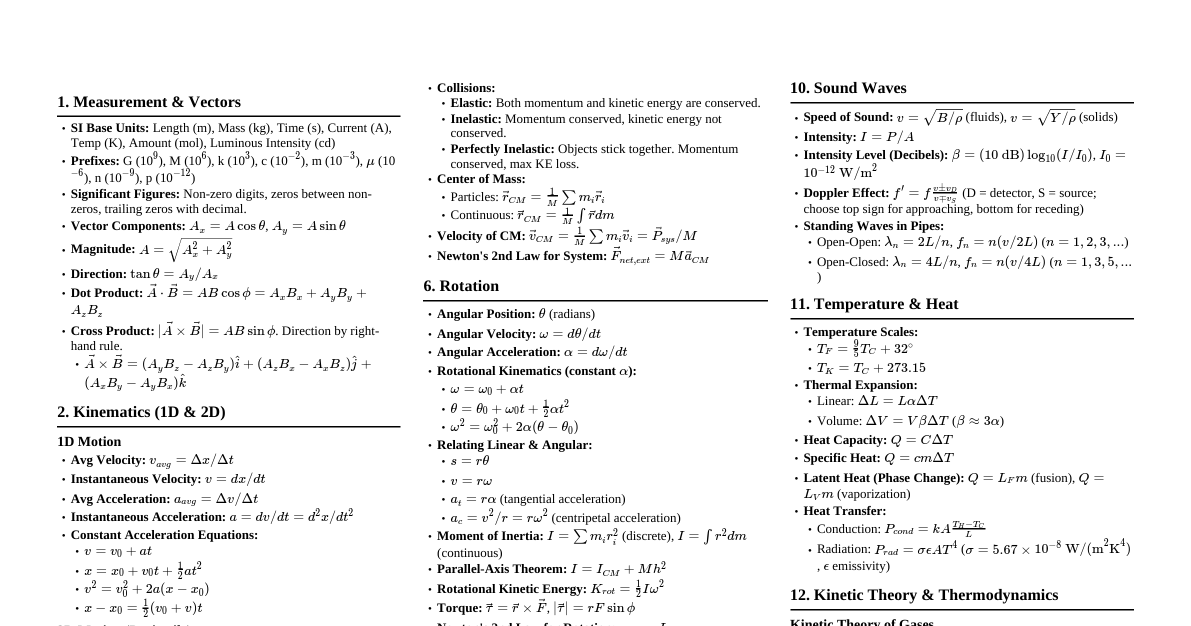
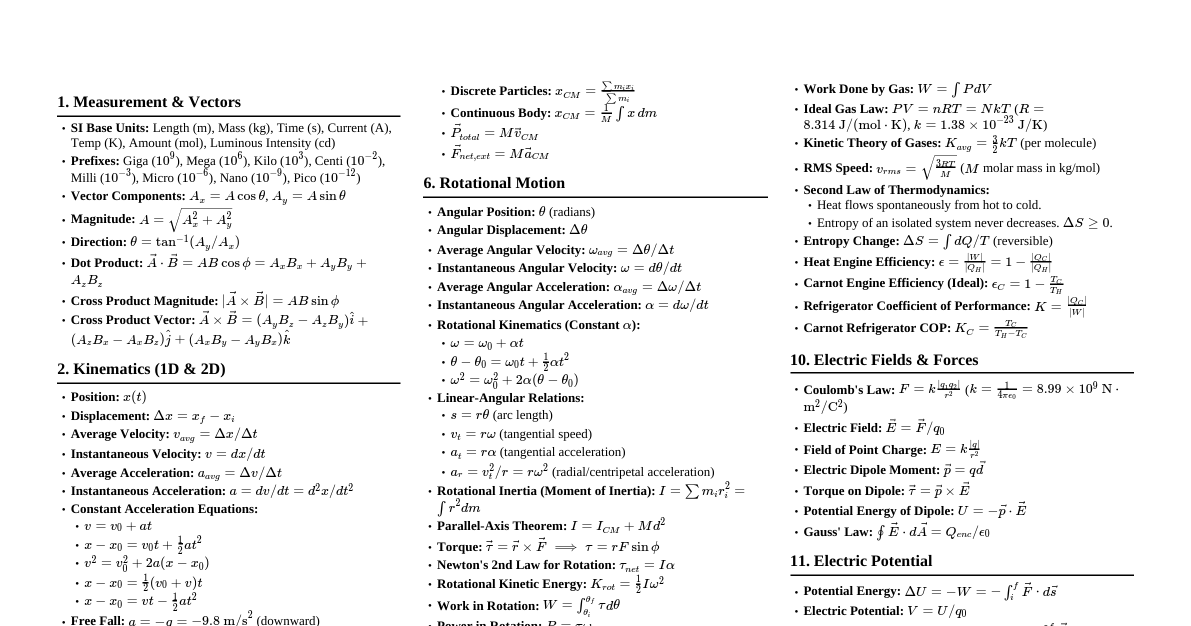
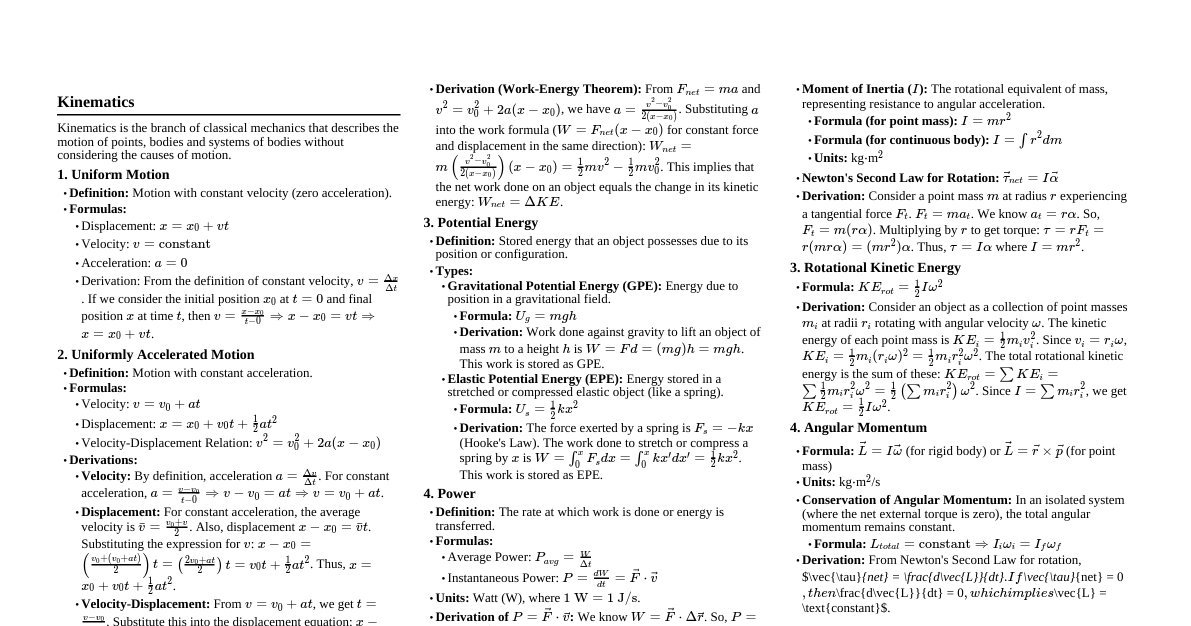
### Vectors - **Definition:** Quantity with both magnitude and direction. Represented as $\vec{A}$. - **Components:** $\vec{A} = A_x\hat{i} + A_y\hat{j} + A_z\hat{k}$ - **Magnitude:** $|\vec{A}| = \sqrt{A_x^2 + A_y^2 + A_z^2}$ - **Unit Vector:** $\hat{u}_A = \frac{\vec{A}}{|\vec{A}|}$ (direction only) - **Vector Addition:** $\vec{A} + \vec{B} = (A_x+B_x)\hat{i} + (A_y+B_y)\hat{j} + (A_z+B_z)\hat{k}$ - **Dot Product (Scalar Product):** $\vec{A} \cdot \vec{B} = |\vec{A}||\vec{B}|\cos\theta = A_x B_x + A_y B_y + A_z B_z$ - If $\vec{A} \cdot \vec{B} = 0$, vectors are perpendicular. - **Cross Product (Vector Product):** $\vec{A} \times \vec{B} = (A_y B_z - A_z B_y)\hat{i} + (A_z B_x - A_x B_z)\hat{j} + (A_x B_y - A_y B_x)\hat{k}$ - Magnitude: $|\vec{A} \times \vec{B}| = |\vec{A}||\vec{B}|\sin\theta$ - Direction: Right-hand rule. - If $\vec{A} \times \vec{B} = 0$, vectors are parallel. ### Kinematics (Constant Acceleration) - **Displacement:** $\Delta x = x_f - x_i$ - **Average Velocity:** $v_{avg} = \frac{\Delta x}{\Delta t}$ - **Average Acceleration:** $a_{avg} = \frac{\Delta v}{\Delta t}$ - **Kinematic Equations:** 1. $v = v_0 + at$ 2. $\Delta x = v_0 t + \frac{1}{2}at^2$ 3. $v^2 = v_0^2 + 2a\Delta x$ 4. $\Delta x = \frac{1}{2}(v_0 + v)t$ - **Projectile Motion:** - Horizontal: $v_x = v_{0x}$, $\Delta x = v_{0x}t$ - Vertical: $v_y = v_{0y} - gt$, $\Delta y = v_{0y}t - \frac{1}{2}gt^2$, $v_y^2 = v_{0y}^2 - 2g\Delta y$ - $g \approx 9.81 \text{ m/s}^2$ (downwards) ### Newtonian Mechanics - **Newton's First Law (Inertia):** An object at rest stays at rest, and an object in motion stays in motion with the same speed and in the same direction unless acted upon by an unbalanced force. - **Newton's Second Law:** $\sum \vec{F} = m\vec{a}$ - Force ($\vec{F}$) in Newtons (N), mass ($m$) in kg, acceleration ($\vec{a}$) in m/s$^2$. - **Newton's Third Law:** For every action, there is an equal and opposite reaction. $\vec{F}_{AB} = -\vec{F}_{BA}$ - **Weight:** $W = mg$ - **Friction:** - Static: $f_s \le \mu_s N$ (N is normal force) - Kinetic: $f_k = \mu_k N$ - $\mu_s \ge \mu_k$ - **Centripetal Force:** $F_c = \frac{mv^2}{r}$ (directed towards center of circle) - **Gravitation:** $F_g = G\frac{m_1 m_2}{r^2}$ - $G \approx 6.674 \times 10^{-11} \text{ N}\cdot\text{m}^2/\text{kg}^2$ ### Work, Power & Energy - **Work:** $W = \vec{F} \cdot \Delta\vec{r} = F\Delta r \cos\theta$ - Work done by a variable force: $W = \int \vec{F} \cdot d\vec{r}$ - Unit: Joules (J) - **Kinetic Energy:** $K = \frac{1}{2}mv^2$ - **Work-Energy Theorem:** $W_{net} = \Delta K = K_f - K_i$ - **Potential Energy:** - Gravitational (near Earth): $U_g = mgh$ - Elastic (Spring): $U_s = \frac{1}{2}kx^2$ (k is spring constant, x is displacement) - **Conservative Forces:** Work done is independent of path (e.g., gravity, spring force). - **Non-Conservative Forces:** Work done depends on path (e.g., friction). - **Conservation of Mechanical Energy:** If only conservative forces do work, $E_{mech} = K + U = \text{constant}$ - $K_i + U_i = K_f + U_f$ - **Power:** Rate at which work is done. - Average Power: $P_{avg} = \frac{\Delta W}{\Delta t}$ - Instantaneous Power: $P = \frac{dW}{dt} = \vec{F} \cdot \vec{v}$ - Unit: Watts (W) = J/s - **Efficiency:** $\text{Efficiency} = \frac{\text{Output Power}}{\text{Input Power}}$ ### Electromagnetism: Electrostatics - **Coulomb's Law:** $F = k \frac{|q_1 q_2|}{r^2}$ (Force between two point charges) - $k = \frac{1}{4\pi\epsilon_0} \approx 8.99 \times 10^9 \text{ N}\cdot\text{m}^2/\text{C}^2$ - $\epsilon_0 \approx 8.85 \times 10^{-12} \text{ F/m}$ (Permittivity of free space) - **Electric Field:** $\vec{E} = \frac{\vec{F}}{q_0}$ (Force per unit positive test charge) - **Electric Field for a Point Charge:** $E = k \frac{|q|}{r^2}$ - **Electric Potential:** $V = \frac{U}{q_0}$ (Potential energy per unit charge) - **Electric Potential for a Point Charge:** $V = k \frac{q}{r}$ - **Relationship between E-field and Potential:** $E_x = -\frac{\partial V}{\partial x}$ (for uniform field, $E = -\frac{\Delta V}{\Delta x}$) - **Electric Potential Energy:** $U = qV$ - **Capacitance:** $C = \frac{Q}{V}$ - Parallel Plate Capacitor: $C = \frac{\epsilon_0 A}{d}$ - Energy Stored in Capacitor: $U_C = \frac{1}{2}QV = \frac{1}{2}CV^2 = \frac{Q^2}{2C}$ ### Electromagnetism: Circuits - **Ohm's Law:** $V = IR$ - Resistance: $R = \rho \frac{L}{A}$ ($\rho$ is resistivity) - **Resistors in Series:** $R_{eq} = R_1 + R_2 + ...$ - **Resistors in Parallel:** $\frac{1}{R_{eq}} = \frac{1}{R_1} + \frac{1}{R_2} + ...$ - **Capacitors in Series:** $\frac{1}{C_{eq}} = \frac{1}{C_1} + \frac{1}{C_2} + ...$ - **Capacitors in Parallel:** $C_{eq} = C_1 + C_2 + ...$ - **Kirchhoff's Rules:** - **Junction Rule:** $\sum I_{in} = \sum I_{out}$ (Conservation of Charge) - **Loop Rule:** $\sum \Delta V = 0$ (Conservation of Energy) - **Power in a Circuit:** $P = IV = I^2R = \frac{V^2}{R}$ ### Electromagnetism: Magnetism - **Magnetic Force on a Moving Charge:** $\vec{F}_B = q(\vec{v} \times \vec{B})$ - Magnitude: $F_B = qvB\sin\theta$ - **Magnetic Force on a Current-Carrying Wire:** $\vec{F}_B = I(\vec{L} \times \vec{B})$ - Magnitude: $F_B = ILB\sin\theta$ - **Magnetic Field from a Long Straight Wire:** $B = \frac{\mu_0 I}{2\pi r}$ - $\mu_0 = 4\pi \times 10^{-7} \text{ T}\cdot\text{m/A}$ (Permeability of free space) - **Magnetic Field at Center of Current Loop:** $B = \frac{\mu_0 I}{2R}$ - **Magnetic Field inside a Solenoid:** $B = \mu_0 n I$ ($n$ is turns per unit length) - **Magnetic Flux:** $\Phi_B = \int \vec{B} \cdot d\vec{A}$ (for uniform field, $\Phi_B = BA\cos\theta$) - **Faraday's Law of Induction:** $\mathcal{E} = -\frac{d\Phi_B}{dt}$ (Induced EMF) - **Lenz's Law:** The induced current flows in a direction that opposes the change in magnetic flux that caused it. - **Inductance:** $L = \frac{N\Phi_B}{I}$ - Energy Stored in Inductor: $U_L = \frac{1}{2}LI^2$ ### Thermodynamics - **Zeroth Law:** If two systems are in thermal equilibrium with a third system, they are in thermal equilibrium with each other. - **First Law:** $\Delta U = Q - W$ (Conservation of Energy) - $\Delta U$: Change in internal energy - $Q$: Heat added to system - $W$: Work done *by* system - **Work Done by Gas:** $W = \int P dV$ - Isobaric ($P$=const): $W = P\Delta V$ - Isothermal ($T$=const): $W = nRT \ln(\frac{V_f}{V_i})$ - Adiabatic ($Q$=0): $PV^\gamma = \text{const}$ - **Heat Capacity:** $Q = mc\Delta T$ ($c$ is specific heat) - **Latent Heat:** $Q = mL$ ($L$ is latent heat of fusion/vaporization) - **Ideal Gas Law:** $PV = nRT = Nk_B T$ - $R \approx 8.314 \text{ J/(mol}\cdot\text{K)}$ (Ideal gas constant) - $k_B \approx 1.38 \times 10^{-23} \text{ J/K}$ (Boltzmann constant) - **Kinetic Energy of Gas Molecules:** $K_{avg} = \frac{3}{2}k_B T$ - **Second Law:** - Heat flows spontaneously from hot to cold. - The entropy of an isolated system never decreases. $\Delta S \ge 0$ - **Entropy:** $\Delta S = \int \frac{dQ}{T}$ (for reversible process) - **Carnot Engine Efficiency:** $\text{Eff} = 1 - \frac{T_C}{T_H}$ ($T$ in Kelvin) ### Waves & Oscillations - **Simple Harmonic Motion (SHM):** - Position: $x(t) = A\cos(\omega t + \phi)$ - Velocity: $v(t) = -A\omega\sin(\omega t + \phi)$ - Acceleration: $a(t) = -A\omega^2\cos(\omega t + \phi) = -\omega^2 x(t)$ - Angular Frequency: $\omega = 2\pi f = \frac{2\pi}{T}$ - Spring-Mass System: $\omega = \sqrt{\frac{k}{m}}$ - Simple Pendulum (small angles): $\omega = \sqrt{\frac{g}{L}}$ - **Wave Properties:** - Wave Speed: $v = \lambda f$ - Transverse Wave on a String: $v = \sqrt{\frac{T}{\mu}}$ ($T$ is tension, $\mu$ is linear mass density) - Sound Speed in Fluid: $v = \sqrt{\frac{B}{\rho}}$ ($B$ is bulk modulus, $\rho$ is density) - **Intensity:** $I = \frac{P}{A}$ (Power per unit area) - **Doppler Effect:** $f' = f \left(\frac{v \pm v_D}{v \mp v_S}\right)$ - Upper signs: detector/source moves *towards* each other. - Lower signs: detector/source moves *away* from each other. - $v_D$: speed of detector, $v_S$: speed of source, $v$: speed of wave. - **Standing Waves:** - String fixed at both ends / Open-open pipe: $L = n\frac{\lambda}{2}$, $f_n = n\frac{v}{2L}$ ($n=1,2,3,...$) - Open-closed pipe: $L = n\frac{\lambda}{4}$, $f_n = n\frac{v}{4L}$ ($n=1,3,5,...$)