Physics Fundamentals
Cheatsheet Content
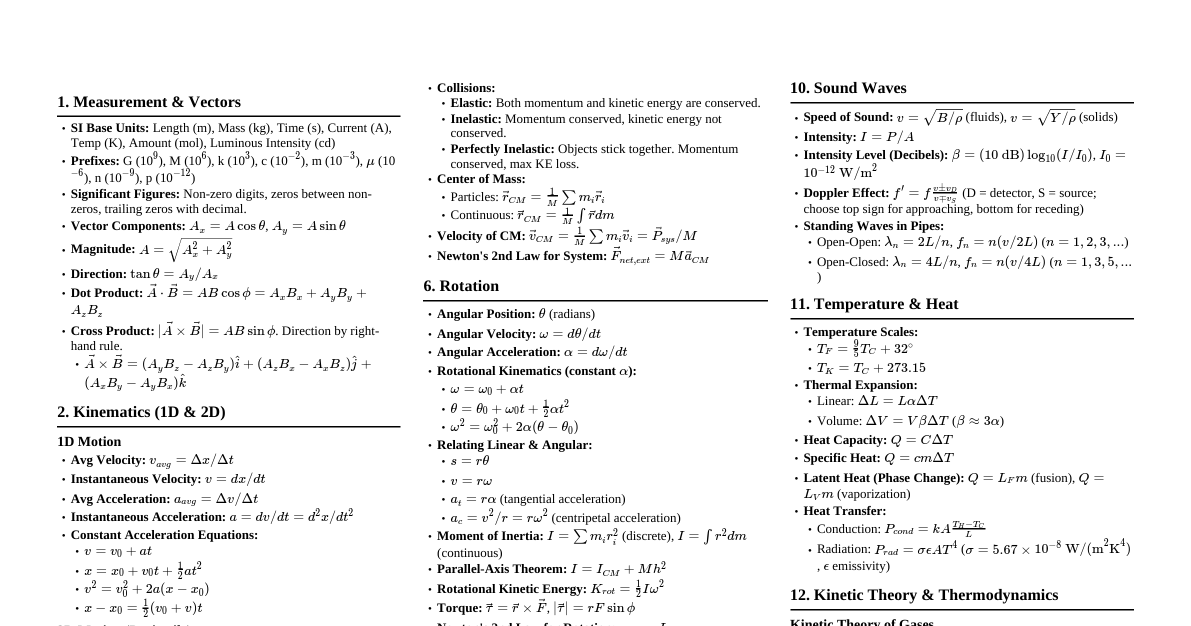
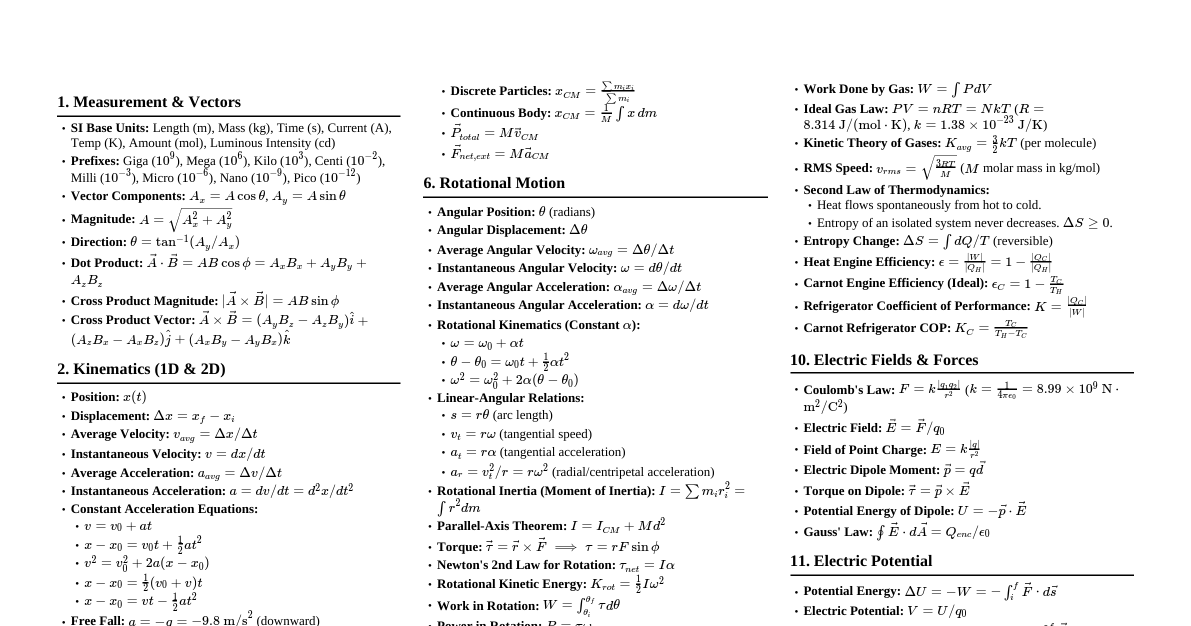
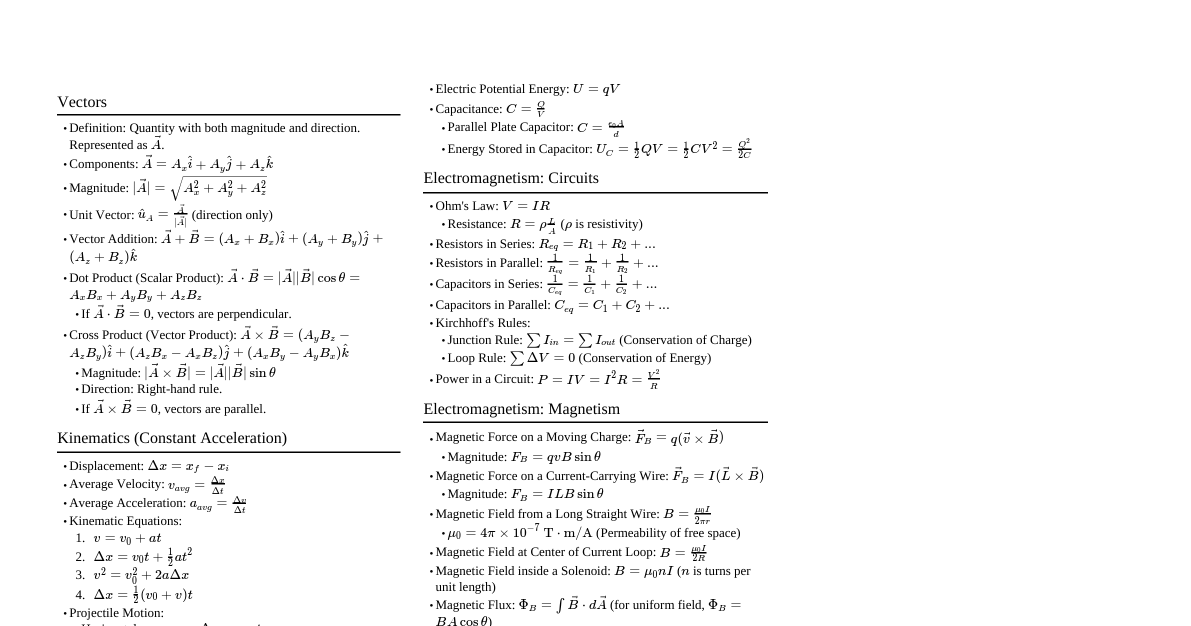
### Introduction to Physics Physics is the natural science that studies matter, its fundamental constituents, its motion and behavior through space and time, and the related entities of energy and force. It is one of the most fundamental scientific disciplines, with its main goal being to understand how the universe behaves. - **Branches of Physics:** - **Classical Physics:** Deals with concepts like motion, energy, force, heat, sound, light, and electricity at the macroscopic and astronomical scales. - **Mechanics:** Study of motion and its causes. - **Thermodynamics:** Study of heat and its relation to other forms of energy. - **Optics:** Study of light and its properties. - **Electromagnetism:** Study of electricity and magnetism. - **Modern Physics:** Deals with concepts at the atomic and subatomic levels, and at very high speeds. - **Quantum Mechanics:** Study of matter and energy at the most fundamental level. - **Relativity:** Study of space, time, mass, and energy, especially at high velocities. ### Arithmetic of Scientific Notation Scientific notation is a way of writing numbers that are too large or too small to be conveniently written in decimal form. It uses powers of 10. A number in scientific notation has the form $a \times 10^b$, where $1 \le |a| ### Scalars and Vectors Physical quantities can be categorized into scalars and vectors based on whether they have direction. - **Scalars:** - Quantities that are fully described by a magnitude (numerical value) alone. - Examples: Mass, temperature, time, speed, distance, energy, work. - Follows ordinary arithmetic rules. - **Vectors:** - Quantities that are fully described by both a magnitude and a direction. - Examples: Displacement, velocity, acceleration, force, momentum. - Represented graphically by arrows where length indicates magnitude and arrowhead indicates direction. #### Vector Operations - **Vector Addition (Graphical):** Head-to-tail method. The resultant vector goes from the tail of the first to the head of the last. - **Vector Addition (Component Method):** 1. Resolve each vector into its x and y components. 2. Add all x-components together and all y-components together. 3. The resultant vector's magnitude is $R = \sqrt{R_x^2 + R_y^2}$ and direction $\theta = \arctan(R_y / R_x)$. - **Vector Subtraction:** $\vec{A} - \vec{B} = \vec{A} + (-\vec{B})$, where $-\vec{B}$ is a vector with the same magnitude as $\vec{B}$ but in the opposite direction. - **Scalar Multiplication:** Multiplying a vector by a scalar changes its magnitude. If the scalar is positive, the direction remains the same; if negative, the direction reverses. ### Waves as Carriers of Energy A wave is a disturbance that propagates through space and time, usually with the transfer of energy. Waves do not transfer matter. - **Types of Waves:** - **Mechanical Waves:** Require a medium to propagate. They are caused by the disturbance of matter. - *Examples:* Sound waves, water waves, seismic waves. - **Electromagnetic (EM) Waves:** Do not require a medium and can travel through a vacuum. They consist of oscillating electric and magnetic fields. - *Examples:* Light waves, radio waves, X-rays, microwaves. - **Wave Motion:** - **Transverse Waves:** The particles of the medium oscillate perpendicular to the direction of wave propagation. - *Examples:* Light waves, waves on a string. - **Longitudinal Waves:** The particles of the medium oscillate parallel to the direction of wave propagation. - *Examples:* Sound waves. - **Energy Transfer:** Waves transfer energy from one point to another without net displacement of the medium itself. The amount of energy carried by a wave is related to its amplitude and frequency. Higher amplitude and higher frequency generally mean more energy. ### Wave Characteristics Key properties used to describe waves: - **Amplitude (A):** The maximum displacement or distance moved by a point on a vibrating body or wave measured from its equilibrium position. Relates to the energy of the wave. - Unit: meters (m) for mechanical waves, volts/amperes for EM waves. - **Wavelength ($\lambda$):** The spatial period of a wave, the distance over which the wave's shape repeats. It is the distance between consecutive corresponding points of the same phase. - Unit: meters (m). - **Frequency (f):** The number of complete wave cycles (oscillations) that pass a point per unit of time. - Unit: Hertz (Hz), where 1 Hz = 1 cycle/second. - **Period (T):** The time it takes for one complete wave cycle to pass a given point. It is the reciprocal of frequency ($T = 1/f$). - Unit: seconds (s). - **Wave Speed (v):** The speed at which the wave propagates through the medium. - **Wave Equation:** $v = f \lambda$ - For EM waves in a vacuum, $v = c$, where $c \approx 3 \times 10^8$ m/s (speed of light). #### Wave Phenomena - **Reflection:** The bouncing back of a wave when it encounters a boundary or surface. - **Refraction:** The bending of a wave as it passes from one medium to another, due to a change in speed. - **Diffraction:** The spreading out of waves as they pass through an opening or around an obstacle. - **Interference:** The superposition of two or more waves, resulting in a new wave pattern. - **Constructive Interference:** Waves combine to produce a larger amplitude. - **Destructive Interference:** Waves combine to produce a smaller or zero amplitude. ### Sound and Its Properties Sound is a mechanical, longitudinal wave that travels through a medium (solid, liquid, or gas) by causing particles of the medium to vibrate. - **Production of Sound:** Caused by vibrations. These vibrations create compressions (regions of high pressure and density) and rarefactions (regions of low pressure and density) in the medium. - **Speed of Sound:** Depends on the properties of the medium (elasticity and density). Generally, sound travels fastest in solids, slower in liquids, and slowest in gases. - *In air at 20°C:* $v \approx 343$ m/s. - *In water:* $v \approx 1500$ m/s. - *In steel:* $v \approx 5000$ m/s. #### Characteristics of Sound - **Loudness (Intensity):** Perception of the amplitude of the sound wave. Higher amplitude means louder sound. Measured in decibels (dB). - Intensity $I = P/A$, where $P$ is power and $A$ is area. - **Pitch:** Perception of the frequency of the sound wave. Higher frequency means higher pitch. - **Human Hearing Range:** Approximately 20 Hz to 20,000 Hz. - **Infrasound:** Frequencies below 20 Hz. - **Ultrasound:** Frequencies above 20,000 Hz. - **Timbre (Quality):** The characteristic quality of a sound that distinguishes it from other sounds of the same pitch and loudness. Determined by the waveform and the presence of overtones. #### Sound Phenomena - **Echo:** Reflection of sound waves from a surface. - **Resonance:** Occurs when an object vibrates at its natural frequency due to an external force or wave of the same frequency. - **Doppler Effect:** The apparent change in frequency or pitch of a sound wave relative to an observer moving relative to the source of the sound. - Source approaching: Higher perceived frequency. - Source receding: Lower perceived frequency. ### Light Intensity and Visible Light Light is an electromagnetic wave, meaning it does not require a medium to travel and can propagate through a vacuum. Visible light is a small portion of the electromagnetic spectrum. - **Electromagnetic Spectrum:** The full range of all types of electromagnetic radiation, ordered by frequency or wavelength. - From lowest frequency/longest wavelength to highest frequency/shortest wavelength: Radio waves, Microwaves, Infrared, **Visible Light**, Ultraviolet, X-rays, Gamma rays. - **Visible Light:** The segment of the electromagnetic spectrum that the human eye can detect. - **Wavelength Range:** Approximately 400 nm (violet) to 700 nm (red). - **Colors of the Rainbow (ROYGBIV):** Red, Orange, Yellow, Green, Blue, Indigo, Violet. Red has the longest wavelength and lowest frequency, while Violet has the shortest wavelength and highest frequency. - **Light Intensity:** The amount of light energy incident on a surface per unit area per unit time. It is a measure of the power of light distributed over a given area. - **Unit:** Watts per square meter ($W/m^2$). - **Relationship to Amplitude:** Intensity is proportional to the square of the wave's amplitude ($I \propto A^2$). - **Inverse Square Law:** For a point source of light, intensity decreases with the square of the distance from the source: $I \propto 1/r^2$. This means if you double the distance, the intensity becomes one-fourth. #### Light Properties - **Speed of Light (c):** In a vacuum, all electromagnetic waves travel at the same speed, $c \approx 3 \times 10^8$ m/s. This is the ultimate speed limit in the universe. - **Color:** Determined by the wavelength (or frequency) of the light. - **Brightness:** Corresponds to the intensity of light. A brighter light has higher intensity. - **Dispersion:** The separation of white light into its constituent colors (spectrum) when it passes through a prism or water droplets, due to different wavelengths refracting at slightly different angles.