Momentum (CBSE Class 10)
Shared 4/3/2026•89 views
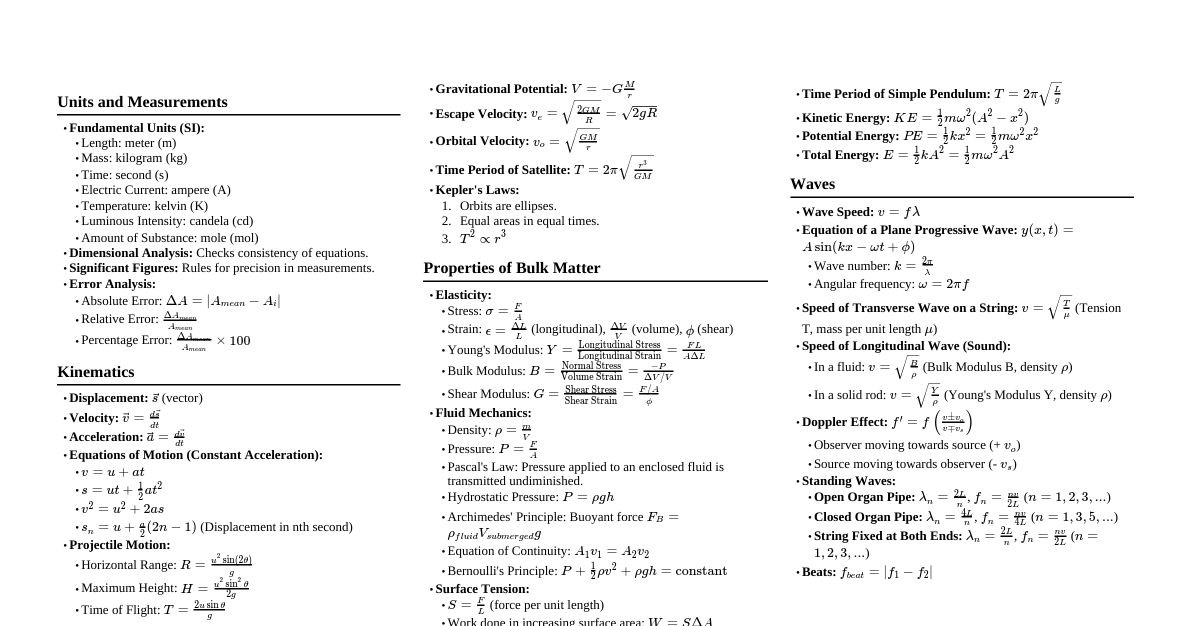
### Introduction to Momentum - **Definition:** Momentum is the quantity of motion of a moving body, measured as a product of its mass and velocity. - It is a vector quantity, meaning it has both magnitude and direction. - **Symbol:** Represented by 'p'. - **Formula:** $p = m \times v$ - Where: - $p$ = momentum - $m$ = mass of the body (in kg) - $v$ = velocity of the body (in m/s) - **SI Unit:** kilogram-meter per second (kg m/s) or Newton-second (N s). - **Direction:** The direction of momentum is the same as the direction of the velocity of the body. ### Factors Affecting Momentum - **Mass (m):** - If velocity is constant, a body with more mass will have more momentum. - Example: A fully loaded truck has more momentum than an empty truck moving at the same speed. - **Velocity (v):** - If mass is constant, a body moving at a higher velocity will have more momentum. - Example: A small bullet fired from a gun has high momentum due to its very high velocity. - **Direct Proportionality:** - Momentum is directly proportional to mass ($p \propto m$, if $v$ is constant). - Momentum is directly proportional to velocity ($p \propto v$, if $m$ is constant). ### Newton's Second Law of Motion - **Statement:** The rate of change of momentum of an object is proportional to the applied unbalanced force in the direction of the force. - **Mathematical Form:** $F \propto \frac{\Delta p}{\Delta t}$ - Where: - $F$ = applied force - $\Delta p$ = change in momentum ($p_{final} - p_{initial}$) - $\Delta t$ = time taken for the change - **Derivation to F=ma:** - If $p_{initial} = mu$ and $p_{final} = mv$ - $\Delta p = mv - mu = m(v - u)$ - $\frac{\Delta p}{\Delta t} = \frac{m(v - u)}{\Delta t}$ - Since $a = \frac{v - u}{\Delta t}$ (acceleration) - So, $F \propto ma$ - By choosing a suitable unit of force, the constant of proportionality becomes 1. - Therefore, $F = ma$ - **Significance:** This law defines force and provides a method to measure it. It shows that a larger force causes a larger change in momentum over a given time. ### Applications of Newton's Second Law - **Reducing Impact Time:** - **Cricket fielders:** Pull their hands back while catching a fast-moving ball. This increases the time ($\Delta t$) over which the momentum of the ball is reduced to zero, thereby decreasing the force ($F = \frac{\Delta p}{\Delta t}$) exerted on their hands and preventing injury. - **Car safety features:** Seatbelts and airbags in vehicles increase the time taken for the occupants to come to rest during a collision, reducing the force of impact. - **High Jumpers:** Land on soft surfaces (cushions or sand) to increase the time of impact, reducing the force experienced by their bodies. - **Falling from a height:** Landing on a hard surface results in a very short impact time and thus a large force, causing injury. Landing on a soft surface increases impact time and reduces force. ### Law of Conservation of Momentum - **Statement:** When two or more bodies act upon each other, their total momentum remains constant, provided no external unbalanced force is acting on them. - In simpler terms: The total momentum before a collision (or interaction) is equal to the total momentum after the collision. - **Conditions:** Applicable only when there are no external forces (like friction or air resistance) acting on the system. - **Formula:** $m_1 u_1 + m_2 u_2 = m_1 v_1 + m_2 v_2$ - Where: - $m_1, m_2$ = masses of two bodies - $u_1, u_2$ = initial velocities of the bodies before interaction - $v_1, v_2$ = final velocities of the bodies after interaction - **Example:** - **Gun and bullet:** When a gun is fired, the bullet moves forward with a high velocity, and the gun recoils backward. The total momentum of the gun and bullet system before firing (both at rest) is zero. After firing, the forward momentum of the bullet is equal and opposite to the backward momentum of the gun, so the total momentum remains zero. - $0 = m_{bullet} v_{bullet} + m_{gun} v_{gun}$ - $v_{gun} = -\frac{m_{bullet} v_{bullet}}{m_{gun}}$ (Negative sign indicates recoil) - **Collision of two billiard balls:** The sum of momenta of the two balls before collision is equal to the sum of their momenta after collision. ### Numerical Problems (Momentum) - **Type 1: Calculating Momentum** - **Problem:** A car of mass 1500 kg is moving with a velocity of 20 m/s. Calculate its momentum. - **Solution:** - Given: $m = 1500$ kg, $v = 20$ m/s - Formula: $p = m \times v$ - $p = 1500 \times 20 = 30000$ kg m/s - **Type 2: Using Newton's Second Law (F=ma)** - **Problem:** A force of 10 N acts on a body of mass 5 kg for 2 seconds. If the initial velocity is 0 m/s, what is the final velocity? - **Solution:** - Given: $F = 10$ N, $m = 5$ kg, $t = 2$ s, $u = 0$ m/s - First, find acceleration: $F = ma \Rightarrow 10 = 5 \times a \Rightarrow a = 2$ m/s$^2$ - Then, find final velocity: $v = u + at \Rightarrow v = 0 + 2 \times 2 \Rightarrow v = 4$ m/s - **Type 3: Using Conservation of Momentum** - **Problem:** A bullet of mass 20 g is fired from a pistol of mass 2 kg with a velocity of 150 m/s. What is the recoil velocity of the pistol? - **Solution:** - Given: $m_1 = 20$ g $= 0.02$ kg (bullet), $u_1 = 0$ m/s - $m_2 = 2$ kg (pistol), $u_2 = 0$ m/s - $v_1 = 150$ m/s (bullet) - Formula: $m_1 u_1 + m_2 u_2 = m_1 v_1 + m_2 v_2$ - $0.02 \times 0 + 2 \times 0 = 0.02 \times 150 + 2 \times v_2$ - $0 = 3 + 2v_2$ - $2v_2 = -3$ - $v_2 = -1.5$ m/s - The recoil velocity of the pistol is 1.5 m/s in the opposite direction. ### Key Terms - **Momentum:** Mass in motion. - **Inertia:** Resistance of an object to any change in its state of motion. Related to mass. - **Force:** An interaction that, when unopposed, will change the motion of an object. - **Impulse:** Change in momentum ($\Delta p$). Also, $F \times \Delta t$. - **Recoil:** The backward movement of a gun when it is fired. ### Common Misconceptions - **Momentum vs. Force:** Momentum is a property of a moving object, while force is an external cause that changes momentum. - **Momentum vs. Kinetic Energy:** Both depend on mass and velocity, but momentum is a vector ($mv$) and kinetic energy is a scalar ($\frac{1}{2}mv^2$). They are conserved under different conditions. - **Conservation of Momentum:** Only applies to a closed system where no external unbalanced forces are acting. Friction and air resistance are external forces.